Are You Giving It Away?

Creamed honey from the beekeepers’ co-op. Price per pound: CAN $9.00 (US $7.25)

A few days ago, I was shopping at our local co-op grocery store. As usual, I checked the price of honey. I like to use their prices as a minimum guide for honey produced by hobby beekeepers. Here in Calgary, beekeepers are beginning to extract. We make nice, mild, white honey. It’s beautiful stuff. But some of my friends give their honey away. Others price it so low that you’d think they’re not proud of what their bees have done.

So, here’s my annual admonition. Charge a lot of money for your honey. People will assume that it’s worth it. And it probably is. Certainly, it must be worth more than the stuff on the grocery shelf. Here are the prices worked out per pound for you:

Remember, this inventory was taken at just one store, on one day. Sales come and go; prices vary. But if you are cheaper than the cheapest honey at the local grocery, maybe you’re giving it away.

Gramma Bee’s was the cheapest honey at the store. It’s officially Canada #3 honey. To be #1, it has to meet a few standards (colour and moisture) which this honey likely met. But it’s ‘Never Heated, Never Filtered’ and “RAW”. Your honey, dripping from the extractor tonight, is probably similar. This honey is selling for $6.80/pound ($5.44 US).

This honey is called “McKenzie Natural White Honey”. There is no ‘McKenzie, except that the name is perhaps the most quintessential Canadian of all names.
I’ve tried this brand, it’s really good. It’s packed by some good folks in central Alberta. In the store at $8.16 per pound. ($6.53 US)

Billy Bee (now owned by McCormick foods) has promised to only retail 100% Canadian honey. Hooray for that. I once bought this brand just for the squeeze-bee. Sells here for $8.33/pound. ($7.00US)

On the top shelf, out of reach for kids and people (like me) shopping from a wheelchair, is the store’s only blatantly imported honey. It’s from the Australian packer, Capilano. (If you haven’t read my story about the defamation case involving Capilano, you’re in for a treat.) The Capilano brands shown here are the most expensive in the store – one is organic, the other is from manuka. These honeys are around $10.75/pound. ($8.50US)

Posted in Honey | Tagged , , | 11 Comments

Fireweed Attraction

Last week, fires in western Canada forced 47,000 people from their mountain homes. Over a hundred houses were destroyed. Livestock, wildlife, even bees went up in flame. Millions of stately pines and firs are now little more than spent matches on the landscape. It’s horribly destructive, but like everything, forest fires are complicated.

If you’ve lost property and had to scramble ahead of flames, then you have no sympathy for the idea of forest renewal. But forest fires are part of the natural cycle that burns old growth and allows new. For thousands of years, lightning on a hot dry summer evening was the spark that led to the destruction of huge swaths of forest. Fires kill pests and tree bugs, leading to a fresh environment for shrubs, small trees, and herbaceous colonizers. Fireweed is among the new-growth sprouts. Here in Canada, it’s sometimes called willowherb, but most of us like to call it fireweed, a name that conjures  rebirth amid destruction.

We expect to see fireweed as a wild weed that grows in remote forests after fires have scorched the ground and blackened the dormant fireweed seeds. But there is a grand fireweed blooming beside our deck in the backyard.  Ten years ago, a kind breeze blew its seed into our lives. It took root and has been a lovely addition to our eclectic floral menagerie.  

It has been a century since any fires swept through our back yard, but year after year,  our single sprig of fireweed shoots up.  It is a myth (perpertrated by beekeepers) that fireweed seeds need fire to ‘burn off their tough seed pod’ – that’s what my father told me and that’s what I tell my kids, even though I know it’s not true. Instead, fireweed is a ‘pioneer species’ that needs sunlight and wide-open meadows to get established.  After a fire, the plant can conquer huge sections.  Beekeepers sometimes haul their bugs into those fresh ranges to gather tonnes of water-white nectar. 

Here in my city backyard, our friendly fireweed started to bloom a couple of weeks ago. It’s covered in bees. Bumblebees, not honey bees.  In fact, I have never seen a single honey bee on our backyard fireweed, not this year nor any previous year.  This summer, the absence of honey bees on this fireweed specimen is especially odd since I recently placed a small hive just a few metres away.  

Why do honey bees shun my fireweed while a variety of native bees enjoy its blossoms? There are several reasons.  For one thing, honey bees are more likely to forage as a mob. They communicate discoveries of huge fields (near us, it’s sweet clover and alfalfa). A scout bee would be seriously ridiculed if she were to announce the discovery of a solitary sprig.  If there were thousands of fireweed plants, I’m sure that millions of bees would be having a party in our yard.  But one plant? Why bother.  

I also suspect that the workers in my nuc, which you see in the picture above, are better adapted to imported forage such as alfalfa and sweet clover while indigenous bumblebees find this indigenous variety of fireweed appealing.  Lastly, honey bees fly kilometres while gathering nectar so they aren’t as partial to their immediate surroundings. Most other bees only forage near their nests so they are stuck with lonely bouquets.  These are just guesses. It would be interesting to follow up with a project to be more certain about the reasons that I’ve never seen honey bees on this honey plant, but have watched dozens of other bees work its blossoms. 

Posted in Honey Plants | Tagged , , , | 5 Comments

YIKES! Small Hive Beetle in Alberta

Small Hive Beetles? No, thank you.

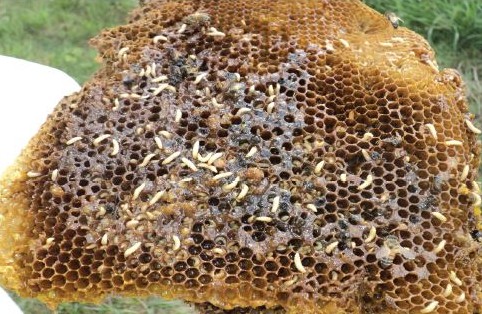
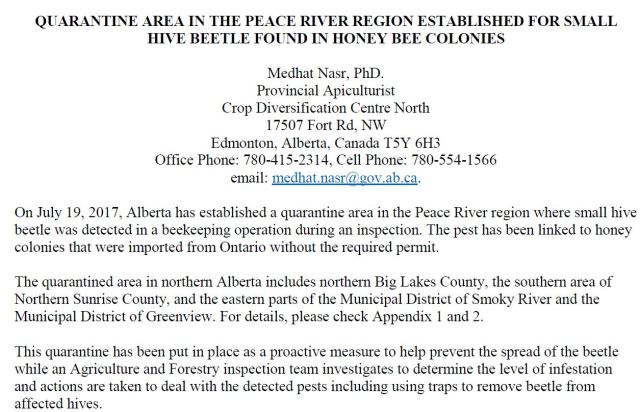
Two days ago, our apiary inspector announced the unfortunate discovery of the ugly Small Hive Beetle (SHB), species Aethina tumida, in the northern part of our province.  I think that this is the first time SHB has been found in Alberta, Canada. Our prairies are a long way north of the beetle hotspots, so the beetle didn’t arrive of its own volition. Instead, according to the government press release, it was inadvertently imported among “honey colonies that were imported from Ontario without the required permit”.  The permit would have required an inspection and the inspectors issuing the permits in Ontario (2,000 kilometres east) might have seen the beetles. Instead, the bugs are now in our pristine province and a major quarantine has been put in effect.  Here’s part of the announcement:

The SHB is a filthy little animal. It makes a mess of weak hives and unkempt honey shops, chewing honey and wax, then dropping dirty little droppings everywhere. Although the beetle is native to tropical and subtropical regions of Africa and probably won’t thrive up here in North America’s fridge, SHB could survive in heated honey shops and be a bee yard nuisance in the summer. The last time I wrote about this pest, I lamented that inspectors on our mild west coast (in British Columbia) had found the animal. So, we were wary that the beetle would arrive from the west. But this discovery was imported from the east, from Ontario.

Unfortunately, Ontario beekeepers have already exported this pest earlier this year – Ontario SHBs were discovered in New Brunswick. In that case, the beetles were hitching a ride among Ontario hives trucked to the maritime provinces to pollinate blueberries. Kevin McCully, New Brunswick’s agriculture director, was surprised to discover the beetles since the colonies were “all reported to not have any presence of small hive beetles in them,” when they were issued moving permits in Ontario. Nevertheless, the beetles were discovered among some of the 25,000 hives hauled into New Brunswick’s blueberries from Ontario.

Meanwhile, here in Alberta, the provincial government has issued a quarantine of a 15-kilometre zone around the affected hives. This means that apiaries belonging to 15 different operators in the Peace River region (about 800 kilometres north of Montana) will have a new set of rules to follow this summer – they won’t be allowed to sell or move any nucs or hives over the next 45 days, but they are allowed to produce and pull honey from hives within the quarantine.  Hopefully, this will prove to be a tiny infestation which can be eradicated quickly and permanently. But the accidental importation serves as a warning to beekeepers to be vigilante – and follow the rules about moving hives across borders.

Posted in Beekeeping, Diseases and Pests | Tagged , , , , | 7 Comments

The Beekeeper Everyone Knows

Hillary, left, and Norgay on Mount Everest, 1953

There aren’t many beekeepers that the whole world knows. No one gets famous for keeping bees. Sometimes a beekeeper becomes locally infamous, but I can’t think of any beekeeper as well-known as, say, Sir Edmund Hillary. He and his climbing partner, Tenzing Norgay, will be honoured forever as the first to scale Mount Everest.  Hillary’s day job? Beekeeping. He spent his first thirty years working on the family honey farm. Hillary, who passed away in 2008, would have been 98 years old today.

Surprisingly, when he returned from his expedition, the beekeeper who climbed the world’s highest mountain went right back to hard manual labour, working with the family’s 1,400 hives. He had a remarkable humility about his feat. Here’s Sir Hillary, in 1953.  He was 34 years old when he was interviewed in this film. He doesn’t mention his bees in this clip, but I put it here so you can see the grace and charm of the young man.

When Hillary and Tenzing climbed Everest back in 1953, most of us weren’t even around yet. Back then, technology was relatively primitive – a typical TV was bigger than a fridge. Communication was painfully slow.  It took 3 days before the world knew whether Edmund Hillary and Tenzing Norgay had reached the peak – or had died trying. The team wasn’t the first to attempt Everest, but previous efforts ended in tragedy.

I mentioned Sir Edmund Hillary’s bee farm. He wasn’t a hobby beekeeper with one hive under an apple tree in the orchard. He was a real commercial honey farmer. Hillary wrote several times that beekeeping had conditioned him physically and mentally for the challenges of mountain climbing. Here, from his book A View from the Summit are Hillary’s own words about his beekeeping experiences:

“My brother Rex was a year younger than me and he, too, was part of our family beekeeping business. Rex and I worked well together as a team. He was smaller than me but very strong and vigorous. In the friendliest fashion we competed energetically with each other, often running side by side with heavy loads of honey to pile them on our truck…we actually enjoyed the beekeeping. Our thirty-five apiaries were spread out on fertile dairy farms up to forty miles away, so we were always on the move. The spring and summer, when the bees were gathering nectar, was a time of great excitement. The weather made beekeeping a tremendous gamble, of course. Each apiary we visited could have a substantial crop of honey in its hives or almost nothing. Rex and I reveled in the hard work.”

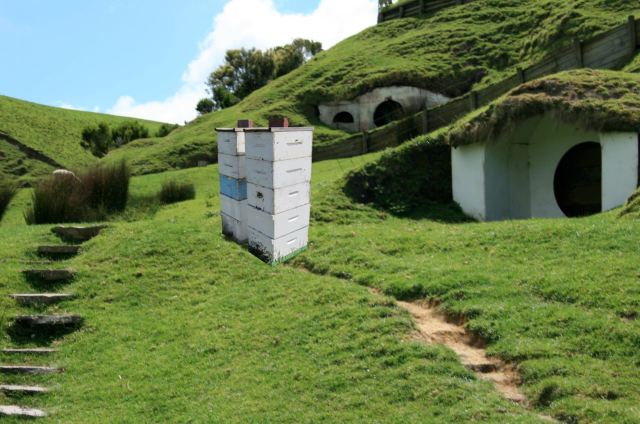
New Zealand: An amazing land of bees, hobbits, and mountain climbers.

For a few seasons after his famous conquest, Sir Edmund Hillary went back to tending the family’s 35 apiaries scattered around his island home. At the time, he didn’t think the climb was a big deal and he expected his moment of glory to fade quickly. It didn’t.

Posted in Beekeeping, Culture, or lack thereof, History, People | Tagged , , , | 18 Comments

Bees with Beards

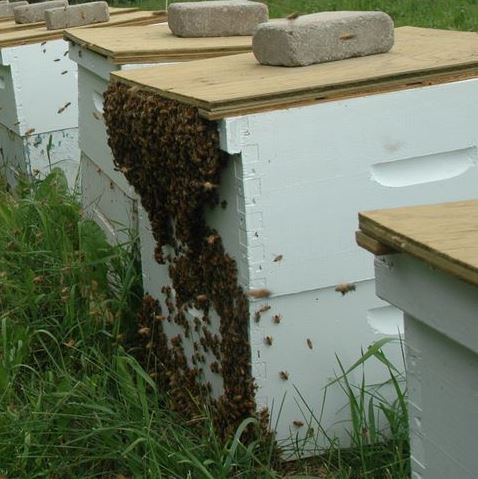
Ah, the bearded hive. With our current heatwave, beards are in fashion among beehives here in Calgary. Last week, I was called to the home of some new beekeepers. The front of their two-story hive was completely masked by a wildly unkempt beard of bees, listless workers hanging out on a warm summer’s evening.

Remarkably, the hive had developed from a package which the new beekeepers had installed just two months earlier. (Bees are amazing!)  Since the forecast predicted persisting heat and it was still earlier in our honey season, we split the hive  and inserted a third box between the two brood chambers, intermingling sheets of starter comb. Half an hour later, the beard was waning. Inside, the bees were waxing the foundation.  I wish my camera had been handy. The before and after scene was spectacular. But I have other beards to show you, so I’ve placed a few on this page.

My friend Veronica shared this image of her neatly kept backyard hive. It’s mustached rather than bearded. Bees are drawing air into the hive. An upper entrance might help.

The hive to the left caused mild alarm for another friend. She wondered if such behaviour is normal. It is. Although it was after dark and the air had cooled a bit, a few hundred bees continued to cover the upper lip of the entrance. For new beekeepers, such activity seems rather odd. The situation is usually relieved with the addition of a few honey supers and additional ventilation. Slatted bottoms, a wider, taller front entrance, and an upper entrance may be helpful.

We are having an unusual hot spell here.  Perhaps it will surprise you, but it occasionally gets very warm in Canada. While building homes for Habitat for Humanity in Winnipeg this week, former president Jimmy Carter suffered heat exhaustion. (With his work ethic and his skill with power tools, he would have been a fine beekeeper.)  Just like an active retired president, your bees need shade, plenty of water, and ventilation. You’ve probably heard all that before and you can look it up in any basic beekeeping book. I’m not going to belabour the obvious.   Hot, crowded bees will sit on the front porch. You don’t want this. Idle bees are the devil’s bees, as they say.

Bearded hive with a mop-top, just before supering. My hive has an upper entrance, that’s why the bees are hanging from the top.

It’s not only beehives that grow bee beards, but humans also fancy the fashionable. I wrote about this summery trend a few years ago. To save you the effort of following my link, I’ve repeated that post here.

🐝 🐝 🐝 🐝 🐝 🐝 🐝 🐝 🐝 🐝 🐝 🐝 🐝 🐝 🐝 🐝 🐝 🐝 🐝 🐝 🐝 🐝

Braving the Beards

An itchy growth of facial bees

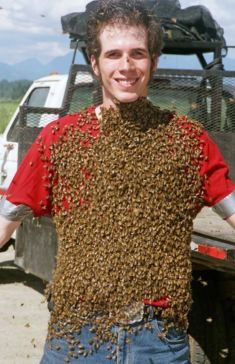
Almost anyone can grow a beard. Especially if honey bees are the nubs. The young lady in the picture to your right is showing off a sporty growth of facial bees. Surely there is some medicine or therapy that could have prevented this? A few days ago, the web master of a new beekeeping site (Beekeeping Planet) sent me a link to his site’s Top Ten Bee Beards page. So, it got me thinking about bee beards.

Perhaps a stylish bee jacket?

What is the fascination with bee beards? Not everyone likes the appearance of a shaggy face. (Although Darwin, Lincoln, Marx, and Castro all got good mileage from theirs.) And not everyone enjoys having small stinging creatures buzzing the cheeks. But combine the two, and you could make a PBS documentary. Photos of bee-bearded folks are almost as old as photography. I guess it’s because the bee beard combines the yucky, the creepy-crawly, and the daring-do in a delectable way. Having a potentially dangerous motley crew of stinging creatures hanging under one’s nose has an almost universal appeal.

Almost anyone can grow a bee beard. But I am reminded of this tragic story about a 34-year-old gentleman in Vermont: Man Has Trouble Growing Full Beard Of Bees. It seems to be true – patchiness, uneven color, itchiness, and the odd stray gray bee seem to plague the young man whose father “always had a full thick beard of bees his whole life.” There is a solution, which The Onion fake news didn’t report: some young men have been going for the full bee jacket to take attention off their lack of bee beard. It’s easier to maintain and has just as much “Wow Power” as the facial bees. However, the bee jacket is not recommended while motorcycling.

.

Posted in Beekeeping, Climate, Humour | Tagged , , | 2 Comments

Shake, Rattle, Roll: Our Little Earthquake

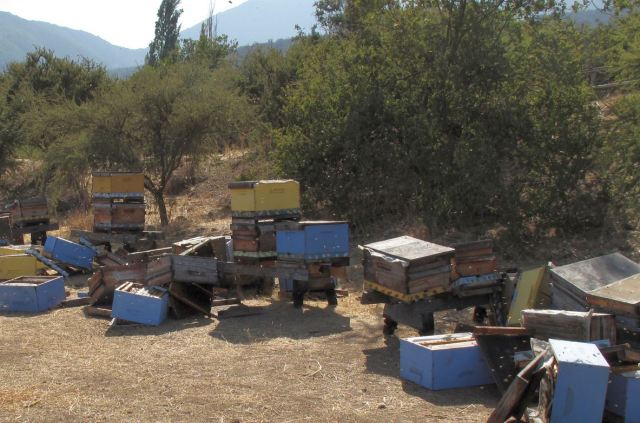
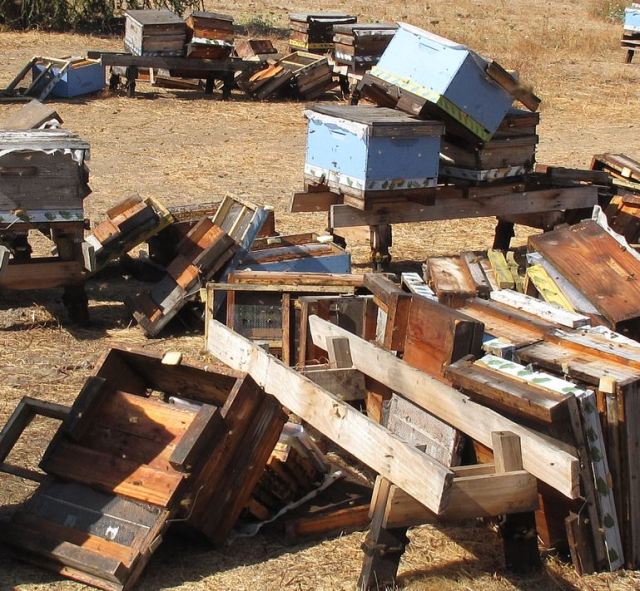
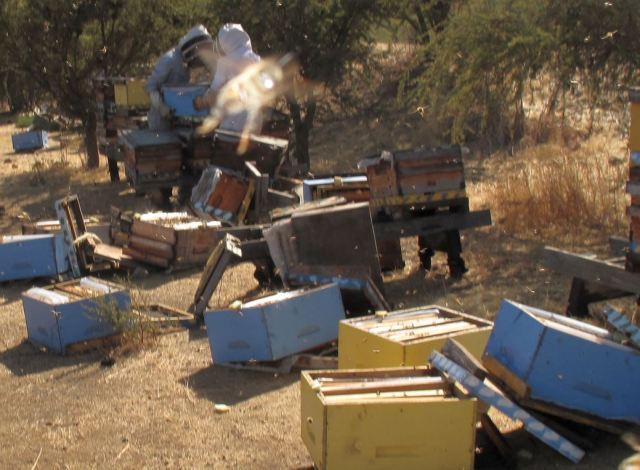
Hives, in Chile, toppled by an earthquake. (Photo: Rey)

I live in one of the less shaky parts of the world. I don’t think that Calgary has ever had a damaging earthquake. (Granted, the city isn’t much over a hundred years old, so it’s a short history.)  When the Rocky Mountains (50 kilometres to my left) popped out of the ground, there must have been some horrific earthquakes. However, our last tectonic jolt was millions of years ago. It’s been quiet ever since.

But Montana, just a few hours’ drive south of us, suffered a hefty shake last week.  Folks around Missoula woke up to the biggest quake they’d had in over 20 years. It measured 5.8 on the shake-me scale. That’s enough to rattle windows, close doors, smash some dishes, and mimic poltergeist behaviour. That’s the worst that Mother Earth has thrown at Big Sky Country in decades. Across the border, up here in Canada, a few people say that they felt the Earth move that night, but I didn’t.  Closer to the epicenter, beehives would not have thought much more than, “Good grief! Is that the truck taking us to almonds already?”

But it was quite a different story a few years back in one of the world’s most alluring countries – Chile. About a week after I visited in 2010, Chile experienced the sixth strongest earthquake ever recorded, anywhere on Earth. The ground bolted upwards, traveled ten feet, then crashed back down. That’s right – houses, gas stations, firetrucks, everything – lifted and flung three metres. Scientists from Ohio State used GPS to measure the movement. If you were able to leap high into the air when the quake struck, and (even more skillfully) stayed afloat for half a minute, you’d have fallen into your neighbour’s yard, which would have moved in under your feet.

The February 27, 2010, magnitude 8.8 Chilean earthquake released the energy of 240 million tonnes of TNT. A 600-kilometre wedge of oceanic Nazca Plate subducted under South America while the continent lifted and sprung westwards.  Six hundred people were killed. Fifty billion dollars was lost through damages and interrupted business. Homes, schools, bridges, and apartment buildings toppled. 125 million bottles of wine fell and broke, turning streets red in vineyard towns.

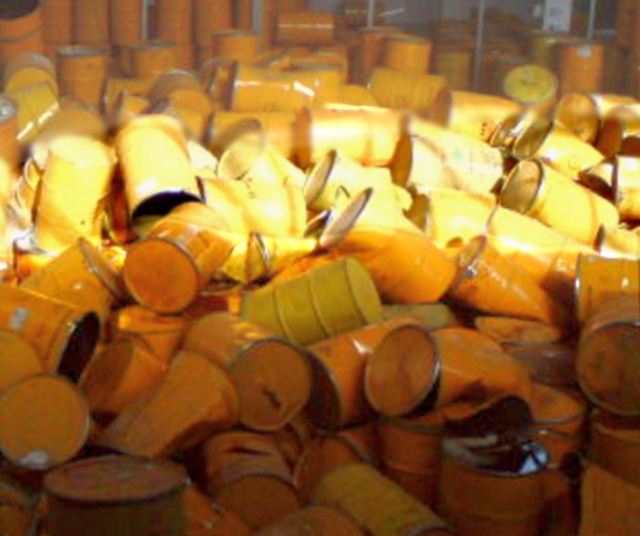
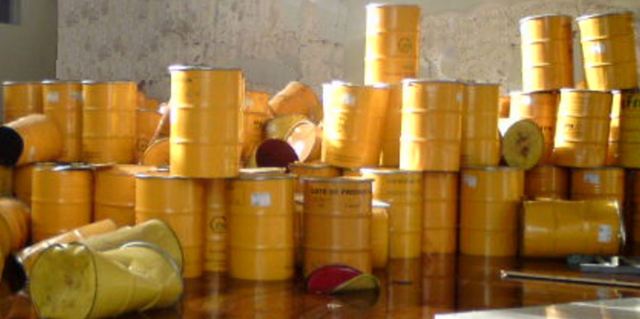
I have beekeeping friends in Chile (that’s why I was visiting). They and their families were OK. But their companies were not. They sent me chilling photographs, a few of which are on today’s post. You can see what the quake did to their businesses. Francisco Rey was in the middle of his queen rearing season. Hives and nucs were scattered everywhere, queens lost, cell-builders destroyed. Honey packer Juan Pablo Molina lost two million pounds of honey when drums were knocked over, lids popped, and honey drained.

The firms of both Srs. Rey and Molina were kilometres from the epicenter, so destruction wasn’t total. But it was still devastating. That was seven years ago. Both of my friends are still in business, but they lost a lot.  If you’d like to know how to prepare for an earthquake, or if you’d like to see a complete story about how this big one affected beekeeping in Chile, here’s a link to an article I wrote for American Bee Journal at the time. Meanwhile, we’re thankful that Montana was just slightly shaken – this time.

Drums of honey tossed and churned by the big one in 2010. (Photo: Molina)

The floor is flooded – with lost honey. (Photo: Molina)

Repairing the damage. Francisco Rey and his team went from apiary to apiary, reconstructing hives, one at a time. (Photo: Rey)

.

Posted in Friends, Honey, Queens, Science, Strange, Odd Stuff | Tagged , , | 4 Comments

Please Don’t Burn the Bees

Since most people are radically pro-bee, it shocks me when I come across stories about people burning swarms to destroy them. Such arrogance. Such ignorance. Or maybe, pathetic panic is at work. There are always better options than firing your pollinators.

I’m not talking about the accidental fires started by beekeepers’ smokers. Those happen – but fortunately such fires are rare. Hot smokers, sparks, and dry grass are a dangerous combination. I’m also not talking about stories like this one, from June or this year, which may be described by police as suspicious. As the Kent (England) police tell it, 26 hives may have been incinerated in an arson that might be linked to bee thefts.

Bees aren’t the only fire-target. A couple of months ago, a Pennsylvania man burned down his house trying to smoke out possums.  (Officials say the man had issues with bees, too.) No word on how the possum family is doing. Meanwhile, here are a couple of recent stories of folks using fire to kill bees:

In Georgia, a chap set fire to a swarm that had landed on the eave of his home. What might have started out as a bad idea turned the poor fellow’s house into ashes.

Credit: Shannon Millard

Earlier this week, a Michigan gentleman tried to remove bees that had settled into his garage. It was July 4th. Patriotically, he used fireworks to do the job. The fire department couldn’t save his garage, which looks like this now.  You can see the story here.

Finally, there is this story of a Florida homeowner who melted his kids’ swing set because a swarm of honey bees landed on it. Hot photos are at the end of this link.

If you’d like to see some interesting ways of being stupid around bees, here are some instructive videos for you. The first one, called “Killing Bees with an AR-15, Gasoline, and Beer Bottles, shows how an assault rifle, gasoline, and beer bottles are used to eliminate pollinating insects when they are apparently deep in a forest and not bothering anyone.

If you’ve got the stomach for more incorrigible fire stunts, you may enjoy “Setting Bees on Fire“.  I kept thinking that the fire would spread to the dry grass nearby, giving the dude an instructive learning moment. Fortunately, though, that didn’t happen. However, it looks like the protagonist gets stung 30 seconds into the clip, so keep watching.

What should you do if a swarm lands on your house, garage, or family playground? Most readers of this blog are beekeepers. They probably already know what to do. If you’re not a beekeeper (or if you suffer from lack of common sense), call a beekeeper. They can usually collect honey bees. And they probably will not burn your house down during the rescue.

Posted in Save the Bees, Strange, Odd Stuff | Tagged , | 4 Comments

One Week with a Queenless Hive

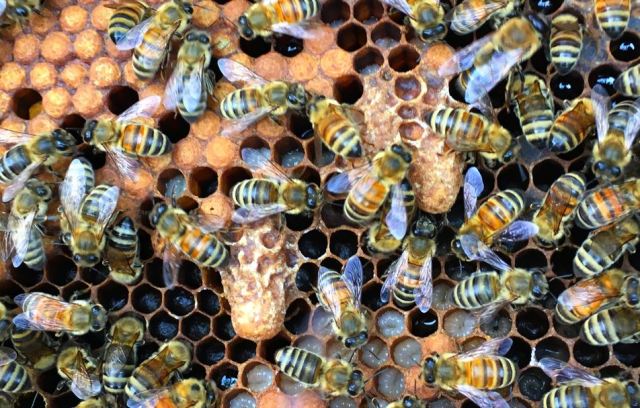
Day 6 of a queenless nuc: sealed queen cells amidst risk-taking bees.

Over a week ago, I brought a nuc into my back yard. Twelve days have passed, so there should be an emerged virgin queen inspecting the neighbourhood, looking for boys. My little nuc was intentionally built as a queenless hive. When my son (left, now a confirmed beekeeper) and I dug through the deeper chasms of the little hive, we found the cluster of queen cells captured in the image above.

I was surprised by the fragility of this nuc’s effort to guarantee its future. Although this nuc had about 400 potential larvae of the ‘right’ age, the bees chose just three candidates, plus one suspended from bottom of the same frame. The bees could have built their new queen cells in other places among the three frames of brood and the hundreds of larvae, yet they picked this tiny number of tightly clustered incubating royals. The cells are vulnerably contiguous. They represent a tiny wager towards the entire colony’s future survival.

There is so much we don’t know about bees. Why so few cells? Evolution dictates the balance between a large number of well-fed queen cells and a risky slim number. Honey bees have survived for millions of years. Obviously, a small number is the right number. There is a cost to a hive if it raises too many of cells. Many cells require a lot of royal jelly, create a burden for the colony, reduce the number of future workers (each becomes a queen, not a foraging worker), and ultimately result in a grand battle-to-the-death for all those emerging queens. Personally, I would have directed the creation of a few dozen cells. But I’m not a bee.

When I produced and sold queens, I used to place about sixty grafted cells into a starter, transfer them to the appropriate finisher hive the next day, then take them to the field hours before the queens were expected to emerge. When I began distributing queen cells to the mating nucs, it was just one cell per hive. That’s right – just one cell per hive. I was even more frugal than my little backyard nuc!  The result? I usually had 60 to 80% of those nucs with good laying queens two weeks later. (Better queen breeders regularly get 90%, but I was a relatively bad beekeeper.) I would have improved my odds a bit if I’d put two cells in each mating box, but it takes a lot of energy to raise twice as many queen cells. The ‘missing queens’ in the nucs were not usually due to damaged or unopened cells, but due to queens getting lost on their mating flights or eaten by hovering squadrons of dragonflies. Since only one of the cells results in a mature viable virgin, multiple cells don’t reduce airborne losses.

Magpie: our local bee-eater
Photo by Connor Mah

I’m writing this a few days after I saw that little cluster of queens cells. By now, at least one of those cells has opened (the others were probably destroyed by whichever hyper-competitive queen emerged first). The victor might already be making her first flights. But I don’t know for sure. There is a chance that all the cells failed or the new queen has already disappeared into the jaws of a western magpie – many of whom already squawked their gratitude at my nuc’s arrival in their playground.  In another week, I’ll sneak a quick peek and let you know what I see.

Posted in Beekeeping, Queens | Tagged , , , | 17 Comments

Canada: More Buzzing than Ever at 150

Today is Canada’s 150 birthday,  so “it’s Canada Day, up Canada way”, as Stompin’ Tom Connors used to say. If you don’t know Stompin’ Tom, here’s your chance to rectify a serious deficiency. Connors was a great Canadian country/folk singer and song writer.  The day he died, back in 2013, my younger kids’ school day was interrupted with the principal announcing that old Stompin’ Tom had left the stage. Then the PA system let loose with Stompin’ Tom’s Hockey Song. The folk singer, who got his Stompin’ title from the way his cowboy boot kept time with his guitar, is essential Canadiana. An indelible cultural fixture. Even if you are not lucky enough to be Canadian (you can fix that), you might appreciate Connors’ Canada Day Song. So here it is:

If you’re not Canadian, but you keep bees, you might be persuaded to experience some of our famous fabulous honey crops. How would you like to make 200 pounds of water-white, smooth-as-silk honey from each of your hives every year?

If that sounds like something you’d enjoy, come on in.  (That’s a slight exaggeration. Saskatchewan, where I landed, has a 30-year average of only 186 pounds per hive.) When I immigrated to Canada in the 1970s, beekeeping as an occupation was given more points in the immigration scheme than engineering. My application wasn’t exactly rubber-stamped, but being a beekeeper helped. A lot. My interview with the Canadian consulate was pretty much over when he began by saying, “We need beekeepers.”  Is that true today? I’m not sure. But good beekeepers are always welcome almost everywhere.

What makes a good honey country? Why is Canada so good for bees? It’s not hard to explain. Perfect honey plants (alfalfa and sweet clover). extremely long days (sun’s up for 18 hours today) and great weather (sunny, warm summers) are the simple answers. Western Canada has a short and sweet honey season. But it’s intensity that counts, not a long, slow, lingering honey flow. We’ve got intensity here.

Bees arrived in Canada about 400 years ago and spread west with homesteaders. Along with cattle, sheep, horses, and hogs, bees are imported livestock. Until Europeans planted sweet clover and alfalfa as hay crops on the western prairies, honey production was small. The native wildflowers aren’t honey bee plants. Saskatchewan, for example, went from a 20-pound per hive average when bees worked only wildflowers in 1890 to nearly 200 pounds today, simply with the spread of imported bee forage.

Colony numbers across Canada grew rather slowly at first,  but then almost tripled in the past hundred years. In 1924, when Stats Canada began tracking honey production, there were just 280,000 colonies. They made 16.8 million pounds – 60 pounds per hive. At the time, Ontario led the nation in honey crops. In the early 1940s, there was a big boost in beekeeping because of sugar rationing saw during the Second World War, though many beekeepers later left for factory jobs as soon as the war ended.

By 1960, Canada’s sweet spot shifted west with the prairie provinces making twice as much honey as Ontario. Soon, new crops (such as canola) and new farmland (especially in the northern “bush” in western Canada) saw a big revival in beekeepers and honey production. Things were really blooming until the late 1980s when the federal government accidentally destroyed beekeeping in the western provinces with embargoes designed to help Ontario and Quebec beekeepers. Canada’s hive counts fell by over 200 thousand, as you can see in the graph below. However, thirty years later, as Canada turns 150, the country’s bee stocks have recovered and we now have more colonies than ever.  Also, with enormous hobbyist interest, more and more people have begun appreciating bees and living with them.

Canadian beekeeping history, just like the country’s, is largely a story of growth. It includes lots of characters with fascinating stories. Someday I’ll write a more complete history. For now, let’s celebrate 150 years as a beekeeping nation with a great future.

Posted in Culture, or lack thereof, History, Honey Plants | Tagged , , | 1 Comment

Moving the Bees

Yesterday, I wrote about nuking the bees. Today, it’s moving the bees. My nuc started out on my daughter’s farm, 130 kilometres east of my home in Calgary. That’s over an hour’s drive, out on the prairie, away from the mountains. The farm is near the Snake (as in rattlesnake) River Valley. The Snake is not much of a river, more of a valley with ephemeral spasms of moisture. It’s especially dry this year. Snake River won’t wet the underbellies of many rattlers this summer. But that’s where the farm lies, and you can see its ideal ten acres of beekeeping workshops and sheltered bee spots in the photo above.

The bees. After Justin and Erika set up my new nuc, they stapled a screen across the small round hive entrance. When I moved bees in the past, I never used screens. But a lot of people do, so they’re probably effective. My nuc has one small hole as its only entrance, the rest of the box is solidly bee-tight. Stapling a wire mesh across the entrance helps keep bees safe during a trip. In the photo, you can see the screen barrier after we partially opened it at the nuc’s new home in town. When you move a hive, bees are confused for a few days. A small entrance slows them down and forces them to realize that they are in a new place. I may keep the entrance reduced all summer (unless the weather turns really hot). A small convoluted entrance protects against wasps that sneak into small colonies and kidnap bees.

When we move big loads of bees, commercial beekeepers usually leave hive entrances open. Entrance screens aren’t typical. If it’s a really short haul (less than ten or twenty kilometres), we like to move under the cloak of twilight when it’s cool and the bees aren’t interested in flying. Thirty or forty hives are loaded in half an hour. A short drive later, we quickly set the hives off the flatbed. For long hauls, a bee net covers the load. Moving without a net is probably illegal almost everywhere, so if you’ve got a bunch of bees, buy a nice big fluorescent net.  The one shown here covers 400 double-story colonies. It cost me a few hundred dollars and weighs 100 pounds. There are cheaper and lighter ones available.  Dealers will give you details. I bought mine custom-made from A.H. Meyer in South Dakota.
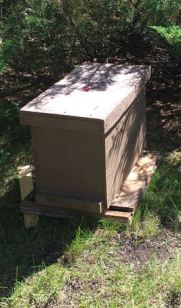
A trick.  So, here we are – 5,000 bees in a little camo nuc box. I worry about loose screens and dislodged hive lids, so here’s my trick: a large black garbage bag. Big bags perfectly encapsulate a single-story hive. I’ve stuffed dozens of colonies into such plastic bags, usually without screening or closing the hive entrance. It keeps the colony quietly in darkness, and keeps every bee inside the bag if they venture out of their box. The only caveat is a concern about heat. When I moved hives this way, it was always around 20C/70F or cooler. But when I toted this nuc on its 130-kilometre journey, I turned on the A/C in the van because it was over 27C/80F outside. I kept the van’s air conditioning set at 18C and the hive was kept shaded. Too much heat can be a killer when it comes to transporting bees.

A 66×85 cm (26×33.5 inch) 1.2 mil plastic bag perfectly swallows the nuc. The bees stay dark and bees which escape the screen (there were a few) stay inside the bag enroute to their new home, rather than crawling into the drivers’ nose. (Use an extra-large sack for bigger equipment.)  I don’t do this with hives taller than singles.

I’m not sure how much air bees need when they are sightseeing. Putting living thing into a plastic bag should make you feel queasy.  In the past, I never worried about oxygen for the bees on the big loads, not even for the colonies buried deep inside a big semi-truck load of hives, traveling for two or three days. My trip with the nuc-in-the-bag took two hours from bagging to release. There must be some oxygen requirements, but I’m not sure what they are. Recently, researcher Stefan K Hetz studied insect respiration. Here’s a piece from The American Physiological Society regarding his work:

. . . insects, which have a respiratory system built to provide quick access to a lot of oxygen, can survive for days without it.

The insect respiratory system is so efficient that resting insects stop taking in air as they release carbon dioxide, according to research by Stefan K. Hetz of Humboldt University in Berlin, Germany. This allows them to keep oxygen and carbon dioxide levels in balance. Too great a concentration of oxygen is toxic, causing oxidative damage to the insect’s tissues, just as it does in humans.

Bees consume large amounts of oxygen, and so it might be tempting to think they are panting – tiny inaudible pants. They are not, because they do not breathe through noses or mouths. Instead, insects draw in oxygen through holes in their bodies known as spiracles and pump the oxygen through a system of increasingly tiny tubes (tracheae) that deliver oxygen directly to tissues and muscles. Insects typically have a pair of spiracles for each thoracic and abdominal segment.

This system is much more efficient than the system that vertebrates evolved. Insects deliver much greater volumes of oxygen, in proportion to their size, than do mammals. They also deliver oxygen directly to the tissues, while vertebrates dissolve oxygen in blood, transport it to tissues, and then reconvert the oxygen to usable form.

“Insects are able to survive hypoxic environments,” explained Kirkton, the symposium chairman. “They can shut down and survive for hours or days. They have a low metabolic rate and can close their spiracles,” he said.

5,000 bees in a box

The bees survived two hours of bagged darkness with no audible complaints. At home, my 15-year-old was waiting for me. He off-loaded the hive. We started to peel off the bag while the nuc was still inside the parked van, but decided to leave it partly covering the box when we realized that some bees had found a way around the screen. Those strays stayed safely in the bag. We freed the nuc and the escapees, placing the hive in our yard.

Soon, the colony was quietly humming and comfortably settled.  The temporary lack of fresh air was not a problem and the van’s A/C kept the bees cool. If you are moving a single hive or two, as I did this week, consider the plastic bag.  It worked for me.

Posted in Bee Biology, Beekeeping, Commercial Beekeeping, Hives and Combs, Tools and Gadgets | Tagged , , , | 6 Comments