Bees Do Do-Do

Diapers for bees?  Some folks stopped me when I was leaving an apiary that I once had in a Florida orange grove. They didn’t own the grove, but their house was within fifty yards. They told me that my bees were crapping on their bright shiny car. Well, OK, their brownly besmudged car. I saw half a dozen specks. It looked like some sort of yellow rain. They were polite, I was polite. They suggested bee diapers. I told them I’d be moving the hives in a few days, and I did. The citrus honey flow was over.

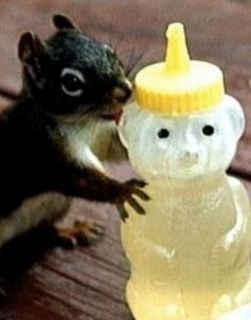
No, bees didn't do this. They couldn't do this even if they didn't like you.

No, it’s not bee do-do. Bees couldn’t do this even if they wanted to.

I had planned to move my bees. But there’s an outfit in Massachusetts that would find relocating rather difficult. The owners are 3rd-generation beekeepers with a 55-acre farm. According to news reports, some distant neighbours have filed a nuisance complaint. They say that they can’t enjoy the outdoors without receiving natural bee fertilizer.   In their hair. On their car.

They filed a complaint. The local health board ruled that the bee business “unreasonably interferes with the owners use and enjoyment of their property.” The beekeepers have a few days to remedy the situation or face a $1,000 a day fine. I think it’s significant that its the local health board that issued the violation notice. They suggest bee droppings are a health issue. They are wrong.

Bee crap is not a health issue. No one gets sick from the scattered bits let loose by flying bees. I agree that the excrement can be unsightly and a nuisance to clean from a bright shiny car. It’s part of life on – or near – a farm. From the complaint, it’s an alleged problem only in May and June. Honey bees do their business in flight, flushing their toilets at about 30 feet. Granted, that’s lower than the Boeing that lets our stuff loose into the stratosphere. But the bee’s do-do is much cleaner. Bees digest honey, they are not the nasty omnivores we are. Bee pooh is clean pooh. Frankly, their shit don’t stink. Not a health issue.

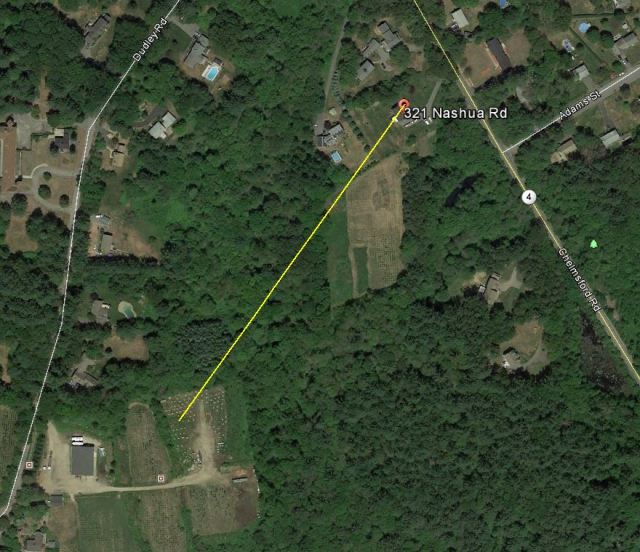
Bee yard, lower left, complainers, upper right - over 300 metres away.

Bee yard, lower left, complainers, upper right – over 300 metres away.

I don’t know all the details, but I looked up the location of the complainers and the location of the honey farm. You can see on the map above, they are 320 metres (about 350 yards) apart. There are a lot of other homes (no complaints?) nearby and quite a few trees and fields around. Bees usually relieve within 100 metres of their hives. The alleged distance is unusual. If you take the numbers of bees and divide by the potential Area of Defecation (AOD), you can see that the actual likely number of defecators within any specific AOD located 350 metres from the hives is pretty small. A trickle, so to speak.

All done!

All done!

To heap dumbness atop dumbness, the Billerica Health Board suggested a silly remedy to the beekeepers: they could plant flowers on their own farm to keep the bees at home. I can feel the ground shake with vibes of unrestrained laughter. Do these people actually think that bees will stay on a farm if flowers are planted for them? Bees fly kilometres in search of food. They don’t recognize any farm’s boundaries. (Bees are smart, but not that smart.)

I suppose that the health officials working for the Massachusetts town of Billerica were trying to be helpful. However, if the health board sages were truly thinking at their best, they would have recommended diapers for the bees.

Posted in Bee Yards, Beekeeping, Commercial Beekeeping, Humour, Strange, Odd Stuff | Tagged , | 15 Comments

Falling Honey Price Makes National News

Something in the news caught my attention. The falling price of honey is now a national news item.  We noticed that prices began falling a year ago, when wholesale prices started their tumble from $2.25 to $1.25.  Now even the press has caught the story.  Here’s a sheet from the USDA’s monthly honey price report:

2016-05-24 prices paid to Can

That’s right. You can buy barrels of Canadian organic honey for as little as $1/pound. It might as well be free.

I figured that beekeepers would suffer this price-tragedy in silent resignation, but then a major news network carried this headline: Global Honey Glut Stinging Manitoba Beekeepers: Producers worry over-supply could force some out of business. This refers to Manitoba beekeepers, but the story is identical across the country. And around the world.

Here in Canada, last year’s crop was almost 10% larger than the year before, so beekeepers found themselves with a lot of 2015 honey on hand. In fact, some beekeepers may have miscalculated and decided to hold their honey when prices first began to drop, hoping prices would soon recover. Tonnes of last year’s honey are in shops while the 2016 crop is being extracted.

Kissing good prices goodbye.

Kissing good prices goodbye.

Honey is in temporary oversupply. Nothing too dramatic. It only takes a small surplus to collapse prices. Let’s say, for example, there is 5% more honey than the world needs. That would be a hundred million pounds excess. No one wants to be among the folks holding that hundred million pounds. The sad reality is that a 5% oversupply can cut prices in half.

So, beekeepers drop their price to move their stock. As soon as one or two major suppliers sell cheap, others have to match the trend or risk holding honey that becomes less valuable each day. (It works the other way, too. If there is a shortage, beekeepers could hold their crop, hoping prices will continue trending upwards, thus adding to scarcity and pushing prices even higher.)

I suspect with the current downturn, some beekeepers will reduce their colony numbers, and wait for the price to rise again. It will, but it could take a year or two. For beekeepers who have been struggling, two years may be too long to wait. Beekeepers without supplementary income or deep pockets may need to close their businesses. Of course, that will create a future shortage and higher prices.

Posted in Beekeeping, Commercial Beekeeping | Tagged , , | Leave a comment

Elderberry Honey

Arlo's Honey Farm, Kelowna, British Columbia

Arlo’s Honey Farm, Kelowna, British Columbia

Yesterday I wrote about a lovely honey farm called Arlo’s which is near Kelowna, British Columbia. The farm produces a variety of noms (specializing in garlic) but there is a large well-kept apiary, too. I asked beekeeper Helen if she could sell some unusual honey to me. She brought me a jar of elderberry honey.

Elderberry in blossom

Elderberry in blossom

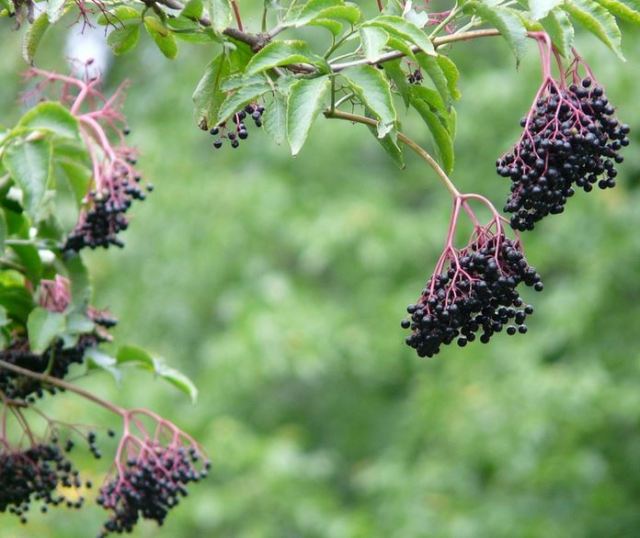
Elderberry (Sambucus canadensis) is a small tree or large bush, depending on who is describing it. It is as tough as a weed and fairly drought-tolerant. It prefers temperate climates, is common in central Europe, but the best berry producer is the Canadian subspecies. And once established, it’s hard to remove. The native North American variety feeds migratory birds and pie-making humans.  When I was a child, I tried to eat the berries, but was not impressed. My father drank the fruit – adding it to his Concord grapes to make a dark sweet wine. I’ve never seen more than a single bush or two growing in an orchard, so it’s surprising to me that there are dense groves of elderberry where enough blossoms are available to actually add up to a distinct variety of honey. But that’s part of the attraction of travelling afield and encountering unusual foods and flavours. You meet the unexpected.

Elderberry fruit: ripe for wine, berry pie, or nibbles for birds and bears

Elderberry fruit: ripe for wine, berry pie, or nibbles for birds and bears

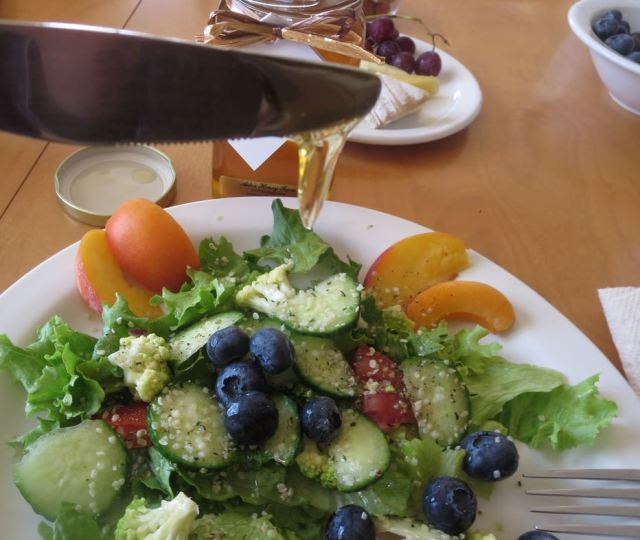
Elderberry HoneyThe elderberry honey which I purchased at Arlo’s Honey Farm in south-central BC was darker than golden, very thick, and had a rich – but not overwhelming – taste and scent. To me, it epitomizes what most people think honey should be. Not mild like my favourite (sweet clover) but not as powerful as buckwheat honey which (to me) is almost medicinal in potency. It’s great when gobbled by the spoonful, but also very nice when drizzled on fresh peaches and blueberries. I even touched up a salad with some of the extraordinary elderberry honey.

elderberry honey and salad

Posted in Honey, Honey Plants | Tagged , , , , | Leave a comment

Dropping into Sunshine Valley

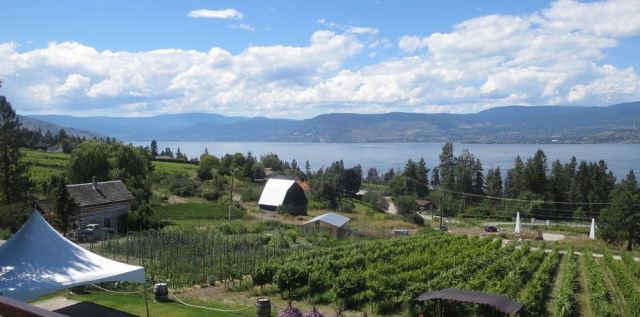
My hometown – Calgary, Alberta, Canada – is having a much needed wet spell. In fact, there has been some ghastly local flooding which I’ll cover in a future blog. Lucky for me, I am a few hundred kilometres farther west, in a milder and sunnier part of Canada. I’m in the town of Kelowna, British Columbia. Kelowna is the biggest community in the Okanagan Valley, a fertile fruit and wine region with a large herd of retirees and an uncomfortable number of mansions. I can see the attraction. If I were wealthy and retired (and didn’t have kids in junior high school), I might add to the traffic snarls on a regular basis.
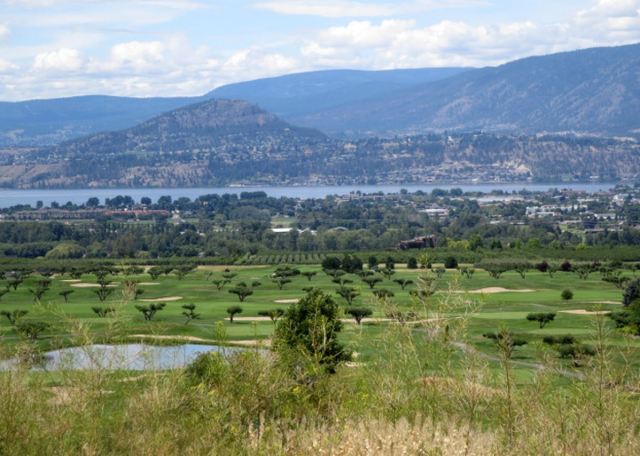
I am visiting Kelowna for a number of reasons, not least of which is to learn about beekeeping near deep blue Lake Okanagan. This area is nearly a desert, but the lake’s water, used for irrigation, has turned it into an oasis of peaches, apples, and increasingly, vineyards specializing in wine grapes. There are also beekeepers who make a bit of honey and help keep the fruits pollinated.

After dropping into this sunshine valley (a one-hour flight from Calgary), renting a car from Enterprise, finding the rental house, and driving around in ever-widening circles atop the mountains surrounding Lake Okanagan, I set out for Arlo’s Honey Farm, perched on one of the area’s scenic hills.
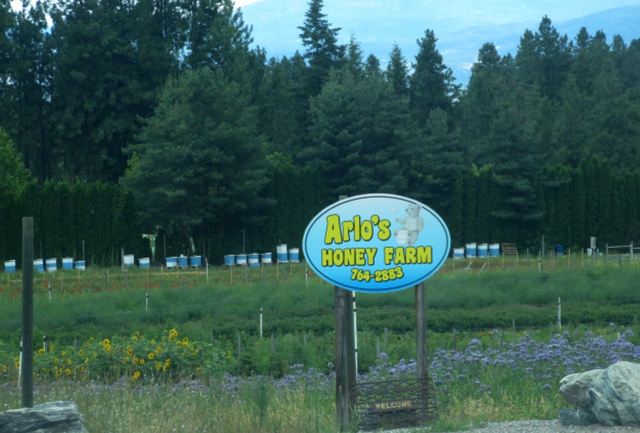
I approached the honey farm from a road called Bedford and entered a lane called Bedford. The farm was unmistakable. The Arlo’s Honey Farm sign was obvious, but so were the strings of beehives stretching along the far side of the farm. The acreage was gorgeously outfitted in blossoming herbs. To my left, as I drove in, were flowers and beehives; to my right, the honey shop. I parked in front and made my way up to an outdoor sitting area. There I chatted with a family on tour from northern Alberta.
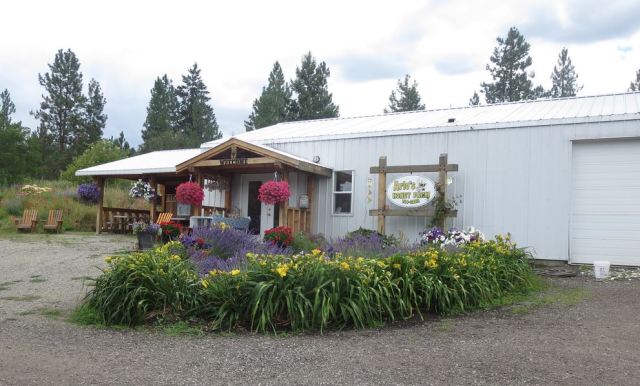
Okanagan-03 - Arlo's shop

The Albertans had driven 1,000 kilometres to be here! The group had purchased some very fresh Russian garlic – stems, bulbs, sand, and all. Among the herbs and vegetables, Arlo’s sells over 50 varieties of garlic. My family grew garlic on our farm when I was a kid. I was gob-smacked to learn there are at least 50 kinds – I thought that the world has maybe 3 or 4 varieties, not 50! The folks I chatted with also showed me a jar of raw BC wildflower honey. I assured them they’d made a great choice. It was slightly darker than golden, seemed a bit cloudy with pollen and maybe even natural beeswax, but was still somewhat translucent. When I flipped their jar end-for-end, a big trapped air bubble slowly rose, telling me that this honey was seriously low-moisture. This appealed to me because I much prefer thick honey over the watery sort.  I guessed that it was about 16% moisture and told the honey jar’s new owners that this sample would keep well for a long, long time. However, it looked so good that I suspect it will be gone before their car has another thousand kilometres on it.

From the picnic tables and that family of tourists, I made way behind the honey shop where another string of colonies was lined up. (They’re in the photo above.) These weren’t noticeable from the entry road, so I was surprised and delighted that I could get personal with some bees. Besides their neat and professional appearance, two things immediately caught my attention. First, the flowers (which grew right up to the hives) were buzzing with bees; and, second, the bees were curing nectar in the afternoon heat, giving off a sweet odour that told me this was a good honey day for them. I would soon learn that these flowers were no accident.

The farm was designed with bees in mind, embracing  veggies and produce that flourish along with the honey bees. I was told that there are thousands of crocuses and pussy willows in March, honeyberry (haskap) in April, later, there’s crop rotation with clover, garlic (bad bugs avoid garlic and its neighbours because it’s a natural insect repellent);  strawberries, raspberries, and gooseberries add to the bees’ floral treats. But at the moment, various fragrant herbs held the bees’ attention.

Arlo’s Honey Farm resident beekeeper, Helen Kennedy

Soon I was back to Arlo’s storefront, enjoying the sunshine and a pleasant chat with the beekeeper/farmer/owner.  Arlo’s is named after a bear, I was told, but is run by Rick and Helen. Helen Kennedy is the beekeeper. She gave up part of her afternoon, talking bees. I wasn’t jotting down notes, but I think she told me that most of her bees were on the acreage.(*) There were somewhere about 60 colonies in the two lines that I saw. I addition to the herbs, garlic, and honey, her farm store also sells hand-made natural soap. I bought four bars – you can see them in my picture. Instead of hog’s lard and willow ashes, Helen uses her honey, plus the oils of almond, palm, sunflowers, and tea tree, along with grains and the like to make her various soap varieties. (The soaps smell delicious – it’s hard to remember not to eat them.)
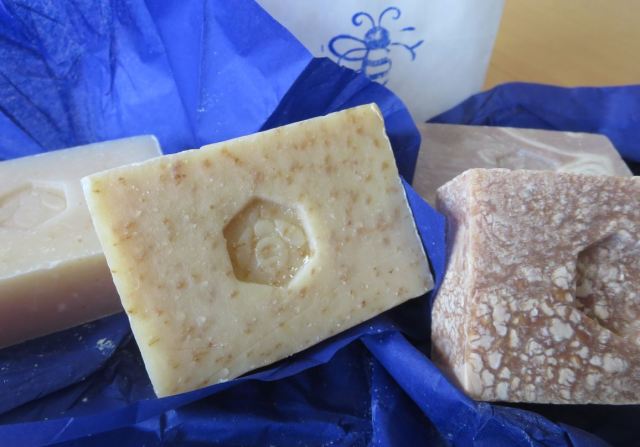
Okanagan-06 - soaps

Helen told me that (just like everywhere) they have good years and bad years, mostly dependent on rainfall and seasonal weather. One key to her success is the idea that “healthy bees are happy bees” –  by maintaining a clean, low-stress environment, her bees live a healthy and happy life. From the spring crocus bloom through to the autumn asters, the bees usually have something to feast upon every day. While I was visiting, I saw bees on sedum, cleome, calendula, and lavender.

In this hot dry valley, thick, low-moisture honey is pretty much guaranteed. I told her that I’d guessed that the jar she’d sold a bit earlier was 16% moisture. “Our honey usually runs 15%,” Helen told me. I couldn’t resist, so I asked her to sell something unusual to me. She brought me a jar of elderberry honey. This is a variety of honey which I’d never had before. In tomorrow’s blog, I’ll show you elderberry honey and tell you what it was like.
Okanagan-07

(*) correction:   In the original post, I said that Arlo’s keeps most of their hives on their farm. Since then, Helen Kennedy told me that they operate a few hundred hives and keep eight outyards.

Posted in Bee Yards, Beekeeping, Ecology, Friends, Save the Bees | Tagged , , , , | 5 Comments

Bad Beekeeping Competition

I came across a blog posting titled “Bad beekeeping” over at ScienceBlogs.com. I was concerned that someone had picked up on my nomen – not that I have universal rights on the bad beekeeping phrase. But I wrote the book called Bad Beekeeping way back in 2004 and I was pretty sore when a few years later, a game-show host dancer in London named Bill Turnbull put out a series of Bad Beekeeper Club books. Turnbull’s books will do you no good, so don’t bother to spend your honey money on any of them.

With Turnbull out there, you can understand my anxiety when I found a blog titled Bad beekeeping. But that’s not the name of the blog, it’s just one entry’s title among many interesting articles written by William Connolley. His blog is called Stoat: Taking Science by the Throat. Turns out that Mr Connolley is a legitimate bad beekeeper, possibly much badder than I have been.

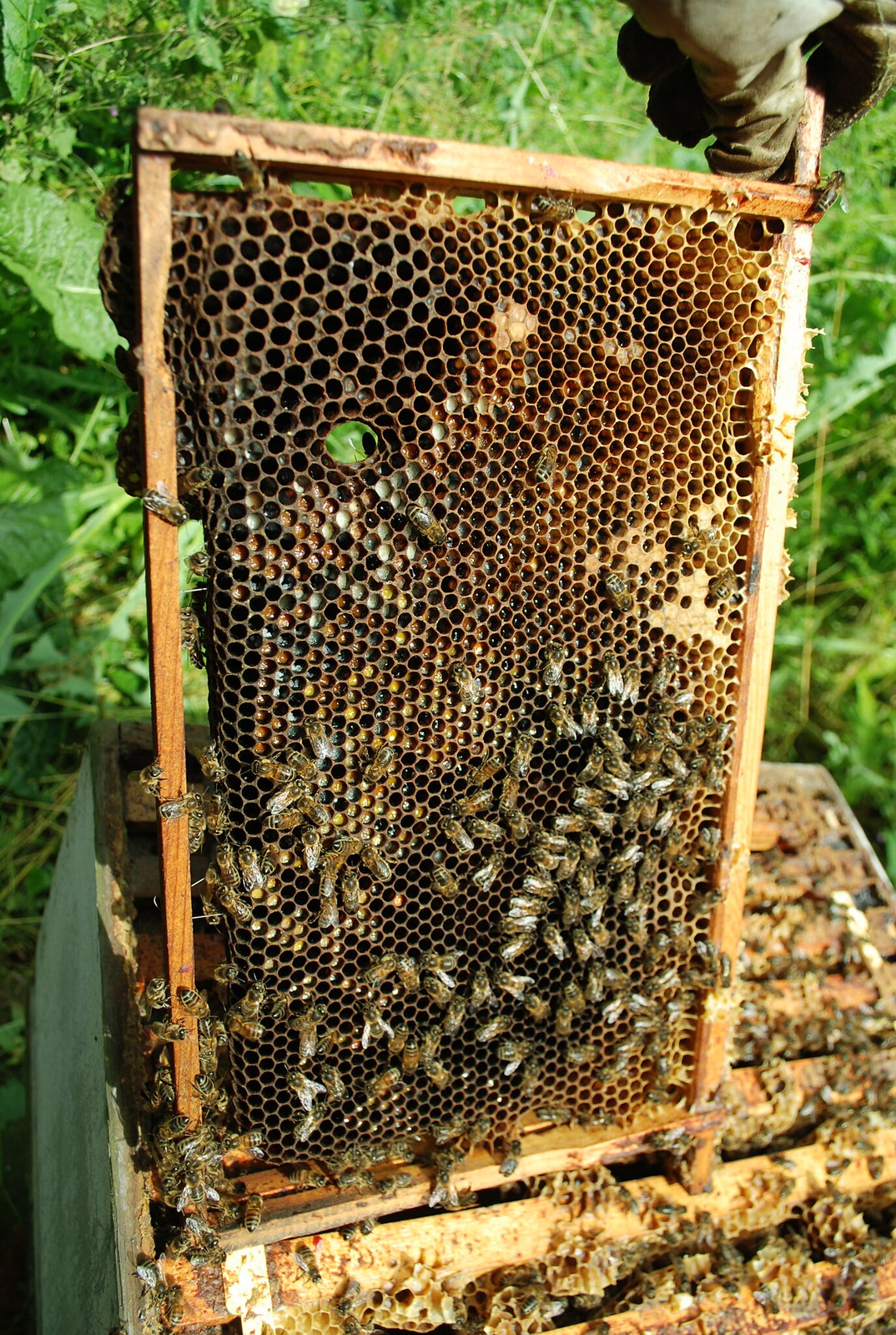
Here’s one important thought about the stuff that follows. As you look at the pictures, you realize that these bees have been neglected for a year or two. Yet they are alive – without receiving  foulbrood mix or varroa treatments for at least a year. (The fellow admits he left varroa strips in one hive for a long, long time.)  However, they aren’t thriving, so they are likely succumbing to mites. And two of the middle pictures show signs of nosema.  What do you think?  Bad beekeeper or not?

I asked the science blogger if I could repost his blog. He said, and I quote: “Sure. You’re welcome to use me as a terrible example to keep people in line 🙂 -W”


Here’s the blog from Stoat’s Bad beekeeping. Enjoy. And learn.

Bad beekeeping:  A photographic essay.

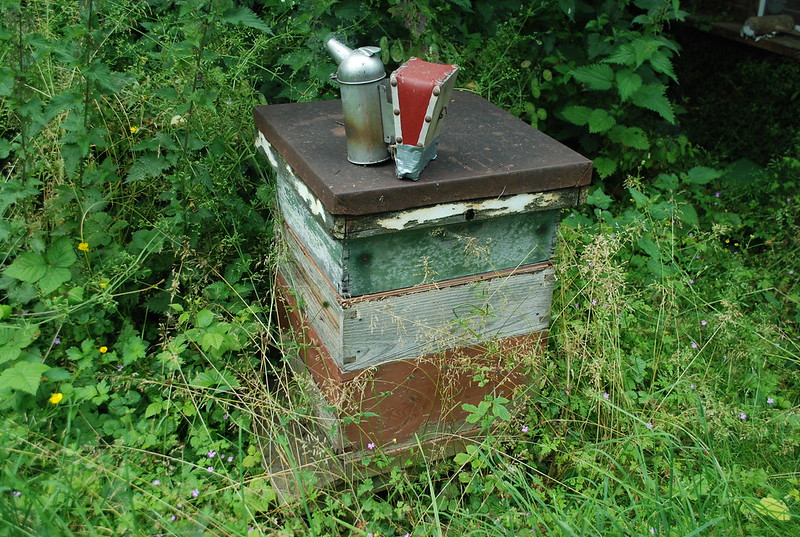
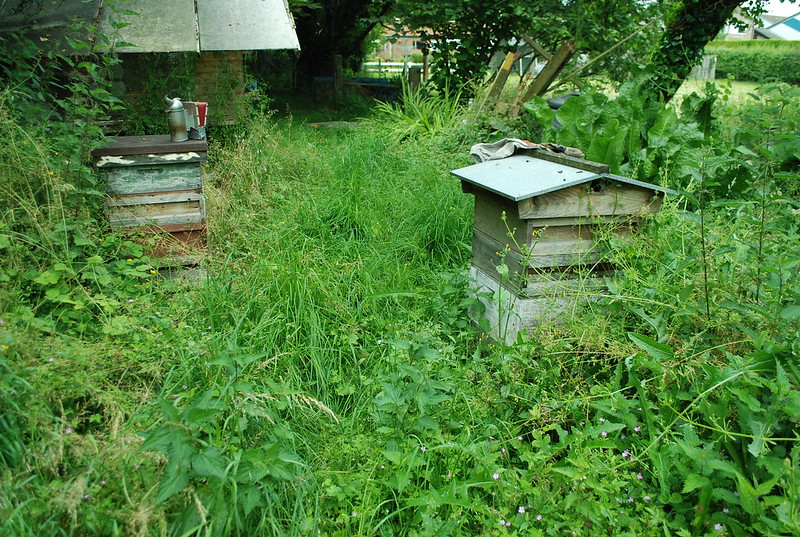
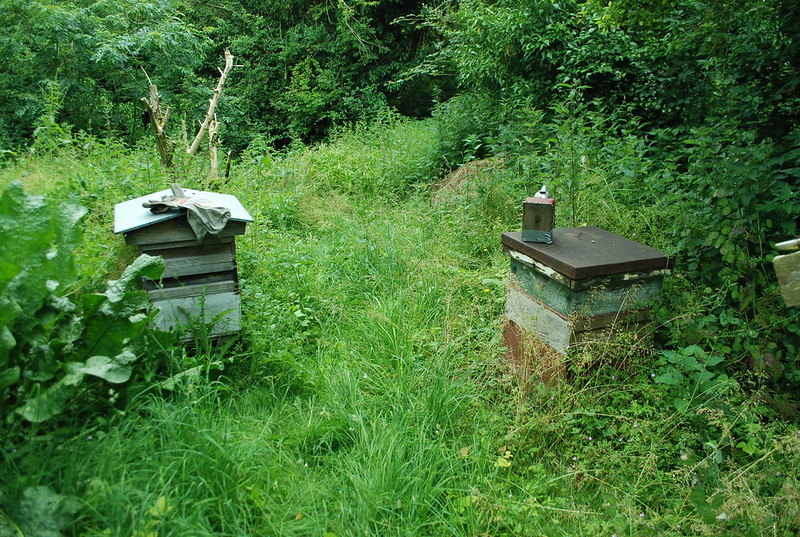
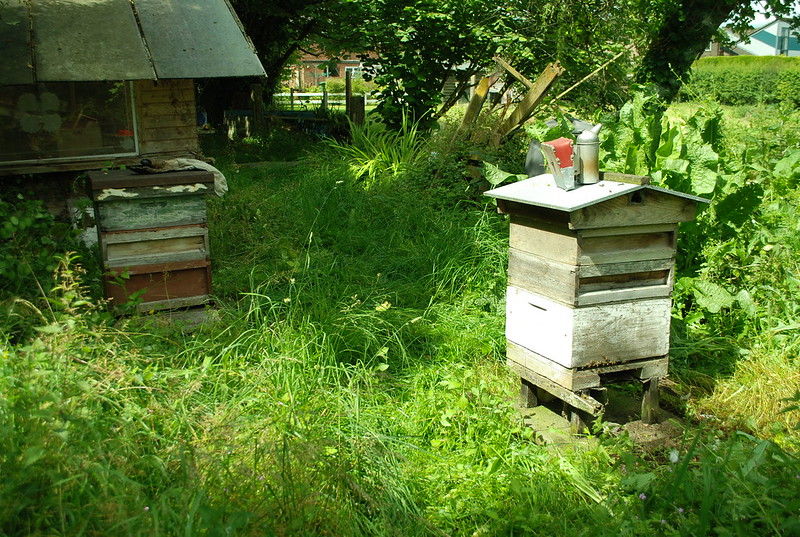
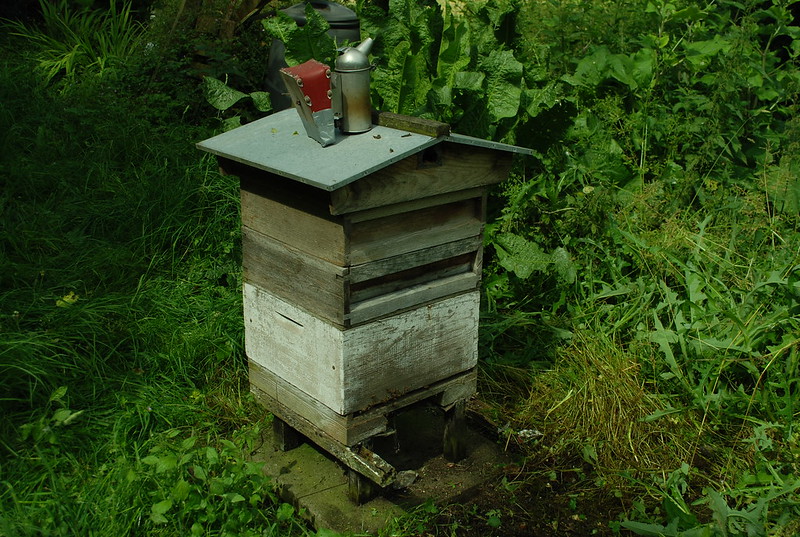
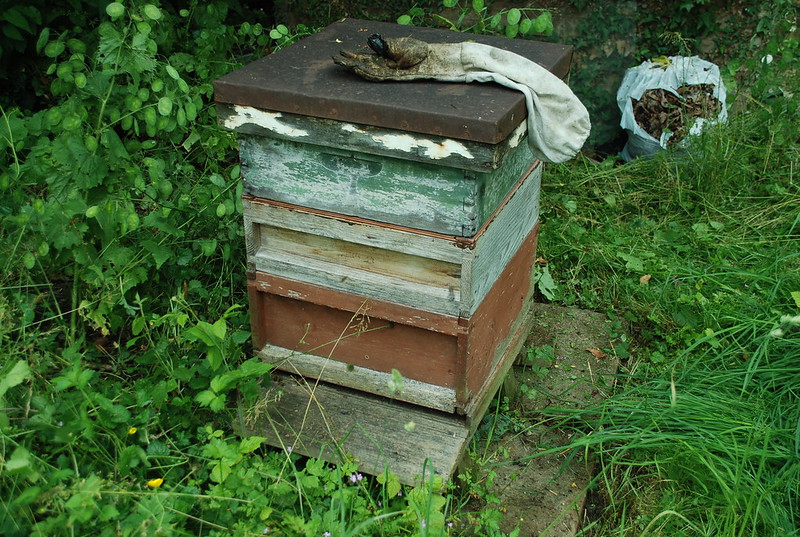
Hive #2, “flattop”, with a smoker on top and surrounded by a carpet of weeds. The bees don’t really mind that, I think. The observant will notice the roof is in rather poor condition – but its been like that for years and not getting much worse – and the queen excluder is above the first super, which is careless of me.

DSC_5634

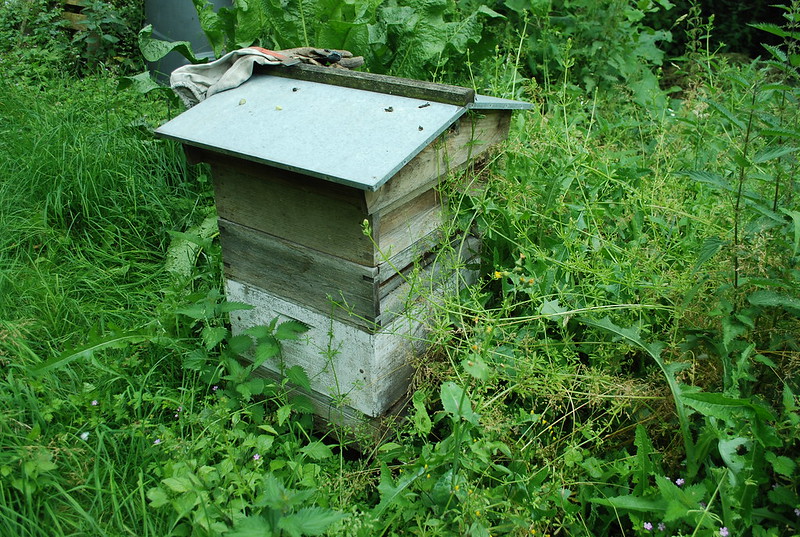
Hive #1 is even more covered in weeds, perhaps a little more than is desirable. The odd blob on top is my gloves.

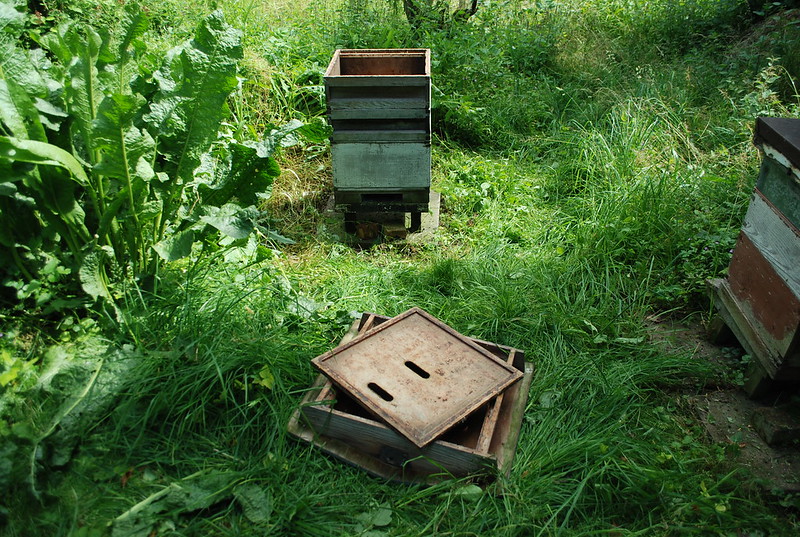
General view, with my shed in the background.

Looking the other way to the (not visible) stream at the bottom. The triffid on the left is a horseradish, I’m assured.

After some vigorous weed-pulling. The wet June has been bad for weeds, in the sense that they’ve grown well and that’s bad.

Hive #1. The decayed bit at the front is the “alighting board” but bees don’t need it.

And for completeness the de-weeded #2 also.

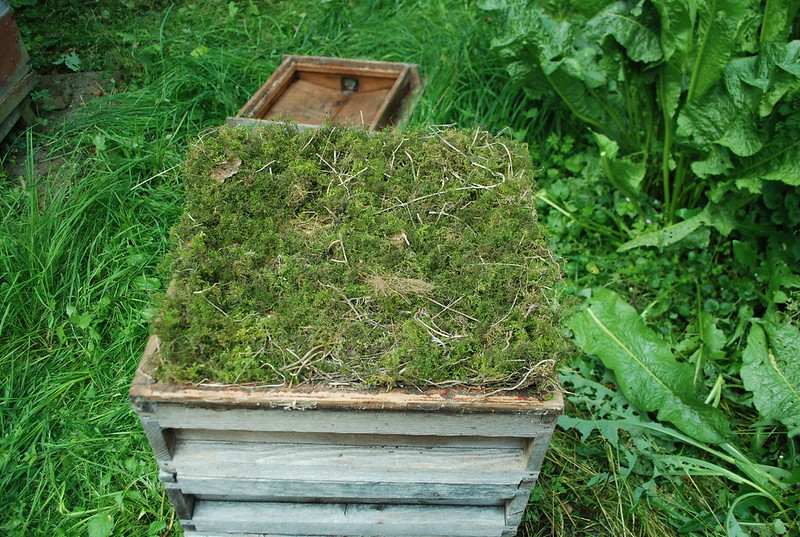
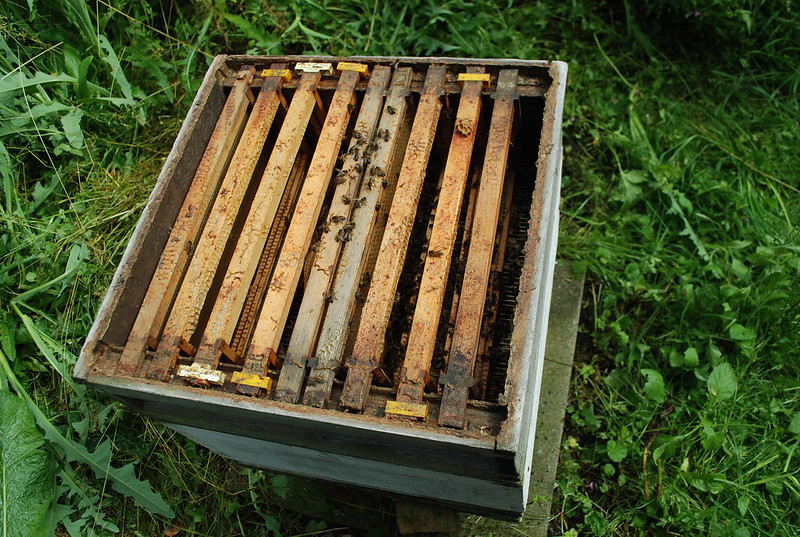
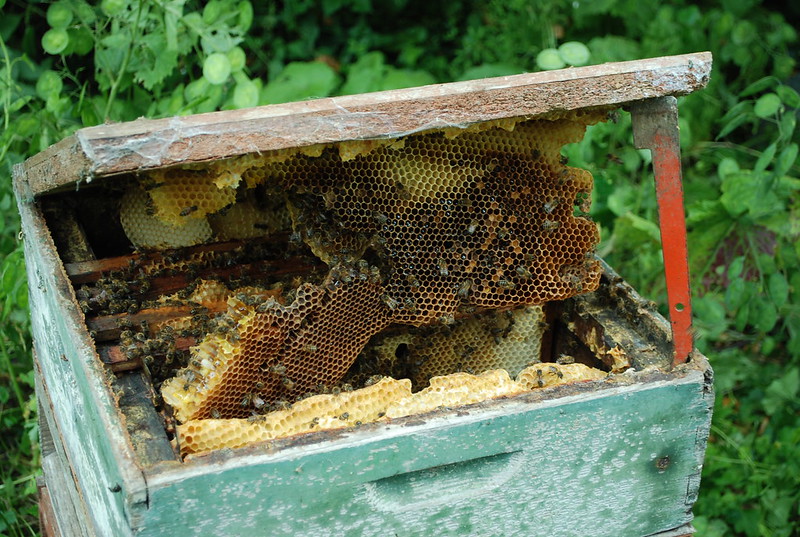
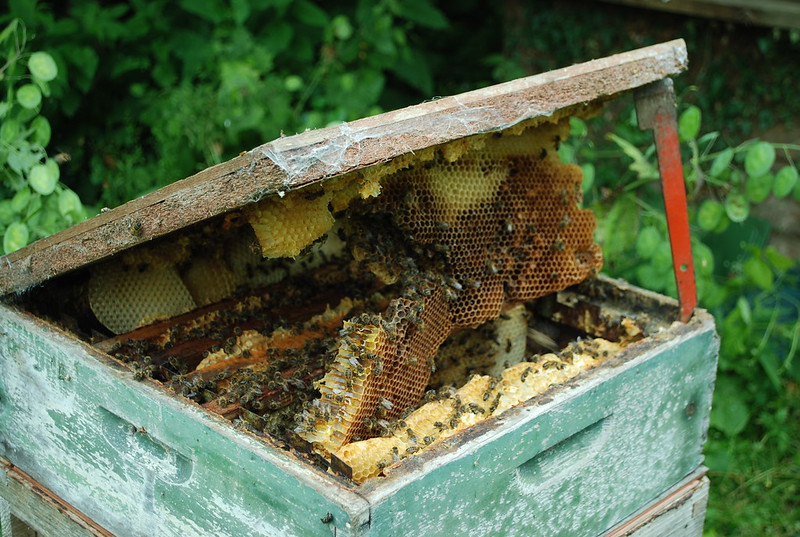
Oh dear. Who left a garden inside the top of my hive?

Remove roof and cap board, and all is fairly quiet.

Yes, pretty quiet. In a good year, they’d have filled the empty space (that really should have frames in it) with comb.

One layer down. I remember now, I didn’t get round to putting wax into all the frames, but hoped the bees would. But, its all looking pretty thin in there. Not hopeful.

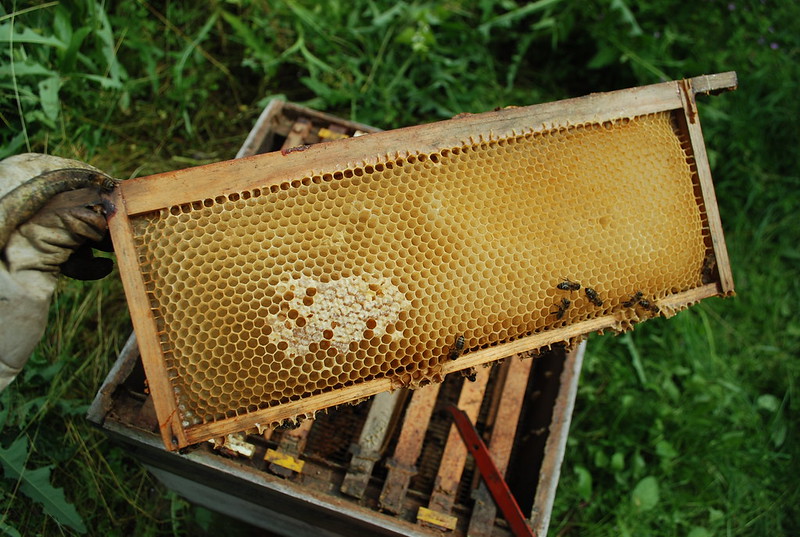
Pffft. Is that all? Just one small capped area? Oh dear.

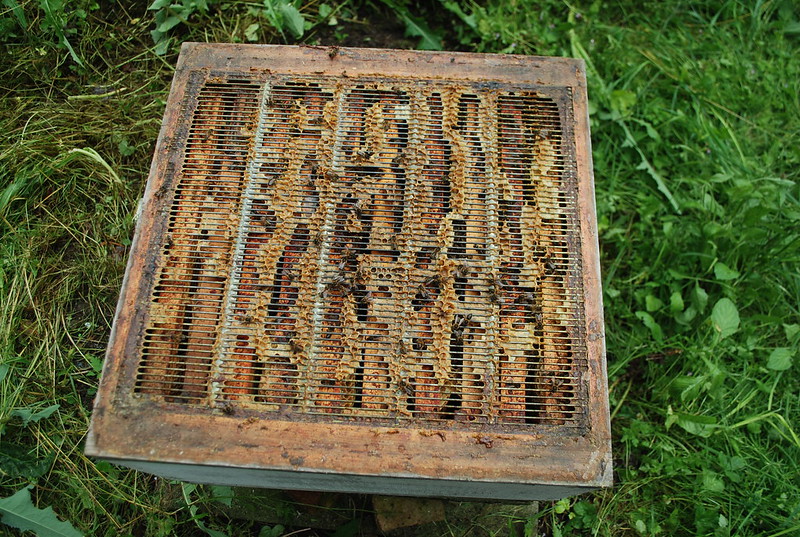
One lower, the top of the brood box, and careful inspection shows I left the Apistan in. I really should not have done that.

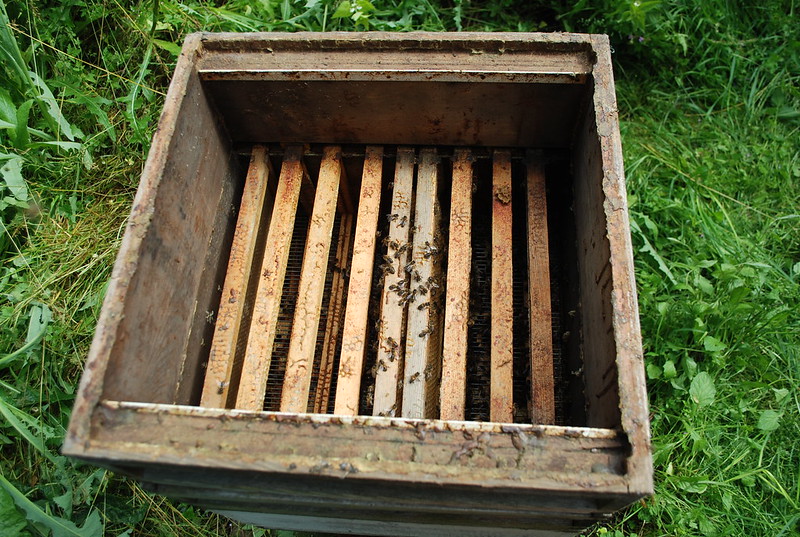
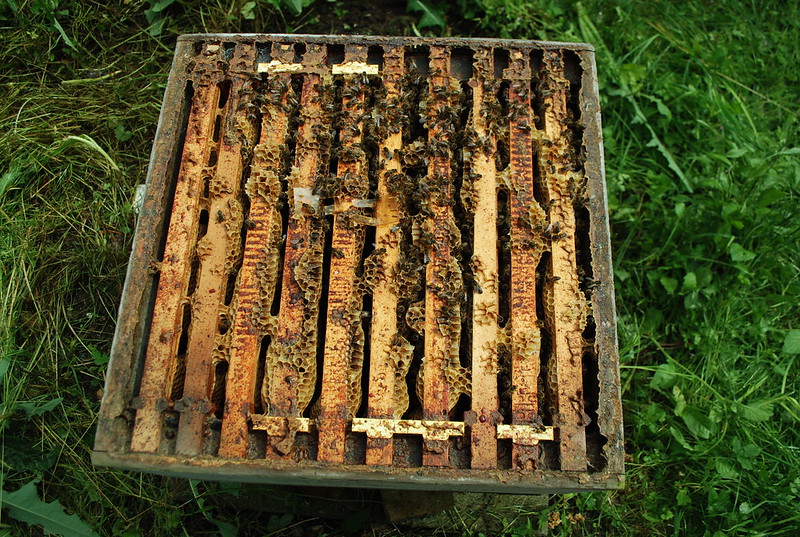
The brood box. A reasonable but not overwhelming number of bees, and inspection of a couple of frames didn’t show much or any brood. Well, we’ll see.

A brood frame. Black as the ace of spades: it really ought to be replaced. Next year.

DSC_5650

So much for hive #1. What of #2? Oh dear, I didn’t put enough frames in did I?

Slightly less obviously, there’s not a lot of honey in all that comb, either. It really hasn’t been a good year.

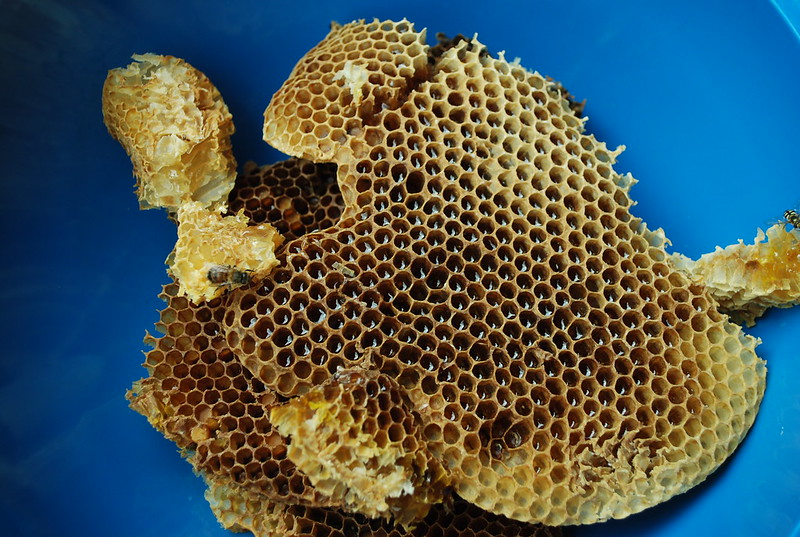
So I took a bit out, and left the rest. Let’s hope the remainder of the summer is sunnier.

Posted in Beekeeping, Hives and Combs, Humour, Save the Bees | Tagged , | 4 Comments

Don’t Step on a Bee Day

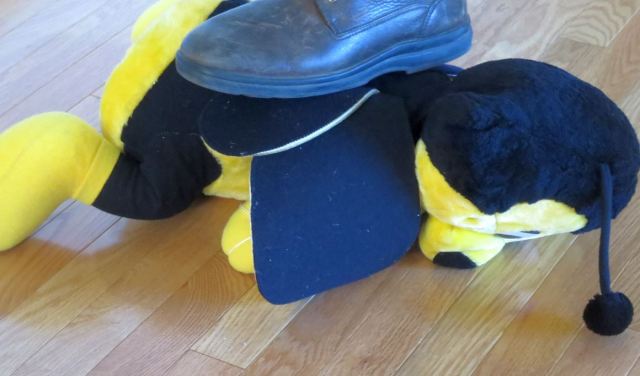
squashed Benny

Today is Don’t Step on a Bee Day.  See if you can keep it up all week!

Posted in Culture, or lack thereof, Humour, Save the Bees | Tagged , | 1 Comment

Malathion and Pesky Bugs

There’s a pesticide causing grief among some hobby beekeepers. No, not the neonicotinoids again (though they’re not without blame). This is an “older” poison. If you are a new beekeeper, you might not have heard of malathion.

canada mosquito flagMalathion is deadly stuff.  Not so much to humans. For us, it’s relatively safe, though farm kids are cautioned not to eat it. Because malathion can be handled fairly carelessly, it was used a lot on farms in past decades. Insects are not so lucky. Malathion wiped out billions of honey bees over the years. Of course, it sometimes saved farm crops from hungry bugs and beetles and it did a number on malaria – for a while. But we still have nasty bugs and malaria, so the effects of malathion are ephemeral. Except where it has killed bees and put beekeepers out of business. Then the effects are permanent.

Until February, beekeeping wasn’t legal in Manitoba’s capital city. Then city council allowed kept bees (wild ones were already there and those bees generally ignored the council rules). Hives began sprouting on rooftops and in backyards. Unfortunately, in an effort to control Winnipeg’s famous mosquito population, malathion spraying was set to begin.  Some beekeepers are concerned that their city’s use of malathion to fog out mosquitoes will kill the newly established beehives.

Downtown Winnipeg - lots of rooftop beeyards available.

Downtown Winnipeg – lots of rooftop bee yards available.

We all know that mosquitoes are lovely blood-sucking parasites that spread Zika and West Nile viruses when they don’t have their mouths full of malaria. I’m not a fan of malaria or mosquitoes. But one of the few truisms I’ve appreciated in my days of keeping bees out here on the semi-arid western prairie is that when mosquitoes are especially bad, honey bees do especially well. We’ve had seasons without mosquitoes pestering us – those were poor years for honey crops. The common link, of course, is water. Mosquitoes magically appear when water puddles abound. In our dry climate here in western Canada, water puddles are also good for honey crops. This year started out really dry in Winnipeg, but now the water puddles are growing.

So, where does that leave Winnipeg beekeepers? The city is putting all registered urban hives on a no spray list. That will help the human-owned hives, but all those naturally occurring wild bees should think about quickly registering their homes, too.

Posted in Ecology, Pesticides, Save the Bees | Tagged , , , | Leave a comment

Honey Food Stuff

I was sorting a few pictures and ran across some honey/bee foodie things I thought I’d share. When people find out that you work with bees, you inevitably end up receiving bee gifts. Wasp-shaped butter trays, pollen-encrusted soap bars, stingers mounted in glass. But you also run across the edibles whose existence is intended to be ephemeral and enjoyable. Following are some bee-related foods I’ve run across over the past couple of years.

My wife and two of my kids arrived in Europe this weekend, reminding me that central Europe is really one big bee fest – bees, beekeeping, and honey are everywhere. So my first picture shouldn’t surprise you. It’s a page I photographed from a menu at an outdoor restaurant we visited in Hungary last summer, when I was there with the family. I love ice cream, but defeated the temptation to devour a piece of this bit of delicious art called Maja, the Ice Cream Bee. I know, Maja looks grumpy, but she’s got her reasons – she’s about to be eaten and she’s melting.

hungarian ice cream restaurant

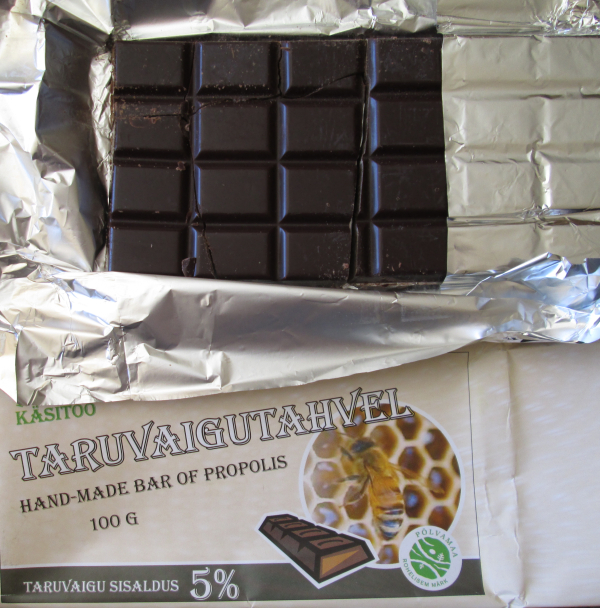
Honey candies are popular. (As if honey’s just not sweet enough.) Some of my traveling friends regularly return with tasty honey/pollen/wax/propolis treats, most originating in Europe. Here’s a “Hand-Made Bar of Propolis” which was brought to me from Estonia. (It was 10% propolis, smothered in black chocolate.)  It had a magnificent propoline flavour. You felt healthier with every bite.  I liked it.

propoliscandybar

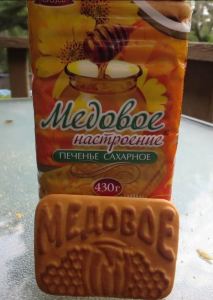
Medovoye Cookie

Sometimes you don’t have to travel around the globe to find the exotic – to your left is a Medovoye Cookie. We bought a bag of these treats from our neighbourhood “Russian” store, which is in Calgary, not Moscow.  You don’t need to know the Cyrillic alphabet to recognize the international symbol for honey – the swirl spoon.

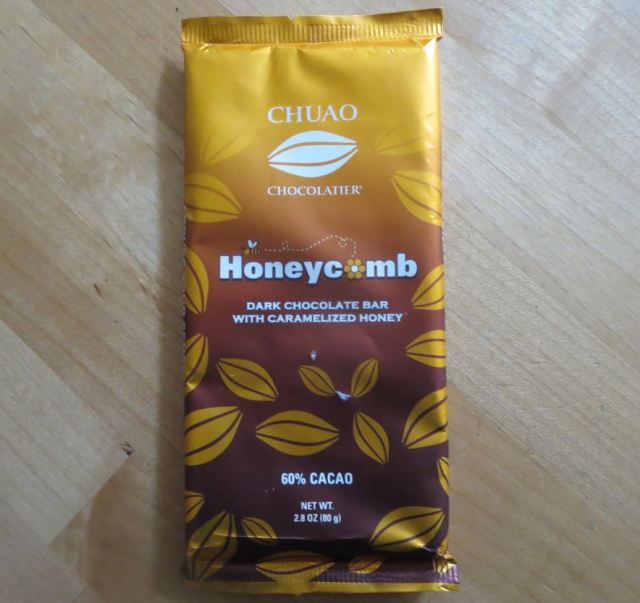
Staying with the unique and faintly unhealthy, here’s a chocolate bar from the Chuao Chocolatier in San Diego (USA). The actual honeycomb was missing when I peeled back the wrap.

Chuao Bar

For a really natural treat, there’s raw, pure comb honey.  This next picture features my younger son, about ten years ago. He was the posterboy for comb honey in those days. Now he’s a 6-foot-tall 14-year-old, but to his embarrassment, he is still our lingering comb honey poster-child:

Daniel honey comb

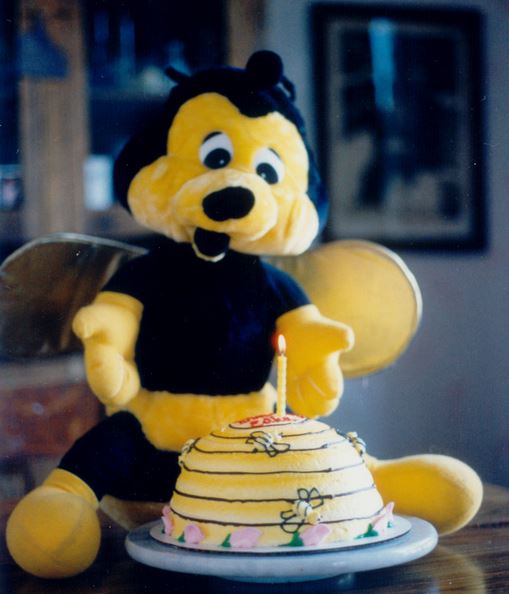
Next, our favourite family stuffie, named for my nephew Ben whose skillful pitching arm won Benny the Bee at the King’s Island arcade in Cincinnati in 1993. Benny the Bee has helped us celebrate a birthday or two.  Here’s Benny the Bee, in his younger days. The cake is edible; this bee is not:

benny and cake

A while back, I wrote about John the Baptist’s delightful breakfast food, rumoured to be all locusts and honey. You can catch the full story at this link, but the cereal is boxed up below.

johnbaptistcereal

Here’s yet another honey-inspired breakfast cereal.  To me, it’s interesting that honey bees can be so horrifying to some (they’ve even appeared in some awful frightening B-movies), yet almost everyone agrees that bees can be totally adorable. That’s why a major cereal company enlisted bees to help sell oats tinged with a smidgen of honey. Honey Nut Cheerios has certainly been good for honey, oats, bees, and General Mills:

Benny with Cheerios

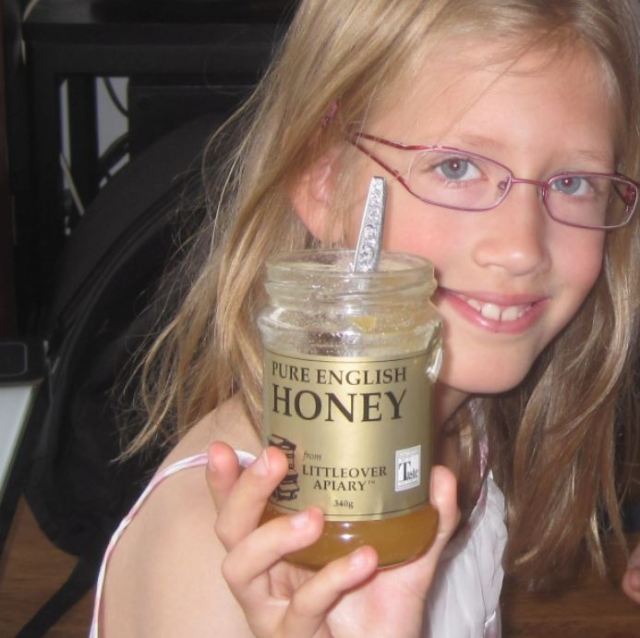
Finally, I’ll make my b-exit with a shot of my youngest daughter, in London, last summer. Just some real, old-fashioned Pure English Honey:

Pure English Honey

Posted in Culture, or lack thereof, Hive Products, Honey | Tagged , , , , | Leave a comment

Canada Day in the Land of Honey

can_flag_75Happy Birthday Canada!  149 years ago, the Fathers of Confederation signed the paperwork that began the Canadian experience. I always figured it was kind of those politicians to give us a summer holiday that suits a beekeeper’s calendar. Across most of Canada, honey boxes are stacked high on the hives, the honey flows have begun, but extracting is a week or two away. So beekeepers begin July with a slightly more relaxed workday on Canada Day, though it may be their last breather before things get really hectic.

Canadian beekeepers do well – the country’s 8,500 beekeepers bottle 100 million pounds of the good stuff. That averages 12,000 pounds per beekeeper and over 100 pounds per hive. (Of course, there are beekeeps making a million pounds a year and in places like Alberta, 200 pounds per hive is common.)  Our northern latitude gives us long summer days. Most of the country has a ‘continental climate’ which includes hot summers. Our formula for success also includes long, warm days and nectariferous field crops (especially clovers, alfalfa, and canola).

canadian flag and mountains

I’ve been lucky enough to keep bees in two provinces and three different areas – the desert-like grasslands of southern Saskatchewan, the parkland of northern Saskatchewan, and the mountain foothills of western Alberta. But Canada is more than my narrow experience. Bees are kept from Newfoundland to Vancouver Island, from the arctic’s Yukon to Pelee Island in the sunny south. To really celebrate Canada Day, I’ve got Stompin’ Tom queued up, so don’t go away.

Canada is a major honey producing country, but has fallen a bit at the global scale. A few decades ago, Canada was the fourth-largest honey-making country in the world. Today, we are at about 14th place with previously small producers like Ethiopia and Iran now tonnes ahead of us. But, as a consolation prize, we still make the world’s best honey!


Posted in Culture, or lack thereof, History, Honey | Tagged , , , | Leave a comment

African Beekeeping May “Save the Trees”

zimbabwe trees

Rather than “Save the Bees”, it’s “Save the Trees” in central Africa. A story from Zimbabwe reminds us that beekeeping can be very, very good for ecology. Bees (and beekeepers) are saving Zimbabwe’s forests.

The country of Zimbabwe, lest we forget, is the messed-up place where 92-year-old Robert Mugabe has claimed to be the freely elected ‘president’ for the past 30 years – a position he maintains with the help of an elite North Korean-trained security force.  But today we have a good-news story, which is a nice break for the poor people of Zimbabwe.

Much of the honey produced in rural Zimbabwe comes from its old-growth forests. In the past, people saw trees as firewood and little else. Tobacco became a big cash crop, resulting in clearing of forests to plant the loathsome herb. Even more trees were felled to make the fires needed to cure the tobacco. You can see where this is leading – desertification, ecological ruin, and cancer. But push-back has gently arisen from Zimbabwe’s beekeepers.

In a country where the average annual income isn’t much more than a new T-shirt and socks, beekeepers can make about $60 per hive each season. Some of Zimbabwe’s 50,000 beekeepers manage a hundred or more colonies. Honey production is fairly good, but wax is an important by-product because political ineptness results in intermittent lighting, which people supplement with beeswax candles.

Beekeepers rely on seasonal blossoms  on scrubby shrubs and trees for the nectar that makes the nectar that makes the beekeepers’ honey. In turn, beekeepers have fought tree poachers and wildfires to preserve their honey source. The forests are making a comeback and even rivers are healthier with improved basins and less erosion into the streams. To read more, please see this article.  To help, you may look here.

Bees and beekeeper in a tree.

Bee hive and beekeeper in a tree

Non-Africans may point out the environmental damage taking place when people in the sub-Sahara cut trees to clear farmland and pay bills, but unless they help with money-making alternatives like beekeeping, deforestation will continue.

A few outfits support co-ops and communities that help Zimbabwe beekeepers – Environment Africa is one example.  On your left is a picture from their website. It shows that trees not only feed bees, they also serve as bee yards, keeping hives off the ground and safe from predators.

Posted in Beekeeping, Ecology, Save the Bees | Tagged , , , | 3 Comments