

Recording bee visits on domesticated sunflowers in Alberta, Canada.
It can feel a little creepy, sitting on a bench on the edge of a sunflower forest with your back to the sun. In that position, all the sunflowers are looking at you. If it’s morning.
The marvel of the ‘sun’ flower didn’t escape the notice of North American natives. Various pre-Columbian cultures domesticated sunflowers about 5,000 years ago. Mexico’s Aztec adopted the sunflower as a religious symbol, as have some new-ager cults. It’s a sun symbol because of its solar shape and colour, not because it ‘follows the sun’ across the sky.
Not only are a sunflower’s eyeless- and lipless-heads creepy, but math profs tell us that the flower goes out of its way to creep them out, too. Its florets form a Fermat’s spiral, building a 137.5° angle that is related to da Vinci’s golden ratio, because 137.5° is 55/144 of a (360°) circle and the numbers 55 and 144 are Fibonacci rabbit numbers.
Most of us think that the huge sunflower flower always twists toward the sun, but most of us are wrong most of the time. We cheerfully live with the sunflower misconception – until it’s interrupted by Wikipedia or some other reliable source. As it turns out, sunflowers do face east to catch the morning sun and rotate west as the day progresses (here’s a video)- but they only do this while they are young and gaining height. Once mature, the sunflower blossom gets stuck facing east. Bee scientists think that the flowers are stalled on “east” once their heads mature because the massive flower collects solar heat, which enhances nectar secretion, which attracts pollinators.
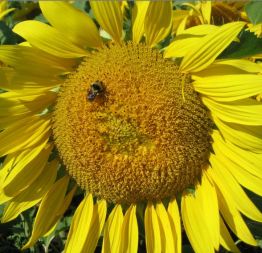 A Dakota beekeeper told me that he liked to place his bees on the east side of big acreages of sunflowers so that his bees would see the flowering heads first thing in the morning and they wouldn’t waste time flying around to the other side of the plant, which they’d have to do if he put his colonies in a different spot. (He was a fussy beekeeper.)
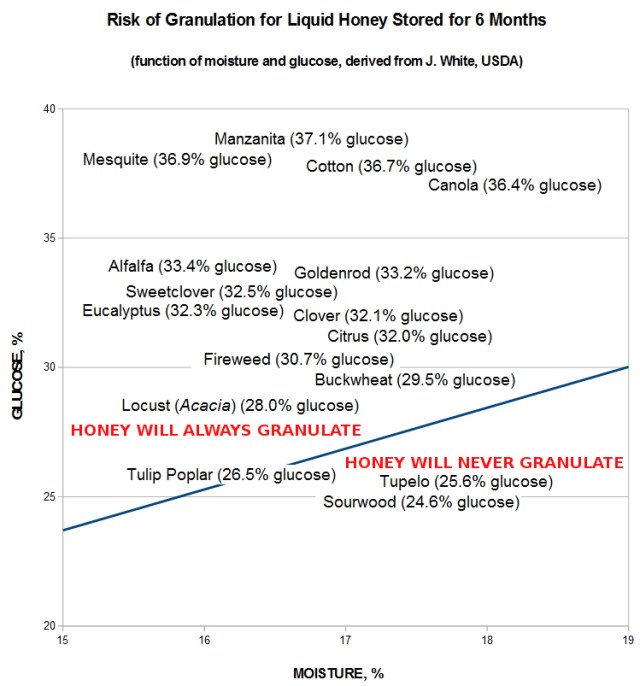
My friend favoured sunflowers because, in his area, they make a nice bit of honey – usually about 30 kilos (60 pounds) per hive per year. Most of that honey comes on warm July days, though up here in Alberta the flowers peak in early August. Each head has about 1,500 florets. The first to open seem to offer the most nectar. From first flowering to last withering sunset, about three weeks passes. With staggered timing of seeding and individual plant variations, beekeepers may have a four or five week sunflower nectar flow. When given a choice though, beekeepers in my part of the world (western Canada) prefer sweet clover and alfalfa – sunflower honey is darker and it granulates quickly because of its high glucose content. But the plant is a fun flower and some mystic types off folks like to eat honey from the symbol of the sun, so the stuff sells well.
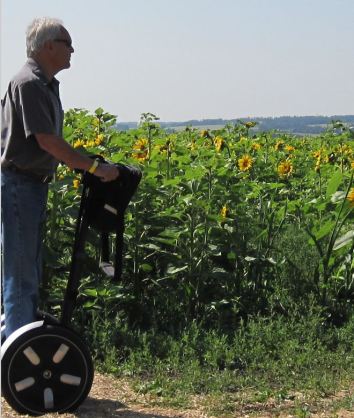 The sunflower does, in fact, spin around as it chases the sun across the sky, but only when the plant is gaining height.
This was discovered years ago. The side pf the stem receiving more sunlight grows a tiny bit faster, hence twisting the plant as the day goes on. It’s the twisting that makes the immature sunflower follow the sun. When growth stops, the flowery faces face east.
The biggest mystery is the immature sunflower’s nightly backward twist. Returning to the east where it waits for sunrise. Turns out that domesticated sunflowers (Helianthus annuus) have a circadian clock that tells the plant when to return to the east. This idea was established in a sealed lab where sunflowers were raised with constant light but no sunshine. For a few days, young lab sunflowers continued twisting towards the east every twelve hours, but with the constant light, they got smart and the habit died.
All of this – circadian rhythms, internal clocks, memory – reminds me that plants are people, too, and should be treated with respect. Unless we’re hungry.


 I first wrote about Zombees over four years ago


 Someone would enter one of our bee yards at night and flip over a hive or two. I suspect there was always more than one vandal involved – there would be little joy in hive flipping (or


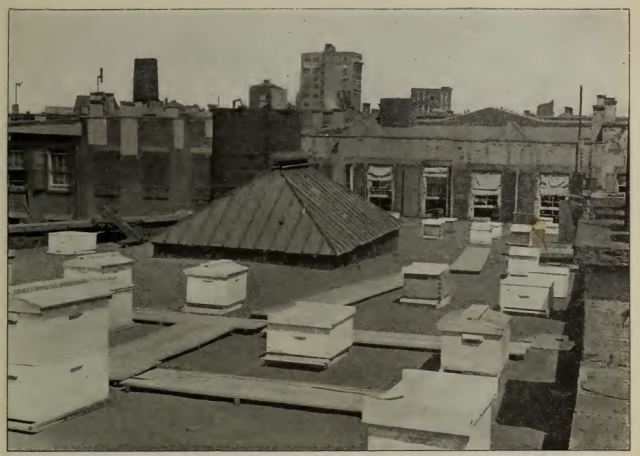

 Our previous Canadian prime minister (Stephen Harper) has a fearless wife who grew up on an Alberta farm where bees were kept. A few years ago, a chef led Mrs Prime Minister of Canada (and an entourage of reporters) to the roof of Toronto’s Royal York Hotel where hives were kept. The chef seemed to have lost his way with the bees. The insects chased the poor guy, leaving the prime minister’s wife to replace the lid on an angry hive. To the left, you see the chef, a bit removed from the action, struggling with errant bees. Bravo to Laureen Harper! (You can








 Bad Beekeeping Blog