The Bees’ Sixth Sense

bee's eye close-up

Bees sense the environment differently than humans. For example,  bees can see ultra-violet colour and distinguish it from violet and white, yet they see red as if it were black. They sense the orientation of polarized light. Their massive compound eyes give them an image made of hexagonal images, similar (but not quite) to the picture I made below, to the right. The honey bee’s eyes are good at sensing thin structures (like flowers on stems) and motion but, for a bee, a person pressed flat against a wall has disappeared from sight.

Bees see in mosaic hexagons, similar (but not quite the same) to what you is shown here.

Bees see mosaic hexagons, similar (but not quite the same) to what’s shown here.

Bees taste with the tips of their antennae, sampling sweet, bitter, sour, and salt. They can taste salts better than humans can, but are less sensitive to the bitter flavour of coffee. Their antennae also give them a sense of touch which monitors bee dances and cell wall thicknesses.

The honey bees’ sense of smell is 100 times more sensitive than ours – in London, experimenters have trained bees to smell/detect cancer. When not engaged in cancer research, that keen sense of scent can draw workers to perfumed sugars (as Karl von Frisch proved a hundred years ago) and can help queens find drones. Bees sense sound, too, but not through the ears they don’t have. Instead, honey bees pick up vibrations made by low frequency noises. They probably can’t hear your soft murmurs or sharp curses when you are near their hive.

In their own ways, bees use the same senses that humans use – sight, sound, smell, taste, touch. But bees have at least one extra sense. Some years ago, scientists found that bees also sense the magnetic field that surrounds them. When he was awarded the Nobel Prize in 1973 for his bee research, Karl von Frisch mentioned magnetism. In his Nobel Lecture, he said:

“The idea that the magnetic field might play a role in the puzzling orientation performance of animals was rejected for a long time. During the past years it has been confirmed by new observations, especially in birds and insects. Nothing so far points to the possibility that bees, in their purposeful flights cross-country, are making use of the earth’s magnetic field. Unexpectedly, however, it proved equally significant biologically but in a different way. When a swarm of bees builds its combs in a hive furnished to them by the beekeeper, their position in space is prescribed by the small suspended wooden frames. In the natural habitat of the bee, perhaps in the hollow of a tree, there are no wooden frames present. Nevertheless, thousands of bees labor together and in the course of one night achieve an orderly structure of parallel combs; the individual animal works here and there without getting instructions from a superintendent. They orient themselves by the earth’s magnetic field and uniformly have in mind the comb position which they knew from the parent colony.”

Von Frisch spoke these words in Stockholm in 1973, stating, “Nothing so far points to the possibility that bees, in their purposeful flights cross-country, are making use of the Earth’s magnetic field.” That statement (true at the time) has since been modified. Among other research, four scientists showed the importance of magnetism during bee foraging in a paper in December 2014 (Does the Earth’s Magnetic Field Serve as a Reference for Alignment of the Honeybee Waggle Dance? by Veronika Lambinet, Michael E. Hayden, Marco Bieri, and Gerhard Gries).

Earth's magnetic field: multitudes of local variations.

Earth’s magnetic field: multitudes of local variations.

Honey bees apparently make use of the ambient magnetic field that surrounds us and influences our direction-finding compasses. This magnetic field is generated within the Earth. It changes with time and varies in direction at different latitudes, but for the purposes that bees need, it is stable enough.

Scientists aren’t sure where the bees’ magnetic sensor is located. Bees have iron-based crystals in cells in their abdomen which could work as magneto-receptors. In 2012, an idea emerged that suggests bees may literally “see” lines of magnetism superimposed on their visual image. This does not necessarily mean that the information is collected at the bees’ eyes, but it could mean that magnetic and visual data merge in the brain, giving bee navigators a view similar to fighter pilots whose helmets include projections of pathways and flight data. Obviously, there’s still a lot to be unraveled here.

How do we know that bees use magnetic field information? Since we don’t really know where the input sensor is nor how it communicates with a honey bee brain, we can’t directly surgically alter or manipulate the sense organ. Instead, to see how honey bees and magnetism interact, scientists use two different skills.

1: Observing the natural environment.  For many years, people have noticed that animals tend to perform some habits in alignment with the magnetic field. Sort of animal kingdom feng shui. For example, dogs face north (or south) when peeing on a tree while cows prefer to align with the Earth’s magnetic field while grazing. Swarms of bees build their comb inside trees or hollow boxes so that they are parallel to the combs in their mother hive. This obviously saves a lot of argument among the bees when they start building their new house because they immediately agree on the orientation for the new comb. With nothing to guide them, the bees could as easily build east-west as north-south – or any angle between. However, up to nine days after swarming, the bees will remember their old home’s pattern and will copy it.

2: Manipulating the environment.  You may have questioned the science in the last bit above:  How do we know that bees use the magnetic field to agree on how to build new comb?  Maybe the honey bees are using the sun’s position in the evening, or some other stimulus.

'Wild' combs. (Photo by Ursula Da Rugna)

‘Wild’ combs. (Photo: Ursula Da Rugna)

We are fairly certain the magnetic field influences comb building because researchers have placed swarms in dark rooms, then aligned an artificial magnetic field at various angles and found that the bees respond by building their comb correspondingly.

Researchers have also confused the poor little animals by placing strong magnets in their hives – twisted and messy combs result instead of uniform straight ones.

Similarly, by experimenting with the magnetic field, it appears that bees supplement their navigation with magnetic information. Zoologists disturb the bees’ magnetic environment and wait to see if anything interesting happens when scout bees host bee dance parties. It does. In one unusual experiment, tiny magnets were strapped to bees’ bellies. These made it hard for bees to follow flight path data they’d received back at the dance hall. Under normal conditions, honey bees can sense variations in magnetism 1/2000 as strong as the Earth’s ambient magnetic field (26 nT vs 46,000 nT). This is extremely significant, indicating that very minor local magnetic differences may help bees find their way.

Theoretical affect of magnetic fields on bee navigation.

Theoretical affect of magnetic fields on bee navigation. (Source)

Such fine discernment of just a few nano-Teslas (nT) implies (according to Taiwanese researchers Hsu, Ko, Li, Fann, and Lue) that bees may memorize their homestead magnetic field intensity and orientation, allowing them to navigate home from almost anywhere.** This helps explain what happens when bees are used to beeline a wild swarm. In bee-lining, bees are captured in a small box, carried around for hundreds of metres/yards, and then freed, one at a time. After circling overhead a few times, the bees make a beeline towards home. The human with the little box of bees chases for a while, then lets another bee loose, watching her go and following a little farther towards the bee tree.

There is at least one other place that magnetism may play a role in bee behaviour – drone congregation sites. Before queens and drones mate, the queen is attracted by pheromones to meet up in aerial clusters where drones hang out in great numbers. We know that the queen’s nose leads her to the boys. But the same congregation sites are used year after year by the drones who gather by the thousands but never live more than one season. Repeated use of the same congregation spot – by drones who had never been there before – is baffling. Now it appears that the spot where drones meet to wait on queens may involve local magnetic anomalies that encourage drones to congregate.

Much remains to be discovered. There is not much agreement yet among the animal scientists. However, the fact that bees use magnetism to orient their combs in a new home seems proven. The idea that bees use the magnetic field to help them navigate seems likely. Beyond that, we speculate that magnetism is involved in communication and congregation.

Earlier in this blog post, I mentioned that humans and bees share the same five basic senses. Perhaps the sixth sense, too. This week, an article in the prestigious Science journal made a case for human magneto-receptivity.  Careful experiments show that people also sense the magnetic field. The experiments involved willing subjects strapped into magnetism-free Faraday cages with brain basket hoodies and electrodes that could sense variations in neural alpha-waves. Abrupt changes induced by zoologists in the ambient magnetic field caused brain wave changes. What this means for our ability to navigate, communicate, and contemplate is not yet known.

—————————————-

* Citation: Lambinet V, Hayden ME, Bieri M, Gries G (2014) Does the Earth’s Magnetic Field Serve as a Reference for Alignment of the Honeybee Waggle Dance? PLoS ONE 9(12): e115665. doi:10.1371/journal.pone.0115665

** Citation: Hsu C-Y, Ko F-Y, Li C-W, Fann K, Lue J-T (2007) Magnetoreception System in Honeybees (Apis mellifera). PLoS ONE 2(4): e395. doi:10.1371/journal.pone.0000395


Posted in Bee Biology, Science | Tagged , , , , , , | 9 Comments

Dozens of Bees

strong_hiveYou know that a hive of bees may contain 50,000 insects. You probably also know that you can often open a hive and work its frames with just short-sleeves, sandals, and a bit of smoke. We tend to forget that normal people might be totally freaked out by a few dozen bees, let alone 50,000.

However, with all the recent attention on bees in the papers and on-line, we may have begun to think that people are generally OK with bees. They’re not. So, Here are two articles appearing this week’s news that remind us that people are still generally timid when it comes to honey bees. A few dozen might as well be a few million.

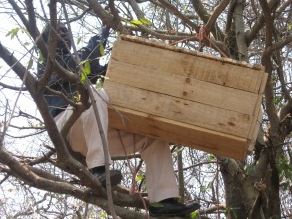
The first story is downright bizarre. A young man in Toronto is being hailed on social media as a fearless hero. The CBC story headline (“Man saves queen-less bee swarm with help of Facebook group”) comes close to summarizing North American culture in 2016.  The good Samaritan, Nima Alizadeh, saw a FB posting about a cluster of bees huddled around a fire hydrant. He lived nearby, rode his bike to the spot and reported the rescue progress on the FB group. Followers cheered (“Save the Bees!”) and jeered (“ARE YA NUTS?”) while Mr Alizadeh – who is not a beekeeper – scooped the bugs into a cardboard box.

little prince's box

There were probably 200 honey bees. A typical swarm has 30,000. (There is a report that some beekeepers caught a swarm at the same fire hydrant a few days earlier and these were accidentally left behind.) Some of the 200 straggler bees were reluctant to participate in their own rescue, but eventually they were in thefire hydrant box, on the bike, then transferred to a car and taken to a beekeeper where they “will be taken to three colonies by the beekeeper on Monday.”  Three colonies? I don’t know why they’d be taken to three colonies (instead of one) unless it’s because the bees are carrying mites and foulbrood spores and this will help infect all the healthy hives with bad karma more quickly.

After delivering the box of bees, Mr Alizadeh drove away, but quickly returned to the beekeeper because he discovered one bee had escaped the box inside his car and had crawled into his coffee cup holder. Everyone on social media should be thrilled and relieved to know that the lost bee was re-united with her sisters. Meanwhile, in the time it took you to read this, three kids died of preventable disease in the tropics. That’s also indicative of our culture in 2016, though it’s a reality that’s not likely to be shared among the same social media postings as the Toronto bee rescue. Just doesn’t have the same urgency, I guess.

The second story is less trivial, but reminds us of the shock and wow that a few bees sometimes brings to the general public. There is a more reasonable quest in this honey bee movement. But the reporter goes for the scare bits first by writing, “Forget snakes. How about bees on a plane? Thousands and thousands of them?” This story from the CBC tells us about two nucs being carried in the cargo bay on a flight from Ottawa to Whitehorse, in the Yukon. The reporter would not be expected to know that millions upon millions of bees travel all the way from the south Pacific to Canada and the USA every spring. The excitement of two small hives in cargo seems to overwhelm the news reporter – who almost misses the bigger story.

Whitehorse, Yukon's capital and home to a few bees.

Whitehorse, Yukon’s capital and home to a few bees.

The bigger story is that the very northern city of Whitehorse has a Downtown Urban Gardener’s Society which had to ask permission of the town council to be able to bring these two small hives to town. I’ve been to Whitehorse. It’s nice. A lovely city. It’s way up north where winters last too long. Bees are tough to maintain at a place that’s 61-degrees north of the equator. Approval from the town council shouldn’t have been necessary, instead the city leaders might have suggested the gardeners bring 20 colonies to help the city gardens and fruits, and to make a few pounds of local honey. But as long as news stories continue to remind the public about how scary a few bees are, we can expect such caution to be the norm.

Posted in Culture, or lack thereof, Outreach, Save the Bees, Strange, Odd Stuff | Tagged , , | Leave a comment

Say, Have You Heard About That Thermosolar Hive?

Recently, I wrote about something called a “honey bee sauna” which received government grants and crowd-source cash to produce a $1700 gadget to cook mites. A different device, described in a new post by The Prospect of Bees’ blog, is likely much cheaper. It would be nice to know if anyone has had real success from these, or if they are just fundraising gimmicks. Meanwhile, I’ve re-blogged this piece on the thermo-solar hive.

theprospectofbees's avatarThe Prospect of Bees

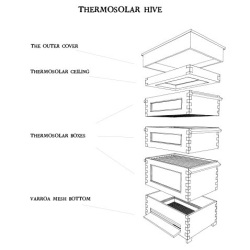
Picture from thermosolarhive.com Picture from thermosolarhive.com

The fundraising effort for this new hive technology is not flooding the internet as the FlowHive did, perhaps because there is no dramatic visual like the infamous pancake video. Just claims of dead varroa and live bees without chemicals. Or perhaps the internet does not wish to rouse those grouchy, skeptical beekeepers again?

The hive is basically an insulated version of the familiar vertical hive of stacking, frame-holding boxes with solar heating built in. When treatment is required, the beekeeper removes the outer cover exposing a “thermosolar ceiling” to the sun. When the built-in thermometer indicates 117F(47C) the cover is restored and this elevated temperature is maintained, causing mites to fall off and die while not harming bees or brood. Such is the claim anyway. What is our take?

View original post 243 more words

Posted in Reblogs | 2 Comments

The Price of Honey

honey - PDThe price of honey has been falling for over a year. Honey is such a strange commodity. It’s agricultural. It’s ubiquitous (produced on all but one continent). It’s easily transported. Doesn’t need refrigerated. Doesn’t spoil (though quality may diminish with time and circumstance).  Sometimes honey is produced in primitive conditions; sometimes in ultra-modern facilities. It has widely varying colours and flavours, yet it’s fungible, which means that a bit of clover honey produced in Argentina is pretty much interchangeable with a bit produced in Minnesota or Kazakhstan. With all of this in mind, it is interesting that the price is so volatile – we’ve seen honey prices nearly double in a single year, but also fall to nearly half within months.


Last year, Canadian beekeepers received about $2/pound for their crop, according to the USDA. Here’s a clip from the January 2015 National Honey Report:

USDA Jan honey prices

Then, 15 months later: here is the US government’s National Honey Report for May 24, 2016, showing prices paid to Canadian beekeepers for their honey sold to American packers. It’s not pretty:

2016-05-24 prices paid to Can

poorguyHistorically, beekeepers have earned a marginal living. To stay viable as commercial operators, most have expanded and stream-lined their production. In the 1970s, a commercial beekeeper might have operated between 600 and 1200 colonies. That was enough to feed and cloth a flock of kids and keep the honey farm going. Honey was 50 cents a pound.  That was almost 50 years ago. Minimum wage at the time was less than $5/hour. Gasoline was 36 cents a gallon. Money went a lot further, even though there wasn’t much of it
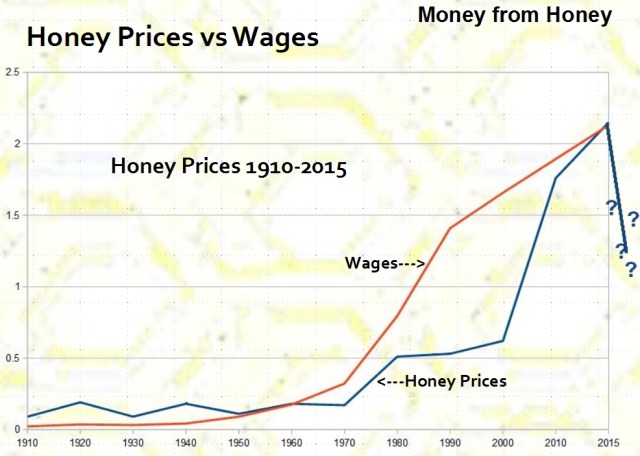


As part of a course I help teach – Making Money from Honey – I prepared a graph of wholesale honey prices compared to average labour. Here’s how to make sense of my chart. On the left (the y-axis), you see the wholesale price of honey in dollars. Along the bottom are years, from 1910 to today. The purple line is the wholesale price of honey in US money. It has mostly risen over the past century. The red line is wages, also in dollars, for the average semi-skilled labourer for each 6 minutes of his or her time. So, today, that person (a bee inspector, or computer operator, for example) is paid about $22/hour or $2.20 for each 6 minutes of her time. At the beginning of the last century, using federal statistics for average wages, people made just a few cents every six minutes –  for example, my grandfather earned $5 for a 10-hour workday in 1915 building railroad cars. My grandfather made 5 cents every six minutes. Honey at the time wholesaled at 9 to 12 cents a pound. Beekeepers in 1915 did well.

Wage-Price Graph

From the chart, you can see that during the first half of the 20th century (1910 to 1950) a pound of honey was worth more that 6 minutes of a worker’s time. That era is sometimes called the Golden Age of Beekeeping, a reference to something other than the colour of honey.

After 1950, beekeepers struggled. Beekeepers tried to survive with more efficient production. But thousands of beekeepers simply quit and took better-paying employment. America’s beehive count fell from 10 million hives in 1915 to 3 million by the 1970s. This wasn’t caused by neonicotinoids, mites, or colony collapse disorder – those hadn’t entered the scene yet – it was simply a response to bee economics. In the past few years, the price of honey spiked. For the first time in generations, beekeepers were financially comfortable with their career choice.

If you pick beekeeping for a livelihood, you should be aware that the past few years have been unusually good. Now it’s getting less good. But you might be encouraged to know that self-disciplined, hard-working beekeepers who are good money managers have been able to stay with bees through the worst of times – if they are also lucky. In that way, beekeeping is like almost any other business.

Posted in Beekeeping, History, Honey | Tagged , | 6 Comments

Cotton Picking Time on the Prairie

Our western poplars, also known as cotton wood trees.

Our neighbourhood poplar trees, also known as cottonwoods.

I’m posting this a bit late. It’s about something that happened two weeks ago. My 9-year-old daughter and I were in a neighbourhood park and we noticed lots of fluffy white stuff floating through the air. Lots and lots. It looked like snow, actually.

I told her that it was probably from the dandelions which were finishing their spring bloom. But neither she nor I were particularly convinced. Then she pointed toward a row of trees on the far side of the park. “Look, it’s coming from over there.” She was right. We were getting snowed-in by cottonwood trees.

In all my years, I had never ventured to examine these poplars up close while they were shedding their seeds. The trees are rather large so their seeds and fluff are usually out of reach. Besides, I’ve always been too busy making a living to think much about the tree, except to recognize the nuisance it causes when sap drips from the buds in May and fluff fills the yard in June. But my kid doesn’t know the priorities of life yet, so she ran across the big park and came back to me with a branch of the cotton in full production. You can see it here.

cotton wood cotton

Looking at the expired catkins and their opening buds of fluff, it occurred to me that one of the tales I’d heard from old-timers might be true. They claimed that when they were children, they were sent up into massive cottonwood trees with rakes to collect cotton. The women folk would spin the cotton and make socks and snugly caps for newborns. I didn’t believe the stories and said so. I was told, quite rightly, that kids these days don’t know what hard work really is. That part is true enough. We have it easy these days, but that’s not all bad. I knew people who were killed by their work and children who never became adults because of farm accidents. I’d rather not have to send a child up a tree with a rake to collect cotton from a poplar tree – unless we really, really needed socks.

Things were different in the old days. On the Pennsylvania farm where I spent my childhood – middle kid in a family of ten – we worked hard and did without. I’d worked so hard as a kid that I once drove a bee truck into the ditch, having fallen asleep from too many hours working. Or maybe it was because I had siphoned leaded gasoline from a barrel to fill the truck earlier that day and I’d inhaled a lung full of gas in the process. Try to tell young people today what it was like when you were a kid – they won’t believe you.  Though I’ll admit that it wasn’t as bad for me as it was for the four Yorkshiremen in this video, over in north England at about the same time:

Posted in Culture, or lack thereof, Humour | Tagged , | Leave a comment

The Wonders of Beekeeping

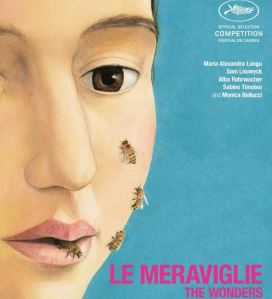
I’m wondering if anyone reading this blog has seen a movie called The Wonders. It’s a beekeeping movie. Sort of. From what I’ve read about the film (and seen in the trailers) it appears to be an Italian Ulee’s Gold with English subtitles.  Do you remember Ulee’s Gold? It was the story of a ulee_vidFlorida beekeeper with a messed up family. Artistically, it was brilliant. Apiculturally, it was also brilliant – and that doesn’t happen often in the theatre when bees are involved. Ulee’s was a major movie with the star (Peter Fonda) receiving the Oscar’s best actor nomination in 1997. It’s still one of my favourite films. Here’s a link to Ulee’s trailer – if you like it, you’ll find the movie in some libraries, maybe even on YouTube, here. If you like slow-paced drama with lots of bees, Ulee’s Gold is your movie.
I don’t know if The Wonders is as good as Ulee’s Gold. From the little that I’ve seen, it’s more artsy. On the other hand, the Daily Herald calls it a post-realism film that borders on documentary: “this hyper-realistic drama could pass for a documentary on the lives of a family of Italian beekeepers in rural Tuscany.” Then the reviewer tells us that the movie records the “unhurried, unexciting daily routines” of beekeeping which suggests that this might not be a bee movie after all.  However, it does have bees, so that could make up for almost any flaws.

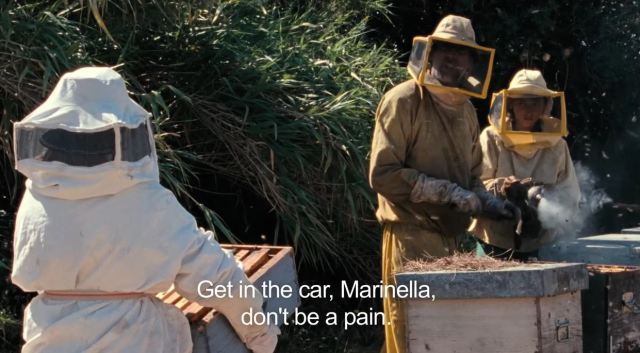
Get in the Car

The movie is about an impoverished family of beekeepers (why are beekeeping families poor in the movies, but so rich off stage?). They are husband/beekeeper, wife/sometimes-mom, and five daughters. Gelsomina, the 13-year-old, is beginning to feel independent and manipulates the family into being featured on an Italian reality TV show that comes to the region in search of a ‘typical family with traditional values’. Meanwhile, the father’s business is almost ruined by new government rules on honey house cleanliness, so he takes in a 14-year-old juvenile delinquent to help with the work and because the government will pay papa to foster the wayward boy. If all this sounds complicated, it is. But the movie unfolds slowly over two hours, so you have plenty of time to check your notes if you get confused.

The Wonders beekeeper, why not

The WondersThe Wonders (Le meraviglie)  has won 14 significant prizes, including Munich Film Festival’s Best Film by an Emerging Director, the Abu Dhabi Film Festival’s Black Pearl Award, and Cannes’ Grand Prize of the Jury. At Cannes’ the film ended with 12 minutes of audience applause! The movie is apparently very good. It opened in November, 2105, at select theatres, but like so many great films, it appears to have missed a screening in my hometown, Calgary. This again reminds me of Ulee’s Gold which was shown in an artsy show hall downtown here instead of the massive box-theatres where one could find much livelier and stupider entertainment. Which brings me back to my original question: Have any of the readers of this blog seen this movie? Or have any ideas of where to watch it?


Update: August 3, 2016

Well, I watched the movie. For a beekeeper, there were at least a dozen distracting fundamental errors (including the extractor which looms large in the plot and runs non-stop for hours and hours dribbling into pails – maybe it symbolizes the existential angst of unachievable satisfaction.)  More importantly, the movie was too dark and depressing for me. I know, I know. It was supposed to be moody and bleak. But really? I was surprised when it ended. Is that it? Is that all we get? Really? Is the entire movie simply a metaphor for the existential angst of unachievable satisfaction? Or what?

Posted in Culture, or lack thereof, Movies, Outreach | Tagged , , , | 11 Comments

Calgary’s ALS Fundraiser

Ron and family-r

This is a beekeeping blog, I know. But I sometimes write non-bee stuff. Once a year I go entirely off-topic and write a bit about our annual Calgary ALS fundraiser, Betty’s Run. Thank you for indulging my digressions.

I have motor neuron disease, sometimes called ALS (amyotrophic lateral sclerosis) or Lou Gehrig’s Disease. Lucky for me, my motor neuron disorder is atypical ALS, which means it’s not the typical fast-paced disease. Instead, mine has a much slower progression. Normally, ALS paralyzes within two or three years. All motion – walking, talking, breathing, everything – stops. Unless the afflicted chooses a respirator, feeding tube, and constant nursing care, the patient dies. However, the brain is unaffected.

hawking

Using assists like ventilators and aides is how people such as Stephen Hawking survive. His ALS started early (he was 22) and progressed more slowly, but he has equipment and full-time nursing help. Mine started at age 44 so I’ve been living with my variant of motor neuron disorder for almost 20 years. Mine is progressive – I can’t walk much any more and my arms and hands are weak, but that’s not too bad after 18 years. It will continue to get worse, but if the progression remains slow, I’ll be blogging for many years to come.

No one knows why my form of motor neuron disease is so unusually slow. A friend asked me if all those thousands of bee stings I’d had over the years made the difference, but other beekeepers I’ve known (commercial beeman Ernie Fuhr from the Peace River country, up near the Yukon; and, Bill Turner from our own Calgary Bee Club) were both killed by this disease. Recently, a group looking at alternative treatments for ALS reviewed bee venom and found that it was unlikely to be helpful. You can read about this investigative group here and the bee venom report is at this link.

Betty’s Run was on Sunday, June 12 this year. Not long after Betty died of ALS years ago, some of her friends met, and decided to honour her memory and raise awareness and funds to fight the disease. This year about 1,500 people participated as walkers and runners. They raised $400,000 for ALS research and to help the organization that provides support (vans, motorized wheelchairs, in home care equipment) and outreach programs. During the 20 years of Betty’s Runs, nearly seven million dollars were raised here in Calgary. The walk/run/roll has become a social event with friends meeting and chatting. I was happy to have my wife (who is an organizing volunteer for the local ALS society) and my four kids and three grandchildren on today’s walk. For the smallest kids, the bouncy castle was the main draw. For us older kids, walking 5 kilometres (or being pushed in a chair, as I was) gives an opportunity to think about people and the illness. Most participants wore tags that said things like “I’m Here for My Wife” or “I’m Here for Jim”. My tag said “I’m Here for Everyone” as a reminder that everyone is affected, directly or indirectly by this illness.

Betty's Run, in Calgary, is the largest ALS fundraiser in the country. This is part of my family, surrounded by participants.

Calgary’s Betty’s Run is the largest ALS fundraiser in the country.
This is part of my family, surrounded by a much larger family.

Pure Sweet Sign-rAs I said earlier, today’s beekeeping blog doesn’t have much about bees. But I want to thank my friends Willi and Stan who run a honey packing business in Madison for their huge financial support for this year’s fundraiser. These guys have been my friends since my early beekeeping days,  40 years ago. As they have done for the past decade, they contributed to Betty’s Run once again. Their Wisconsin packing company – Pure Sweet Honey Farm Inc – was one this year’s two Silver Sponsors,  which means they are big supporters of this event.

Pure Sweet Sign on shirt

If you are reading this and thinking that you should help, too, you can find a local organization that does what our Alberta ALS Society does. You probably know someone who has died from motor neuron disease. The disease remains incurable, untreatable, and poorly understood. It can affect anyone, any of your friends or family, so please donate to your local ALS charity.

I’ll close with two more pictures from today’s event.

This was the 20th ALS fundraiser. Pictured is the organizing team with Calgary's mayor Naheed Nenshi and actress Wendy Crewon.

This was the 20th ALS fundraiser.
Pictured is the organizing team with Calgary’s mayor Naheed Nenshi.

Selfie. With two of my kids and a grandson on my lap. It was quite a day.

Selfie. With two of my kids and a grandson on my lap. It was quite a day.

Posted in Friends, Outreach | Tagged , , , | 1 Comment

Bees on Leashes

Back in November, the City of Halifax in Nova Scotia, Canada, accidentally made it illegal to keep bees. Or wasps, hornets, yellow jackets and fire ants. (What? No more pet fire ants?)  Now they are trying to amend the prohibition on honey bees, as you can see in this bee-law by-law amendment. Below are the current insect prohibitions, which include bees. Amendment A-700 will exempt bees and treat them like any other pet.

Amendment to allow beekeeping in NS

Apiaries – if properly registered and maintained – are legal in Nova Scotia. Because it’s legal and because of popular demand,  the city of Halifax is removing ‘bees’ from its prohibited creatures list. It looks like the amendment will come in effect next week. If it stands as written, honey bee possession will be similar to cat and dog ownership and will no longer be a crime – as long as the bees either stay on the owner’s property. If they do leave (to visit flowers, for example) they must be properly leashed, like other pets. For those of you who doubt bees can be tethered on a leash, the kids in the video below show you how to do it.

h/t and thanks and story credit to:  The Coast – Halifax’s Website.

Posted in Outreach, Strange, Odd Stuff | Tagged , , | Leave a comment

Investigating the Crime Scene

A few days ago, I read an interesting American Bee Journal article by Tammy Horn (et al.) and it made me think differently about something. Although I know that poisoned bees represent a real crime, I never really thought of poisoned bee yards as literal ‘crime scenes’.

KY inspector and author Tammy Horn

KY inspector and author Tammy Horn

In her informative and engaging article, Kentucky’s chief apiarist, Tammy Horn, explains that we need to adopt the mindset that dead bees need inspected responsibly – like police would do at a crime scene. Don’t scoop dead bees into a baggie and ship them off.  If a farmer or agri-business has misused pesticides, they have committed a crime. Crimes need undisturbed evidence for successful prosecution. Ms Horn writes, “When dealing with a possible pesticide kill, time is not on your side. You need to get a sample taken as soon as possible. If you want to take legal action…the sample must be collected by a regulatory official.”

I hadn’t really considered that a crime is a crime and a crime scene can be a bee yard. If you start cleaning things up improperly, you may impair future litigation and possible recovery of losses. Before securing your equipment and helping any surviving hives, the best immediate action is to call your regional chief inspector and ask for advice.

One possible sign of pesticide damage in your bees.

One possible sign of pesticide damage in your bees.

Horn’s article helps us to recognize chemical bee kills, collect samples (when appropriate), report losses, and take pro-active steps to protect honey bees and native pollinators. I won’t repeat it all here, you should read her article in the bee journal. If you don’t already receive ABJ, consider ordering it or perhaps get your bee club or library to subscribe. Though I’m not going to detail Tammy Horn’s information, I am going to list some of the links she gave in her article:

Posted in Pesticides, Save the Bees | Tagged , , , , | 2 Comments

Sound and Honey (as seen in BeesCene)

SciFair-2The editor of BC’s BeeScene bee magazine picked up an earlier blog post of mine. Last month I wrote about my 13-year-old’s science fair project where Daniel used ultrasound to liquefy comb honey. The results were promising, but not overwhelming. Heather Sosnowski, an editor of BeesCene, wrote to my son and asked him for more details and whether the scheme might be applied outside the lab. She printed their Q&As in her magazine. I’ve posted Heather’s piece below.

FROM THE BEESCENE NEWSLETTER:

Saving Honey with Sound
At the recent Calgary Youth Science Fair, 13-year-old Daniel
Miksha unveiled a project he had done using ultrasound to
liquefy granulated honey. Daniel is the son of beekeeper Ron
Miksha, who has contributed to this newsletter and also writes
a blog: badbeekeepingblog.com.

SciFair-3
We got in touch with Daniel to ask a few questions about how
he got started on this project …

Heather: How did you come up with the idea for this project? What made you think of using ultrasound to liquefy honey?

Daniel: My older sister and her husband own a honey farm that produces comb honey. Honey made from flowers in their area is high in glucose, and therefore it granulates easily. When we went on a recent trip to visit their farm out in the countryside, Dad pointed out to me all the granulated combs that were no longer marketable. Once I got home I did a bit of research into ways that honey can be liquefied without being heated which would ruin the wax structure. I found a particularly interesting study that was conducted in Germany in which granulated honey could be “melted” using high frequency ultrasound. I wanted to see whether I could apply this same principle to our local comb honey, and perhaps re-liquefy some of it on my sister’s farm.

Heather: Can you briefly describe the equipment that you used to conduct your experiment?

Daniel: The study I had found was using extremely high frequency ultrasound that required expensive laboratory grade equipment. Unfortunately I didn’t have access to speakers that were that powerful. I ended up having to lower the pitch and power of the ultrasound I was using for my experiment, but that meant I was able. to use standard household speakers that could simply plug into my laptop. I used a computer program to generate high-frequency ultrasound (18,000 Hz) with these speakers.

Heather: Do you plan to try doing your experiment on a bigger scale?

Daniel: As of right now, no. In my experiments I only tested a total of 12 combs, with consistent but slightly underwhelming results. If I were to go further I would need laboratory-grade, powerful ultrasound speakers, and I would conduct more research to determine the exact frequencies of sound that would fully reliquefy comb honey. If someone else were able to get access to these speakers and be doing this experiment on a larger scale, I would be very interested to see their results!
VOLUME 32, #2 SUMMER 2016 11.

Posted in Comb Honey, Honey, Outreach, Science, Tools and Gadgets | Tagged , , , , | Leave a comment