Bad Beekeeping Competition

I came across a blog posting titled “Bad beekeeping” over at ScienceBlogs.com. I was concerned that someone had picked up on my nomen – not that I have universal rights on the bad beekeeping phrase. But I wrote the book called Bad Beekeeping way back in 2004 and I was pretty sore when a few years later, a game-show host dancer in London named Bill Turnbull put out a series of Bad Beekeeper Club books. Turnbull’s books will do you no good, so don’t bother to spend your honey money on any of them.

With Turnbull out there, you can understand my anxiety when I found a blog titled Bad beekeeping. But that’s not the name of the blog, it’s just one entry’s title among many interesting articles written by William Connolley. His blog is called Stoat: Taking Science by the Throat. Turns out that Mr Connolley is a legitimate bad beekeeper, possibly much badder than I have been.

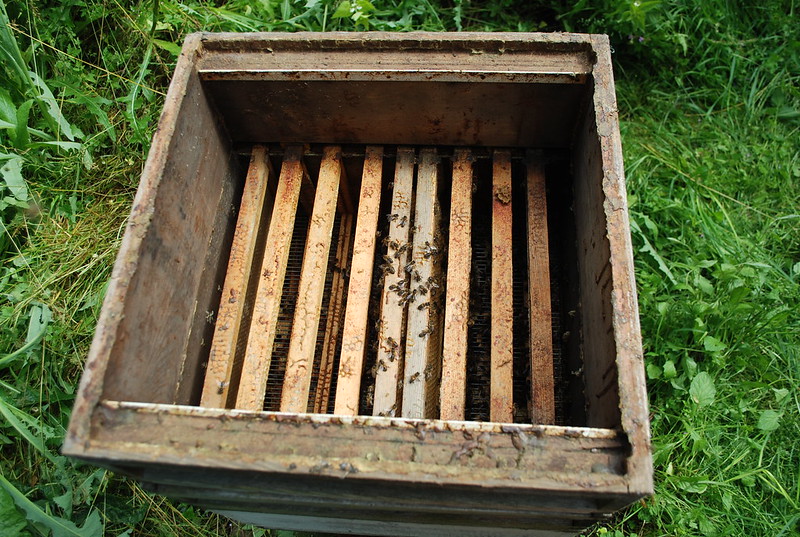
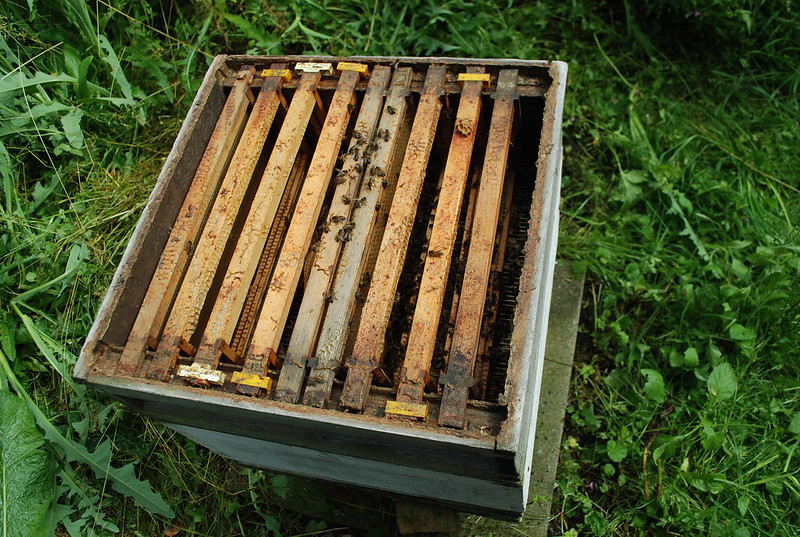
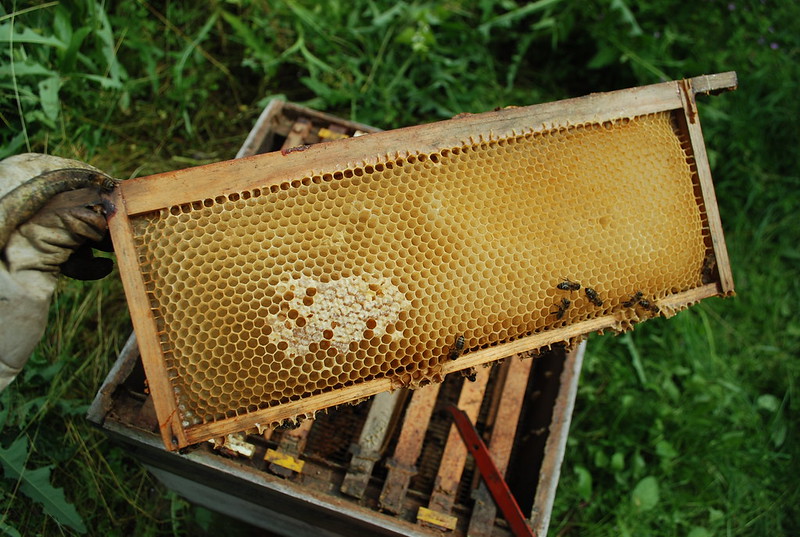
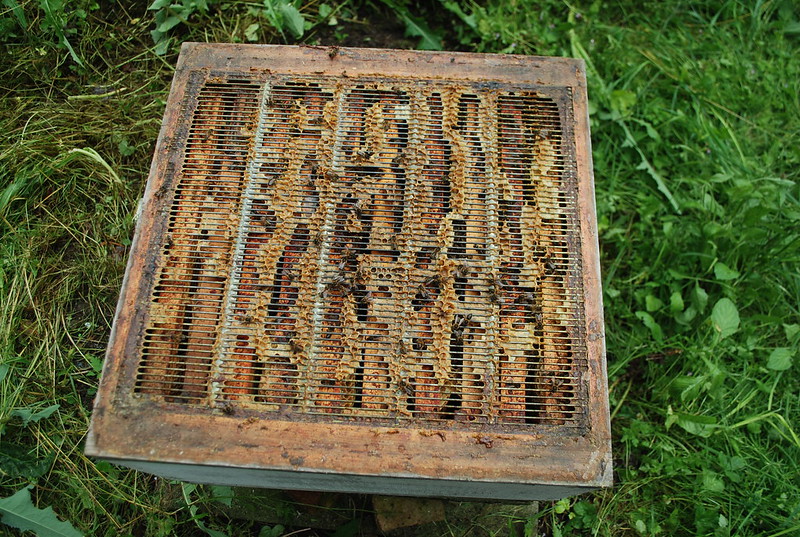
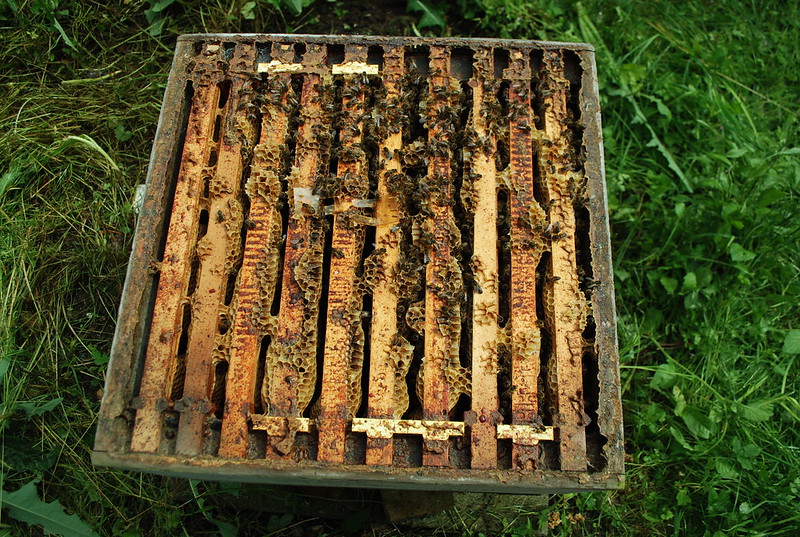
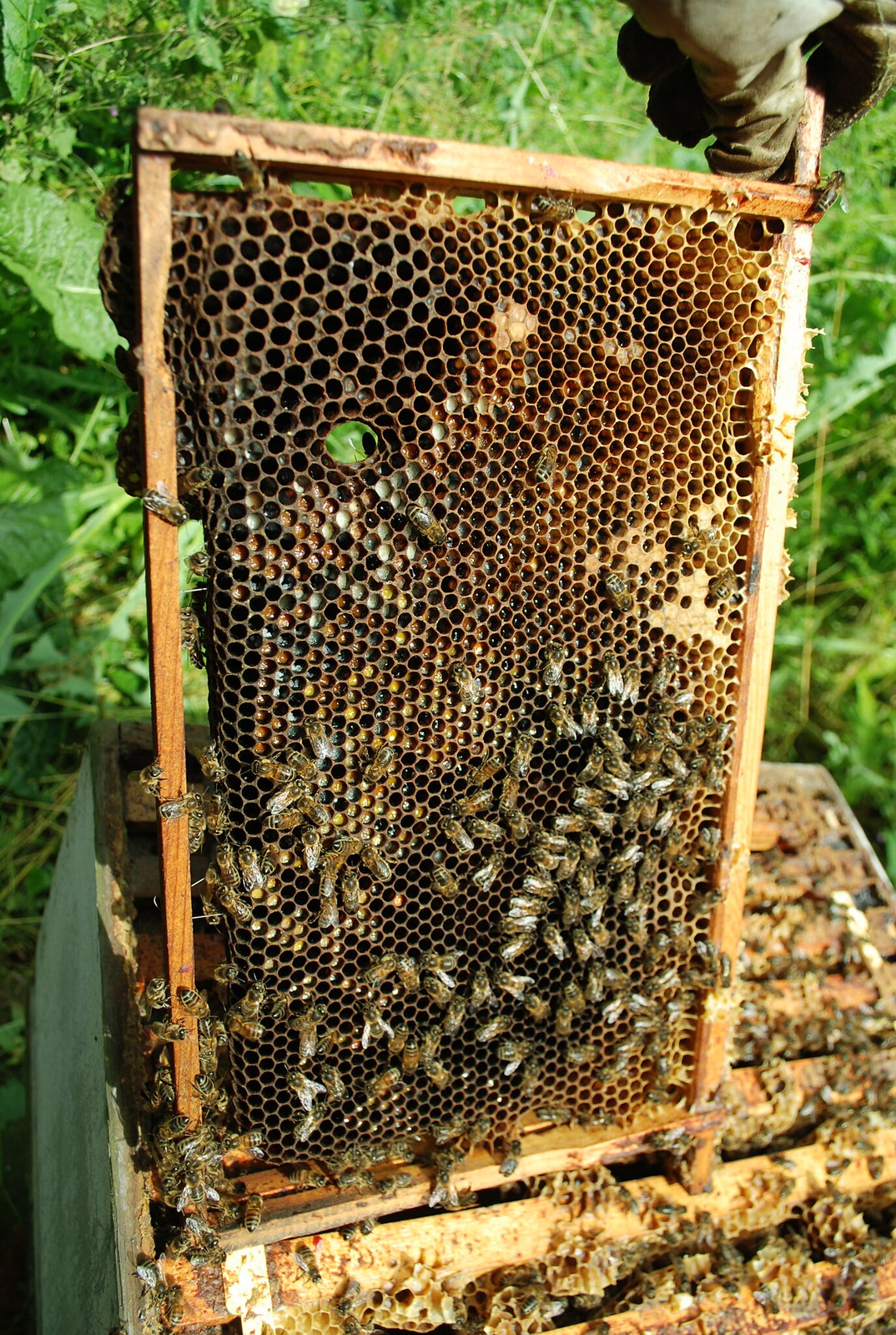
Here’s one important thought about the stuff that follows. As you look at the pictures, you realize that these bees have been neglected for a year or two. Yet they are alive – without receiving  foulbrood mix or varroa treatments for at least a year. (The fellow admits he left varroa strips in one hive for a long, long time.)  However, they aren’t thriving, so they are likely succumbing to mites. And two of the middle pictures show signs of nosema.  What do you think?  Bad beekeeper or not?

I asked the science blogger if I could repost his blog. He said, and I quote: “Sure. You’re welcome to use me as a terrible example to keep people in line 🙂 -W”


Here’s the blog from Stoat’s Bad beekeeping. Enjoy. And learn.

Bad beekeeping:  A photographic essay.

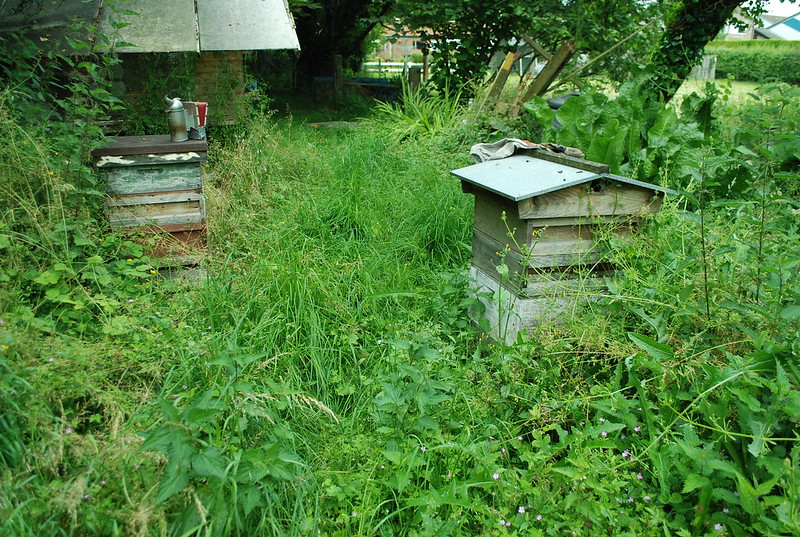
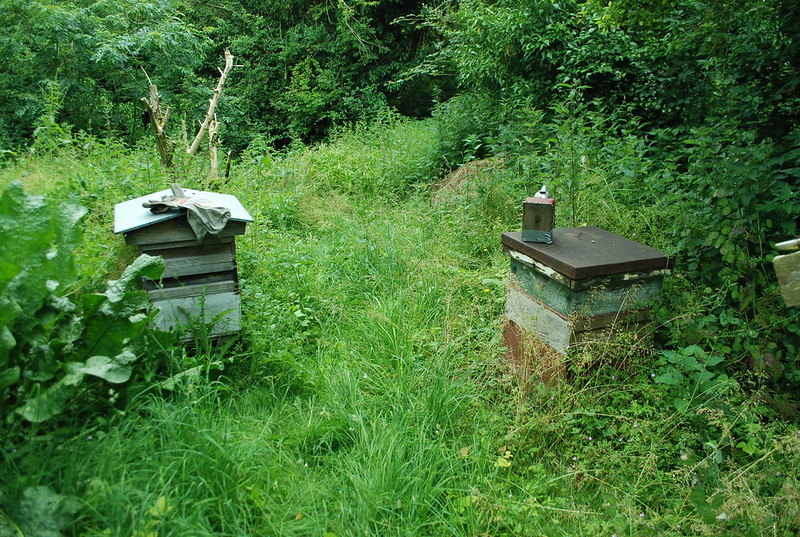
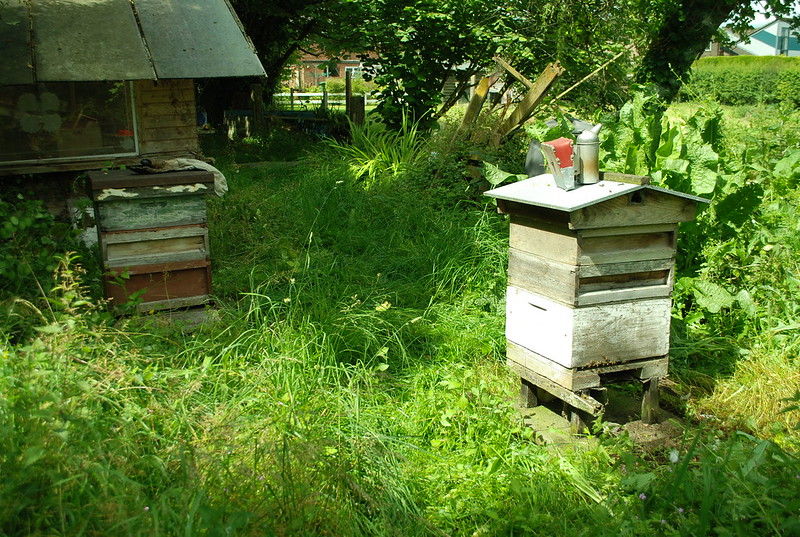
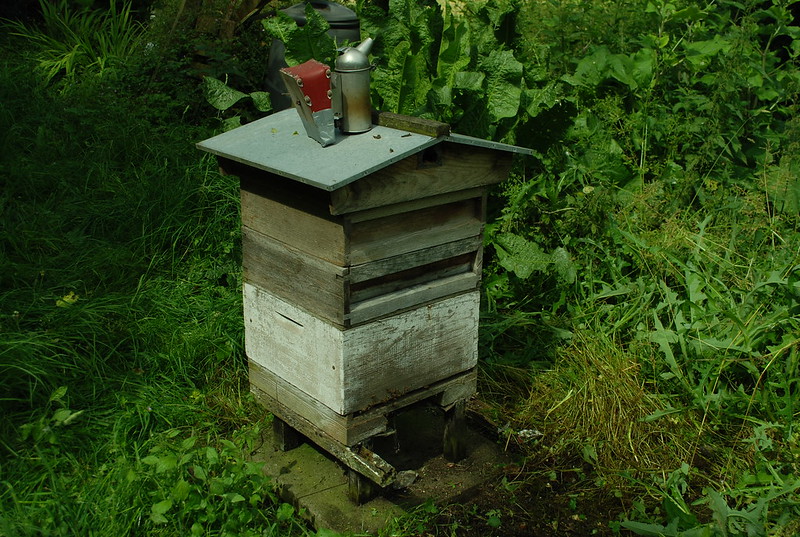
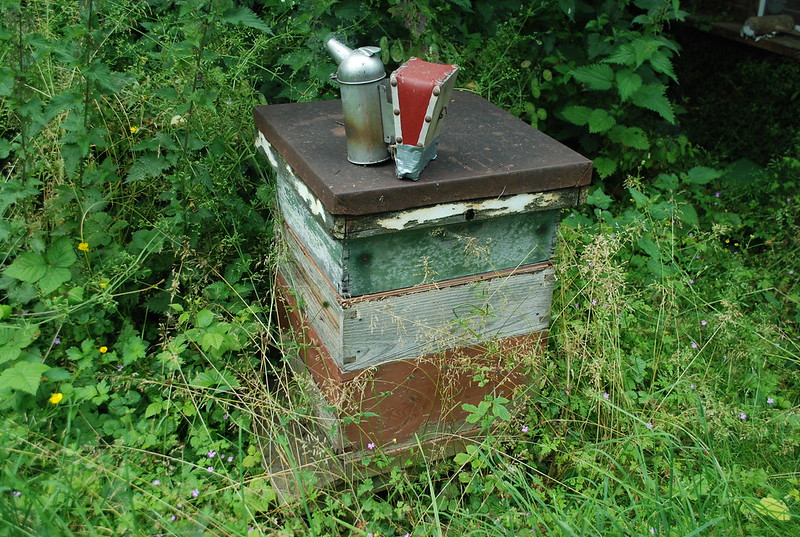
Hive #2, “flattop”, with a smoker on top and surrounded by a carpet of weeds. The bees don’t really mind that, I think. The observant will notice the roof is in rather poor condition – but its been like that for years and not getting much worse – and the queen excluder is above the first super, which is careless of me.

DSC_5634

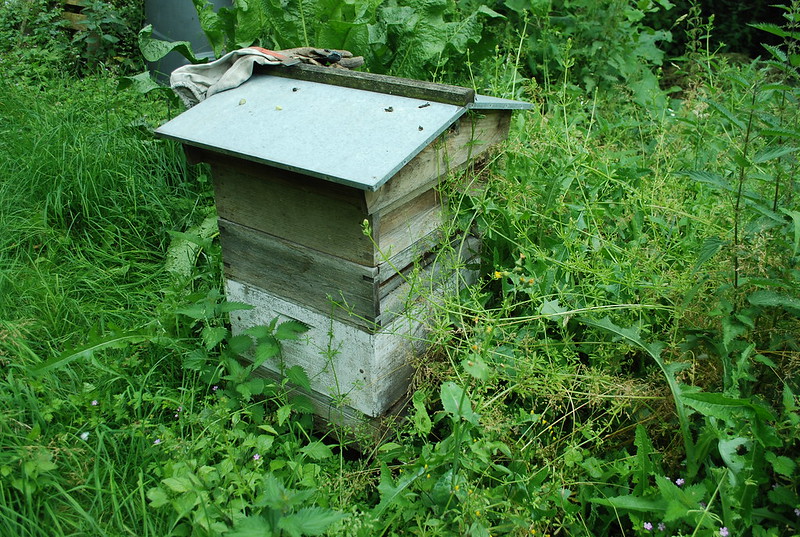
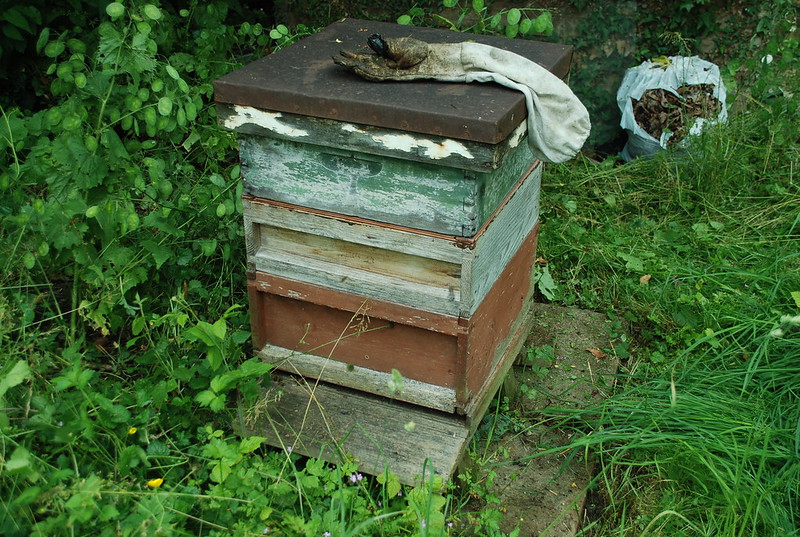
Hive #1 is even more covered in weeds, perhaps a little more than is desirable. The odd blob on top is my gloves.

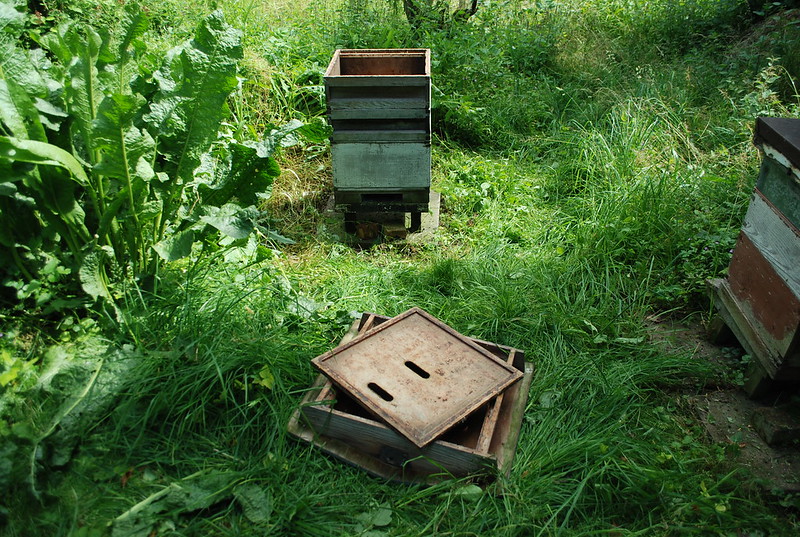
General view, with my shed in the background.

Looking the other way to the (not visible) stream at the bottom. The triffid on the left is a horseradish, I’m assured.

After some vigorous weed-pulling. The wet June has been bad for weeds, in the sense that they’ve grown well and that’s bad.

Hive #1. The decayed bit at the front is the “alighting board” but bees don’t need it.

And for completeness the de-weeded #2 also.

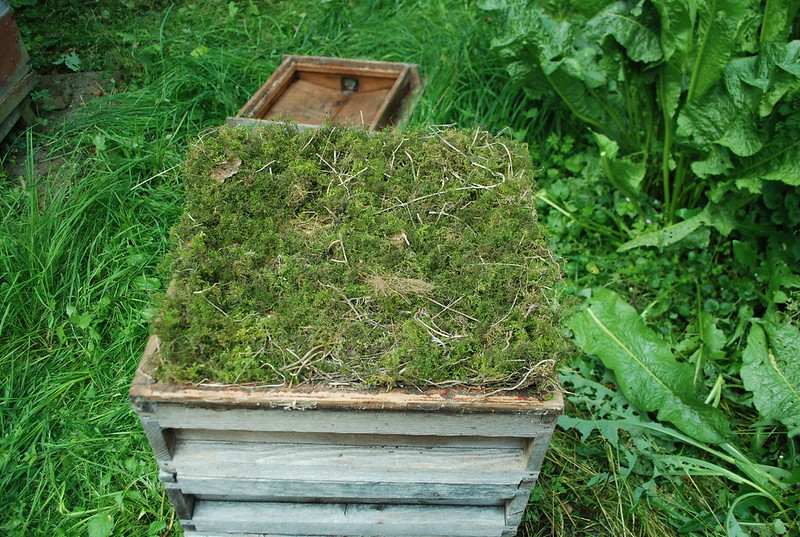
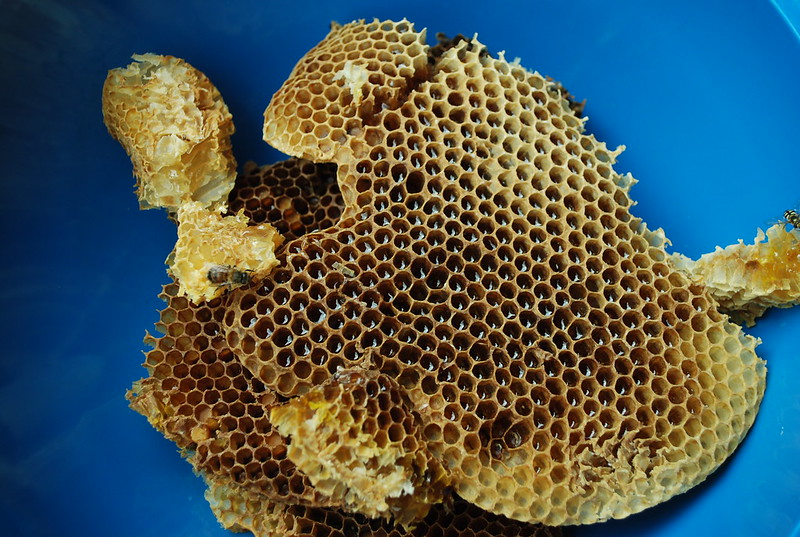
Oh dear. Who left a garden inside the top of my hive?

Remove roof and cap board, and all is fairly quiet.

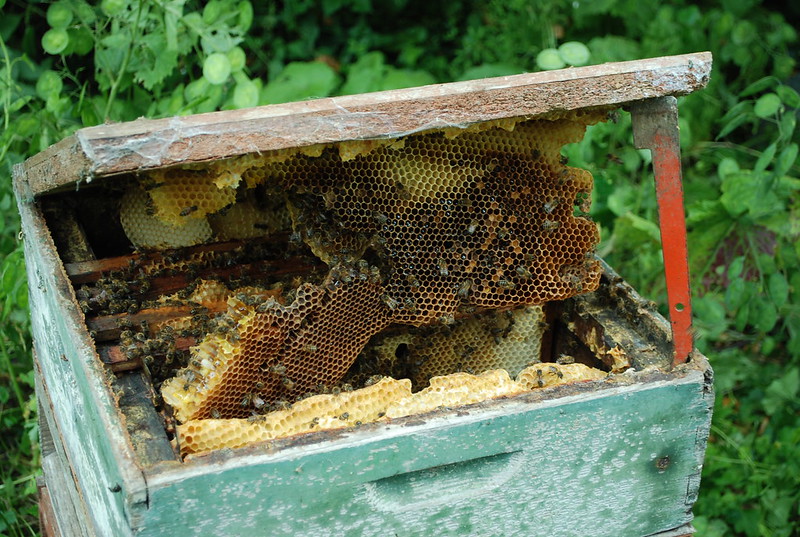
Yes, pretty quiet. In a good year, they’d have filled the empty space (that really should have frames in it) with comb.

One layer down. I remember now, I didn’t get round to putting wax into all the frames, but hoped the bees would. But, its all looking pretty thin in there. Not hopeful.

Pffft. Is that all? Just one small capped area? Oh dear.

One lower, the top of the brood box, and careful inspection shows I left the Apistan in. I really should not have done that.

The brood box. A reasonable but not overwhelming number of bees, and inspection of a couple of frames didn’t show much or any brood. Well, we’ll see.

A brood frame. Black as the ace of spades: it really ought to be replaced. Next year.

DSC_5650

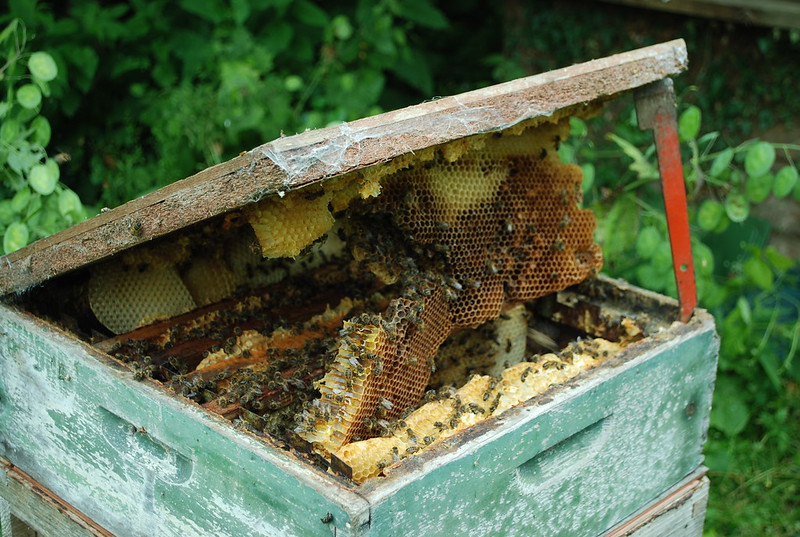
So much for hive #1. What of #2? Oh dear, I didn’t put enough frames in did I?

Slightly less obviously, there’s not a lot of honey in all that comb, either. It really hasn’t been a good year.

So I took a bit out, and left the rest. Let’s hope the remainder of the summer is sunnier.

Posted in Beekeeping, Hives and Combs, Humour, Save the Bees | Tagged , | 4 Comments

Don’t Step on a Bee Day

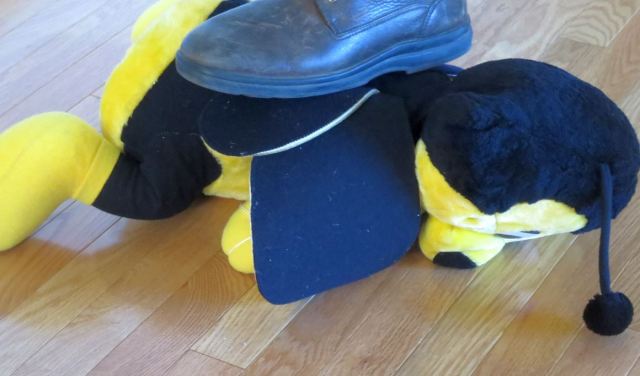
squashed Benny

Today is Don’t Step on a Bee Day.  See if you can keep it up all week!

Posted in Culture, or lack thereof, Humour, Save the Bees | Tagged , | 1 Comment

Malathion and Pesky Bugs

There’s a pesticide causing grief among some hobby beekeepers. No, not the neonicotinoids again (though they’re not without blame). This is an “older” poison. If you are a new beekeeper, you might not have heard of malathion.

canada mosquito flagMalathion is deadly stuff.  Not so much to humans. For us, it’s relatively safe, though farm kids are cautioned not to eat it. Because malathion can be handled fairly carelessly, it was used a lot on farms in past decades. Insects are not so lucky. Malathion wiped out billions of honey bees over the years. Of course, it sometimes saved farm crops from hungry bugs and beetles and it did a number on malaria – for a while. But we still have nasty bugs and malaria, so the effects of malathion are ephemeral. Except where it has killed bees and put beekeepers out of business. Then the effects are permanent.

Until February, beekeeping wasn’t legal in Manitoba’s capital city. Then city council allowed kept bees (wild ones were already there and those bees generally ignored the council rules). Hives began sprouting on rooftops and in backyards. Unfortunately, in an effort to control Winnipeg’s famous mosquito population, malathion spraying was set to begin.  Some beekeepers are concerned that their city’s use of malathion to fog out mosquitoes will kill the newly established beehives.

Downtown Winnipeg - lots of rooftop beeyards available.

Downtown Winnipeg – lots of rooftop bee yards available.

We all know that mosquitoes are lovely blood-sucking parasites that spread Zika and West Nile viruses when they don’t have their mouths full of malaria. I’m not a fan of malaria or mosquitoes. But one of the few truisms I’ve appreciated in my days of keeping bees out here on the semi-arid western prairie is that when mosquitoes are especially bad, honey bees do especially well. We’ve had seasons without mosquitoes pestering us – those were poor years for honey crops. The common link, of course, is water. Mosquitoes magically appear when water puddles abound. In our dry climate here in western Canada, water puddles are also good for honey crops. This year started out really dry in Winnipeg, but now the water puddles are growing.

So, where does that leave Winnipeg beekeepers? The city is putting all registered urban hives on a no spray list. That will help the human-owned hives, but all those naturally occurring wild bees should think about quickly registering their homes, too.

Posted in Ecology, Pesticides, Save the Bees | Tagged , , , | Leave a comment

Honey Food Stuff

I was sorting a few pictures and ran across some honey/bee foodie things I thought I’d share. When people find out that you work with bees, you inevitably end up receiving bee gifts. Wasp-shaped butter trays, pollen-encrusted soap bars, stingers mounted in glass. But you also run across the edibles whose existence is intended to be ephemeral and enjoyable. Following are some bee-related foods I’ve run across over the past couple of years.

My wife and two of my kids arrived in Europe this weekend, reminding me that central Europe is really one big bee fest – bees, beekeeping, and honey are everywhere. So my first picture shouldn’t surprise you. It’s a page I photographed from a menu at an outdoor restaurant we visited in Hungary last summer, when I was there with the family. I love ice cream, but defeated the temptation to devour a piece of this bit of delicious art called Maja, the Ice Cream Bee. I know, Maja looks grumpy, but she’s got her reasons – she’s about to be eaten and she’s melting.

hungarian ice cream restaurant

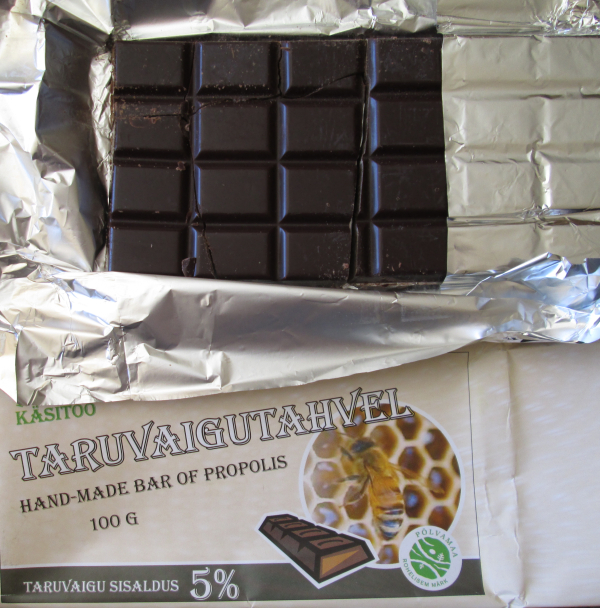
Honey candies are popular. (As if honey’s just not sweet enough.) Some of my traveling friends regularly return with tasty honey/pollen/wax/propolis treats, most originating in Europe. Here’s a “Hand-Made Bar of Propolis” which was brought to me from Estonia. (It was 10% propolis, smothered in black chocolate.)  It had a magnificent propoline flavour. You felt healthier with every bite.  I liked it.

propoliscandybar

Medovoye Cookie

Sometimes you don’t have to travel around the globe to find the exotic – to your left is a Medovoye Cookie. We bought a bag of these treats from our neighbourhood “Russian” store, which is in Calgary, not Moscow.  You don’t need to know the Cyrillic alphabet to recognize the international symbol for honey – the swirl spoon.

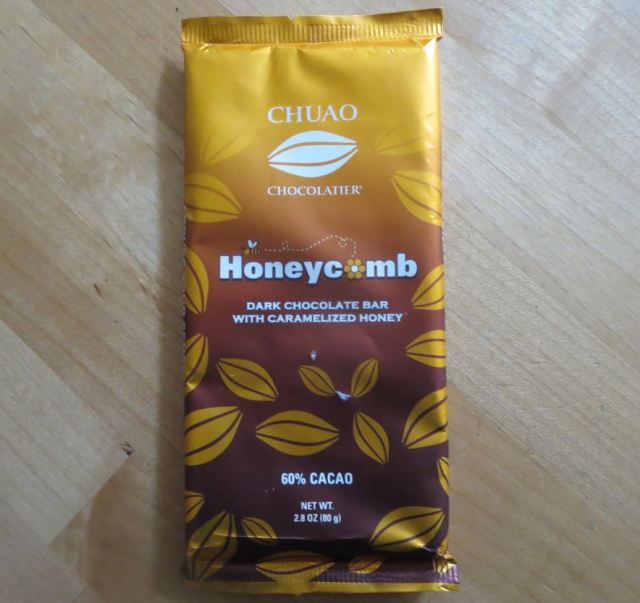
Staying with the unique and faintly unhealthy, here’s a chocolate bar from the Chuao Chocolatier in San Diego (USA). The actual honeycomb was missing when I peeled back the wrap.

Chuao Bar

For a really natural treat, there’s raw, pure comb honey.  This next picture features my younger son, about ten years ago. He was the posterboy for comb honey in those days. Now he’s a 6-foot-tall 14-year-old, but to his embarrassment, he is still our lingering comb honey poster-child:

Daniel honey comb

Next, our favourite family stuffie, named for my nephew Ben whose skillful pitching arm won Benny the Bee at the King’s Island arcade in Cincinnati in 1993. Benny the Bee has helped us celebrate a birthday or two.  Here’s Benny the Bee, in his younger days. The cake is edible; this bee is not:

benny and cake

A while back, I wrote about John the Baptist’s delightful breakfast food, rumoured to be all locusts and honey. You can catch the full story at this link, but the cereal is boxed up below.

johnbaptistcereal

Here’s yet another honey-inspired breakfast cereal.  To me, it’s interesting that honey bees can be so horrifying to some (they’ve even appeared in some awful frightening B-movies), yet almost everyone agrees that bees can be totally adorable. That’s why a major cereal company enlisted bees to help sell oats tinged with a smidgen of honey. Honey Nut Cheerios has certainly been good for honey, oats, bees, and General Mills:

Benny with Cheerios

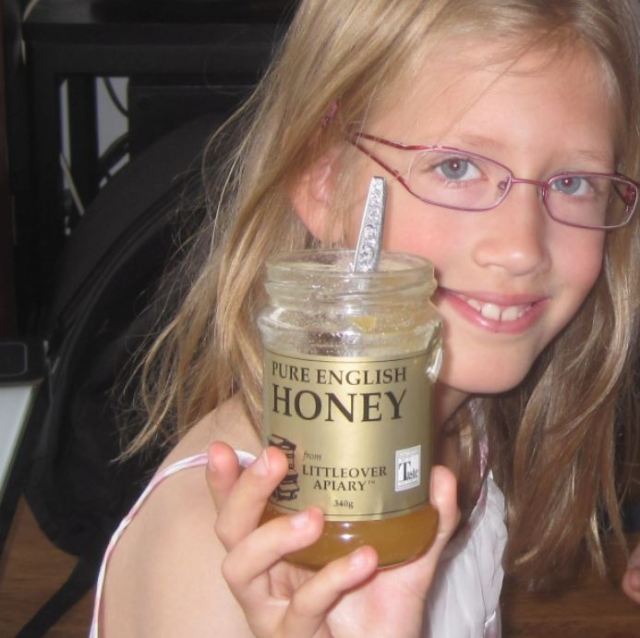
Finally, I’ll make my b-exit with a shot of my youngest daughter, in London, last summer. Just some real, old-fashioned Pure English Honey:

Pure English Honey

Posted in Culture, or lack thereof, Hive Products, Honey | Tagged , , , , | Leave a comment

Canada Day in the Land of Honey

can_flag_75Happy Birthday Canada!  149 years ago, the Fathers of Confederation signed the paperwork that began the Canadian experience. I always figured it was kind of those politicians to give us a summer holiday that suits a beekeeper’s calendar. Across most of Canada, honey boxes are stacked high on the hives, the honey flows have begun, but extracting is a week or two away. So beekeepers begin July with a slightly more relaxed workday on Canada Day, though it may be their last breather before things get really hectic.

Canadian beekeepers do well – the country’s 8,500 beekeepers bottle 100 million pounds of the good stuff. That averages 12,000 pounds per beekeeper and over 100 pounds per hive. (Of course, there are beekeeps making a million pounds a year and in places like Alberta, 200 pounds per hive is common.)  Our northern latitude gives us long summer days. Most of the country has a ‘continental climate’ which includes hot summers. Our formula for success also includes long, warm days and nectariferous field crops (especially clovers, alfalfa, and canola).

canadian flag and mountains

I’ve been lucky enough to keep bees in two provinces and three different areas – the desert-like grasslands of southern Saskatchewan, the parkland of northern Saskatchewan, and the mountain foothills of western Alberta. But Canada is more than my narrow experience. Bees are kept from Newfoundland to Vancouver Island, from the arctic’s Yukon to Pelee Island in the sunny south. To really celebrate Canada Day, I’ve got Stompin’ Tom queued up, so don’t go away.

Canada is a major honey producing country, but has fallen a bit at the global scale. A few decades ago, Canada was the fourth-largest honey-making country in the world. Today, we are at about 14th place with previously small producers like Ethiopia and Iran now tonnes ahead of us. But, as a consolation prize, we still make the world’s best honey!


Posted in Culture, or lack thereof, History, Honey | Tagged , , , | Leave a comment

African Beekeeping May “Save the Trees”

zimbabwe trees

Rather than “Save the Bees”, it’s “Save the Trees” in central Africa. A story from Zimbabwe reminds us that beekeeping can be very, very good for ecology. Bees (and beekeepers) are saving Zimbabwe’s forests.

The country of Zimbabwe, lest we forget, is the messed-up place where 92-year-old Robert Mugabe has claimed to be the freely elected ‘president’ for the past 30 years – a position he maintains with the help of an elite North Korean-trained security force.  But today we have a good-news story, which is a nice break for the poor people of Zimbabwe.

Much of the honey produced in rural Zimbabwe comes from its old-growth forests. In the past, people saw trees as firewood and little else. Tobacco became a big cash crop, resulting in clearing of forests to plant the loathsome herb. Even more trees were felled to make the fires needed to cure the tobacco. You can see where this is leading – desertification, ecological ruin, and cancer. But push-back has gently arisen from Zimbabwe’s beekeepers.

In a country where the average annual income isn’t much more than a new T-shirt and socks, beekeepers can make about $60 per hive each season. Some of Zimbabwe’s 50,000 beekeepers manage a hundred or more colonies. Honey production is fairly good, but wax is an important by-product because political ineptness results in intermittent lighting, which people supplement with beeswax candles.

Beekeepers rely on seasonal blossoms  on scrubby shrubs and trees for the nectar that makes the nectar that makes the beekeepers’ honey. In turn, beekeepers have fought tree poachers and wildfires to preserve their honey source. The forests are making a comeback and even rivers are healthier with improved basins and less erosion into the streams. To read more, please see this article.  To help, you may look here.

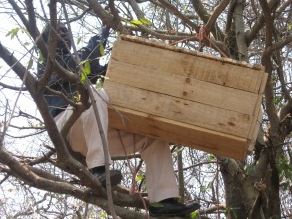
Bees and beekeeper in a tree.

Bee hive and beekeeper in a tree

Non-Africans may point out the environmental damage taking place when people in the sub-Sahara cut trees to clear farmland and pay bills, but unless they help with money-making alternatives like beekeeping, deforestation will continue.

A few outfits support co-ops and communities that help Zimbabwe beekeepers – Environment Africa is one example.  On your left is a picture from their website. It shows that trees not only feed bees, they also serve as bee yards, keeping hives off the ground and safe from predators.

Posted in Beekeeping, Ecology, Save the Bees | Tagged , , , | 3 Comments

The Bees’ Sixth Sense

bee's eye close-up

Bees sense the environment differently than humans. For example,  bees can see ultra-violet colour and distinguish it from violet and white, yet they see red as if it were black. They sense the orientation of polarized light. Their massive compound eyes give them an image made of hexagonal images, similar (but not quite) to the picture I made below, to the right. The honey bee’s eyes are good at sensing thin structures (like flowers on stems) and motion but, for a bee, a person pressed flat against a wall has disappeared from sight.

Bees see in mosaic hexagons, similar (but not quite the same) to what you is shown here.

Bees see mosaic hexagons, similar (but not quite the same) to what’s shown here.

Bees taste with the tips of their antennae, sampling sweet, bitter, sour, and salt. They can taste salts better than humans can, but are less sensitive to the bitter flavour of coffee. Their antennae also give them a sense of touch which monitors bee dances and cell wall thicknesses.

The honey bees’ sense of smell is 100 times more sensitive than ours – in London, experimenters have trained bees to smell/detect cancer. When not engaged in cancer research, that keen sense of scent can draw workers to perfumed sugars (as Karl von Frisch proved a hundred years ago) and can help queens find drones. Bees sense sound, too, but not through the ears they don’t have. Instead, honey bees pick up vibrations made by low frequency noises. They probably can’t hear your soft murmurs or sharp curses when you are near their hive.

In their own ways, bees use the same senses that humans use – sight, sound, smell, taste, touch. But bees have at least one extra sense. Some years ago, scientists found that bees also sense the magnetic field that surrounds them. When he was awarded the Nobel Prize in 1973 for his bee research, Karl von Frisch mentioned magnetism. In his Nobel Lecture, he said:

“The idea that the magnetic field might play a role in the puzzling orientation performance of animals was rejected for a long time. During the past years it has been confirmed by new observations, especially in birds and insects. Nothing so far points to the possibility that bees, in their purposeful flights cross-country, are making use of the earth’s magnetic field. Unexpectedly, however, it proved equally significant biologically but in a different way. When a swarm of bees builds its combs in a hive furnished to them by the beekeeper, their position in space is prescribed by the small suspended wooden frames. In the natural habitat of the bee, perhaps in the hollow of a tree, there are no wooden frames present. Nevertheless, thousands of bees labor together and in the course of one night achieve an orderly structure of parallel combs; the individual animal works here and there without getting instructions from a superintendent. They orient themselves by the earth’s magnetic field and uniformly have in mind the comb position which they knew from the parent colony.”

Von Frisch spoke these words in Stockholm in 1973, stating, “Nothing so far points to the possibility that bees, in their purposeful flights cross-country, are making use of the Earth’s magnetic field.” That statement (true at the time) has since been modified. Among other research, four scientists showed the importance of magnetism during bee foraging in a paper in December 2014 (Does the Earth’s Magnetic Field Serve as a Reference for Alignment of the Honeybee Waggle Dance? by Veronika Lambinet, Michael E. Hayden, Marco Bieri, and Gerhard Gries).

Earth's magnetic field: multitudes of local variations.

Earth’s magnetic field: multitudes of local variations.

Honey bees apparently make use of the ambient magnetic field that surrounds us and influences our direction-finding compasses. This magnetic field is generated within the Earth. It changes with time and varies in direction at different latitudes, but for the purposes that bees need, it is stable enough.

Scientists aren’t sure where the bees’ magnetic sensor is located. Bees have iron-based crystals in cells in their abdomen which could work as magneto-receptors. In 2012, an idea emerged that suggests bees may literally “see” lines of magnetism superimposed on their visual image. This does not necessarily mean that the information is collected at the bees’ eyes, but it could mean that magnetic and visual data merge in the brain, giving bee navigators a view similar to fighter pilots whose helmets include projections of pathways and flight data. Obviously, there’s still a lot to be unraveled here.

How do we know that bees use magnetic field information? Since we don’t really know where the input sensor is nor how it communicates with a honey bee brain, we can’t directly surgically alter or manipulate the sense organ. Instead, to see how honey bees and magnetism interact, scientists use two different skills.

1: Observing the natural environment.  For many years, people have noticed that animals tend to perform some habits in alignment with the magnetic field. Sort of animal kingdom feng shui. For example, dogs face north (or south) when peeing on a tree while cows prefer to align with the Earth’s magnetic field while grazing. Swarms of bees build their comb inside trees or hollow boxes so that they are parallel to the combs in their mother hive. This obviously saves a lot of argument among the bees when they start building their new house because they immediately agree on the orientation for the new comb. With nothing to guide them, the bees could as easily build east-west as north-south – or any angle between. However, up to nine days after swarming, the bees will remember their old home’s pattern and will copy it.

2: Manipulating the environment.  You may have questioned the science in the last bit above:  How do we know that bees use the magnetic field to agree on how to build new comb?  Maybe the honey bees are using the sun’s position in the evening, or some other stimulus.

'Wild' combs. (Photo by Ursula Da Rugna)

‘Wild’ combs. (Photo: Ursula Da Rugna)

We are fairly certain the magnetic field influences comb building because researchers have placed swarms in dark rooms, then aligned an artificial magnetic field at various angles and found that the bees respond by building their comb correspondingly.

Researchers have also confused the poor little animals by placing strong magnets in their hives – twisted and messy combs result instead of uniform straight ones.

Similarly, by experimenting with the magnetic field, it appears that bees supplement their navigation with magnetic information. Zoologists disturb the bees’ magnetic environment and wait to see if anything interesting happens when scout bees host bee dance parties. It does. In one unusual experiment, tiny magnets were strapped to bees’ bellies. These made it hard for bees to follow flight path data they’d received back at the dance hall. Under normal conditions, honey bees can sense variations in magnetism 1/2000 as strong as the Earth’s ambient magnetic field (26 nT vs 46,000 nT). This is extremely significant, indicating that very minor local magnetic differences may help bees find their way.

Theoretical affect of magnetic fields on bee navigation.

Theoretical affect of magnetic fields on bee navigation. (Source)

Such fine discernment of just a few nano-Teslas (nT) implies (according to Taiwanese researchers Hsu, Ko, Li, Fann, and Lue) that bees may memorize their homestead magnetic field intensity and orientation, allowing them to navigate home from almost anywhere.** This helps explain what happens when bees are used to beeline a wild swarm. In bee-lining, bees are captured in a small box, carried around for hundreds of metres/yards, and then freed, one at a time. After circling overhead a few times, the bees make a beeline towards home. The human with the little box of bees chases for a while, then lets another bee loose, watching her go and following a little farther towards the bee tree.

There is at least one other place that magnetism may play a role in bee behaviour – drone congregation sites. Before queens and drones mate, the queen is attracted by pheromones to meet up in aerial clusters where drones hang out in great numbers. We know that the queen’s nose leads her to the boys. But the same congregation sites are used year after year by the drones who gather by the thousands but never live more than one season. Repeated use of the same congregation spot – by drones who had never been there before – is baffling. Now it appears that the spot where drones meet to wait on queens may involve local magnetic anomalies that encourage drones to congregate.

Much remains to be discovered. There is not much agreement yet among the animal scientists. However, the fact that bees use magnetism to orient their combs in a new home seems proven. The idea that bees use the magnetic field to help them navigate seems likely. Beyond that, we speculate that magnetism is involved in communication and congregation.

Earlier in this blog post, I mentioned that humans and bees share the same five basic senses. Perhaps the sixth sense, too. This week, an article in the prestigious Science journal made a case for human magneto-receptivity.  Careful experiments show that people also sense the magnetic field. The experiments involved willing subjects strapped into magnetism-free Faraday cages with brain basket hoodies and electrodes that could sense variations in neural alpha-waves. Abrupt changes induced by zoologists in the ambient magnetic field caused brain wave changes. What this means for our ability to navigate, communicate, and contemplate is not yet known.

—————————————-

* Citation: Lambinet V, Hayden ME, Bieri M, Gries G (2014) Does the Earth’s Magnetic Field Serve as a Reference for Alignment of the Honeybee Waggle Dance? PLoS ONE 9(12): e115665. doi:10.1371/journal.pone.0115665

** Citation: Hsu C-Y, Ko F-Y, Li C-W, Fann K, Lue J-T (2007) Magnetoreception System in Honeybees (Apis mellifera). PLoS ONE 2(4): e395. doi:10.1371/journal.pone.0000395

Posted in Bee Biology, Science | Tagged , , , , , , | 9 Comments

Dozens of Bees

strong_hiveYou know that a hive of bees may contain 50,000 insects. You probably also know that you can often open a hive and work its frames with just short-sleeves, sandals, and a bit of smoke. We tend to forget that normal people might be totally freaked out by a few dozen bees, let alone 50,000.

However, with all the recent attention on bees in the papers and on-line, we may have begun to think that people are generally OK with bees. They’re not. So, Here are two articles appearing this week’s news that remind us that people are still generally timid when it comes to honey bees. A few dozen might as well be a few million.

The first story is downright bizarre. A young man in Toronto is being hailed on social media as a fearless hero. The CBC story headline (“Man saves queen-less bee swarm with help of Facebook group”) comes close to summarizing North American culture in 2016.  The good Samaritan, Nima Alizadeh, saw a FB posting about a cluster of bees huddled around a fire hydrant. He lived nearby, rode his bike to the spot and reported the rescue progress on the FB group. Followers cheered (“Save the Bees!”) and jeered (“ARE YA NUTS?”) while Mr Alizadeh – who is not a beekeeper – scooped the bugs into a cardboard box.

little prince's box

There were probably 200 honey bees. A typical swarm has 30,000. (There is a report that some beekeepers caught a swarm at the same fire hydrant a few days earlier and these were accidentally left behind.) Some of the 200 straggler bees were reluctant to participate in their own rescue, but eventually they were in thefire hydrant box, on the bike, then transferred to a car and taken to a beekeeper where they “will be taken to three colonies by the beekeeper on Monday.”  Three colonies? I don’t know why they’d be taken to three colonies (instead of one) unless it’s because the bees are carrying mites and foulbrood spores and this will help infect all the healthy hives with bad karma more quickly.


After delivering the box of bees, Mr Alizadeh drove away, but quickly returned to the beekeeper because he discovered one bee had escaped the box inside his car and had crawled into his coffee cup holder. Everyone on social media should be thrilled and relieved to know that the lost bee was re-united with her sisters. Meanwhile, in the time it took you to read this, three kids died of preventable disease in the tropics. That’s also indicative of our culture in 2016, though it’s a reality that’s not likely to be shared among the same social media postings as the Toronto bee rescue. Just doesn’t have the same urgency, I guess.

The second story is less trivial, but reminds us of the shock and wow that a few bees sometimes brings to the general public. There is a more reasonable quest in this honey bee movement. But the reporter goes for the scare bits first by writing, “Forget snakes. How about bees on a plane? Thousands and thousands of them?” This story from the CBC tells us about two nucs being carried in the cargo bay on a flight from Ottawa to Whitehorse, in the Yukon. The reporter would not be expected to know that millions upon millions of bees travel all the way from the south Pacific to Canada and the USA every spring. The excitement of two small hives in cargo seems to overwhelm the news reporter – who almost misses the bigger story.

Whitehorse, Yukon's capital and home to a few bees.

Whitehorse, Yukon’s capital and home to a few bees.

The bigger story is that the very northern city of Whitehorse has a Downtown Urban Gardener’s Society which had to ask permission of the town council to be able to bring these two small hives to town. I’ve been to Whitehorse. It’s nice. A lovely city. It’s way up north where winters last too long. Bees are tough to maintain at a place that’s 61-degrees north of the equator. Approval from the town council shouldn’t have been necessary, instead the city leaders might have suggested the gardeners bring 20 colonies to help the city gardens and fruits, and to make a few pounds of local honey. But as long as news stories continue to remind the public about how scary a few bees are, we can expect such caution to be the norm.

Posted in Culture, or lack thereof, Outreach, Save the Bees, Strange, Odd Stuff | Tagged , , | Leave a comment

Say, Have You Heard About That Thermosolar Hive?

Recently, I wrote about something called a “honey bee sauna” which received government grants and crowd-source cash to produce a $1700 gadget to cook mites. A different device, described in a new post by The Prospect of Bees’ blog, is likely much cheaper. It would be nice to know if anyone has had real success from these, or if they are just fundraising gimmicks. Meanwhile, I’ve re-blogged this piece on the thermo-solar hive.

theprospectofbees's avatarThe Prospect of Bees

Picture from thermosolarhive.com Picture from thermosolarhive.com

The fundraising effort for this new hive technology is not flooding the internet as the FlowHive did, perhaps because there is no dramatic visual like the infamous pancake video. Just claims of dead varroa and live bees without chemicals. Or perhaps the internet does not wish to rouse those grouchy, skeptical beekeepers again?

The hive is basically an insulated version of the familiar vertical hive of stacking, frame-holding boxes with solar heating built in. When treatment is required, the beekeeper removes the outer cover exposing a “thermosolar ceiling” to the sun. When the built-in thermometer indicates 117F(47C) the cover is restored and this elevated temperature is maintained, causing mites to fall off and die while not harming bees or brood. Such is the claim anyway. What is our take?

View original post 243 more words

Posted in Reblogs | 2 Comments

The Price of Honey

honey - PDThe price of honey has been falling for over a year. Honey is such a strange commodity. It’s agricultural. It’s ubiquitous (produced on all but one continent). It’s easily transported. Doesn’t need refrigerated. Doesn’t spoil (though quality may diminish with time and circumstance).  Sometimes honey is produced in primitive conditions; sometimes in ultra-modern facilities. It has widely varying colours and flavours, yet it’s fungible, which means that a bit of clover honey produced in Argentina is pretty much interchangeable with a bit produced in Minnesota or Kazakhstan. With all of this in mind, it is interesting that the price is so volatile – we’ve seen honey prices nearly double in a single year, but also fall to nearly half within months.
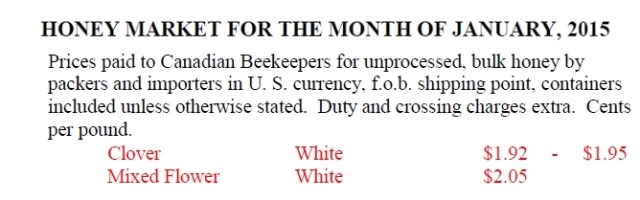

Last year, Canadian beekeepers received about $2/pound for their crop, according to the USDA. Here’s a clip from the January 2015 National Honey Report:

USDA Jan honey prices

Then, 15 months later: here is the US government’s National Honey Report for May 24, 2016, showing prices paid to Canadian beekeepers for their honey sold to American packers. It’s not pretty:

2016-05-24 prices paid to Can

poorguyHistorically, beekeepers have earned a marginal living. To stay viable as commercial operators, most have expanded and stream-lined their production. In the 1970s, a commercial beekeeper might have operated between 600 and 1200 colonies. That was enough to feed and cloth a flock of kids and keep the honey farm going. Honey was 50 cents a pound.  That was almost 50 years ago. Minimum wage at the time was less than $5/hour. Gasoline was 36 cents a gallon. Money went a lot further, even though there wasn’t much of it
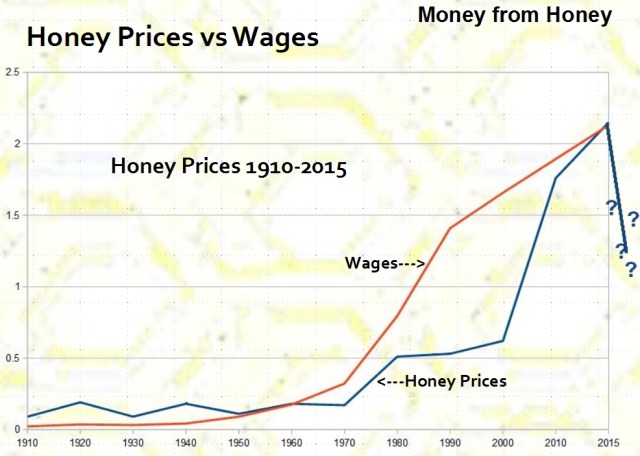
As part of a course I help teach – Making Money from Honey – I prepared a graph of wholesale honey prices compared to average labour. Here’s how to make sense of my chart. On the left (the y-axis), you see the wholesale price of honey in dollars. Along the bottom are years, from 1910 to today. The purple line is the wholesale price of honey in US money. It has mostly risen over the past century. The red line is wages, also in dollars, for the average semi-skilled labourer for each 6 minutes of his or her time. So, today, that person (a bee inspector, or computer operator, for example) is paid about $22/hour or $2.20 for each 6 minutes of her time. At the beginning of the last century, using federal statistics for average wages, people made just a few cents every six minutes –  for example, my grandfather earned $5 for a 10-hour workday in 1915 building railroad cars. My grandfather made 5 cents every six minutes. Honey at the time wholesaled at 9 to 12 cents a pound. Beekeepers in 1915 did well.

Wage-Price Graph

From the chart, you can see that during the first half of the 20th century (1910 to 1950) a pound of honey was worth more that 6 minutes of a worker’s time. That era is sometimes called the Golden Age of Beekeeping, a reference to something other than the colour of honey.

After 1950, beekeepers struggled. Beekeepers tried to survive with more efficient production. But thousands of beekeepers simply quit and took better-paying employment. America’s beehive count fell from 10 million hives in 1915 to 3 million by the 1970s. This wasn’t caused by neonicotinoids, mites, or colony collapse disorder – those hadn’t entered the scene yet – it was simply a response to bee economics. In the past few years, the price of honey spiked. For the first time in generations, beekeepers were financially comfortable with their career choice.

If you pick beekeeping for a livelihood, you should be aware that the past few years have been unusually good. Now it’s getting less good. But you might be encouraged to know that self-disciplined, hard-working beekeepers who are good money managers have been able to stay with bees through the worst of times – if they are also lucky. In that way, beekeeping is like almost any other business.

Posted in Beekeeping, History, Honey | Tagged , | 6 Comments