The Price of Honey

honey - PDThe price of honey has been falling for over a year. Honey is such a strange commodity. It’s agricultural. It’s ubiquitous (produced on all but one continent). It’s easily transported. Doesn’t need refrigerated. Doesn’t spoil (though quality may diminish with time and circumstance).  Sometimes honey is produced in primitive conditions; sometimes in ultra-modern facilities. It has widely varying colours and flavours, yet it’s fungible, which means that a bit of clover honey produced in Argentina is pretty much interchangeable with a bit produced in Minnesota or Kazakhstan. With all of this in mind, it is interesting that the price is so volatile – we’ve seen honey prices nearly double in a single year, but also fall to nearly half within months.

Last year, Canadian beekeepers received about $2/pound for their crop, according to the USDA. Here’s a clip from the January 2015 National Honey Report:

USDA Jan honey prices

Then, 15 months later: here is the US government’s National Honey Report for May 24, 2016, showing prices paid to Canadian beekeepers for their honey sold to American packers. It’s not pretty:

2016-05-24 prices paid to Can

poorguyHistorically, beekeepers have earned a marginal living. To stay viable as commercial operators, most have expanded and stream-lined their production. In the 1970s, a commercial beekeeper might have operated between 600 and 1200 colonies. That was enough to feed and cloth a flock of kids and keep the honey farm going. Honey was 50 cents a pound.  That was almost 50 years ago. Minimum wage at the time was less than $5/hour. Gasoline was 36 cents a gallon. Money went a lot further, even though there wasn’t much of it

As part of a course I help teach – Making Money from Honey – I prepared a graph of wholesale honey prices compared to average labour. Here’s how to make sense of my chart. On the left (the y-axis), you see the wholesale price of honey in dollars. Along the bottom are years, from 1910 to today. The purple line is the wholesale price of honey in US money. It has mostly risen over the past century. The red line is wages, also in dollars, for the average semi-skilled labourer for each 6 minutes of his or her time. So, today, that person (a bee inspector, or computer operator, for example) is paid about $22/hour or $2.20 for each 6 minutes of her time. At the beginning of the last century, using federal statistics for average wages, people made just a few cents every six minutes –  for example, my grandfather earned $5 for a 10-hour workday in 1915 building railroad cars. My grandfather made 5 cents every six minutes. Honey at the time wholesaled at 9 to 12 cents a pound. Beekeepers in 1915 did well.

Wage-Price Graph

From the chart, you can see that during the first half of the 20th century (1910 to 1950) a pound of honey was worth more that 6 minutes of a worker’s time. That era is sometimes called the Golden Age of Beekeeping, a reference to something other than the colour of honey.

After 1950, beekeepers struggled. Beekeepers tried to survive with more efficient production. But thousands of beekeepers simply quit and took better-paying employment. America’s beehive count fell from 10 million hives in 1915 to 3 million by the 1970s. This wasn’t caused by neonicotinoids, mites, or colony collapse disorder – those hadn’t entered the scene yet – it was simply a response to bee economics. In the past few years, the price of honey spiked. For the first time in generations, beekeepers were financially comfortable with their career choice.

If you pick beekeeping for a livelihood, you should be aware that the past few years have been unusually good. Now it’s getting less good. But you might be encouraged to know that self-disciplined, hard-working beekeepers who are good money managers have been able to stay with bees through the worst of times – if they are also lucky. In that way, beekeeping is like almost any other business.

Posted in Beekeeping, History, Honey | Tagged , | 6 Comments

Cotton Picking Time on the Prairie

Our western poplars, also known as cotton wood trees.

Our neighbourhood poplar trees, also known as cottonwoods.

I’m posting this a bit late. It’s about something that happened two weeks ago. My 9-year-old daughter and I were in a neighbourhood park and we noticed lots of fluffy white stuff floating through the air. Lots and lots. It looked like snow, actually.

I told her that it was probably from the dandelions which were finishing their spring bloom. But neither she nor I were particularly convinced. Then she pointed toward a row of trees on the far side of the park. “Look, it’s coming from over there.” She was right. We were getting snowed-in by cottonwood trees.

In all my years, I had never ventured to examine these poplars up close while they were shedding their seeds. The trees are rather large so their seeds and fluff are usually out of reach. Besides, I’ve always been too busy making a living to think much about the tree, except to recognize the nuisance it causes when sap drips from the buds in May and fluff fills the yard in June. But my kid doesn’t know the priorities of life yet, so she ran across the big park and came back to me with a branch of the cotton in full production. You can see it here.

cotton wood cotton

Looking at the expired catkins and their opening buds of fluff, it occurred to me that one of the tales I’d heard from old-timers might be true. They claimed that when they were children, they were sent up into massive cottonwood trees with rakes to collect cotton. The women folk would spin the cotton and make socks and snugly caps for newborns. I didn’t believe the stories and said so. I was told, quite rightly, that kids these days don’t know what hard work really is. That part is true enough. We have it easy these days, but that’s not all bad. I knew people who were killed by their work and children who never became adults because of farm accidents. I’d rather not have to send a child up a tree with a rake to collect cotton from a poplar tree – unless we really, really needed socks.

Things were different in the old days. On the Pennsylvania farm where I spent my childhood – middle kid in a family of ten – we worked hard and did without. I’d worked so hard as a kid that I once drove a bee truck into the ditch, having fallen asleep from too many hours working. Or maybe it was because I had siphoned leaded gasoline from a barrel to fill the truck earlier that day and I’d inhaled a lung full of gas in the process. Try to tell young people today what it was like when you were a kid – they won’t believe you.  Though I’ll admit that it wasn’t as bad for me as it was for the four Yorkshiremen in this video, over in north England at about the same time:

Posted in Culture, or lack thereof, Humour | Tagged , | Leave a comment

The Wonders of Beekeeping

I’m wondering if anyone reading this blog has seen a movie called The Wonders. It’s a beekeeping movie. Sort of. From what I’ve read about the film (and seen in the trailers) it appears to be an Italian Ulee’s Gold with English subtitles.  Do you remember Ulee’s Gold? It was the story of a ulee_vidFlorida beekeeper with a messed up family. Artistically, it was brilliant. Apiculturally, it was also brilliant – and that doesn’t happen often in the theatre when bees are involved. Ulee’s was a major movie with the star (Peter Fonda) receiving the Oscar’s best actor nomination in 1997. It’s still one of my favourite films. Here’s a link to Ulee’s trailer – if you like it, you’ll find the movie in some libraries, maybe even on YouTube, here. If you like slow-paced drama with lots of bees, Ulee’s Gold is your movie.

I don’t know if The Wonders is as good as Ulee’s Gold. From the little that I’ve seen, it’s more artsy. On the other hand, the Daily Herald calls it a post-realism film that borders on documentary: “this hyper-realistic drama could pass for a documentary on the lives of a family of Italian beekeepers in rural Tuscany.” Then the reviewer tells us that the movie records the “unhurried, unexciting daily routines” of beekeeping which suggests that this might not be a bee movie after all.  However, it does have bees, so that could make up for almost any flaws.

Get in the Car

The movie is about an impoverished family of beekeepers (why are beekeeping families poor in the movies, but so rich off stage?). They are husband/beekeeper, wife/sometimes-mom, and five daughters. Gelsomina, the 13-year-old, is beginning to feel independent and manipulates the family into being featured on an Italian reality TV show that comes to the region in search of a ‘typical family with traditional values’. Meanwhile, the father’s business is almost ruined by new government rules on honey house cleanliness, so he takes in a 14-year-old juvenile delinquent to help with the work and because the government will pay papa to foster the wayward boy. If all this sounds complicated, it is. But the movie unfolds slowly over two hours, so you have plenty of time to check your notes if you get confused.

The Wonders beekeeper, why not

The WondersThe Wonders (Le meraviglie)  has won 14 significant prizes, including Munich Film Festival’s Best Film by an Emerging Director, the Abu Dhabi Film Festival’s Black Pearl Award, and Cannes’ Grand Prize of the Jury. At Cannes’ the film ended with 12 minutes of audience applause! The movie is apparently very good. It opened in November, 2105, at select theatres, but like so many great films, it appears to have missed a screening in my hometown, Calgary. This again reminds me of Ulee’s Gold which was shown in an artsy show hall downtown here instead of the massive box-theatres where one could find much livelier and stupider entertainment. Which brings me back to my original question: Have any of the readers of this blog seen this movie? Or have any ideas of where to watch it?


Update: August 3, 2016

Well, I watched the movie. For a beekeeper, there were at least a dozen distracting fundamental errors (including the extractor which looms large in the plot and runs non-stop for hours and hours dribbling into pails – maybe it symbolizes the existential angst of unachievable satisfaction.)  More importantly, the movie was too dark and depressing for me. I know, I know. It was supposed to be moody and bleak. But really? I was surprised when it ended. Is that it? Is that all we get? Really? Is the entire movie simply a metaphor for the existential angst of unachievable satisfaction? Or what?

Posted in Culture, or lack thereof, Movies, Outreach | Tagged , , , | 11 Comments

Calgary’s ALS Fundraiser

Ron and family-r

This is a beekeeping blog, I know. But I sometimes write non-bee stuff. Once a year I go entirely off-topic and write a bit about our annual Calgary ALS fundraiser, Betty’s Run. Thank you for indulging my digressions.

I have motor neuron disease, sometimes called ALS (amyotrophic lateral sclerosis) or Lou Gehrig’s Disease. Lucky for me, my motor neuron disorder is atypical ALS, which means it’s not the typical fast-paced disease. Instead, mine has a much slower progression. Normally, ALS paralyzes within two or three years. All motion – walking, talking, breathing, everything – stops. Unless the afflicted chooses a respirator, feeding tube, and constant nursing care, the patient dies. However, the brain is unaffected.

hawking

Using assists like ventilators and aides is how people such as Stephen Hawking survive. His ALS started early (he was 22) and progressed more slowly, but he has equipment and full-time nursing help. Mine started at age 44 so I’ve been living with my variant of motor neuron disorder for almost 20 years. Mine is progressive – I can’t walk much any more and my arms and hands are weak, but that’s not too bad after 18 years. It will continue to get worse, but if the progression remains slow, I’ll be blogging for many years to come.

No one knows why my form of motor neuron disease is so unusually slow. A friend asked me if all those thousands of bee stings I’d had over the years made the difference, but other beekeepers I’ve known (commercial beeman Ernie Fuhr from the Peace River country, up near the Yukon; and, Bill Turner from our own Calgary Bee Club) were both killed by this disease. Recently, a group looking at alternative treatments for ALS reviewed bee venom and found that it was unlikely to be helpful. You can read about this investigative group here and the bee venom report is at this link.

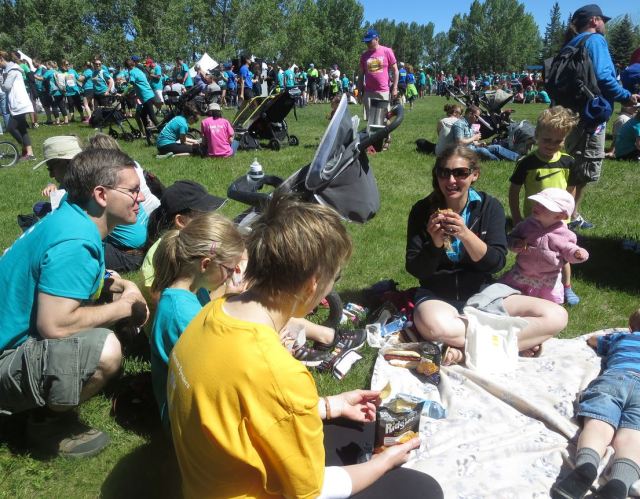
Betty’s Run was on Sunday, June 12 this year. Not long after Betty died of ALS years ago, some of her friends met, and decided to honour her memory and raise awareness and funds to fight the disease. This year about 1,500 people participated as walkers and runners. They raised $400,000 for ALS research and to help the organization that provides support (vans, motorized wheelchairs, in home care equipment) and outreach programs. During the 20 years of Betty’s Runs, nearly seven million dollars were raised here in Calgary. The walk/run/roll has become a social event with friends meeting and chatting. I was happy to have my wife (who is an organizing volunteer for the local ALS society) and my four kids and three grandchildren on today’s walk. For the smallest kids, the bouncy castle was the main draw. For us older kids, walking 5 kilometres (or being pushed in a chair, as I was) gives an opportunity to think about people and the illness. Most participants wore tags that said things like “I’m Here for My Wife” or “I’m Here for Jim”. My tag said “I’m Here for Everyone” as a reminder that everyone is affected, directly or indirectly by this illness.

Betty's Run, in Calgary, is the largest ALS fundraiser in the country. This is part of my family, surrounded by participants.

Calgary’s Betty’s Run is the largest ALS fundraiser in the country.
This is part of my family, surrounded by a much larger family.

Pure Sweet Sign-rAs I said earlier, today’s beekeeping blog doesn’t have much about bees. But I want to thank my friends Willi and Stan who run a honey packing business in Madison for their huge financial support for this year’s fundraiser. These guys have been my friends since my early beekeeping days,  40 years ago. As they have done for the past decade, they contributed to Betty’s Run once again. Their Wisconsin packing company – Pure Sweet Honey Farm Inc – was one this year’s two Silver Sponsors,  which means they are big supporters of this event.

Pure Sweet Sign on shirt

If you are reading this and thinking that you should help, too, you can find a local organization that does what our Alberta ALS Society does. You probably know someone who has died from motor neuron disease. The disease remains incurable, untreatable, and poorly understood. It can affect anyone, any of your friends or family, so please donate to your local ALS charity.

I’ll close with two more pictures from today’s event.

This was the 20th ALS fundraiser. Pictured is the organizing team with Calgary's mayor Naheed Nenshi and actress Wendy Crewon.

This was the 20th ALS fundraiser.
Pictured is the organizing team with Calgary’s mayor Naheed Nenshi.

Selfie. With two of my kids and a grandson on my lap. It was quite a day.

Selfie. With two of my kids and a grandson on my lap. It was quite a day.

Posted in Friends, Outreach | Tagged , , , | 1 Comment

Bees on Leashes

Back in November, the City of Halifax in Nova Scotia, Canada, accidentally made it illegal to keep bees. Or wasps, hornets, yellow jackets and fire ants. (What? No more pet fire ants?)  Now they are trying to amend the prohibition on honey bees, as you can see in this bee-law by-law amendment. Below are the current insect prohibitions, which include bees. Amendment A-700 will exempt bees and treat them like any other pet.

Amendment to allow beekeeping in NS

Apiaries – if properly registered and maintained – are legal in Nova Scotia. Because it’s legal and because of popular demand,  the city of Halifax is removing ‘bees’ from its prohibited creatures list. It looks like the amendment will come in effect next week. If it stands as written, honey bee possession will be similar to cat and dog ownership and will no longer be a crime – as long as the bees either stay on the owner’s property. If they do leave (to visit flowers, for example) they must be properly leashed, like other pets. For those of you who doubt bees can be tethered on a leash, the kids in the video below show you how to do it.

h/t and thanks and story credit to:  The Coast – Halifax’s Website.

Posted in Outreach, Strange, Odd Stuff | Tagged , , | Leave a comment

Investigating the Crime Scene

A few days ago, I read an interesting American Bee Journal article by Tammy Horn (et al.) and it made me think differently about something. Although I know that poisoned bees represent a real crime, I never really thought of poisoned bee yards as literal ‘crime scenes’.

KY inspector and author Tammy Horn

KY inspector and author Tammy Horn

In her informative and engaging article, Kentucky’s chief apiarist, Tammy Horn, explains that we need to adopt the mindset that dead bees need inspected responsibly – like police would do at a crime scene. Don’t scoop dead bees into a baggie and ship them off.  If a farmer or agri-business has misused pesticides, they have committed a crime. Crimes need undisturbed evidence for successful prosecution. Ms Horn writes, “When dealing with a possible pesticide kill, time is not on your side. You need to get a sample taken as soon as possible. If you want to take legal action…the sample must be collected by a regulatory official.”

I hadn’t really considered that a crime is a crime and a crime scene can be a bee yard. If you start cleaning things up improperly, you may impair future litigation and possible recovery of losses. Before securing your equipment and helping any surviving hives, the best immediate action is to call your regional chief inspector and ask for advice.

One possible sign of pesticide damage in your bees.

One possible sign of pesticide damage in your bees.

Horn’s article helps us to recognize chemical bee kills, collect samples (when appropriate), report losses, and take pro-active steps to protect honey bees and native pollinators. I won’t repeat it all here, you should read her article in the bee journal. If you don’t already receive ABJ, consider ordering it or perhaps get your bee club or library to subscribe. Though I’m not going to detail Tammy Horn’s information, I am going to list some of the links she gave in her article:

Posted in Pesticides, Save the Bees | Tagged , , , , | 2 Comments

Sound and Honey (as seen in BeesCene)

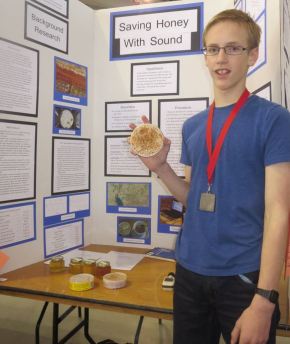
SciFair-2The editor of BC’s BeeScene bee magazine picked up an earlier blog post of mine. Last month I wrote about my 13-year-old’s science fair project where Daniel used ultrasound to liquefy comb honey. The results were promising, but not overwhelming. Heather Sosnowski, an editor of BeesCene, wrote to my son and asked him for more details and whether the scheme might be applied outside the lab. She printed their Q&As in her magazine. I’ve posted Heather’s piece below.
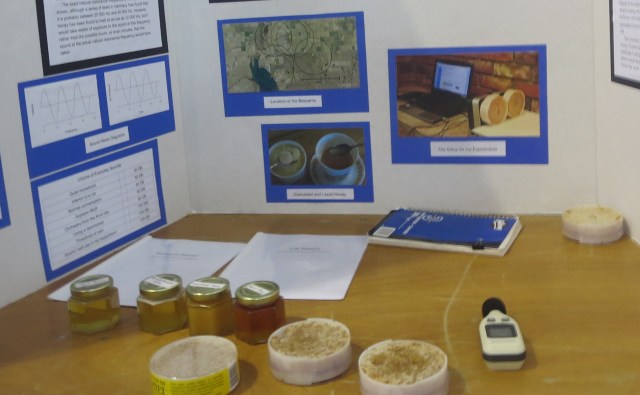
FROM THE BEESCENE NEWSLETTER:

Saving Honey with Sound
At the recent Calgary Youth Science Fair, 13-year-old Daniel
Miksha unveiled a project he had done using ultrasound to
liquefy granulated honey. Daniel is the son of beekeeper Ron
Miksha, who has contributed to this newsletter and also writes
a blog: badbeekeepingblog.com.

SciFair-3
We got in touch with Daniel to ask a few questions about how
he got started on this project …

Heather: How did you come up with the idea for this project? What made you think of using ultrasound to liquefy honey?

Daniel: My older sister and her husband own a honey farm that produces comb honey. Honey made from flowers in their area is high in glucose, and therefore it granulates easily. When we went on a recent trip to visit their farm out in the countryside, Dad pointed out to me all the granulated combs that were no longer marketable. Once I got home I did a bit of research into ways that honey can be liquefied without being heated which would ruin the wax structure. I found a particularly interesting study that was conducted in Germany in which granulated honey could be “melted” using high frequency ultrasound. I wanted to see whether I could apply this same principle to our local comb honey, and perhaps re-liquefy some of it on my sister’s farm.

Heather: Can you briefly describe the equipment that you used to conduct your experiment?

Daniel: The study I had found was using extremely high frequency ultrasound that required expensive laboratory grade equipment. Unfortunately I didn’t have access to speakers that were that powerful. I ended up having to lower the pitch and power of the ultrasound I was using for my experiment, but that meant I was able. to use standard household speakers that could simply plug into my laptop. I used a computer program to generate high-frequency ultrasound (18,000 Hz) with these speakers.

Heather: Do you plan to try doing your experiment on a bigger scale?

Daniel: As of right now, no. In my experiments I only tested a total of 12 combs, with consistent but slightly underwhelming results. If I were to go further I would need laboratory-grade, powerful ultrasound speakers, and I would conduct more research to determine the exact frequencies of sound that would fully reliquefy comb honey. If someone else were able to get access to these speakers and be doing this experiment on a larger scale, I would be very interested to see their results!
VOLUME 32, #2 SUMMER 2016 11.

Posted in Comb Honey, Honey, Outreach, Science, Tools and Gadgets | Tagged , , , , | Leave a comment

Flow(TM) Hive Wins Design Award

Flow Hive

Our favourite Surfer Dude and his Retired Dad are the folks who invented the 21st-Century honey-on-tap bee hive. They have now won artistic recognition. You know their hive – it’s the revolutionary, earth-shaking innovation that has inspired thousands of lazy folks to take up beekeeping. You needn’t learn to extract, nor even open a hive. Just turn the tap and catch some honey on a pancake.  I speak, of course, of the contraption known as the Flow™ Hive.  Do you have yours? You may want one for your Museum of Things That Didn’t Work the Way You Thought They Would.

The snazzy hive promoters have won Australia’s Good Design Award of the Year. This puts them on the shelf with other winners who have invented a stylish toilet and an alarm clock with a big button. (Sensing a trend here.) Australia’s Good Design awards are supposed to go to people/companies creating clever designs. Sort of the Apple I-pad/I-phone/I-hive prizes for lesser folks than Steve Jobs.

The Flow™ Hive design is certainly clever. I don’t think anyone has ever thought of a way to get liquid honey out of a hive without opening the hive. Well, there was once a design for a Rube-Goldberg-esque hive that used an empty steel box as a super. A series of rotating knives dropped down and puréed the box’s wax and honey into a slurry, after all the bees left through an automatic bee escape. Then the whirling knives retracted and the box’s lid descended, crushing the mess of wax and honey and forcing it out through a pipe. I invented that when I was 12. My drawing covered a huge piece of thick brown paper that used to be a grocery bag. It had arrows and circles and knives and my design (which I called The Easy Hive) even had a button for the beekeeper to push. After the mess of mixed honey and wax was tapped out, the lid rose back up again so bees could refill the the steel box. But that was long ago. We had neither the internet nor crowd-funding, so it went nowhere. I forgot about it and my drawing was lost during one of my many rushed changes of address.

wine on tapThe new award-winning Flow™ Hive reminds me that in my younger days, I occasionally bought some extraordinarily cheap and tasteless wine, sold in an equally cheap and tasteless box with a hose on the bottom. It was a hit at my house parties. Had I drunk the box of “Wine on Tap” all by myself, I might have been intoxicated enough to buy the Australian “Honey on Tap” bee hive. I was young, I was idealistic. But I was also cynical (a trait that has served me well for decades). However I was too poor to buy a Flow™ Hive, even if it were available in the 1980s. The honey-on-tap hive is very, very expensive.

But it is novel, clever, and innovative. There are a dozen reasons why it won’t work as expected, but also a dozen reasons why it has enthusiastic fans among people who have never kept bees and have not yet actually tried the hive. I won’t go into the problems. (“It’s animal husbandry with a negative twist.“, “It’ll promote sloppy beekeeping.“, “Is it good for the bees? Who cares. We’ve got flowing honey.“, “We have found larvae and eggs in the harvested honey.” . . . and on and on. By the way, that last comment is a big turn-off, both for the hive-owner and for the bees whose little larvae are floating away towards the honey jar.) On the other hand, bright and shiny things attract many people, especially if the things are trendy and bright and  shiny. I can’t deny there are enthusiastic Flow™ Hive owners.

But if a Good Design Award is given, shouldn’t the award-givers wait to see if it’s really a good design before giving out the award? Maybe all of us old cynics will be proven wrong. (Someone recently pointed out to me that age is not a substitute for wisdom.) I’ve been wrong before. Maybe the flow hive will be happily and successfully used by millions (or even billions!) of backyard beekeepers. All of these new bee enthusiasts will save bees from extinction and everyone will have a fresh jar of honey every year. That would be great. And if it happens, I’ll write about it right here.

Meanwhile, congratulations to the Flow™ Hive people and their award from Good Design! I mean that sincerely. It is incredibly hard to come up with new ideas and create the schemes that market them. The technical design is clever. Should it win a ‘good design’ award? Probably not. Instead, I think Harvard Business School should give the designers a marketers’ and promoters’ award. They have done a brilliant job of catching a wave and hanging ten. Someday, MBA courses will lecture about the day the Flow™ Hive and crowd-funding met.

Posted in Beekeeping, Culture, or lack thereof, Hives and Combs, Humour, Save the Bees, Tools and Gadgets | Tagged , , | Leave a comment

A Kardashian and her Honey

girleatinghoneyThis caught my eye today. I know it’s junk news, and with honey bees everywhere going extinct and dying or maybe just disappearing and hiding and not  dying, or whatever, it’s refreshing to know that Kourtney Kardashian uses honey. To eat, not for the other purpose. Besides, it’s summer, so let’s take our dietary advice from a celebrity, or at least learn how to make a Kardashian Smoothie. It uses honey and bee pollen, so we know that she knows what she’s talking about.  (The picture to the left? Not a Kardashian.)

According to this E!online breaking news, the 37-year-old-single-mother-of-three and former star of the reality show Filthy Rich: Cattle Drive uses honey in her summery blend. You can make a Kardashian Smoothie yourself and if you do, you’ll be as cool as a Kardashian, so why not?

The Kardashian Smoothie sounds like a healthy drink. It promotes honey and pollen (and hemp hearts, almond milk, blueberries, and spinach). Actually, it sounds so good I might try it today. I’m not going to repeat the recipe here (that would be beyond journalistic standards of fair copyright use), so you should go to E! and get it yourself.

Well, here’s my thing. Attacking an easy target like Kourtney Kardashian because of her accident of birth and her upbringing serves no purpose. (Though what she did with her life after college might.) Dismissing her thoughts on nutrition because she is a Kardashian is wrong-headed, too. (Debaters call that an ad hominem attack – it means you attempt to discredit an idea because of the personality of the presenter. Ad hominems make  weak, stupid arguments – though in political speeches they seem to work.) Just because she is a Kardashian, it doesn’t mean she is wrong. When it comes to including honey and bee pollen and spinach and such in a breakfast smoothie, she’s right.

Kourtney Kardashian - an application of honey?

Kourtney Kardashian – an application of honey?

By the way, I mentioned “the other purpose” for honey. I don’t know what you were thinking, but in another E! piece,  Kourtney Kardashian reveals the secret to her gorgeous skin.

It’s honey, of course. She says that she smears manuka honey on her hands and under her eyes before going to bed each night. Don’t worry, the maid will clean up later. I jest – Kourtney Kardashian has a job, she pays taxes, she raises money for charity, she uses honey. Perhaps she even cleans up her own messes.

Posted in Apitherapy, Culture, or lack thereof, Hive Products, Honey, Humour, Strange, Odd Stuff | Tagged , , | Leave a comment

Sweet Sweet Clover (part 2)

Grasslands National Park, in southern Saskatchewan, Canada, is the natural home for beautiful yellow sweet clover. This painting, which I bought from Lise Perrault

Grasslands National Park, southern Saskatchewan, Canada.
This is the natural home for beautiful yellow sweet clover.
I bought this painting from my friend Lise Perrault in 1987.
She and her husband ranched here before it was a national park.

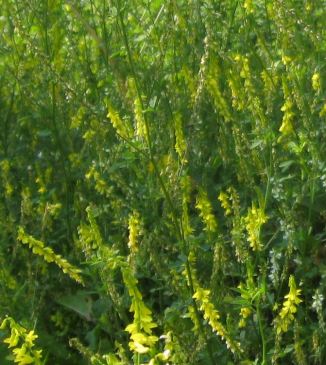
Yesterday, I couldn’t say enough good things about sweet clover. The magic honey plant is just starting to bloom here in southern Alberta. In a few weeks, it will yield so much nectar that bees will plug supers with fine white honey. The sides of trucks will become sticky if driven through dense waysides flushed in blooming sweet clover. It has been like that for over 50 years here in western Canada.

In yesterday’s enthusiastic blog post, I wrote that sweet clover nectar is among the richest in fructose and glucose of all nectar and among the most generous plants that nourish bees. I even included a short story about how sweet clover saved the state of Kentucky when hills were eroding and farmers were going broke. Today, I’m writing about the war against sweet clover. The Canadian government enlists volunteers and pays summer students (mostly budding ecologists) to destroy sweet clover. It’s been labeled a noxious, invasive weed.

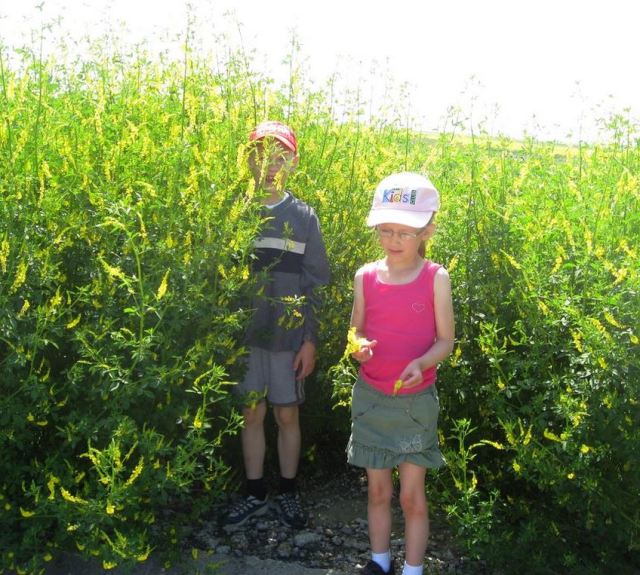
The author - outstanding in a field of sweet clover.

The author  – out standing in a field of sweet clover.

Sweet clover is not native to Canada (or the USA, either). It’s an invasive plant, an interloper, a foreign arrival. Way back in 1880, before people realized that sweet clover rebuilds exhausted soil, prevents erosion, and feeds bees, bison, and birds, the American government started an eradication program to destroy sweet clover. It was believed to be an unwanted pest, brought from the old country in 1738 by careless immigrants. In the mid-19th century, there were laws in every state making it illegal to possess or traffic in sweet clover. Farmers were obliged to remove it when discovered – or they’d face a fine. The fear was that sweet clover would crowd out alfalfa and dry up grasslands. That was almost 150 years ago. Then a funny thing happened.

Farmers discovered that sweet clover is a hardy, drought-resistant forage for cattle and a fine crop to rebuild soil and reduce wind erosion. As we saw yesterday, it saved the state of Kentucky from bankruptcy. That was the turning point. Agriculture research stations began promoting sweet clover for land reclamation. By 1920, it was planted in about five million acres in the USA. The state of Illinois had a million acres of sweet clover that year. John Lovell wrote that sweet clover in 1926 was America’s biggest source of nectar and he predicted that states like the Dakotas and Montana – which were then marginal for beekeeping – would become major honey producers because sweet clover was moving in. He was right. Sweet clover fed bees; bees gave us mild, water-white sweet clover honey. By 1950, America’s farms grew 20 million acres of sweet clover. Pastures, roadsides, and meadows held millions more.

There are no longer millions of acres of sweet clover grown as ‘green manure’ to rebuild soil. Industrial fertilizer does that instead. Nor is sweet clover grown as hay – alfalfa is the rancher’s choice. The hay day (yea, that’s a pun) of sweet clover ended in the 1950s. I was amazed to read (according to the US Department of Agriculture) only 30,000 pounds of sweet clover seed were harvested in the USA in 2001. That seed, if sold to farmers, would only fill 5,000 acres. It’s startling how agriculture can change so much. Sixty years ago, the US had 20 million acres. Fifteen years ago,  5,000.

yellow sweet clover, closerCultivated sweet clover has almost vanished from farms. And now an effort is afoot to eradicate wild sweet clover. Way back in the late 19th century, the failed attempt to rid the country of wild sweet clover grew from the false idea that it would spread into farms and hurt them. Today, the effort to eradicate sweet clover is much narrower in focus and it’s not being done to protect farmers. It’s being done to restore the old ways at a new national park.
Near my former bee farm in Val Marie, Saskatchewan, the Canadian government is trying to remove sweet clover from Grasslands National Park. The  grasslands is a natural home to sweet clover, which has been feeding deer and antelope in the area for a century. But, it’s exotic, invasive, intrusive, foreign, and its ancestors came from another continent. Sort of like all the people who are trying to kill the flower. Sweet clover is non-native – just like the horses, wheat, sheep, cattle, and other signs of agriculture that surround and enter the grasslands park. And honey bees, too. Honey bees, as you may know, are also exotic, invasive, intrusive, foreign species – brought by European immigrants and as alien to North America as sweet clover.

This blog's author, at the rattlesnake hiberatium before it became part of the Grasslands National Park. I was looking for a bee yard.

This is I, at a rattlesnake hibernation/rendezvous spot before it became part of the Grasslands National Park. I wasn’t looking for a bee yard.

Parks Canada would like to get rid of the yellow sweet clover that thrives in the park. They say – correctly – that it’s not part of the original landscape. The idea is to revert the grasslands to what it looked like before people messed it up. It’s a gorgeous place with buttes, coulees, rattlesnakes, prairie dogs, coyotes, bison, burrowing owls, cacti, and sage brush. You really should see it – try to get there within the next hundred years, before all the yellow sweet clover has been killed by the government, and you can see the illicit yellow honey flowers, too. 

To eradicate sweet clover from the Grasslands National Park, summer students and volunteers hike the hills, digging up plants. This has been going on for several years. It began under the Conservatives and now continues under the new Liberal government, so it’s not a political thing.

The challenge is to find all the first-year plants which are much more obscure than the larger second-year growth of the biennial. The plant’s roots are deep and they don’t pull out easily. You can go to this link on the Grassland’s Facebook page to see some people lugging big sacks up a coulee, plucking sweet clover. You’ll read a side caption there that explains how sweet clover impedes the Greater Short-horned Lizard as it crawls around the badlands. Darwin reminds us that smarter Greater Short-horned Lizards learn to navigate around sweet clover, resulting in clever lizard descendants. Are we really doing these special little snowflakes a favour by pampering them? But I digress. And jest – I like the little lizards.

Uprooting sweet clover by tugging on its stem is not the biggest problem facing the ecologists. Each sprig releases 100,000 tiny seeds that can drift for miles. Trying to remove yellow sweet clover – even from a relatively small national park – is the one feat that Hercules never finished.

Will James' Cabin

Will James’ Cabin

Assuming we are stronger and more persistent than Hercules, should sweet clover be removed from Canada’s Grasslands National Park? Yes, if the park intends to represent a point in time before people began to change the natural landscape. But what of the tipi rings left by natives who lived in the badlands of the park? Hopefully those won’t be removed. How about Will James‘ famous cabin? (James was a cowboy from Quebec who ranched in the area before it became a park. He moved to California and wrote million-selling novels and screenplays for westerns.) OK, we keep James’ cabin and the tipi rings, but kill the clover. But what about the rutted car-trail that takes tourists on the scenic loop through the national park?

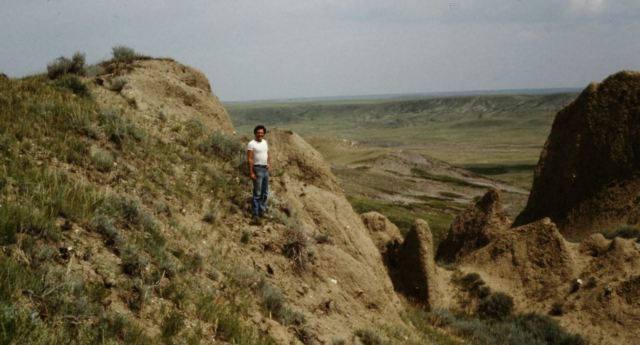
You see, of course, it’s not an easy fix.  Someone has to make an arbitrary decision. A cut-off date. Should the park be restored to the early 20th century or the 17th? Yellow sweet clover, which I remember fondly from my youth spent hiking in the grasslands (before the area became a park), will be destroyed. But the flower is part of my personal heritage, my memories, and my experiences. You can see the proof in this picture, a photograph I took of my brother Joe in 1979, within the bounds of what later became the Grasslands National Park. Do you see all those pretty little yellow flowers, stunted because they were chewed by antelope?  Sweet clover.  Part of my heritage.

The Grasslands national Park, before it became a national park. Some of the world's most astounding scenery - with or without yellow sweet clover.

The Grasslands National Park in 1978, before it became a national park.
Some of the world’s most astounding scenery – with or without sweet clover.

Posted in Ecology, Honey Plants, Save the Bees | Tagged , , , , , | 7 Comments