Sweet Sweet Clover (part 1)

Yellow Sweetclover in Alberta, Canada

Yellow sweet clover in Alberta, Canada

Every June there is a wash of yellow along the edge of almost every highway and trail in North America. The yellow is from sweet clover that grows and blooms all across the continent. It’s wild and it has been reseeding itself, year after year, for centuries. The yellow biennial (there’s a white variety, too) is an amazing honey plant and was once celebrated as the weed that saved Kentucky from economic ruin, as you will see shortly.

Sweet clover is one of the sweetest weeds you’ll ever meet. A century ago, farmers in Indiana and Illinois (and other states) planted sweet clover for hay. It escaped their fields and spread along the nation’s highways, occasionally helped by other farmers who captured the seeds and planted the weed in their own fields. Planting sweet clover to enrich fields and provide livestock forage has waned. The last time I saw yellow sweet clover intentionally planted in a field was during the 1970s, in southern Saskatchewan, Canada.

Making hay from sweet clover, Val Marie, Saskatchewan, 1975.

Making hay from sweet clover, Val Marie, Saskatchewan, 1975.

I can’t say enough good things about sweet clover. The yellow variety brightens the scenery and announces summer. Sweet clover replenishes soil, ‘fixes’ nitrogen, as farmers call the process where this element is sucked from the air and stuck into the dirt. Farmers once plowed millions of acres of sweet clover into the ground – the plant’s bushy fiber mulched, fertilized, and enriched the soil. Here is what Ag scientists told South Dakota farmers in 1925:

SWEET CLOVER was once considered only as a weed, but now [1925] it is held a very valuable crop. This deep-rooted, vigorous-growing, hardy, biennial legume surely has a place on South Dakota farms. It has no equal as a combined soil-building, weed-fighting, pasture and hay crop.
Sweet clover is a most important crop in a successful system of crop rotation in South Dakota. It is a legume and our farms must have more acres of these crops. Its large, deep-growing roots add much valuable nitrogen and vegetable matter to the soil, thus improving the soil on which it grows; it endures dry weather and still produces valuable pasture and hay; it successfully competes with the weeds that rob our other crops; it reduces the acreage of small grain crops and it improves the quality, yield and profit of the crops that follow it. Surely such a crop, when properly used, has a place on the farms of South Dakota.

Since 1925, sweet clover has been replaced by less natural fertilizer and isn’t seen much in cultivated fields. Yet even today, sweet clover’s deep roots prevent erosion on hillsides. Those tap roots keep the plant alive during drought, giving noms to wildlife even when the rest of the landscape is burnt and sere. Most important of all, I think, is the fact that  sweet clover is a fantastic honey plant – one of the best in the world.

With all this to commend it, you may be surprised to learn that the Canadian government pays summer students (mostly budding ecologists) to destroy sweet clover. It’s been labeled a noxious, invasive weed. I’ll get to that in tomorrow’s blog post, but I’ll spend the rest of today praising the honey bees’ best friend.

Beekeepers in ancient Greece recognized sweet clover as a wonderful honey plant. It still attracts bees by the millions to the steep, dry hillsides where it flourishes. Long after Aristotle swallowed his last chunk of clover honeycomb, scientists searched for a scientific name to tag to sweet clover. They chose Melilotus – from Greek words that celebrate honey (meli-) and lotus, which they somehow thought sweet clover resembles. (Even scientists goof up occasionally.) Sweet clover has a long history as a renowned honey plant.

How good is it? Melilotus nectar averages 52% sugar and just 48% water. Most nectar is 20% sugar and 80% water. The 52%-sugary nectar was sampled in North Dakota on a dry summer day. You can see the advantage to the bee – each belly-load carries twice the sugar as typically found in other honey plants.  Honey supers fill twice as fast. It takes fewer trips and bees process it more easily during nectar’s conversion into honey.

Sweet clover is found nearly everywhere, but it does best in the lime soils of the American plains and Canadian prairie, secreting particularly well on sultry summer days. As mentioned, it’s drought-resistant – but prefers about 16 inches (40 cm) of annual rainfall. This moisture is typical on the plains. In drier climates, sweet clover hugs irrigation canals.

Sweet clover yields enough nectar to make 250 to 500 pounds of honey per acre (Pellet, 1920 and Kolbina, 2007). Millions of pounds of honey are lost each year, simply because there are not enough honey bees to gather all the nectar secreted by the world’s sweet clover. For beekeepers, dropping 20 colonies near a section of sweet clover doesn’t begin to touch its potential.

Sweet clover is now found throughout the world, but is native to north Africa, Europe, and west Asia. In those places, over a dozen species of Melilotus are found. Four have invaded North and South America, Australia, Oceania, southern Africa, and eastern Asia. Sweetclover was assisted in its travels by humans, who have cultured the yellow (M. officinalis) and white (M. alba) biennials since 1738 in North America. We generally treat yellow and white sweet clover as one plant with two hues – they are similar, but not totally identical. Yellow sweet clover blooms two weeks before its pale cousin, but I don’t think the honey is noticeably different.

My father, in a patch of white sweet clover in a limestone strip mine in western Pennsylvania, 1950.

My father, in a patch of white sweet clover
at an abandoned limestone strip mine – western Pennsylvania, 1950.

Sweet clover was imported to North America from Europe. It spread across the continent from east to west. During the 1700s, it was mostly confined to the east coast. The plant likes alkaline soil and doesn’t do well in the east, where acidic soil abounds. But – as you see in the picture above – it can grow quite well in some eastern localities, such as Pennsylvania limestone strip mines, where the soil is alkali. My father used to haul hundreds of hives to catch a July sweet clover honey flow each year. As a child, I remember that other beekeepers were baffled because our family produced white sweet clover honey when most of them had only reddish autumn goldenrod, made from the spiky plant that thrived in the local acidic soil. They hadn’t caught on to moving hives into the old limestone quarries where the clovers grew, then moving back to the goldenrod for the fall flow.

In the 1800s, sweet clover crossed the Appalachian Mountains. Shortly after the first American Civil War (1860s), it was still just taking root in Kentucky. Here’s a story from Frank Pellet’s 1920 honey plant book. Pellet tells us about the day sweet clover came to a poor, rural part of Kentucky:

     “One of the pioneer growers [of sweet clover] was E. E. Barton, and his experience with it sounded like a fairy tale. Mr. Barton said that following the Civil War, most of Pendleton County was given over to tobacco growing, with little live stock, and not much rotation of crops. It was a hill country, and although it had a fertile soil over a clay subsoil, the heavy rains soon washed away the shallow surface soil, and one farm after another was abandoned. Hundreds of farms were abandoned, and many of them were sold for taxes, because no buyers could be found. More than a third of the population left the county, and the farmers who remained had hard lines to make ends meet. Sweet clover was stealthily sowed, probably by beekeepers intent on increasing the bee pasturage. At first it was regarded with disfavor and fought as a dangerous weed.

     “Mr. Barton came into possession of a farm, somewhat against his will, because the owner could not pay the mortgage. He tried renting it, and the tenant was unable to make a living, much less pay the rent. After it had been abandoned, he went to great trouble to keep down the weeds, especially sweet clover. Then came a year of drought, when there was very little feed for the cattle, and they were turned into the roads to graze.

     “Even there there was but little except the sweet clover, which was by this time rather common along the roadsides. It was soon noticed that the cows were eating the sweet clover with relish and doing well. Then somebody tried an experiment by sowing it in a field. It thrived, the cows liked it, and the milk flow was increased. Mr. Barton by this time was quite ready to profit by the experience, and within five years the farm which would not grow grass was producing good crops. He bought more abandoned farms and sowed them to sweet clover, and his neighbors began to do likewise. One by one the farmers came back to their abandoned farms, new settlers came in, and everybody began to grow sweet clover.

     “Now there are fifty thousand acres of it in that county. Ask any farmer you meet on the streets of Falmouth what he thinks of sweet clover and he will tell you such tales of rebuilt fortunes from a combination of dairy cows and sweet clover as you never expect to hear. There are now shipped from the county about half a million pounds of seed yearly, besides thousands of dollars’ worth of dairy products every week. They find that an average of 300 to 600 pounds of hulled seed per acre can be secured from the white variety and 500 to 700 pounds of the yellow. An average yield of from $40 to $100 per acre is the return from the sweet clover, according to local reports picked up on the streets. Now one finds evidences of prosperity on every hand. The farmers have fine homes, automobiles, and money in the bank.”

By reading Frank Pellet’s tale of how sweet clover saved Kentucky from chaos and economic ruin, you can see that it is a plant worthy of unending praise. Pellet’s little essay doesn’t mention that Kentucky also became one of America’s great honey states in the late 1890s, mostly because of the arrival of sweet clover. In 1900, at least 50,000 Kentucky farms had bees – they totaled over 200,000 hives.

By the 1920s, sweet clover had spread through most of Kansas and was crossing the Dakotas. It became established in southern Saskatchewan just 40 years before I kept bees there in the 1970s. By then, sweet clover matched alfalfa as the honey plant that gave me 300-pound per hive honey crops. But that same area – southern Saskatchewan – is also the place where the government is now attempting to eradicate sweet clover – seen as an invasive pest, a noxious weed. It’s not the farmers who want it gone, it’s the government. Tomorrow we’ll look at the debate and see how eradication is going.

Yellow and white sweet clover, co-habiting in the Rockies.

Yellow and white sweet clover, co-existing in the Rockies.

Posted in Ecology, Honey Plants | Tagged , | 20 Comments

Too Close?

Sam Droge - drone

Today I have a photo essay for you. These are fantastic close-ups of honey bees – maybe too close for some people. All of these pictures are from the United States Geological Survey. As such, they are in the public domain.

The American government – in order to speed scientific discoveries and access to information – passed a law years ago that automatically places most information and photographs made during work hours by employees of the US government into an open and free depository.

You can use these pictures anytime, anywhere – at school presentations, in your bee club’s newsletters, on your web pages. You will find extremely high-quality copies of these images (and several thousand others of various bees and bugs) on the USGS Bee Inventory Flickr Page.

Sam Droge - bee head

A few months ago, I wrote about the photographer, Sam Droge, when I examined a book he co-authored, Bees: An Up-Close Look at Pollinators Around the World. The book is gorgeous and would make a great gift for any bee-person on your shopping list. You can order your own copy of this engaging volume either through the publisher, Quarto, or from Amazon.com  in the USA or Amazon.ca  in Canada.

Honey bees’ wing:

Sam Droge - wing

Drone bees’ leg:

Sam Droge - hairy bee leg

Posted in Bee Biology | Tagged , , | 2 Comments

May 20: World Bee Day

Portable apiary in Slovenia. (Photo by David Miksa)

Portable apiary in Slovenia. (Photo by David Miksa)

There’s a small country in Central Europe, a very beautiful alpine country, called Slovenia.  Slovenia has only about two million people, but this tiny country is very big in beekeeping.  Tucked between Italy and Austria, it has both mountains and Mediterranean sea coast, creating enticing niches for bees.

Every Slovene family has at least one beekeeper. I think beekeeping might be enshrined in their constitution.  I visited before they adopted the Euro and paid for a Laško with coins that had images of bees, not presidents or queens. Beekeeping is taken so seriously that the nation’s unofficial motto is “Land of the Good Beekeepers“. The country produces gourmet honey, offers beekeeping tourism, and likes to point out that the Slovenes – the wealthiest Slavic nation in the world – takes its work ethic from the honey bee.  Now Slovenia is trying to convince the world to recognize World Bee Day, a day for the bees, which we would celebrate on the presumed birthday of their most famous beekeeper, Anton Janša.

Janša (pronounced YAN-shah)  is a Slovenian national hero and a beekeeper. We don’t really know his birth date –  his parents were illiterate farmers and probably wouldn’t have even known (or cared) what year it was. But their church kept track. He was baptized on  May 20 in 1734.

Beehive entrance plate, painted by Jansa.

Beehive entrance plate, painted by Janša.

The Janša family was impoverished, but three Janša brothers built an art studio in a barn, got noticed by the village priest, and were whisked off to Vienna, the capital of the Hapsburg Empire, which controlled Slovenia at the time. One of the brothers became an arts professor. Another became a beekeeper. The royal beekeeper.

Anton Janša was the beekeeper. Empress Maria Theresa recognized his skill and appointed him as the queen’s own bee man.  Janša created the world’s first beekeeping school, wrote a couple of important beekeeping books, and introduced modern apiary management. He championed expanding hive boxes to hold extra honey and he encouraged migratory beekeeping, moving hives toward the foothills in the spring to collect acacia (black locust) honey, the Alps in the summer for honeydew from the pines, and into lower pastures in the fall. He was among the first to realize that drones are not water-carriers, but instead mated in the air with queen bees. This latter discovery pre-dates Francois Huber’s similar observation by a few decades but was not generally known when Huber rediscovered it. Janša did all this before he turned 40 – he was only 39 when he died suddenly from a fever.

An image from the Slovene World Bee Day promotional video.

An image from the Slovene World Bee Day promotional video, visible below.

Here’s a lovely, short video of what the Slovenes want you to know about World Bee Day:

World Bee Day is a great idea. The exhibition “Save the Bees” will be opening at the historic Ljubljana castle, on May 20. The Slovene embassy in Washington DC had a big party. Elsewhere, awareness and round tables on “Bees and Sustainable Development” and bee memorials abound. World Bee Day is intended as a day to reflect upon the much maligned and threatened bees. A delegation of the European Union is also meeting May 20 with luminaries of the American bee world at a World Bee Initiative, which you can read about here.

WBDWorld Bee Day is immensely important. Maybe that’s why there are two world bee days.  A group of Americans petitioned the USDA to create a World Bee Day of their own – on August 20th. While the Americans worked their idea through the US Congress, the Slovenes have been asking the United Nations to recognize May 20th as World Bee Day. I’m not sure how all this will play out, maybe the two world bee days will merge and be observed sometime in July.  But I suppose both world bee days will continue, one on a world-scale, the other in the USA.  As they say back at the bee lodge, “You can’t have too many World Bee Days, eh?”

Posted in Culture, or lack thereof, History, Outreach, Save the Bees | Tagged , , , | 13 Comments

Drawing the Bee

Not long ago, Scientific American had a piece about drawing. The story, written by a biology professor, encourages us to look at nature and draw it. The case is made that drawing helps you understand what you are observing. But what if you can’t draw? What if every bee’s wing ends up looking like a bee’s belly button?

I appreciate that “anyone” can draw. But, unfortunately, I’m not just “anyone.”  I have tried; I have failed. I can’t draw. Here’s my picture of an elephant, eaten by a boa.* People have told me that it looks like a poorly drawn hat. What do you think?

boa-hat

But the point to scientific drawing for the student is not a pretty picture to post on the mini-fridge in the dorm room.  The purpose is to learn by engaging in the process.  Anyone who spends 30 minutes attempting to draw a dead bee (for example) will come to know dead bees much more thoroughly than they had a half hour earlier.

Pencil on paper focuses the mind, according to Professor Jennifer Landin. She tells us that drawing used to be a standard of biology classes. But our modern focus is on products, not processes. In her article, she blames the end of classroom science drawing on the start of the Efficiency Movement Era. This is a philosophy that waste and repetition can be systematically eliminated through best practices that streamline production. That’s mostly a good idea. Beginning around 1890 and flourishing until the 1930s, the movement reformed factory and farm production, making growth and prosperity available to everyone. (The Efficiency Movement was popular until the Great Depression began, then some wag pointed out that it hadn’t delivered on all its promises.)

Efficiency Everywhere

Efficiency Everywhere

There is no disputing that improved efficiency delivers products with less cost and less waste. We want efficient energy use. We want to process honey with fewer movements. I’ve seen beekeepers stack honey several metres away from their extractor and then pace back and forth, walking one box at a time to the uncapping point. This isn’t just about money – it is also about wearing out the floor. And the worker. In the 1920s, the people who really promoted the efficiency movement (Frederick Taylor and the Gilberts) were quite concerned about reducing repetitive injuries and accidents in factories. Doing more with less effort, they assured us, was a healthy thing.  (By the way, the efficiency expert husband and wife Gilberts may sound familiar to you – they are the ones who had the idea that big families are more efficient and even cheaper by the dozen.)

But other people pointed out that measuring efficiency of motions and footsteps does not take into account social aspects of the work environment. (For example, each time the beekeeper walked across the shop to get a box, he smiled at his toddler in the playpen.)  There were other overlooked social considerations. The idea of efficiency quickly spread to places it does not need to be. One of these, as the author of the Scientific American article points out, is the classroom. Here’s Dr Landin:

In the 1920s and 1930s, as drawing was eradicated from public school programs, people cheered. No more long, drawn-out (sorry for the pun) lessons on form, accuracy and detail. The product could be prepared in advance, and students would not waste class time practicing outdated drawing techniques.

The camera generated perfectly accurate forms. New-fangled mimeograph machines allowed teachers to sketch an image and copy it for all their students to label. What time-savers!

So, sketching, drawing, and illustrating the natural world should be brought back to school. Such effort can train observers to see anatomical structures and to infer their importance and use. What if one is hopeless at drawing? “Observation skills are crucial. The abilities to see without bias and to focus on detail and pattern require training, not talent,” writes Landin.  So, it could be that I was not inept – I was just not adequately trained.  (Though I strongly suspect that I’m both inept and untrained.)

Here’s an assignment for you. Whatever your age. Get a scrap of paper and a scrappy pencil and take a stab at rendering a dead bee. Or an oak leaf. Don’t worry about the messy results – you can shred your artwork later. You should shred your work later because the product is not the prize – it’s the process.

Jan Swammerdam's 1673 sketch helped him understand the bee's compound eyes

Jan Swammerdam’s 1673 sketch helped him understand the bee’s compound eyes

Professor Jennifer Landin might not care that my drawing* of a swallowed elephant looks like a lop-sided hat. But she would care that I submitted a finished product (found on the internet, of course) and skipped the process entirely.  By the way, I really wanted to do an original drawing of a boa digesting an elephant, but the Calgary Zoo no longer has elephants. They were all swallowed by boas, I suppose.

______________

*(OK, the drawing of the elephant inside a snake is not mine. It’s actually from The Little Prince by Antoine de Saint-Exupéry)

Posted in Culture, or lack thereof, Science | Tagged , , , , | 7 Comments

Friends Among the Bees

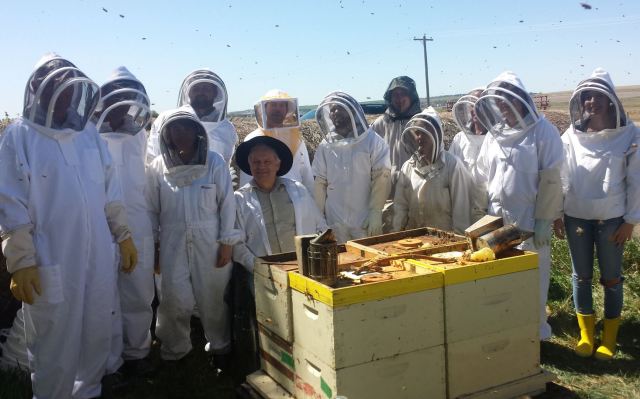
I’m seated, in the wheelchair, surrounded by one of our groups of eager students.

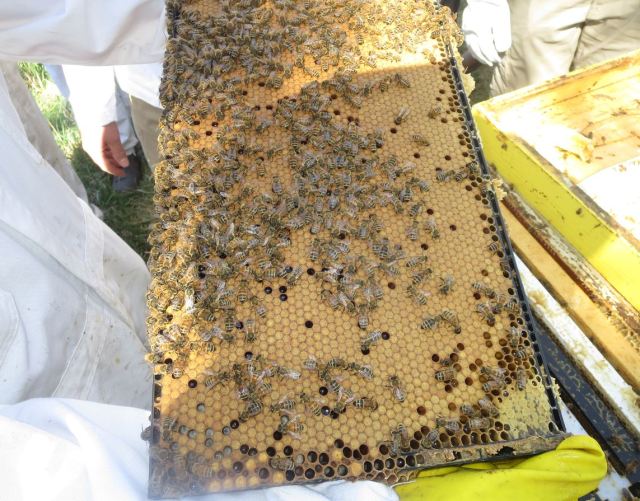
I spent a few hours in the bees today. This was part of our bee club’s beginner beekeeping course and I was one of the instructors, showing 50 new beekeepers the mysterious inner workings of our club president’s hives. The main actors in our show were cooperative – they were dragging in great gobs of orange pollen and enough nectar to moisten top bars when a comb was shaken above the hive. The colonies were doing well. In fact, below you’ll see one of the most perfect frames of brood I’ve ever seen.  As a pleasant bonus, the bees were so calm that I didn’t even need a veil to do the teaching. I’m still able to stand and walk a little, so I was on my feet for a few hours during the show n’ tell. I enjoyed it all immensely.

The student-participants were mostly new beekeepers and all had taken part in our club’s novice beekeeping lecture series. They were educated in the ways of the bee, but many of those present had never seen a hive up close until today. The participants were as eager and pleased as their new veils and whitesuits were fresh and gleaming under the bright Alberta sun. It was a lovely day to do bees and share the little bit of knowledge and experience that I and the other instructors – Neil, Liz, and Bert – could offer the students.

A near-perfect frame of brood.

A near-perfect frame of brood.

Collecting bees for mite counts.

Collecting bees for mite inspection.

Varroa mite check.

Varroa mite check.

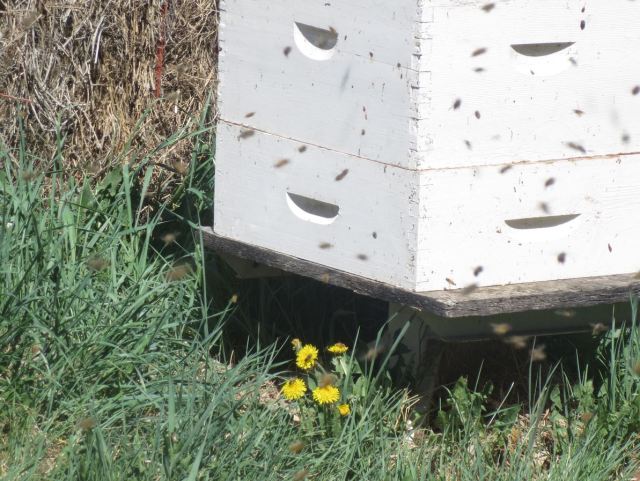
Bees were working dandelions in the apiary.

Bees were working dandelions in the apiary.

Leaving you with one more image of our lovely group!

Leaving you with one more image of our lovely group!


Posted in Friends, Outreach | Tagged , , , | 1 Comment

Almonds Doing Selfies

Services not needed? (Credit: Monica King)

Services not needed?  (Credit: Monica King)

Almond pollination season is over. The billions of bees working in California have moved on. They are now mostly scattered across the American plains. It’s not easy to be a bee in the almond groves during February and March. Colony density reached hundreds of hives per square mile just before dispersal into the groves. During the staging period, disease can spread from hive to hive as the huge number of honey bees compete for limited resources and return to the mega-apiaries where they may drift from hive to hive and perhaps rob weaker colonies.  Out of the staging yards and distributed among the almond trees, bees may suffer from toxic sprays blown from rigs pulled by belching tractors.

Most colonies survive these unnatural assaults because beekeepers do what they can to keep their bees going. After the almond petals have salted the ground, hives are usually moved to recovery apiaries. These may be pristine locations at higher elevations in the Sierras, or up north in Oregon, or more commonly, over the Rockies on rangelands in Wyoming, Montana, and the Dakotas. In those places, spring flowers give respite and nourishment. This has been the pattern for millions of honey bee colonies during the past decade.  But all this migration activity may change one day.

Grove owners are becoming anxious about the cost of pollinating insects and the potential collapse of the bee industry. If honey bee populations should shrink and not recover, almond farmers would be in desperate straits. So, they have been looking at other ways of getting their harvest without dependence on honey bee pollination.

In the distant past – 25 years ago – beekeepers competed for almond pollination contracts. There were fewer groves. Almonds yield pollen that hungry bees enjoy in mid-winter, so beekeepers received just a gratuity to set hives among trees. It wasn’t much money because in those days growers depended on wind, wild bees, and neighbourhood honey bees for pollination. But it was soon apparent that although almonds produce some nuts without hired honey bees, the crop more than doubles when bugs saturate the ranches. In 1990, almonds yielded 1,000 pounds per acre. Today, production is over 2,000 pounds. The increased yield in largely due to increased numbers of honey bees pollinating the almond flowers.

California's almonds. (Credit: amonds.com)

California’s endless almonds.   (Credit: CalValleyBees)

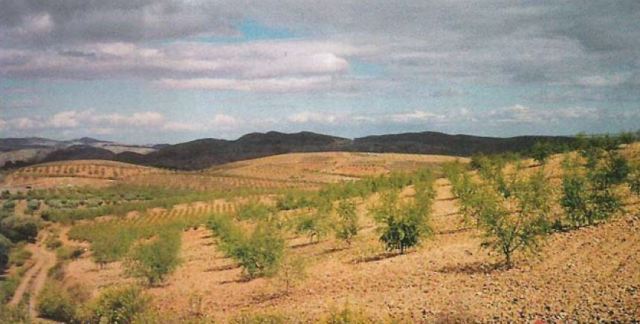
Without bees, less pollen shifts from tree to tree. Fewer nuts develop. Growers could make profitable crops without honey bees if their trees are self-pollinating. Spanish varieties are self-pollinating, but California’s are not. California trees produce more nuts and the almonds are larger and tastier  than Spain’s. I mention Spain because, until 1993, Spain led the world in almond production. At the time, Spanish farmers had three times the acreage planted in almond trees along the Mediterranean coast. The groves weren’t irrigated, nuts were gathered by hand, farms were small, side-line family businesses. Their self-pollinated trees didn’t need much help from pollinating insects – a slight sea breeze was enough to transfer the pollen and set the seed because everything happened inside the same flower. However, despite much greater acreages in Spain, the California crop led the world in 1993 (and every year since) because of intense farming, irrigation, and the use of cross-pollinated varieties.

Spanish almond grove, 1993. From Juan Ramon Murua, et.al.

Spanish almond grove, 1993.   From Juan Ramon Murua, et.al.

California’s almonds don’t do selfies. Bees are needed to transport pollen dust from neighbouring trees, cross-pollinating unrelated flowers. This results in non-incestuous fruits that are larger, hardier, and more glorious than their Spanish cousins. However, some California almond growers have been considering the less valuable self-pollinating species as Plan B for the day the bees quit buzzing.
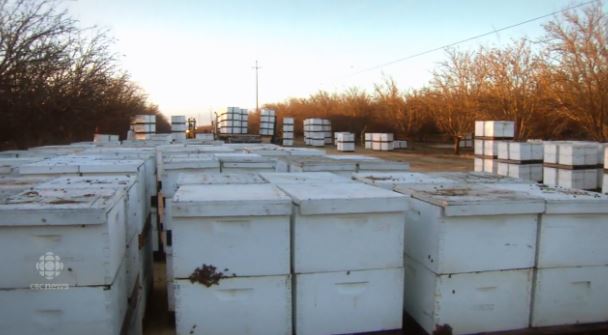
CBC bees among the almonds

Scientists in California have been breeding almonds with the goal of sumptuous self-pollinated nuts, superior to the Spanish varieties, but self-pollinated like Spanish nuts. So far, they have been moderately successful in their quest.

For years, Tom Gradziel has been attempting to design an almond that meets customer demands and growers needs without much help from paid pollinators. Self-pollination, Gradziel says, “can be incorporated by simply transferring the major gene conferring self-compatibility. However, the gene for self-compatibility is not naturally present in almond, which is naturally self-incompatible to enforce outcrossing and to reduce the risk of genetic inbreeding.” Gradziel has tried natural and forced genetic ticks to add the self-compatibility gene. Some of the best result have come from cross-breeding almonds and peaches.

Peaches self-pollinate. You will get plump juicy peaches even if the tree is alone in a pecan forest. Matching up willing peach and almond partners has led to an almond variety called Independence. I think that the name, Independence, reflects the goal of almond growers’ future relationships with beekeepers. Independence has been growing in popularity, but its yield is less than cross-pollinated (Dependent?) almond varieties.  The research continues.

I think that self-pollinated almonds which meet size and yield standards is not so much motivated by cost of pollination as it is by fear that there simply won’t be enough managed colonies of honey bees in the USA to fill future pollination requirements. Last year, the wholesale almond price was $3/pound. It takes about 75 pounds to hire a beehive. We have already seen that production rose from 1,000 to 2,000 pounds per acre over the past few decades – mostly because of honey bee pollination. Bees are worth a lot more than they are being paid. But if a virus/mite/disease/malady/disaster kills America’s bees, almond growers with self-pollinating almonds will have a valuable crop to sell.

Just as the selfie stick is emblematic of the collapse of our narcissistic western society, the self-pollinating almond – designed to perform its own special sort of selfie – may signify another collapse. Bee populations are tough to maintain, possibly making pollination untenable if sustained indefinitely at ever higher levels.  Perhaps almond growers will one day farm without bee help. What’s next? Trees without water? That’s a subject for another day.

Posted in Ecology, Genetics, Pollination | Tagged , , | Leave a comment

Bananas

Gorilla Gardening. Food for thought…

BeeNuts's avatarBee-Nuts

Cartoon 255Guerrilla gardening must be the most benign form of environmental protest; just find some under-utilised land and plant some flowers. So much more constructive than the vandalism embraced by some eco-warriors.

Aside from the obvious pun, I find this cartoon depressing. Our two gorillas have had their habitat reduced to an urban roundabout (traffic circle), but resignation, plentiful bananas and an iPad have reduced them to apathetic torpor. Only the thought that there may be no more bananas galvanises them to take action.

But it’s tokenism. It will take more than a spot of urban gardening to protect our wild pollinators. Sustainable land management is essential.

Our gorillas needn’t have worried. Bees will take nectar from banana flowers, but cultivated bananas don’t need pollination.

Some believe the way to solve the pollinator crisis is to develop more self-fertilising and parthenocarpic fruits. They must be bananas!

View original post

Posted in Reblogs | 1 Comment

Meanwhile in Montréal

Roof apiaries ,ay apear 5hroughout Montreal.

Roof apiaries may appear in Montréal, but city beekeeping is not a new idea.

Here’s an interesting idea. Beekeepers rent massive numbers of colonies to almond, blueberry, cranberry, durian, eggplant, and so on farmers. Money is the attraction – neither the meager honey crop nor the diseases picked up on most of these pollination excursions are alluring. It’s the pollination fee. The money.

Beekeepers living in the city don’t usually cash in on bee rentals. They keep just a few hives (seldom more than 100) and often struggle to find urban bee yards. Well, what if you rent hives to city gardeners for a pollination fee? The beekeeper gets a spot to place hives. It’s a place where the gardener is enthused about bees, recognizes their value, welcomes the insects, and pays a few dollars.

A Montréal company rents hives to about 250 backlot gardeners. Rather than charging a pollination fee, this outfit takes the idea a few steps further. The gardener who pays to rent the colonies actually gets to do the beekeeping and keeps the honey the rented bees make. This is especially appealing to people who want to give beekeeping a try, want to see a hive in action, want an unusual summer project, want to save the bees and eat local, but don’t want to invest in the cost of a colony. In this rental system, the hive usually gives enough honey to pay the rental cost. Best of all, it gives gardeners a way out if, after one year, bees are not their thing. Interested? Here’s a link to a CBC news story about the business.

Bee in Toronto: By-laws or not, bees live in cities.
Credit via Wikipedia: Shawn Caza

How well will the bees do? It takes skill to care for bees, so the Montréal company (Alvéole) teaches beekeeping. Cared for properly, honey bees in Montréal may make 30 kilos (60 pounds) of mixed-flora honey in a typical backyard. Cities usually have more floral diversity and fewer pesticides than rural areas. The only downside is that the activity may be illegal (by-laws sometimes limit where bees may be kept) and homeowners may need extra liability insurance. But for many people, the obstacles can be overcome and the bees are worth it.

I like bees. I understand the attraction for city homeowners. I am waiting for a dairy to start a rent-a-cow business here in Calgary. Our backyard isn’t huge, but we live next door to a greenspace – a village commons, as it would have been called 300 years ago. My kids could sit with the cow whenever it went to the greenspace. Once there, Betsy or Bossy (we haven’t agreed on her name) could graze and fertilize the city’s grass. We’d keep the milk, of course.

Posted in Bee Yards, Outreach, Save the Bees | Tagged , , | 2 Comments

Bee Rustlers on the Rise

In the old days, cowboys occasionally stole cows. Horse thieves were sometimes hanged. Not always, though. Back in Val Marie, Saskatchewan, a cattle town that I lived in for ten years, there was a fellow named Joseph Ernest Nephtali Dufault who showed up from Quebec in 1910. He worked for local ranchers for three years, then was chased off, accused of horse theft.

Getting chased out of Val Marie turned out to be a good thing for Mr Dufault. He headed south, and though he stole horses again (in Nevada), got caught, and spent time in prison, he finally straightened out and did OK. He ended up writing books about the old west. In California, he wrote screenplays. By then, he’d changed his name to Will James and had sold 23 books – 5 became movies. Here you can watch his most famous work, Smoky the Cowhorse, adapted into a 1946 film, starring Fred MacMurray, Anne Baxter, and Burl Ives. Thirty-six minutes into the film, you get to see Smoky hoofing the ground.

Not every horse thief becomes rich and famous. Must just get caught and live a life in shambles. Or they briefly occupy a noose. Bee thieves also have their problems. When I kept bees in Florida, a ring of bee bandits were maundering apiaries at night, stealing hives, taking them home, killing the bees, extracting the honey, melting the wax, and burning the equipment. By morning the evidence was gone. The crooks allegedly used the cash to feed a cocaine habit.

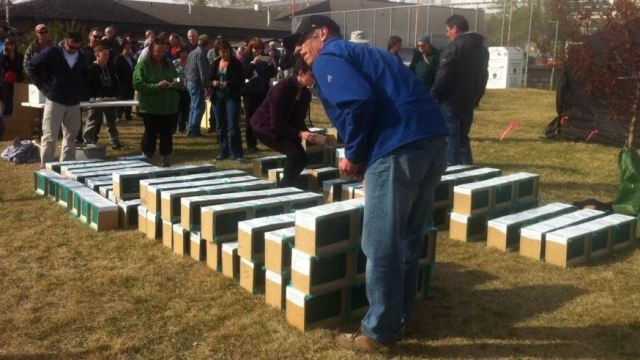
I’ve never had any hives stolen. But I’ve heard of bee thefts, even up here in neighbourly Canada. Today’s news tells the story of a Quebec beekeeper who has had 184 hives go missing.  The newspapers report it as a $200,000 theft. I don’t want to argue the number, but that’s over a thousand dollars a hive. The bee company’s president calculates the loss this way: “It’s a big loss because first you lose the [blueberry] pollination in Lac St. Jean, you lose the pollination for the cranberries, then you lose the honey crop, and you have to build new hives. It’s costly. It’s a loss of a few hundred thousand dollars,” he said.

It’s the biggest bee theft I’ve ever heard of and it’s a tough time of the year to lose bees. Replacement packages can’t be found this late in the season. Pollination contracts have to be filled. This is a really bad situation for the beekeeper.

The police are looking for 5 million missing Quebec honey bees. We presume that the colonies have not been killed, combs melted down to supply a bee rustler with drug money. Instead, the brand burned into the wooden bee hive equipment should alert investigators of the bees’ rightful owners. Hopefully the beekeeping family will get their stolen property back.

Proper punishment: This is Albrecht Durer's The Honey Thief

Proper punishment for a bee bandit:
Albrecht Drürer’s 1514 watercolour, Cupid, The Honey Thief


Update: The Mounties always get their man men. Two brothers have been arrested for the alleged Quebec bee theft:

http://www.ctvnews.ca/canada/suspect-arrested-after-5-million-bees-stolen-in-quebec-bees-remain-missing-1.2892500

Posted in Commercial Beekeeping, Movies, People, Strange, Odd Stuff | Tagged , , , , | 2 Comments

Herbicides, Bacteria Killers, and Honey Bees

Recently, I learned that herbicides such as Roundup and 2-4-D kill bacteria. Not only do they do a fine job of killing broadleaf pollen producers, they also kill some microbes. This information didn’t come from the tin-hat doom-sayer who lives on the other side of my computer screen. I saw it written up on the pro-business Forbes website, so it might be true.

For years, I’ve puzzled over the complaint that herbicides kill bees. I thought this was a mistype. Surely they meant insecticides kill bees. Herbicides are supposed to just kill weeds. Nasty weeds that choke farmers’ fields.

But now I learn that herbicides kill bacteria. You will see in a moment why that’s not so good for bees. A lot of chemicals are antiseptics – rubbing alcohol, iodine, and fire, for example. Honey, of course, also kills bacteria. So it should not surprise us that some of the ingredients of the most popular herbicides are also bactericides. These are either antiseptics (killing bacteria locally and topically) or antibiotics (disrupting bacterial growth, including internally). Here’s a brief summary of a few favourite herb-killers:

2,4-Dichlorophenoxyacetic acid (usually called 2,4-D) is an organic compound. Yes, folks, it’s organic. Its chemical formula is about as complicated as sour dough’s: C8H6Cl2O3.   2,4-D is a systemic herbicide which causes uncontrolled growth in most broadleaf plants, killing them, while most grasses such as cereals, lawns, and grassland are relatively unaffected.  2,4-D has been around since 1945.  Its patent expired long ago so any company with a chemistry lab can make it. As a result, over 1,500 herbicide products contain 2,4-D as an active ingredient.

Roundup’s key ingredient is glyphosate. A Monsanto chemist, John E. Franz, discovered that glyphosate is  an herbicide in 1970.  Its patent has also expired, but Monsanto cleverly and profitably created glyphosate-resistant Roundup Ready crops, enabling farmers to kill a very wide range of weeds without killing crops.  This allows even better (and actually cheaper) weed control for farmers, but they need to buy seeds developed specifically to tolerate the organophosphorus compounds.  Monsanto sells those seeds, of course. Unfortunately, in the same way that Monsanto was able to find genes that resist glyphosate, Mother Nature (a semi-independent unincorporated entity only partially owned by Monsanto) enabled weeds to evolve and become glyphosate-resistant. This is not as bad as it sounds, the weeds are only partially resistant and are killed by increasing the amount of glyphosate applied. (Of course, in a few years, the weeds will evolve to be even more tolerant. But then the farmer simply increases the dosage again. Meanwhile, the World Health Organization found that glyphosate is carcinogenic.  In 2007, glyphosate was the most-used herbicide in the United States’ agricultural sector’s arsenal and the second-most used in home and garden, government and industry and commerce.   But what’s to worry?

what me worry

Dicamba is sold under names like Banvel, Diablo, Oracle and Vanquish. Is it just me, or do those sound like Satan’s nom de plumes? The Dicamba family is made of organochlorines derived from benzoids. In this 25-year-old fact sheet on Cornell University’s website,  dicamba is described as a highly corrosive acid that can cause skin irritation and “severe and permanent eye damage.”   Sprayed on broadleaf plants, it kills.

We have our pick of dandelion killers:  2-4,D, glyphosate, dicamba. There are others. Now let’s consider if these herbicides kill bees. I can see how they’d make a bee’s life less enjoyable. Just as the bee approaches a bright yellow dandelion flower, grounds-keeper Willie floods the septal nectaries with glyphosate. That shouldn’t kill the bee, but it might make her groggy. Hopefully, she can still return to her nest with her slightly damp pollen. But that’s where the real problem may start.

Bees use bacteria to make pollen more palatable. The bacteria, mixed with pollen in beebread (the bees’ staple protein dinner), makes the pollen more easily digested. Herbicides kill bacteria. Obviously, if the herbicides kill bee-friendly pollen-reducing bacteria, herbicides may result in malnourished bees. This alone does not cause colony collapse disorder, nor has it alone caused the demise of bumblebees and other creatures. But it’s probably one more ingredient in the toxic soup that makes a bees’ life brief and dreary.

Posted in Ecology, Pesticides, Save the Bees | Tagged , , , | 6 Comments