On Friday, I led an ecology program at the local elementary school. My 32 students ranged in age from 6 to 12. They were part of an experimental class where kids in their school could select their interest and indulge for a couple hours each Friday. One of the school’s teachers invited me to lead a 2-hour honey bee ecology session. Bees, flowers, little kids. What could go wrong with that? Actually, it went much better than I expected so I’ll share what I did and what worked best.
 We started the program inside a classroom. I made a 30-slide Powerpoint which featured bees, flowers, and children working with bees. (For a kids’ Powerpoint, use just one picture per slide and just two or three large, simple words. Don’t clutter the slide with wordy details and excess photos. This advice goes double on presentations for adults – they have even shorter attention spans.)
The pictures were a backdrop to the more active hands-on presentation which I conducted simultaneously. It began with a big plastic garbage bag. Meanwhile, the first slide showed someone’s palm covered in bees. The kids squirmed and one youngster demanded to know why the hand in the picture wasn’t getting stung. In answer, I held up the plastic bag.
“I have a bee in this bag. Is everyone OK if I take the bee out and show it?” A few kids slid away from me. I didn’t let their anxiety build. I promised it would be OK if I took out Benny the Bee.
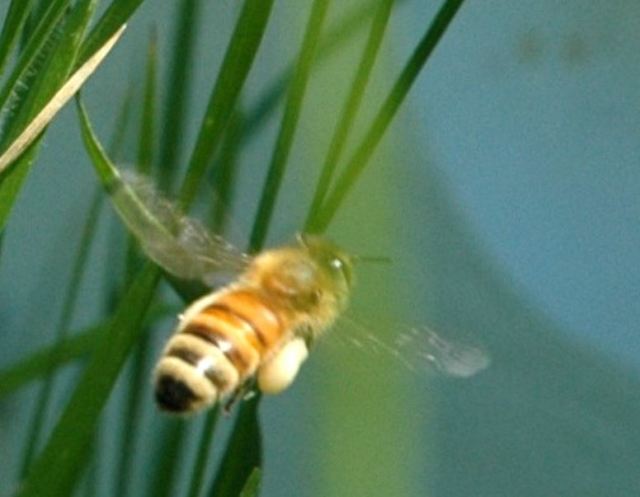
 Benny is a big, stuffed, adorable bee. He’s a boy, just like the bees causing concern in the picture on the white-board behind me. “Boy bees, like Benny and the drones on the screen, don’t have stingers.” I used this as a starting point for bee safety. (“Girl bees can sting if they feel threatened.”) I began a quick overview of bee anatomy. Even the smallest of the kids knew that bees have three main body parts. I described the head as the brain, eyes, and mouth of the bee while the thorax is like a huge muscle that powers the wings and six legs. The abdomen (for the kids’ presentation) is mostly a stomach and a stinger. The kids were fascinated that bees have three sets of eyes. I didn’t go into the way polarized light can be sensed by a bee’s third eye, but I did touch on ultraviolet, comparing the bee’s extra colour vision with the high-pitch sound perception of their pets – something these kids understood.
 The presentation continued like this. After a few more slides, the teacher dressed a child in the little bee suit which I’d brought. Meanwhile I passed around a new Pierco frame and a new small copper smoker. We talked about these, but mostly I wanted the kids to physically connect with what we were doing.
We had pictures and discussions of bees on flowers and the idea that bees communicate their discoveries. It was time for the waggle-dance. After half an hour of patiently sitting and listening, the kids needed a stretch, so they waggle-danced. They stand, wiggle quickly, walk forward, turn around, and repeat. I strongly recommend this activity if you are talking bees to small kids for any extended period. The kids need to stretch and they’ll remember that bees dance to communicate. At all times, I try to give simplified but directionally accurate information. This is not the time to point out that debates exist regarding the precision or utility of bee dance communication. On the other hand, respect the kids, use intelligent language, and don’t coo and giggle. They’ll respect you as an adult and pay attention if you treat them as smart young people.
I mentioned flowers and pollination. At this point – with little tots as your audience – you want to select your words carefully so you might be invited back another day and not spend the afternoon explaining yourself at the principal’s office. I never use the words ‘sex’ or ‘reproducing’ – it’s enough to say “bees help flowers make seeds. Without bees, there would not be flowers, seeds, or fruits like apples and blueberries.” The kids never ask for more details so you can generalize. Show pictures of bees dusted in pollen. Talk about the way flowers attract bees with nectar. But genetics can wait until junior high.
At this point, the teacher led the children outside. Benny the Bee accompanied the youngsters, carried by a shy-looking kid whom I’d spotted.

I had three outdoor activities planned. Since the focus was bees and ecology, I wanted the kids to 1) notice flowering trees, bushes, and annuals; 2) look for places where bumblebees might winter (cracks in the ground) or where honey bees might nest (cracks in the school building’s masonry); and, 3) collect pollen. I distributed Q-tips (cotton swabs) from a new, unopened box which I’d brought. The kids each got one new Q-tip and (gently!) attacked flower blossoms, dabbing pollen, pretending to be bees. Soon, almost every child was thrusting a Q-tip towards my face and asking, “Is this pollen?” They always received an affirmative, even when the swab looked like it was covered with dirt.
The kids become rather confident of their knowledge about bees and any fear they may have had abates a bit. So it’s good to use the outdoor setting to remind them again to be careful and respectful of bees. Too much exuberence may lead to stings.
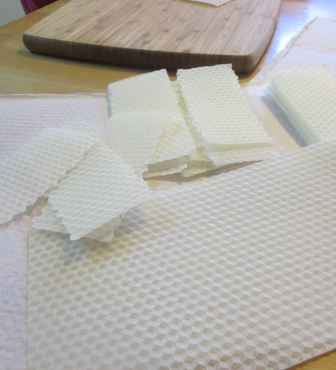 Back inside the classroom (where the children were counted), I distributed handouts with bee cartoons to be coloured and trivia questions to be answered. The kids liked these but were even more interested in the small rectangular strips of new wireless foundation I gave them. This is always a big hit because they notice the waxy odour and hexagonal pattern right away. I caution them not to eat it, but I know that some will and I know that wax is harmlessly ingested. Giving wax is better than giving honey (which beekeepers sometimes distribute) because it’s not sticky and parents are not going to call with complaints about their youngster’s blood sugar and dietary restrictions.
All of this lasted about two hours. In two hours, you reach over 30 kids and, indirectly, a few dozen parents. It takes a few hours to prepare, but if you use some of my tips (especially the wag-dance stretch break, the wax gift, and the outdoor activities), you will find that the kids will enjoy learning and the message about the importance of bees will get out to the schools.

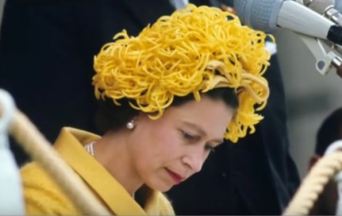 Queen Elizabeth commands tens of thousands and lays up to 2,000 eggs a day? That might be an editing error. Dan Graur, a biologist in Houston, discovered that Reuters News Service once required that all stories about “the queen” should henceforth refer to her majesty as Queen Elizabeth. Thus, instead of “the queen and her horse boarded the queen’s yacht,” reporters must write “Queen Elizabeth and her horse boarded Queen Elizabeth’s yacht.” Well, that’s good, respectful policy. In theory. In practice, it threw a spanner in the works.






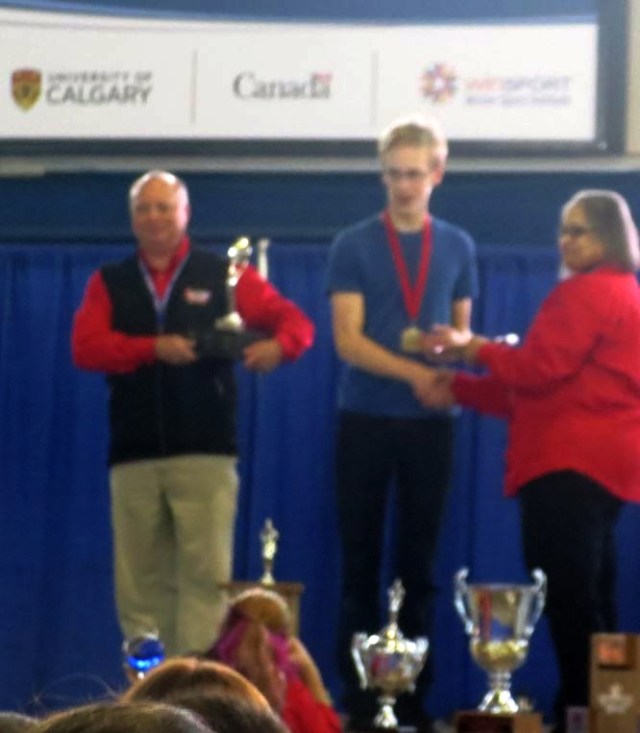
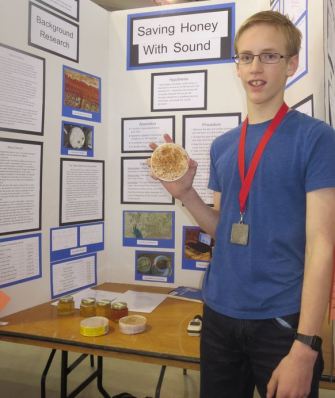 Brag time. We just got home from the big Calgary science fair competition. My 13-year-old won three awards. Here’s the kicker: his project was called Saving Honey with Sound. His experiment was based on sending ultrasonic energy waves into combs of granulated honey, attempting to liquefy the honey without using heat and without melting the wax comb.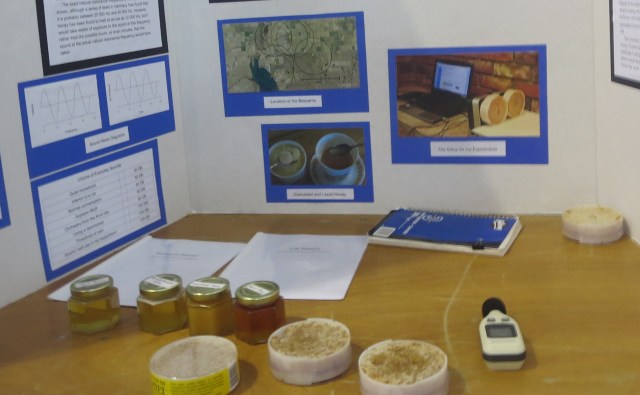
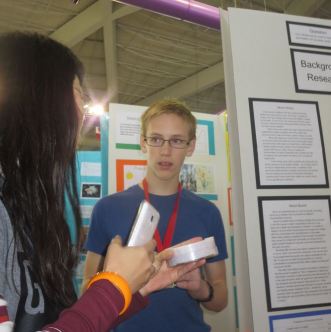 Here is what I learned from him. The idea of using ultrasound to reverse granulation works, at least as part of a small-scale experiment. It may even have commercial application, but my son is not totally convinced. He used speakers which emitted 18,000 hertz sound waves at just over 100 decibels. (By the way, at such a high frequency, the sound is inaudible to humans. There is no risk of hearing damage – we asked an auditory physician before we allowed the boy to start.) After seven days, there was some liquefying. He told me that if he had bigger speakers and if he had an amplifier that could generate a higher frequency, the results would have been more spectacular. That’s what he thinks would be required in a honey operation if a beekeeper wants to extract any combs which are crystallized.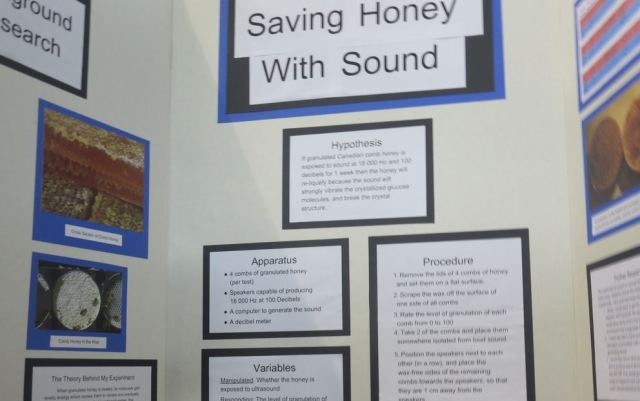
 Although the Ohio River’s


 My last two blog posts (
 Ten years ago, I published a book called