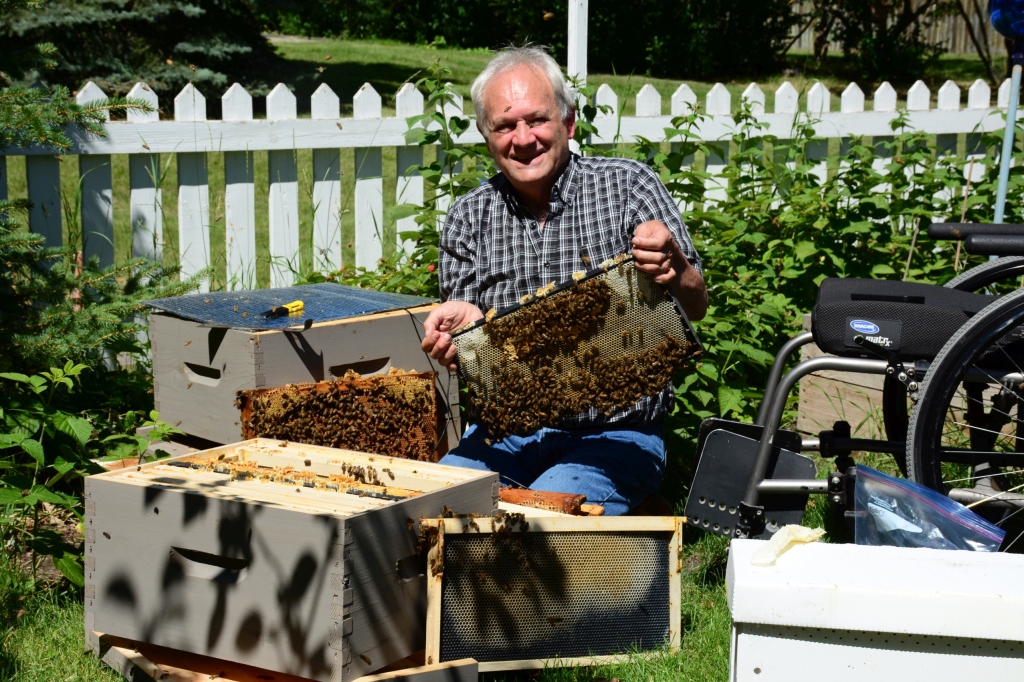
Mid-70s is too young to pass over to the other side. But that was the fate for Kim Flottum, 76, who passed away Sunday, December 10, 2023, after a short battle with cancer. The bright and adventurous bee master, editor, and author was based in Medina, Ohio. Kim was the editor of Bee Culture magazine for 33 years, retiring in 2019. He was originally from central Wisconsin. It followed easily that he would earn his bachelor’s degree in horticulture from the University of Wisconsin. Following graduation, he worked as a researcher at the USDA Honey Bee Research Lab in Madison. His work focused on pesticide issues, crop pollination, and nectar-producing plants, especially for the home gardener.
Most of us knew him as editor of Bee Culture magazine – a job that kept him engaged and knowledgeable about bees and beekeepers. But earlier, his career took him to Connecticut where he was elected president of the Connecticut Beekeepers’ Association. Later, as Publications Manager for Bee Culture, he created a new magazine, Beekeeping: Your First Three Years. This new magazine helped Kim educate new beekeepers at the time that beekeeping was rapidly expanding as a hobby. Over the years, Kim served as the Chairman of the Eastern Apicultural Society, president of the Ohio State Beekeepers’ Association and president of the Medina County Beekeepers Association. Kim retired in 2019 but continued keeping backyard bee colonies, writing beekeeping books and articles, and co-hosting podcasts.
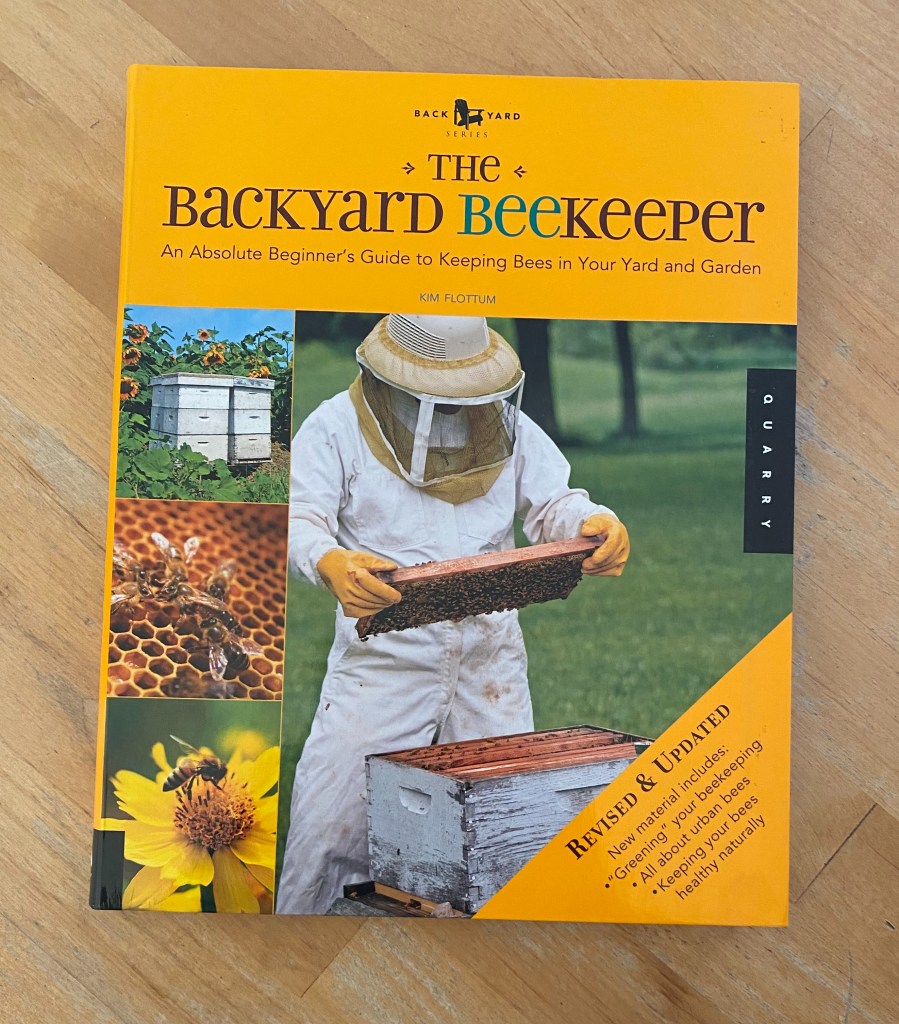
I first met Kim in Ireland at Apimondia-2005 where I gave him my deep thanks for the kind accolades that he gave my Bad Beekeeping book. He said that I’d written a classic (and he repeated that claim in Bee Culture magazine – comments that touched me, considering the source) – but it was he who was the master of writing. I own several of the books that Kim Flottum wrote or co-wrote, including The Backyard Beekeeper; In Business with Bees; The Backyard Beekeeper’s Honey Handbook; First Time Beekeeping; Better Beekeeping: The Ultimate Guide to Keeping Stronger Colonies and Healthier; More Productive Bees; Honey Connoisseur (written with Marina Marchese); Beekeeping for Dummies (by Howland Blackiston with the Foreword by Kim Flottum); Common Sense Natural Beekeeping (with Stéphanie Bruneau); The New Starting Right With Bees (with Kathy Summers); and, Honey Bee Pests, Predators, and Diseases (with Roger A. Morse). I recommend all of these books as good, informative reads and treats.
My last meeting with Kim was in August 2023 when he and Jeff Ott interviewed Etienne Tardiff and me for the Beekeeping Today Podcast. I had no idea that he was ill. I don’t think anyone would have guessed that he’d be gone in a few months. Jeff has posted a heart-felt tribute to Kim and Kim’s association with Jeff and the podcast – you can read it here.
A few days ago, I sat down with the folks at Beekeeping Today Podcast to talk about how our non-native honey bees may affect native bees. Jeff Ott and Becky Masterman were informed, sympathetic interviewers. I had a great time talking to them. Their notes for the episode are below. These notes capture our discussion really well. I hope you have a chance to listen to the podcast. We cover a lot of information, especially regarding my research at the University of Calgary.
In this episode, we talk with Ron Miksha, a former commercial beekeeper now living in Calgary, Alberta. Ron was on the podcast back in August of this year talking about the Western Apiculture Society conference with Étienne Tardiff. At the time, he mentioned his research on the impact of the non-native honey bee on native bees and floral sources. This topic deserved its own space so we invited him back today.
The debate over the impact of honey bees on native bees, pollinators, and floral sources is a complex and multifaceted issue, touching upon ecology, conservation, and agriculture. At the heart of this debate lies the honey bee, a non-native species in many parts of the world.
One major concern is the competition honey bees may pose to native bee populations. By sheer numbers, honey bees can dominate floral resources in an area, potentially outcompeting native bees for nectar and pollen. This competition can be particularly significant in areas with limited floral abundance. Some studies suggest that the presence of honey bees in resource-constrained areas can lead to a decrease in the diversity and abundance of native bees.
Honey bees are renowned for their pollination services, crucial for many agricultural crops. However, their dominance in certain ecosystems may alter pollination dynamics. While they contribute significantly to the pollination of a wide range of crops, their presence may affect the pollination efficiency of native plants, which have evolved alongside native pollinators.
Honey bees not only compete with native bees for existing resources but can also influence the abundance and distribution of floral resources themselves. Their foraging patterns can affect the flowering plants’ reproductive success, potentially leading to changes in plant community composition over time.
The debate extends to conservation and beekeeping practices. There is a growing call for responsible beekeeping that minimizes the impact on native bee populations and ecosystems. This includes managing hive numbers, especially in ecologically sensitive areas, and supporting habitat restoration and conservation efforts to bolster both native and non-native pollinator populations.
The challenge lies in balancing the agricultural benefits of honey bees with the ecological needs of native pollinators and plants. This involves a nuanced understanding of local ecosystems, the role of different pollinators, and the impact of human activities.
The debate over the impact of honey bees on native bees and ecosystems is an ongoing one, requiring continued research, informed policy-making, and collaborative conservation efforts. Thoughtful consideration and continued research are needed. Listen to our conversation with Ron as he shares his research and observations on this topic.
He died 20 years ago. But Richard Taylor is interesting enough to remember, at least every November 5th when a small part of the world stands to salute the practical beekeeper and philosopher. Here’s my tribute, dusted off for today’s post.
As I continue to plod along with a myriad of misadventures, I feel obligated to apologize for the infrequency of these bad beekeeping posts. Sorry. But I’m not going to apologize for occasionally repeating a posting from the past – especially this one, which celebrates the great commercial beekeeper, writer, and philosophy professor, Richard Taylor. He would have been 104 years old this November 5th. I first published a Richard Taylor tribute a few years ago. I wonder what he’d think of our messed-up world if he were alive and philosophizing today…
Today is the anniversary of the birth of our beekeeper-hero,Professor Richard Taylor. A commercial beekeeper with just 300 hives, he was an early champion of plastic bee equipment and the round comb honey system. He was also a philosopher who “wrote the book” on metaphysics. He really wrote the book on metaphysics – for decades, his college text Metaphysics introduced first-year philosophy students to the most fundamental aspect of reality – the nature of cosmology and the existence of all things.
Although his vocation of philosophy was speculative, unprovable, and abstract to the highest degree, Richard Taylor was as common and down-to-earth as it’s possible to become – with some minor tinges of eccentric behaviour added to the mix. I will write about his philosophy and how it shaped his politics, but first, let’s celebrate his beekeeping.
Richard Taylor and his twin brother were born November 5th, 1919. It was shortly after their father had died. That left a widowed mother to raise an impoverished family during the Great American Depression. Richard was fourteen when he got his first hive of bees in 1934 – the year that a quarter of Americans were unemployed and soup lines leading to Salvation Army kitchens stretched for blocks. He began beekeeping that year, and except for submarine duty as an officer during World War II, he was never far from bees. He respected honest hard work and the value of a penny, but as a young man, he nevertheless drifted unfocussed, trying college, then quitting, and then taking various uninspiring jobs.
In the US Navy, he spent evenings on his bunk in a sub, descending into the gloomy passages of Arthur Schopenhauer. Somehow the nihilistic philosopher appealed to Taylor and ironically gave him an interest in life. This led Taylor back to school. He became a philosopher himself.
Richard Taylor earned his PhD at Brown University, then taught at Brown, Columbia, and finally Rochester, from which he retired in 1985 after twenty years. He also held court as a visiting lecturer at Cornell, Hamilton, Hartwick, Hobart and William Smith College, Ohio State, and Princeton. His best years were at Rochester where he philosophized while his trusted German shepherd Vannie curled under his desk. Richard Taylor sipped tea and told his undergrads about the ancient philosophers – Plato, Epicurus, Aristotle, Xeno, and Thales. In the earlier days, he often drew on a cigar while he illuminated his flock of philosophy students. Those who attended his classes remarked on his simple, unpretentious language. They also noted that he was usually dressed in bee garb – khakis and boots. As soon as the lecture ended and the last student withdrew from the hall, he and Vannie quickly disappeared to the apiaries.
Taylor, the hippie beekeeper
It may be unfair to describe Dr Richard Taylor as a hippie beekeeper, but perhaps he was exactly that. As a beekeeper, he was reclusive. He refused to hire help. Rather than deal with customers, he set up a roadside stand where people took honey and left money without ever meeting him. In his shop or out among his bees, Taylor disdained big noisy equipment. He sometimes took a lawn chair and a thermos of tea to his apiaries so he could relax and listen to the insects work, but I doubt that he did this much. Through the pages of American Bee Journal, Bee Culture, and several beekeeping books, he described best beekeeping practices as he saw them – and those practices required hard work and self-discipline more than relaxed lawn-chair introspection.
Running 300 colonies alone while holding a full-time job and writing a book every second year demands focus. His bees were well-cared for, each producing about a hundred pounds every year in an area where such crops are rare. By 1958, he was switching from extracting, which he disliked, to comb honey production, which he loved. Comb honey takes a more skilled beekeeper and better attention to details, but in return it requires less equipment, a smaller truck, and no settling tanks, honey pumps, whirling extractors, or 600-pound drums. “Just a pocket knife for cleaning the combs,” he said.
To me, it’s surprising that Richard Taylor embraced the round comb honey equipment called Cobanas. The surprising thing is that the equipment is plastic. Reading Taylor’s books, one realizes his affinity for simple tools and old-fashioned ways. In that context, plastic seems wrong. But it’s not.
In the past, comb honey sections were square-shaped and made from wood. The wood had to be light-weight and soft enough to bend into boxes without breaking. The wood that suited this need in the eastern USA was basswood (also called linden, Tilia spp.). Early in the twentieth century, over a million comb honey sections were produced each year – leading to the destruction of forests of the stately nectar-producing trees. Plastic is light-weight, durable, and ultimately very practical for bee equipment. It can be recycled, a tangible benefit to a person as frugal as Richard Taylor. He was sure that Cobana equipment, invented by a Michigan physician in the 1950s, would lead to a simple practical way of beekeeping. Taylor was so enthused that in 1958, living in Connecticut, he wrote his first beekeeping article about the new plastic equipment for the American Bee Journal. Here’s the photo that accompanied his story.
Richard Taylor’s son, Randy, packing round comb honey, 1958. (Photo from ABJ).
His comb honey project worked. Richard Taylor, the beekeeper, was financially successful. In today’s dollars, his comb honey bee farm returned about $75,000 profit each year – a tidy sum for a hobby and more than enough spare change to indulge his habit of frequenting farmer’s auctions where he’d delight in carrying home a stack of empty used hive bodies that could be had for a dollar.
Taylor, the teacher
Richard Taylor immensely enjoyed teaching and lamented what he called “grantsmanship” which arose in America while he was a professor. Grantsmanship is the skill of securing funding for one’s projects while possibly ignoring the fundamental duties of teaching. Unethical grantsmanship, of course, can lead to big dollars flowing to researchers who are willing to claim that sugar, for example, does not contribute to obesity and cigarette smoke does little more than sharpen one’s senses. Richard Taylor saw the compromised atmosphere. He also regretted the demise of good faculty instructors replaced “largely by graduate students, some from abroad with limited ability to speak English. Lecturers who simply read in a monotone from notes are not uncommon,” he wrote.
Meanwhile, the (sometimes unethical) pursuit of grants was accompanied by the rise of the “publish or perish” syndrome. In his own field, Taylor pointed out that academic philosophers engaged in “a kind of intellectual drunkenness, much of which ends up as articles in academic journals, thereby swelling the authors’ lists of publications.” Taylor wrote extensively on this in 1989, saying that there were 93 (!) academic philosophy journals published in the USA alone that year – seldom read, seldom good, but filling mailboxes with material to secure a professor’s promotions.
This was not the academic world that Richard Taylor sought when he began his career in the 1950s, but it was the world he eventually left. Although he wrote 17 books – mostly philosophical essays but also several rather good beekeeping manuals – he didn’t publish many academic papers. He spent more time in the lecture halls and with his bees than he did “contemplating the existential reality of golden mountains and writing papers about them”, as he put it.
Taylor, the philosopher
I am only going to give this one short passage about Richard Taylor, the philosopher. He studied and taught metaphysics and ethics. His essays on free will and fatalism are renowned and influential, even today. I’ve never taken a philosophy course, so anything I say about the subject will probably end with me embarrassing myself. However, a few years ago, during a winter trip to Florida, a copy of Richard Taylor’s Metaphysics travelled with me. I read every word and I think that I understood it at the time. For me, most of it was transparent common sense. Since it was well-crafted and interesting, Taylor may have lulled me into believing that I understood his metaphysical description of the universe, even with just this cursory introduction. At any rate, I felt that what he wrote wasn’t different than what I’d come to discover on my own, although it was much more elegantly presented than I could ever manage.
Taylor, the Republican
When I saw Richard Taylor – just once, at a beekeepers’ meeting – I indeed thought that he was a hippie, a common enough form of beekeeper in the 1970s. His belt was baler twine and a broad-rimmed hat hid his face, though a scraggy beard protruded. I was surprised to later discover that Richard Taylor identified as a conservative and voted Republican. But he was also an atheist, advocated for women’s rights, and late in life (though proud of his military service) he became a pacifist, “coming late to the wisdom,” he said. He valued hard work, self-sufficiency, and independence. He disliked Nixon, but gladly voted for Reagan. He even wrote a New York Times editorial praising Reagan’s inaugural address while offering insight on what it means to be an introspective conservative in the 1980s.
At age 62, still a professor of philosophy at the University of Rochester, and the recent author of the book Freedom, Anarchy, and the Law, he penned that widely-circulated New York Times opinion piece. Taylor wrote that in Reagan’s inaugural address, the new president reminded us that “our government is supposed to be one of limited powers, not one that tries to determine for free citizens what is best for them and to deliver them from all manner of evil.” Richard Taylor then goes on to warn that “political subversion . . . is the attempt to subordinate the Constitution to some other philosophy or creed, believed by its adherents to be nobler, wiser, or better.”
Taylor warned of anti-constitutional subversion in American politics, “if anyone were to try to replace the Constitution with, say, the Koran, then no one could doubt that this would be an act of subversion . . . Similarly, anyone subordinating the principles embodied in the Constitution to those of the Bible, or to those of one of the various churches or creeds claiming scripture as its source, is committing political subversion.”
Taylor tells us that conservative spokesmen of Reagan’s era – he mentions Jerry Fallwell and others – are right saying that “it is not the government’s function to pour blessings upon us in the form of art, health, and education, however desirable these things may be.” Nor, Taylor said, is it constitutional for “the Government to convert schoolrooms into places for prayer meetings, or to compel impoverished and unmarried girls, or anyone else, to bear misbegotten children, to make pronouncements on evolution, to instruct citizens on family values, or to determine which books can and cannot be put in our libraries or placed within reach of our children. . . it can never, in the eyes of the genuine conservative, be the role of Government to force such claims upon us. The Constitution explicitly denies the Government any such power.”
I think that Richard Taylor would be politically frustrated today. The Republicans have drifted ever-further from small government and have expanded their reach into personal affairs while the Democrats have pushed forward extensive safety nets. A true libertarian party, or one balancing fiscal conservatism with social liberalism, such as Taylor seems to wish for, gathers little support in America today.
I hope that my summary of Richard Taylor’s political philosophy has not offended his most ardent followers. I’ve tried to distill what Taylor thought about good government – I agree with much of it, but disagree with some. It is presented as just one facet of his personality. Taylor was complicated. His last book, written in his 80s while he was dying from lung cancer, is about marriage – yet his own marriages had heartbreaks.
He showed other complicated and unexpected quirks. For example, he was an avowed humanist, yet showed a spiritual nature. In his office, he mounted a certificate which honored him as a laureate of the International Academy of Humanism, one of the few people chosen over the years. Others included Carl Sagan, Christopher Hitchens, Isaac Asimov, Richard Dawkins, Richard Leakey, Steven Pinker, Salman Rushdie, E.O. Wilson, Elena Bonner, and Karl Popper. He was in extremely elevated intellectual company. Taylor belonged there among the other atheists, even if he once metaphorically wrote in his most popular bee book, “the ways of man are sometimes, like the ways of God, wondrous indeed.”
Taylorisms in the bee yard
Richard Taylor was complicated for a simple man. It is said that he could not stand complacency, vanity or narcissistic behavior, yet he seemed to get along well in gatherings of beekeepers where such attitudes are often on display. He had a love of paradox and Socratic whimsy, yet he was disciplined and direct as a writer. He delighted in the pessimism of Schopenhauer, yet he was not a pessimist himself. Instead, he was quite a puzzle.
I will end this little essay with wisdom from Richard Taylor, the beekeeper. Taylor’s finest bee book, The Joys of Beekeeping, is replete with homey truisms that every aspiring beekeeper should acknowledge and embrace. The book itself is slim, entertaining, personal, and very instructive of the art of keeping bees. Or, as Taylor himself calls beekeeping, “living with the bees. They keep themselves.”
Here, then, are some select Taylorisms:
Beekeeping success demands “a certain demeanor. It is not so much slow motion that is wanted, but a controlled approach.”
“…no man’s back is unbreakable and even beekeepers grow older. When full, a mere shallow super is heavy, weighing forty pounds or more. Deep supers, when filled, are ponderous beyond practical limit.”
“Some beekeepers dismantle every hive and scrape every frame, which is pointless as the bees soon glue everything back the way it was.”
“There are a few rules of thumb that are useful guides. One is that when you are confronted with some problem in the apiary and you do not know what to do, then do nothing. Matters are seldom made worse by doing nothing and are often made much worse by inept intervention.”
. . . and my own favourites . . .
“Woe to the beekeeper who has not followed the example of his bees by keeping in tune with imperceptibly changing nature, having his equipment at hand the day before it is going to be needed rather than the day after. Bees do not put things off until the season is upon them. They would not survive that season if they did, so they anticipate. The beekeeper who is out of step will sacrifice serenity for anxious last-minute preparation, and that crop of honey will not materialize. Nature does not wait.”
“Sometimes the world seems on the verge of insanity, and one wonders what limit there can be to greed, aggression, deception, and the thirst for power or fame. When reflections of this sort threaten one’s serenity, one can be glad for the bees…” – The Joys of Beekeeping
We’ve had unusually mild weather for September and October in Calgary. The heat gave us a chance to clean up some odd bits of beeswax – and turn them into ducks.
I bought this melter, built by Uncle Lee’s Bees in Calgary, a couple of years ago. It quickly builds a high temperature. It is easy to load and clean. Very light to move. Easy to store over winter. I find it hard to believe that it was designed, produced, and sold for just a few hundred dollars. (You can buy one from Worker and Hive in Calgary.) On the other hand, it would take a hobby beekeeper a few years of wax sales to earn the $335CAN ($260US) that it cost. But that’s not the point. Producing nice-quality wax and doing it cleanly, efficiently, using the sun’s energy – and not on the kitchen stove! – is the real point. We found that this melter took the pressure off the kitchen, kept bowls and cutlery from being destroyed, and saved on our electric bill.
It can be expensive running an electric or steam-powered wax melter – and frankly, a waste of energy and money. Of course, there is some energy input in the manufacture and delivery of this unit (glass, insulation, metal, plastics, delivery trucks) but there are equivalent costs in any melter. At most, I would make a wide guess that after labour and profit to the manufacturer and retailer, there might be $40 in actual energy expenses building and delivering this solar wax melter. That’s a couple dollars a year over the lifetime of this melter. All the other energy needs are supplied by the sun.
This melter won’t be for everyone. Nothing ever is. And if we all loved the same thing, we’d all be married to my grandmother, as my grandfather was. But if you are looking for a way to turn cappings into ducks, this is it.
Susan Cormier, author: “Advice to a new beekeeper” (credit: CBC)
“Do not keep bees. . .
“Keep cattle, or chickens or dogs. Their emotions are recognizable, their ailments familiar. Their speech, though foreign, is in a language we understand.”
Thus begins Susan Cormier’s seasoned advice to beekeeping wanna-bees. There are sufficient reasons to refrain from beekeeping, but I hadn’t thought of the communication gap – the bees’ foreign speech. We relish the knowledge (with a bit of pride) that a human among us was able to decipher the code, the language, of scout bees who tell forager bees the distance and direction to fly to visit a meadow of sweetly scented nectar-bearing flowers. That human, Karl von Frisch, sat at a glass-covered colony of honey bees and watched their strange little dances. A bow to the right and a quick wiggle to the left told the other bees to fly two kilometres at a right angle from the sun’s position. The human who interpreted this language was given a Nobel Prize by suitably impressed other humans.
But our communication ends there. It’s a one-way path, from bee to human, and coveys little news of interest to us. Of course, bees communicate other signals to each other (odours when annoyed, brisk movements when defensive) and an astute beekeeper learns to hear this language, too. But we have no real conversation with the bees.
We humans have a much more nuanced intraspecies vocabulary to convey our thoughts and feelings. The CBC Nonfiction award-winner, Ms Cormier, exemplifies this with her light treatise on the gulf between the bee and human species. And she has advice.
“Do not fear deaths, or stings. Both of these happen frequently. Fear fire, drought, dusty parched earth and scorched, wilting flowers. Fear fire, yet carry one with you, waving smoke like fairy dust, like a priest’s incense-filled thurible, quietly chanting blessings and calm.
“Do not fear stings, or the possibility of them. Carry in your arms a box housing 50,000, and think nothing of it. Place your bare hand softly on 200 moving bodies at once and know only warmth.
“Fear tiny mites, the spread of spores and viruses — watch for twisted wings, spasming bodies, the rotting stench of dying brood.
“Fear animals with paws, and hornets. When a small midnight shadow scurries across your lawn, throw rocks, apples, anything at hand. Hiss and growl. Set up traps and hope for the best.”
There is more to Susan Cormier’s story. Her lyrical style should be read for comfort, not for a beekeeper’s enlightenment. To enjoy more passages from her work, read this piece from CBC’s Literary Prize committee; To learn about Susan’s story, see this.
Learn the language of bees. There is no lexicon, no dictionary. They speak in song and scent and secrets and dance. The closest similar language is that of a school of fish, or octopi, or trees.
Learn the smell of anger, sharp and thin like spilled bleach. Learn the sweet air and low, soothing hum of a balanced colony.
I posted this piece a couple of years ago, but it’s timeless. I was reminded of this blog post when my WordPress splash alarm went off – someone was linking to this page on their own blog. That’s OK, of course. The idea here is to throw ideas out into the ether and see who can make use of them. Since my story describes a dystopian apiary, it feels appropriate to have it included in this piece on Artificial Intelligence at a Vancouver art gallery. Enjoy my piece, below, then hop on over to Mad, bad, and dangerous to know. for a cool look at modern art.
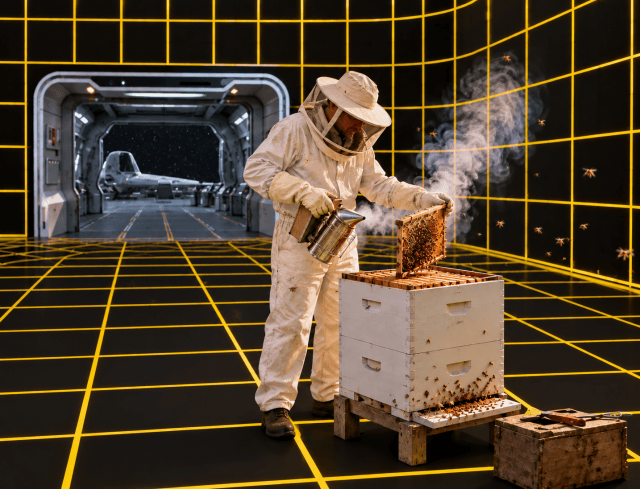
Here’s my Synthetic Apiary story. The video at the end of this link is great, but the whole concept is weird. It’s an artificial, synthetic apiary. I’ll rank it with the Flow(TM)Hive for a reason that will become apparent in a moment. But the weird concept we’re looking at is an artificial indoor living space for frolicking honey bees.
Most beekeepers like the natural touch of wood, the taste of honey, the buzzing in the ears, and the sticky wax on the fingers. I guess that’s one of the many reasons that I’m against the dreadful honey-on-tap hive. The Flow(TM)Hive is perfect for an artificial plastic world – a turn-the-tap and here’s-your-honey mentality. Well, the synthetic apiary I’m about to review should be filled with flow hives. And then forgotten.
“Computer,” demands Captain Picard, “make me an apiary.” And this is what he gets: a weird white world of perpetual spring where bees have an unending supply of sugar water and fake pollen. You see, Jean Luc Picard forgot to order trees and grass and flowers and stuff.
Regular readers of this blog know that I rant against silliness whenever I find it, yet I’ve got a soft spot for technology and design. As Neri Oxman says, the synthetic apiary is just a ‘proof of concept’ – investigating whether bees can be kept alive in an artificial environment. I understand the design experiment. It’s interesting and laudable. But weird, from a beekeeper’s perspective.
Proof of concept was established long ago when commercial beekeepers (including some of my friends) began parking tens of thousands of colonies in huge wintering warehouses where temperature, light and humidity are controlled. Bees can survive in an artificial space, we already know that. To me, the synthetic apiary looks too much like a dystopian future – some warlord has captured two hives and two beekeepers and has put them in his man cave while just outside his walls, Paris has been incinerated in a nuclear war. Or something.
The article about the Synthetic Apiary (“to combat honeybee colony loss”) duly notes that seven (of the world’s 22,000) bee species have been placed on the endangered species list and this experiment points the way to combat honey bee colony loss. Fortunately, honey bees are actually increasing in number, though some other species are, in fact, threatened. Had the designers done their homework, they may have chosen one of the threatened bee species, a nice bumblebee, for example, but that’s another issue.
In a practical sense, the synthetic apiary fails on many fronts: Bees will survive a few months on concoctions of sugar syrup and substitute pollen, but they need a natural variety of amino acids and minerals to actually thrive. They need propolis and floral pollen. They need a ceiling 100 metres high and a 2-kilometre hallway if drone and queen will mate, or they’ll die after the old queen dies. They need an artificial sun that travels across the sky, otherwise, the bees will be attracted to artificial lights and won’t return to their hive. They need flowery meadows, fresh water, open skies. They need a better holodeck.
Anyway, I hope that you will check out the video and the story. I honestly liked the film. The photography is brilliant – even if the entire concept is, well, a bit weird. And knowing that the bees won’t survive like this, it all becomes macabre.
I don’t usually ask readers to help (even with good causes), but you will feel great about this one.
The University of Calgary, where I am looking at the interaction between honey bees and native bees, has a smart group of students studying biodiversity – and quite a few are keen to know as much as possible about pollinator diversity. This means observing, counting, photographing, mapping, and documenting. You can donate to help these future ecologists through the University of Calgary Giving Day.
Among the many projects raising public interest and awareness for pollinators at the University of Calgary, there is a brilliant field guide to bumble bees. Get your own free copy from this link. Productions like this take time, effort, and even a little extra money to produce, so please help us through the University of Calgary’s Giving Day project. Meanwhile, here’s a glimpse at one of the pages from the bumble bee book. (The actual visual quality is much better than my repro, as you’ll see when you download the original book.)
Want to know more about Giving Day? Here’s the announcement from the university’s Biodiversity and Bee Campus Initiative:
The University of Calgary is a designated Bee Campus, where students, faculty, and staff research and promote pollinator, invertebrate, and plant biodiversity on campus and beyond. Your gift allows us to continue offering course-based and co-curricular research and experiential learning experiences for students, outreach and community events, creation and sharing of biodiversity resources and training tools, and community/citizen science initiatives to study and advance the understanding and conservation of biodiversity.
More information on our designation and the efforts your contribution will support can be found here:
When you donate to the University of Calgary, you’re investing in the community — and on Giving Day, your gift can have double the impact! Whether supporting scholarships, faculties, research or any one of our other designated funds, all eligible Giving Day donations made by April 21 will be matched, dollar for dollar, up to $2,500 per gift while matching funds last.
Since its launch in 2017, Giving Day has raised more than $6 million to create lasting, positive change — on campus, in the community and beyond — by creating exceptional student experiences, advancing critical research and empowering the next generation of business and community leaders.
It’s great to know a lot about bees, although it sometimes comes between you and a good time. I enjoyed Keeping the Bees, a Turkish-language drama (2019; 93minutes), but some bee-science was forgotten in the lab and the jars of thin honey was cringe-worthy. But the movie was good.
I don’t know how long Keeping the Bees has been playing on Netflix, but we caught it last night. I’ll try not to post spoilers, but here is a very brief synopsis. The central character (Ayse, in the photo above) returns to her village from Germany, where she had been working for ten years. Her mother is dying, which prompted her return, and indeed, the elderly lady dutifully checks out of the script in the first few minutes. But first, she bequeaths her apiary to Ayse. It’s not a good fit. Nor is the return of the bright and pretty young lady to her homeland.
There are some rather weird bee scenes, which are unforgivable from my perspective, but also some local bee lore (indigenous knowledge), which I fully appreciate, even knowing we can disprove some of it. The fact that Ayse imports an English queen to the apiary of Caucasian bees made me gasp. The local bees had resided and adapted to the environment of the Turkish Caucasus mountainside for thousands of years. Now comes the new British queen. Well, this, of course, is a major theme of the movie. You really can’t come home again. Or can you?
The film has gorgeous scenery, a fairly good script, excellent acting and directing. If you don’t understand Turkish, you’ll have to read the sparse dialogue, as I did. Look past the mistakes that the bees make along the way and enjoy the movie. It’s worth it.
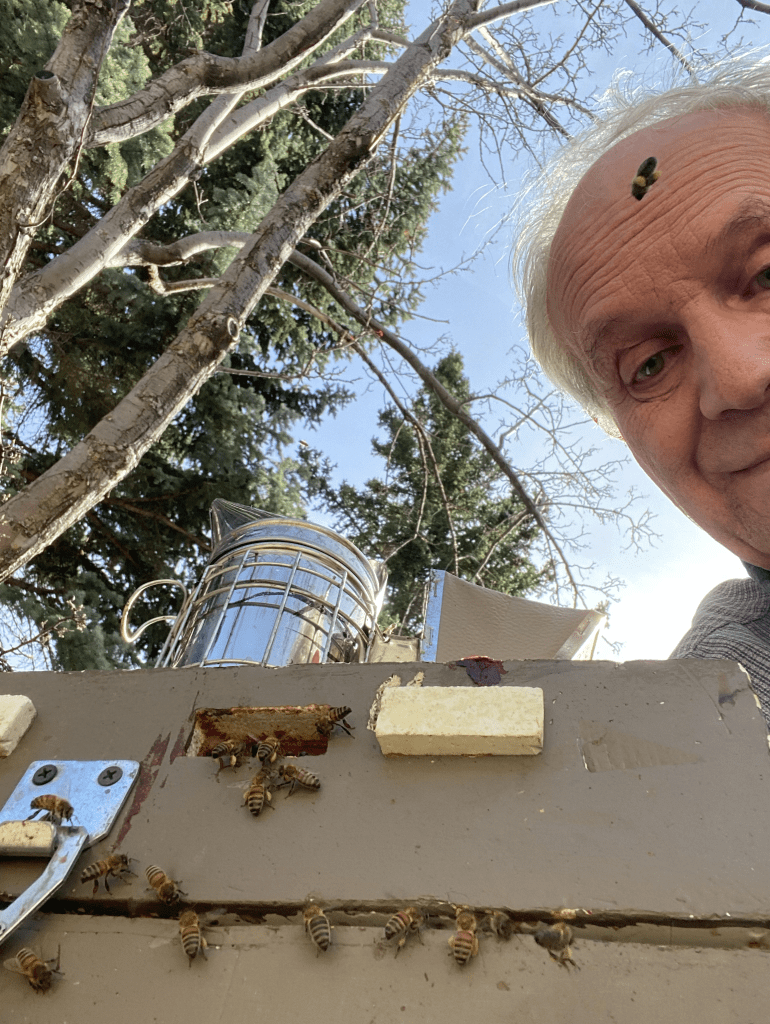
Photo-bombing my bees. Look at the pollen flying past my forehead!
April 7. Our backyard hives are collecting real pollen! Last week, I showed you some fake pollen coming into the colonies. Nothing beats the real stuff. Although desperate honey bees will carry worthless sawdust as a pollen supplement, nothing inspires a colony like a bit of natural pollen and nectar.
My honey bees and I are a long way north, high in elevation, and affected by vagaries of our continental climate. We are in Calgary, a thousand metres above sea level with some rocky mountains in sight along our western horizon. Our semi-prairies, semi-foothills location invites wide fluctuations in weather. For instance, in the past week we’ve been as cool as minus 11C and as warm as plus 21C. (12F to 70F).
The colonies average 6 frames at least 3/4 brooded, which means populations should be up 25,000 more workers in the next three weeks. And there are a lot of fuzzies – I would guess that more bees are already emerging than are dying of old age. This is a critical time for this change-over in bee demographics, with new replacing old. Beekeepers often lose wintered colonies at this time of year when cool wet weather keeps bees from foraging, reduces food resources, and induces nosema. If they get through this, the honey bees will probably be fine.
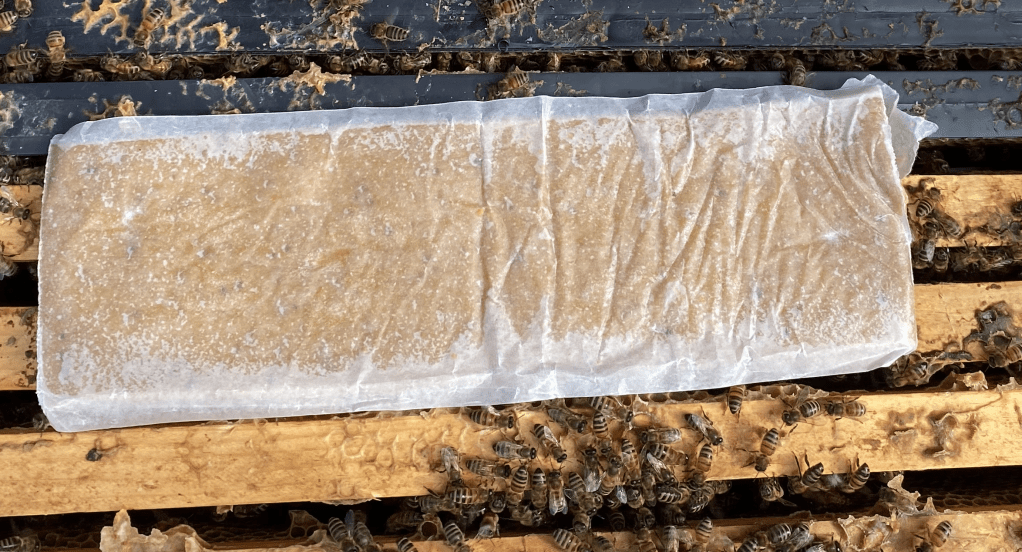
To help them, I make sure they have enough honey in reserve. Syrupy sweets can push them to expand their brood nest. I also give them all the pollen cakes they’ll take. That’s about two pounds every week. If you choose to pollen-supplement your bees, don’t stop until the weather is stable and the bees are collecting enough natural pollen. When there is a consistent, reliable abundance of natural forage, honey bees will quit eating your supplement. But if you stop feeding the bees too soon, they will likely not be able to feed their developing larvae, which will die. Although honey bees are usually vegetarians, they have been caught eating their own young when food is scarce.
Another reason to feed pollen supplement is that honey bees strip an awful lot of pollen from their neighbourhood’s flowers, potentially leaving less for other bee species. In the spring, when flowers are scarce and foraging days few, your nests of honey bees will need about 200 grams of pollen each day to feed the developing brood. That’s four pounds every ten days. Maybe more. If you feed a high-quality supplement, you do the local wild (non-Apis) bees a small favour because your honey bees don’t need to collect as much from flowers, leaving more for the natives.
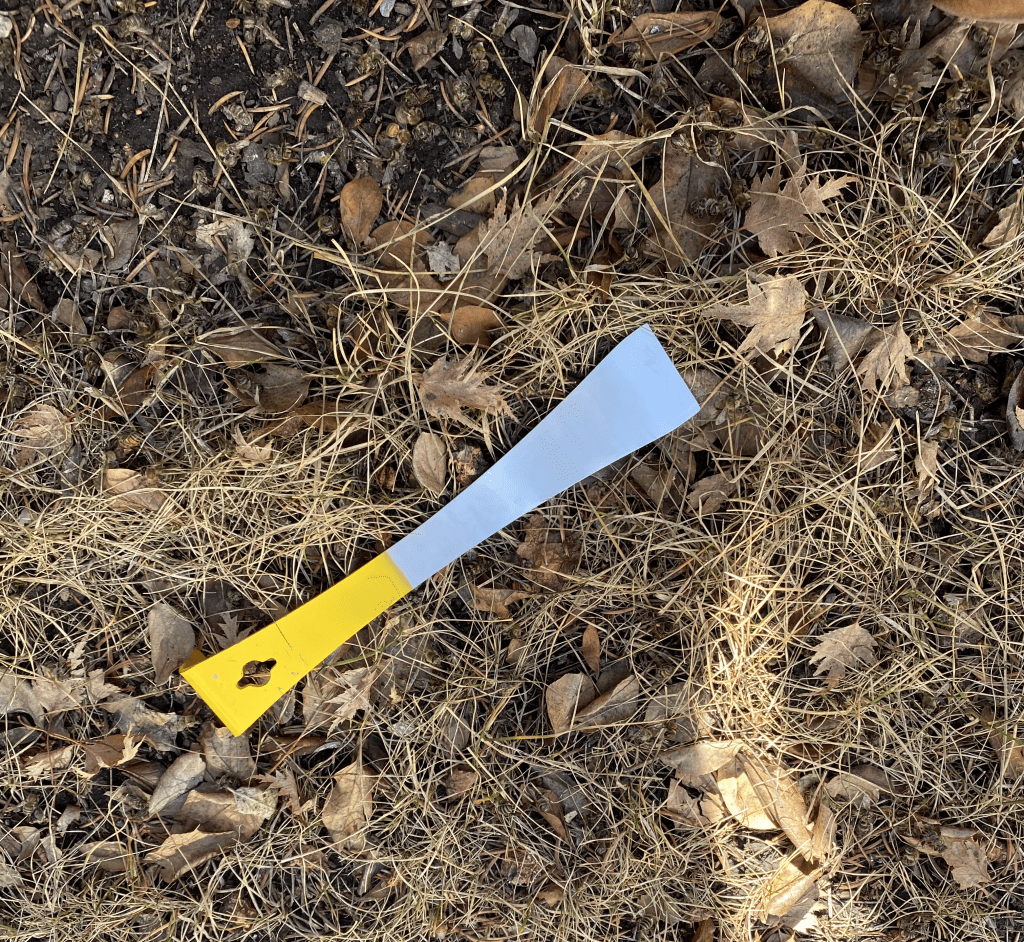
I am severely colourblind, which generally means that the difference between red and green makes little sense to me. I have been told (by enough people) that grass is green, so I have learnt to associate that word to the peculiar hue of grey that I see when I look at grass. Unfortunately, hive tools have been red for most of my life. Therein lies a big problem.
If I drop a red hive tool onto green grass, the tool disappears in greyness. Kind of like this:
OK, you can still see it easily enough. That’s because it’s still falling. But, take a look at this:
This may seem trivial, but for someone like me, this is a big deal. I once painted a hive tool white, but the paint wore off, it turned back to red, and yes, I lost it somewhere in green grass. I am hoping that my new yellow hive tool will last the rest of my life.
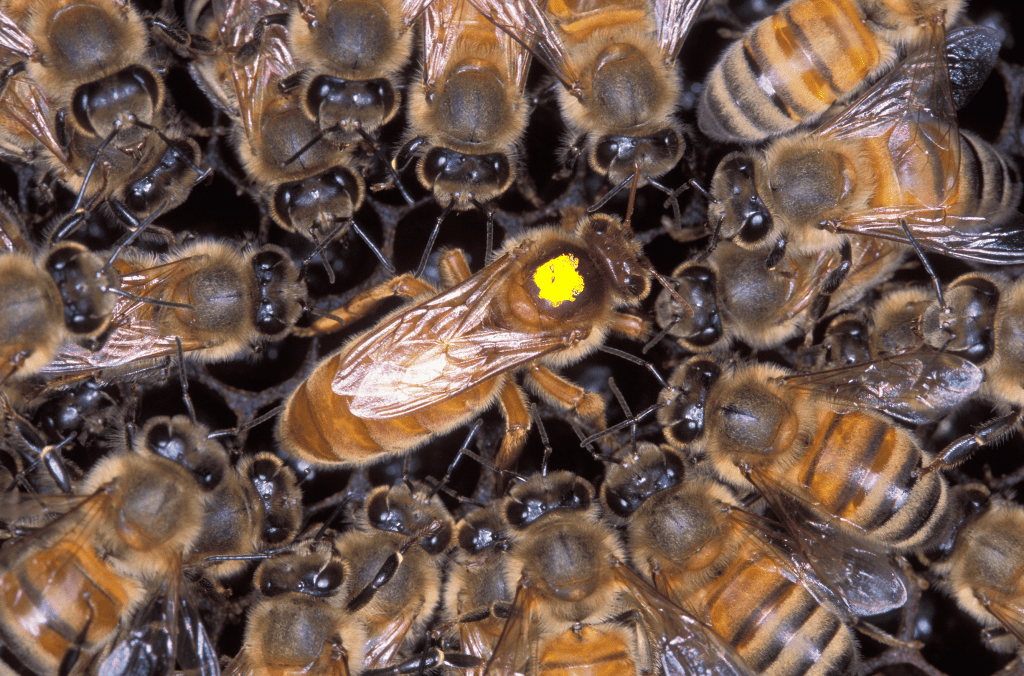
When people came up with the clever idea of painting queens, they used red and green marks among a mix of three other colours. A paint dab on a queen thorax makes her easier to spot and also, if a certain universal code is followed, makes her age known at a glance.
The queen, above, is marked with yellow, which means she emerged from her birth cell in either 2017 or 2022, according to the beekeepers’ colour code. If I saw this bee this summer, I’d know she’s a 2022 queen – I wouldn’t expect a 5-year-old to look nice and fuzzy like this. Lucky for red-green colourblind people like me, we still see yellow, blue, black, and white quite well. But sadly, the bee gods chose to put red and green on consecutive years in order to inflict the most damage upon colour-disabled beekeepers.