The Tired Honey Man

The tired honey man

Friends just back from Uzbekistan shared this photo with me. The gentleman is selling honey and he doesn’t seem too happy about it. We’ll get to that in a moment.

First, what is Uzbekistan? It’s a place on the other side of the planet. From me. If you live in Uzbekistan, then I guess I’m the one on the other side. Uzbeks were taken over by the Russian Empire 200 years ago, then fell under Soviet rule for a couple of generations. One legacy is the Cyrillic script you see almost everywhere. Another legacy is incredible pollution and general despair in daily life. The country is ruled by a “strong man” who enforces allegiance and law and order in an otherwise unruly nation. Uzbekistan has the odd distinction of having more Stans as neighbours than any other place on Earth – its five abutting Stans are Kazakhstan, Kyrgyzstan, Afghanistan, Turkmenistan, and Tajikistan. Uzbekistan is generally perceived as dusty, repressed, depressed, and difficult. I suppose that’s not entirely unfair. The country has slavery, pollution and water problems.

Uzbekistan is cursed with a near-perfect cotton-growing climate and a rotten government. Cotton is the main business in that country, but the fiber has a brutal history. It is tough to grow and in Uzbekistan, cotton is mostly picked by hand. Cotton picking, of course, contributed to slavery in America and elsewhere. In Uzbekistan, Human Rights Watch says that as many as 2,000,000 men, women, and children will be used as slaves to harvest this month’s cotton crop. The government says it is everyone’s national duty to pick cotton. Well, not everyone – just the poor. The result of their national duty is the export of over a billion dollars worth of cotton. It props up the poor country’s economy and keeps the leader in power. But people die in the fields, according to Human Rights Watch, while performing their national duty – unpaid forced labour.

Then there is the water. Cotton thrives in Uzbekistan’s desert climate – if it is irrigated and heavily fertilized. Water is diverted from entering the Aral Sea and directed into the cotton fields. This has quickly turned the world’s 4th largest salt lake into a puddle. Once half the size of England, almost all of Aral has disappeared in the past 40 years. The environmental disaster began in the era of the Russian Empire, but the Soviet overlords brought industrial-scale cotton-growing and landscape degradation to an art.

Along with pillaging the water, there is ubiquitous pollution. Typical for huge monoculture plantations, cotton is targeted by weevils and other evils. The solution is harsh poison – not systemic insecticides, but aerial and boom-spray applications of cancer-causing insecticides. Further, the continuous cropping is sustained only by industrially-produced fertilizer which has polluted what is left of rivers and lakes in the country. The air, I am told, has a stench of poison everywhere. There is little escape for ordinary folks – conscription, dust, and pollution are the reality.

Honey, including Nutella flavoured

Which leads me back to the honey man in the first picture in today’s post. He doesn’t seem very enthusiastic does he? But who could be in his position? Undoubtedly his bees have also tasted the chemicals in the air. It is hard going for Uzbekistan’s beekeepers. The government – the same one responsible for the poisons and the slavery – is expanding beekeeping by seeking bee equipment. Maybe it is some sort of 5-year plan. I imagine their plans will compete against beekeepers such as the one shown above. Last year, the government estimated honey production at about 4 million pounds. They think they can expand it. Much honey is sold in recycled containers, including the Nutella jar you see here. Plastic wrap is often used for lids. There is no fault in that – beekeepers do what they must to survive. Including gloomily retailing honey at the big Tashkent market as the honey man pictured above is doing. He may be exhausted, he may be tired. Or he may be thinking about his trip nexy week into the countryside cotton fields in the back of a big transport truck. Slave labour – the national duty – for his country’s kings of cotton.

Posted in Ecology, Honey | Tagged , , , | Leave a comment

Who is the Saint?

Golden wheat, but not golden rice

On this day in 1970, Norman Borlaug accepted his Nobel Peace Prize. You probably never heard of him. A few days ago, I read an interesting piece in an old New York Times column, written by author/philosopher Steven Pinker. He had a few words to say about Mr Borlaug. I’ll tell you what Steven Pinker said, but you can read the story yourself – it is at this address.

Steven Pinker was writing about how we perceive morality. He noted that if we were asked to pick the most moral person from this group – Mother Teresa, Bill Gates, and Norman Borlaug – we would almost all choose the saintly little lady who went to India. We might reject the billionaire who was accused of monopolizing software. And, about Norman Borlaug, we would likely ask “Norman who?” Mother Teresa moved from Kosovo to Calcutta, tended the poor, sick, and weak, and developed the Missionaries of Charity. She is the obvious choice and directly helped thousands. But Bill Gates adopted the problems of the developing world – malaria, among others – and has (somewhat) quietly contributed billions to find solutions. His work has possibly saved millions of lives. Then there is Norman who. His Nobel Peace Prize recognized his almost invisible work that revolutionized agriculture and invented the Green Revolution. By some accounts, Borlaug is credited with saving a billion people from cruel slow desperate deaths by starvation. A billion lives – that’s more than anyone else in history.

Of course it is unfair to ask who among the three is the most moral without presenting a definition of morality. But on the strength of saving human lives and reducing suffering, Norman Borlaug’s contributions were astounding. During the 1960s, dire predictions of the eminent tragic starvation of the majority of Chinese, Indians, and Africans was prognosticated by the most knowledgeable minds. But it didn’t happen. Norman Borlaug, an American geneticist, applied the latest ideas in bio-engineering and found a way to feed the billions. India, once deemed to decay in misery and starvation, now has 1.1 billion souls and is a net exporter of food.

In the 1950s, Norman Borlaug worked mostly with wheat, genetically dwarfing the plant so it wasn’t spindly and prone to falling over and losing its seeds in the field. He dramatically increased seeds per stalk and developed resistance to disease. The result was wheat that revolutionized food production in Mexico (where he did most of his research), and Pakistan and India which were becoming desperate for the help his wheat brought.

Why write about better farming and morality on a bee blog? Occasionally it is good to commemorate unselfish contributors such as Borlaug. Early in his career, Borlaug was employed by DuPont. He was offered twice the salary to stay with them, but he left for an NGO in Mexico instead. His young family would have appreciated the money. But he took the job that he thought could make the most impact and help the most people. It is also important to occasionally remember that without genetic manipulation and the application of science to solve a desperate problem, a billion people would have died. Today we find a vocal group of wealthy and comfortable folks (wealthy and comfortable by world standards) who are trying to stop scientific progress that could – for one example – allow a genetically altered form of rice to provide nutrition that would save a million children from blindness. Some well-off people with no risk for themselves or their children of suffering vitamin deficiency in America or Europe nevertheless campaign to prevent golden rice from being used in India. It is a twisted sense of smug self-interest that causes this tragedy. A billion people are lucky such people were not able to stop Norman Borlaug’s work fifty years ago.

Posted in Ecology, Genetics, History, Strange, Odd Stuff | Tagged , | Leave a comment

No longer almost free

At a get together with a small group of beekeepers, we all started bugging one of the fellows about the price of his honey. At $10/kilo (less than $5/pound) one lady figured we could do well buying his entire crop and selling it ourselves. She might – she’s a born sales person. Me, not so much. But it got me thinking about the price of honey. And how hard it is for a beekeeper to decide how much to get for the stuff. Many beekeepers, it seems, are embarrassed to ask for the market price for their honey. To them, almost free is almost too much.


Honey has reached a record high price in North America. It has never been worth more. US bees are increasingly diverted into pollination, leaving fewer to gather honey. Much honey is imported into the states (2/3 of all US-consumed honey is imported) but the foreign sources are getting harder to buy because of growing world-wide prosperity – countries that used to export their honey now use it locally. And some countries – such as China, for example – have begun to buy North American honey. I know, first hand, that this is true. So honey prices are up. But I was still shocked to see how big the price increases have been.

Bee Culture magazine has had a group of faithful honey vendors provide prices on a monthly basis for decades. In September 2006, one could sell packaged cases of jars at a wholesale price of $2.80 per pound. Eight years later, the average price for the honey has almost doubled, to $4.98 per pound. Of course, that is filtered and packed and labeled and ready for the store. The USDA reports that the wholesale bulk price (in drums or totes) has more than doubled – from $1.03 per pound to $2.12 per pound in 2013. So, if you are selling a few hundred pounds of your finest wares, check prices at the local stores, tell your customers that your honey is better than the store stuff (It probably is.) and don’t be shy about getting the market price for your effort.

Posted in Beekeeping, Honey | Tagged , | 1 Comment

Caught in the middle

Are they staying or are they going? The Globe and Mail, “Canada’s newspaper,” has an editorial written by Margaret Wente. She calls her piece “Caught in the Middle of the Bee War” and it is about the vanishing honey bees. This is not the first time Ms Wente has written about bees. The first such story that I can remember described her husband’s beekeeping adventures and it appeared around 2004. It was an unusual piece because it was quite funny – Margaret Wente usually shares more serious opinions about politics and economics. Yesterday’s column was fittingly Wente, commenting on the politics of disappearing honey bees.

The Globe and Mail piece surprised me. It begins with the usual “bees are going extinct” and “neonicotinoids are to blame,” but then Ms Wente seems to indicate that she believes neither. Which is refreshing, because managed colonies of bees are certainly not going extinct. Worldwide, the number of kept hives is 45% higher than it was 50 years ago. Since Colony Collapse Disorder was first noticed (around 2006), and since neonics became widespread (also around 2006), the number of bees in North America increased from 2.2 million colonies to 2.4 million today. Not exactly extinction. Nor is it likely that neonicotinoids are playing the leading role where sudden colony collapse is noticed. I say this because I live in Alberta, a place where neonics are used extensively, and Albertans have not suffered colony collapse. Not yet, anyway.

The column by Ms Wente mentions the Ontario lawsuit. The suit pits two Ontario bee outfits against Bayer, a manufacturer of neonicotinoids. But it was set up as an “opt-out” class action suit. Beekeepers are automatically part of the suit, unless they expressly ask to be left out. Here is what the Globe and Mail piece says about Alberta:

“Alberta’s beekeepers, which produce nearly half of Canada’s honey, aren’t joining the lawsuit. They say the new seed treatments actually reduce the bees exposure to harmful pesticides.”

A bit more from the Globe‘s piece:

“There’s no doubt that something is ailing the bees, or at least some of them. Ontario has been hit particularly hard by bee die-offs lately. But a lot of experts say the problem isn’t neonics. In Australia, the bee population is stable even though neonics have been in use there for years. The Australian regulator recently reported that neonics are better for crops and the environment than the products they replaced.”


Posted in Pesticides, Save the Bees | Tagged , , , | Leave a comment

Educating the Humans

Killer Bees in the News

Killer bees used to be big news. Enough people are nervous around bees (even the pleasant, nearly harmless, garden bees) that the idea of massive stings is terrifying. “Bee venom is a cocktail of biologically active components that are designed to inflict pain. The honey bee stings only defensively — they don’t try to kill, they try to educate,” says May Berenbaum, a professor at the University of Illinois. Unfortunately, the Africanized honey bee sometimes forgets this important rule. Yesterday, four landscapers working at a southern Arizona house were attacked. One man died. The Douglas Fire Department Chief reported, “A witness said his face and neck were covered with bees.” That 32-year-old man died of cardiac arrest. Another man, stung more than a hundred times, was treated at the local hospital and released. The workers were part of a program teaching work skills to developmentally challenged adults. Our thoughts are with the families and friends of the people attacked and with the directors of this worthwhile charity.

It is claimed that the offending bees came from a nest of 800,000, according to the press. If that is true, it would be ten times larger than any colony I ever heard of. Most likely, someone miscopied 80,000 bees (which would still be an enormous hive) and wrote 800,000 and that number has been repeated over and over again in all the news coverage, all of which seem to buy the same story and repeat the same mistakes.

Once an error is published, it takes on a life of its own and is almost impossible to eradicate. If you look at this link, you can see how the number was picked up and unquestionably reproduced. The Weather Channel headlined with the absurdity “Arizona Landscaper Dies After 800000 Bees Attack” – only a small percentage of any hive attacks. Isn’t it enough to report the fact that hundreds of bees attacked the unfortunate workers? The Weather Channel headline is either hyperbolic exaggeration or careless fact-checking – both of which are unforgivable errors from an outfit that reports the weather. Meanwhile, the New York Daily rounded up: Nearly 1 million bees swarm Arizona men, killing one. Others repeating the 800,000 number include Gawker, Inquisitr, United Press International, The Mirror, and NBC News. Interestingly, the reporter closest to the source of the attack (Tucson News Now) wrote, “One person is dead and several others are recovering from bee stings after a huge swarm of about 300,000 bees attacked landscapers working outside a home in Douglas.” Hours after the story initially ran, CBS has written, “A swarm of about 300,000 bees killed one landscaper and critically injured another… The [Douglas Fire] Station initially reported that an estimated 800,000 bees were involved in the attack.” Better, but still not right. And why didn’t the initial reporter ask the fire department which entomologist at the station counted the bees?

Deaths from Africanized honey bees are still rare enough to make front page news as this story did on Canada’s National Post, UK’s Telegraph (which accompanied their story with a picture of a tiny cluster of bees in a tree), and the other sources (or repeaters) that I already mentioned. When the Africanized bee first arrived in the USA, there were concerns that thousands of deaths would quickly follow. This angst was led by an overly eager press and encouraged by researchers (some seeking grants to study the problem) who often were inexperienced around bees. To the novice, three bees chasing after an exposed face may elicit thoughts of a fifth apocalypse horseman. Place a young, untested grad student in Brazil next to an Africanized swarm, and he will live to tell some scary stories about the bees. So, for a few years in the mid-1970s, Africanized bees dominated the press whenever honey bees were mentioned. Today, of course, unfounded rumours of bee extinction lead the news stories. I guess that’s a bit more upbeat than the tales of wonton destruction and fears the Killer Bees once conjured. Nevertheless, exaggeration and hyperbole very quickly become tedious.

Posted in Killer Bees, Stings, Strange, Odd Stuff, Swarms | Tagged , | 2 Comments

Bees as a Small Business

A lot of North American beekeepers operate huge operations. These days, 2,000 colonies is about average for a commercial operation. Help is usually imported seasonally and the beekeeper/owner is sometimes a bookkeeper/trucker who has more than a veil and gloves between himself and his bees. I asked one of these operators about this. He told me that’s the only way he can keep bees full time and feed his family. He is probably right.

Real beekeeping – shirtless, shoeless, without gloves and veil – is mostly confined to sideliners. This includes operations like the 26 hives run by actor Morgan Freeman (who probably doesn’t need the extra honey money). And it includes perhaps a thousand or so others in the USA and Canada who run 20 to 100 hives on weekends. For these folks, the bees (when profitable) provide a bit of income, but are mostly kept as a hobby. However, I know of a few others who keep a small number of hives to supplement retirement income.

I have great respect for a beekeeper in my area who retired at age 45 from a rather good job that had him traveling all over the world. He had saved some money, but certainly did not have enough money to live on. But he was determined not to work for anyone ever again. For the past 25 years, he has been keeping about 50 hives of bees. Each year he makes about 8,000 pounds of honey. He owns one small truck, makes his own equipment, hires no one, sells all the honey out his backdoor, and grosses $40,000 a year. With expenses at around $10,000, the profit nicely enhances his unpretentious lifestyle and supplements his modest income from retirement investments. And he genuinely enjoys beekeeping.

There is another beekeeper, this one a world away in northern Russia, who wrote a short interesting piece in a recent issue of American Bee Journal. This fellow, age 63, is a retired professor. He has been running bees for a long time. He has a lot of experience. He stays fit, enjoys the outdoors, and makes a complementary income from his 60 colonies. About the numbers, he writes:

“One ton of honey I produce yearly for about $6 for one pound. In addition, I sell 10-20 overwintered colonies, about 100 kg (220 lbs) of sealed [comb] honey and about 50 kg of a homemade mixture of pollen and honey. So it all adds up to about US $20,000 of gross income. I net about $17,000 a year.”

Both of these beekeepers are retired from professional careers and have found satisfaction and a modest income from keeping a small number of colonies of bees. It can be done. I suppose it can also be done by beekeepers who decide to retire from 40 years of running 2,000 colonies – though most of these folks can not dismount from their behemoth bee businesses (and associated obligations and mortgages) and will never get back to the small scale endeavours that would evince more pleasure than meeting pollination deadlines and payrolls.

Posted in Beekeeping | Tagged , , | Leave a comment

Hives as Art

Sharpening the keeper’s tongue

North Americans are missing a great canvas. The beehive. Solid, often white and publicly visible, it should be used by artists more often. I’ve been lucky enough to work hives in the USA, Canada, Mexico, Europe, and South America. Surprisingly, the most decorated colonies are in one of the most traditional cultures. Slovenia – a tiny country wedged between Italy, Austria, and Croatia – is known for its somber, hard-working folks. Slovenians honour seriousness. They tend towards understatement and practical good sense in their homes, architecture, and businesses. One might think them dour but they sure have some funky beehives. Like the one to your left. Hideous, isn’t it? It shows a woman – the village gossip – with her tongue against the sharpening stone, held in place by devils. The hive panel, called a panjske končnice, is nailed to the front of the hive, near the hive entrance. It helps the bees find their home. Slovenian hives are sometimes stacked atop each other, sometimes squeezed onto semi-permanent trailers, sometimes lined up tightly on the porch near the kitchen door. Without colourful markers, bees could easily flounder. The entrance panels serve a dual purpose – they keep both bees and souls from being lost. Traditional thought remains strong in Slovenia. These message boards are still pretty common, as are their moral messages.

Creative queen nucs

In Chile, my friend Francisco Rey stocks queen-mating nucs like the ones in the next picture. He told me that he turns his helpers loose with paints and brushes, telling them, “Divertirse!” And they do have fun. The only instruction is to be creative. The Chilean paint job serves the same function as the Slovenian entrance board – to help bees find their way home. This, as you likely know, is particularly important when young queens are on their nuptial flights. It would be too easy to end up in the wrong nuc if the boxes looked like houses in Smallville, Indiana. And residents would be like so many party girls coming home late on a weekend night, not quite sure where they belong. (For that, the Slovenians also have an appropriate hive panel.)

The artistic hive

Meanwhile, in North America, we aren’t much into hive art. I think that’s a legacy of our puritanic heritage. Functional and practical and white are preferred. I am just as guilty as most beekeepers here, as you can see in the picture below, from an incredibly dull bee yard we have in Vulcan County, Alberta, Canada. The bees might make more honey if their boxes had eccentric colours and if the hives were aligned less straightly. But don’t they look great?

Our colourless beeyard

Exciting beehives are rare on this continent. It is so uncommon, in fact, that painted hives make the news. At least, beekeeping news. American Bee Journal featured artist Jill Sanders‘ great hive art on their June, 2014, magazine cover. And out at UCLA Davis, Diane Ullman’s half-acre bee garden, the Haagen-Dazs Honey Bee Haven, has a whole bunch of interestingly painted beehives. In this case, too, the painted bee boxes are cool enough to be written about, as you will see if you follow this link. I like the colourful hives, they certainly help bees find their homes, but we North Americans mostly employ drab monotonous unaesthetic hives, rarely straying from “white” as a fashion statement.


Posted in Hives and Combs, Strange, Odd Stuff | Tagged , , , | Leave a comment

Lessons from the Hive

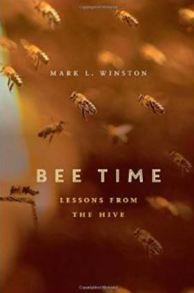
It’s Bee Time!

In the mood for a good read? Looking for a holiday gift? Mark Winston’s latest book, Bee Time: Lessons from the Hive, is as good as his other bee-related books. Which means it is very, very good. I haven’t read it cover-to-cover yet, but I have jumped around a bit like a bee in clover – so much to take it! Those of you who have read some of my reviews on other books (and movies) know that I can be pretty harsh. So, if I tell you that this book is worth more than the $20 Amazon is asking, you know that it is.

It’s a personal story. I especially appreciated the last segment of the book, the Epilogue – Walking Out of the Apiary. But I will quote from the penultimate section, from Winston’s chapter called Lessons from the Hive. It’ll give you a bit of the flavour of the book:

“Bees can be the richest of guides to the most personal understandings about who we are and the consequences of the choices we make in inhabiting the environment around us. Conversations with beekeepers about how they are affected by their time in the bee yard show a remarkable consistency. Words like “calming,” “peaceful,” and “meditative” come up over and over again, and beekeepers visibly relax when talking about their bees.” – Mark Winston, 2014

Posted in Books | Tagged , | Leave a comment

Sweet New Year!

Shanah Tovah!

Shanah Tovah! Rosh Hashanah, or the Jewish New Year, is the only holiday I can think of where honey is an integral part of the celebration. Without honey, the New Year just isn’t as sweet. I came across a really neat article published in the Toronto Star about the sweet new year connection – the article even tries to explain how honey can be kosher, even though it is made by bees. But the main part of the article is about Jewish beekeepers in the Toronto area who have a strong commitment to the environment and to connecting with the soil. It is an interesting story.

By the way, the gorgeous jar of honey in this photo is in season even after the holiday. You can check it out on the Oh! Nuts website.


Posted in Culture, or lack thereof, Honey | Tagged , , | Leave a comment

Bees Back Up on their Knees?

In today’s unlikely Op-Ed article in the New York Times: Are Bees Back up on their Knees? beekeeper Noah Wilson-Rich makes the case that the worst of the mysterious colony collapse syndrome may be over. He reviews what many of us have been saying for a long time – this isn’t the first time bees ‘disappeared’ from their hives. This fact does not reduce the seriousness of the current malady nor does it mitigate the expensive – sometimes bankrupting – losses many beekeepers suffered in the past few years.

However, Noah reminds us that unexplained colony’collapses occurred in “the years 950, 992 and 1443, when Ireland’s beekeepers noted remarkably high mortality events. Reports from the Cache Valley in Utah in 1903 described thousands of dead hives; around the same time, the Isle of Wight in England faced a near total loss of honeybees.” My father told me similar stories of almost totally empty hives a couple of seasons in the 1950s in Pennsylvania and New York. Anyway, the New York Times piece is an interesting read and gives a little balance to today’s situation. As the editorial points out, all is not well and rosy, but neither is it all dire and death. The writer makes valid points about the difficulty commercial beekeepers face in a world of diseases, chemicals, and habitat loss.

Posted in History, Save the Bees | Tagged , | Leave a comment