Beetox: Sting relief for tired skin

Joan Rivers, without Beetox

Natural Beetox

 81-year-old comedian Joan Rivers died last week. The world is now without one of its truly acerbic wits. Ms Rivers loudly paraded her much-sculpted face before crowds, saying that it wasn’t right to pretend she wasn’t getting Botoxed. Lying about having Botox treatments “says to the average woman: I’m naturally beautiful and you are not.” When Gwyneth Paltrow said she was afraid to try Botox again because she was scared she’d end up looking like Joan Rivers, the comedian cleverly retorted “She should see what I look like without Botox – that’s really scary!” Gwyneth is afraid of Botox. Maybe she should be. Botox is a paralyzing toxin derived from botulism, a sometimes fatal illness. She might prefer being stung on the face instead of poked with Botox needles. Beetox, instead of Botox. Adventurous entrepreneurs are advocating this weird bee therapy to smooth tired skin. I have seen products – creams and gels – made of bee venom. Some people are enthusiastic and say it works; others not so much.

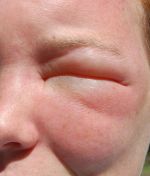
But perhaps skip the expensive creams and go straight to the source. A few stings on the face stretch the skin as smooth as a baby’s tummy. By the way, the young lady in the picture to the left took a nasty sting, but she will be alright. If you should accidentally undergo a Beetox adventure, be sure to scratch the stinger loose without squeezing the venom sac. Some clever folks pull bee stingers with tweezers grasping the poison bag – that injects an extra dose of venom, making the cure worse than the ailment. So please scratch, don’t squeeze.

Should Joan Rivers have tried Beetox? Certainly her dear friend Prince Charles could have rustled up a few bees from the Royal Hives for her. But does Beetox actually work? I don’t know. But I can tell you that most beekeepers get stung on the face. And beekeepers are undoubtedly among the most handsome people you will ever meet.


Posted in Apitherapy, Culture, or lack thereof, Hive Products | Tagged , , | Leave a comment

See You in Court

A few hours ago, Bayer and Syngenta were hit with a $450 million lawsuit for producing a pesticide which has allegedly hurt beekeepers’ businesses. This might be the largest claim ever filed in the history of beekeeping. Two Ontario honey-producing outfits – Sun Parlor Honey Ltd and Munro Honey started the nearly half-billion-dollar class-action lawsuit against the neonicotinoid manufacturers. I had never heard of either Sun Parlor or Munro, so I checked their websites.

As of this morning when I looked, I didn’t notice anything on Munro’s website that indicates their beekeeping activity (maybe I missed seeing that), but Sun Parlor’s website (September 4, 2014) says that “This year their 1,600 hives . . . will produce more than 300,000 pounds of award winning Ontario honey” – a very respectable 187 pounds per hive. Since Ontario’s long-term historic average is only around 100 pounds, that tells me that Sun Parlor’s beekeepers are exceptionally good. Congratulations to them for achieving something that most beekeepers are finding very challenging!

Despite Sun Parlor Honey’s self-reported anticipated bumper honey crop, Ontario beekeepers have generally been suffering. Last winter, losses were reportedly 58%, according to Better Farming‘s article “Cold weather blamed for high bee hive losses in Ontario”. Some Ontario beekeepers are directing blame towards pesticides. But others point out that viruses, destructive varroa mites, nosema, monoculture farming practices, a harsh winter, and bad beekeeping are among the causes of Ontario’s beekeeping woes.

They also point out that AlbertaCanada’s most productive honey province – is saturated in neonicotinoids, but has not seen the devastating losses experienced by Ontario’s beekeepers. In fact, southern Alberta’s canola-growing zone saw only 15% winter kill last year. In Alberta, neonics are used on the province’s most prolific honey source, canola. In Ontario, neonicotinoids are mostly used on corn which doesn’t secrete nectar and does not attract bees as seductively as canola does. The difference between Alberta and Ontario has been difficult to understand. Neonics are, of course, insecticides and they kill bees. If bees are fed toxic levels of neonicotinoids, it has been, well, toxic. But the levels fed in such cruel experiments have been greater than the amounts bees normally encounter. Perhaps Alberta will yet see huge losses of bees, but neonics have been used in the west for nearly ten years and Alberta has yet to see the dramatic problems encountered in Ontario.

Will the beekeepers win their lawsuit? The rebel in me wants to say “Yes!” But here in Canada, litigation is extremely expensive, extremely time-consuming, and is very much fact-driven. The Statement of Claim was filed in Ontario’s Superior Court. I have read its 30 pages, and you can, too – it is at this link. (I will comment on the Statement of Claim in a future blog entry.) The claim was filed on Tuesday asking for $289 million dollars, but was amended the next day, now seeking $400 million dollars for general and specific damages plus another $50 million dollars in punitive damages – or such other sum as the “Honourable Court finds appropriate.” The claim alleges that Syngenta AG and Bayer CropScience were “negligent” in the “design, sale, manufacture and distribution” of neonicotinoid pesticides. This may be true, but it will be difficult to prove. Lengthy discoveries will question the beekeepers’ management skills, sales receipts, expenses, and the pesticides generally used by beekeepers to fight varroa – and lots more. I don’t envy the beekeepers who will need to provide documentation and answer those questions. Eventually, years from now, there will be a trial. Considering the long battle ahead, these beekeepers are brave crusaders.

The courts may decide that the product is legal and safe except when misused. This would be a result similar to failed attempts to punish car and gun makers when their products are used irresponsibly. If beekeepers lose the case, it would probably be effective to issue claims against individual family farmers whenever they are deemed guilty of handling pesticides unsafely. On the other hand, it may turn out that neonicotinoids are viewed by the court as similar to tobacco and the makers may be forced to pay damages – especially if the manufacturers have not accurately portrayed their products, have not divulged all their studies’ results, or have otherwise misled users. If the product is found culpable by the courts, then corn farmers could be bankrupted by statements of claim for having used the nasty stuff. Either win or lose, I can see lots of future litigation directed at bean and corn farmers in Ontario – after all, they were the ones actually applying the poisons. But whatever the courts decide, it may take five years for a decision. And then there will be an appeal to the Supreme Court of Canada, with litigation lingering on for several more years.

Posted in Culture, or lack thereof, Pesticides, Save the Bees | Tagged , , | Leave a comment

Braving the Beards

An itchy growth of facial bees

Almost anyone can grow a beard. Especially if honey bees are the nubs. The young lady in the picture to your right is showing off a sporty growth of facial bees. Surely there is some medicine or therapy that could have prevented this? A few days ago, the web master of a new beekeeping site (Beekeeping Planet) sent me a link to his site’s Top Ten Bee Beards page. So, it got me thinking about bee beards.

Perhaps a stylish bee jacket?

What is the fascination with bee beards? Not everyone likes the appearance of a shaggy face. (Although Darwin, Lincoln, Marx, and Castro all got good mileage from theirs.) And not everyone enjoys having small stinging creatures buzzing the cheeks. But combine the two, and you could make a documentary feature for PBS. I suppose that photos of bee-bearded folks are almost as old as photography. I guess it’s because the bee beard combines the yucky, the creepy-crawly, and the daring-do in a delectable way. Having a potentially dangerous motley crew of stinging creatures hanging under one’s nose has an almost universal appeal.

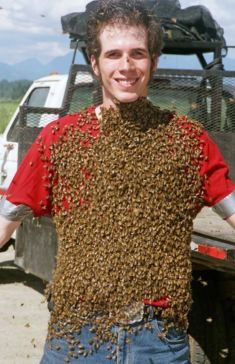
I started this blog entry with the idea that almost anyone can grow a bee beard. But then I was reminded of this tragic story about a 34-year-old gentleman in Vermont: Man Has Trouble Growing Full Beard Of Bees. It seems to be true – patchiness, uneven color, itchiness, and the odd stray gray bee seem to plague the young man whose father “always had a full thick beard of bees his whole life.” There is a solution, which The Onion news story didn’t report: some young men have been going for the full bee jacket to take attention off the lack of bee beard. It is easier to maintain and has just as much “Wow Power” as the facial bees. However, the bee jacket is not recommended attire while motorcycling.

Posted in Culture, or lack thereof | Tagged | 2 Comments

Back to the Cave

This hunter eats honey (and brood).

 Not long ago, a friend of mine was on The Caveman Diet. He devoured raw seeds and nuts, burnt meat, and handfuls of fruits and berries. It was probably a healthy diet. But he couldn’t give up either coffee or cigarettes. (I’m not making this up – he told me that cavemen must have had vices, too.) He moved away. I don’t know if he is still a caveman, but I am pretty sure he is still sipping coffee and smoking expensive cigars. I had forgotten about his culinary habits until this afternoon when my National Geographic magazine arrived. The magazine devoted 20 pages (mostly pictures) to an essay about the dinner habits of our paleolithic ancestors. It’s a good article. Partly because one of the best pictures in the story features a Hadzu gentleman (the story suggests he has a “caveman” diet) gnawing on a chunk of heavily brooded honeycomb.

Some modern dieticians are advocating a return to the primitive diet. The theory is that our forefathers evolved bodies adapted to stone-aged catching and cooking habits and we would be healthier to eat as our bodies expect us to eat. Evolutionary nutritionalist Loren Cordain, author of The Paleo Diet suggests that we could lose weight and get healthy by “eating the foods we were designed to eat.” Cordain studied modern hunter-gatherers and found that a huge amount of the calories in their diet is meat. As much as 70% or so. I guess that’s why we have canine teeth. The Colorado State University scientist recommends we eat lots of lean meat and fish and eggs and avoid foods that were tamed since the agricultural revolution 10,000 years ago – that means skipping cereal, bread, beans, peanut butter, milk and cheese. Among a whole lot of other things. But you don’t have to pass up the honey.

Caveman ate honey. Likely brood and bees, too. The modern African Hadzu diet includes baobab fruit, berries, and plenty of game. But they – and their ancestors – must have loved honey. Who wouldn’t? If the caveman diet works, people could be eating a lot more honey. If it really works well, people will be living longer, and will remain honey customers for a long, long time. Especially if they give up their coffee and smokes.

Posted in Culture, or lack thereof, Honey | Tagged , | Leave a comment

Robo-Bees to the Rescue!

robotic honey bees

US Navy’s flying bug prototype, 8 years ago!

Beekeepers are having a tough time keeping their hives alive. So far, they have been succeeding – there are more colonies of honey bees in the world now than there were 20 years ago. (Contrary to hype, honey bees are not becoming extinct.) However – and this is big – beekeepers have been losing more colonies than usual because of mysterious ailments. To cope with losses, beekeepers raise more queens than usual, make more increases each year than usual – and spend more money than usual. This is expensive, very expensive. In places like Ontario and parts of the American mid-west, over half of all kept colonies died during the winter of 2013-2014. This means those unfortunate beekeepers had to shell out a lot of cash to raise replacements so they could stay in business. This has also forced beekeepers to charge more to the groves and orchards that rent honey bees for pollination.

Growers are getting nervous – with the high cost of rental bees and all the hype about honey bee extinction, growers have begun to look at other ways to pollinate crops. Enter Robo-bees.

Harvard University researchers are coming to the rescue. Harvard’s Robobees website says that autonomously pollinating a field of crops using a fleet of tiny robotic bees is 20 years away. I think the scientists are being modest. In the U.S. Navy photo above, you can see the big clunky insect robot developed in 2006; below, you can watch a video of the newest device. The contrast is amazing. With the ever-accelerating pace of electronic technology, I think the engineers will be able to work the bugs out of their creation much sooner – and in turn, work the real bugs right out of the pollination business. (The pace will also be hastened by the military application of using spy-bugs. The U.S. Army Research Laboratory just signed a $38 million deal with a company called BAE which will lead development of spying dragonflies.)

So what’s next? Beekeepers as mechanics and computer technicians? Robo-bees that both pollinate and carry nectar? Mechanical bees that are drones? Mechanical bees with a honey tummy as big as a bus? I can see the future… Robots harvesting and extracting the honey produced by robo-bees that pollinate robo-trees and gather nectar from… dandelions. Let’s face it, there will always be dandelions.

Posted in Humour, Pollination, Save the Bees | Tagged , , | Leave a comment

Thoughts on Being a Fair Fair Judge

honey judge fair contest jars bottles ribbons

Judgment Day for Honey

What makes first-class honey? Is it the taste? The flavour? The colour? A lack of bubbly foam, dirt, bee lips, and assorted bee organs? It’s a personal choice, of course. Some like it spicy; some like it mild. But the honey judge at the County Fair has to rise above personal quirks and has to select the Blue Ribbon Best of Show on something approaching non-biased criteria.

I was a honey judge at the Millarville Fair today. For some reason, the number of entries was small. A few years ago, there were 40 jars of honey to critique. This year, there were far fewer – it is turning into a good honey year, so maybe all the beekeepers were busy with their bees. Nevertheless, judging proceeded and in the photo to your right you can see the First, Second, and Third Ribbon winners. It takes courage – and time and patience – to enter your honey into a contest. Kudos to those who dare to compete. And filter, fill jars, and finally present their homemade treasure for inspection by some odd character such as I. I tried to be fair. But we all know that wine and honey connoisseurs are snobs.

Well, here is how you, too, can be a honey snob. If you can see the chart in this photograph, you can see how the honey entries are scored here in southern Alberta. Most of the graded factors are entirely objective. Container, for example, worth 10 of the 100 points, includes the appropriateness of the jar (sorry, re-used pickle bottles get fewer marks), cleanliness (not too sticky, please), and the container’s lid and surface condition (no chips on the glass or bent metal on the lid). And so it goes through the list. The only somewhat subjective attribute relates to flavour and taste. But this has nothing to do with the judge’s appreciation of honey. I may like the foulest, blackest buckwheat (an obvious personal defect in my psyche), but I have to rise above that and treat the whitest, mildest honey with equal respect. The attributes of flavour and taste must associate with the honey entry’s degree of suitable (or unsuitable) in quality despite any ravishes of heat or water. Too much heat in the processing spoils otherwise wonderful honey, darkening it and imparting a caramelized flavour. Too much water (moisture) in the honey quickly results in a sour or vinegary flavour – it will spoil. These are the things the judge is judging when flavour and taste are being examined. In the end, then, honey should be judged on its suitability as a food and on its bright and clean presentation. If you would like a copy of the scoring sheet I used for this purpose, you can download it here.

Posted in Culture, or lack thereof, Honey | Tagged , | Leave a comment

Super-strength Beekeepers

Have you heard of the Robo-Suit? Japanese scientists are responding to the problem of creaky-boned farmers in their country by designing muscle suits that can be worn over the farmer’s khakis. Two-thirds of Japan’s farmers are over the age of 65. And much Japanese agriculture operates on small, hand-tended estates. Not so many big tractors there. If the farmer reaches down to pluck a carrot, the exoskeleton provides back support. If the farmer holds a heavy load, the exoskeleton can straighten, strengthen, and support legs. Grape-picking farmers are provided upright posture. One prototype has eight motors, multiple motion sensors and voice recognition software that allows the user to give it commands. When the machine recognizes that a load is becoming too heavy or muscles are getting too tired, it compensates for the human’s strength with its metal and plastic frame.

Not just for building boats

They are working on this idea in Korea, too. Your next Hyundai might be assembled by a small army of bionic men. Or at least loaded onto a ship built by bionic men – the sprawling Korean Daewoo ship-building yard has begun testing human-robot hybrids. Workers strapped into a prototype exoskeleton can effortlessly lift 30 kilos (65 pounds) – about the weight of a super of honey. New models will lift almost 200 pounds. The shipyard has just inked a contract to build 10 of the world’s largest freighters (each will be nearly half a kilometre long and hold 18,000 containers). The men in suits will soon be hoisting and holding and welding pieces of steel heavier than themselves. The suit itself is heavy (about 50 pounds) but the worker feels none of that weight because the aluminum and steel frame’s mass is distributed through the skeleton down into the wearer’s boots.

The military has been watching. And for years, they have been developing their own exoskeletons. The goal is to have a platoon of soldiers trudging hours on end, carrying 200-pounds of gear, possibly even napping while their robo-suits are marching forward on auto-pilot. Special-Ops and Navy Seals are expected to be outfitted with some model of Iron Man suits by late-summer 2018. A beekeeper might not benefit from all the nifty flame-throwers and razor-fingers, but the fact that military use exists makes the suit’s reality and rapid development more likely.

Meanwhile, the other big segment of America’s economy, health care, is also beginning to see exoskeletons as a part of the rehab for patients who have suffered strokes and accidents which limit mobility. But the really remarkable breakthrough will come when light-weight, easily donned robo-suits allow paraplegics to stand and walk. This has already been accomplished in trials. In June, the FDA approved the sale of ReWalk units, a robotic system developed by an Israeli tech company. It was tested at Mount Sinai (the hospital, not the hill) by Errol Samuels, a former athlete who says getting out of his wheelchair was “like a breath of fresh air.” Indeed, exercise and mobility are tough for people forced into a sedentary life by disease or accident. This system would improve circulation and general health, to say nothing of mood and quality of life. As my own paralysis advances year-by-year (I have a motor neuron disorder, similar to Stephen Hawking’s illness), so anything that can increase my activity level is eagerly sought.

I want one. Beehive honey boxes often weigh 40 kilos (over 80 pounds). And the average beekeeper’s age is now 57. This exoskeleton-robo-suit would find a ready market in the army of honey-harvesters in North America. Imagine working through an apiary in half the time at a third the effort. The farmer’s friend has been on sale in Japan for a million yen (about $10,000) per suit, but the price is expected to drop to about $5000. For beekeepers, the robo-suit would strap overtop the bee-suit. Five thousand dollars is beyond the reach of most beekeepers, but if it eliminates back surgery later in life, it’s a worthy investment. And if you are already having trouble walking, such an outfit could keep you active a lot longer.


Posted in Culture, or lack thereof, Strange, Odd Stuff, Tools and Gadgets | Tagged , | 3 Comments

The Mountain Mystery

Mountain Mystery

Not a beekeeping book

Ever wonder why the world has mountains? Where do those things come from? Ask most school kids and they will tell you about plate tectonics – the continents are moving, they bump into each other, mountains are the wreckage from continental collisions. But just fifty years ago, geologists were still thinking mountains are the result of a shrinking Earth. Or an expanding Earth. Or they would have mentioned some complicated system of deep trenches, heat, pressure, and – look out – mountains come springing up. That was 50 years ago.

The idea of mountains puzzled me, too. When I discovered that the science of mountains is about as old as I am, I thought I’d read up on the people who figured out continental drift and plate tectonics. It turned out to be so interesting that I gathered up everything I could find (about thirty books and a thousand scientific papers) and I wrote a book about the people who figured the whole thing out. The book, The Mountain Mystery, is a “people book,” not a science book, though you will accidentally learn a bit about the nature of science along the way. I’d like you to read it, then send me your thoughts about the story.

If you are among my many friends who believe the Earth is 6,000 years old, I’d especially like to hear from you after you have read this book. But be forewarned – I have been a geophysicist and a scientist too many years and the system has corrupted me into seeing the world as over four billion years in age. But science is an open book and I would change my mind in a flash with evidence to the contrary. If you are among the folks who don’t think continents can move, you might not be aware that over 2,000 GPS monitors are stuck like pins into our planet and are tracking the Earth’s movements in real-time, even as you read these words. The continents are moving. Finally, if you are among my many, many friends who are fascinated by everything in science and nature, but don’t know anything about geology or earth sciences, then this book is absolutely for you. You can buy The Mountain Mystery from Amazon – it went on sale earlier this week. By the way, honey bees make a cameo appearance near the end of the book, but this is not a beekeeping book.

Posted in Books | Tagged | Leave a comment

Under surveillance

honey bees

They are watching…

Alberta beekeepers have initiated a nation-wide program to monitor the health of Canadian bees. Even though Alberta has been largely untouched by heavy losses (so far), the Alberta Beekeepers Commission wants to stay ahead of potential disaster. Alberta beekeepers lost an average of 18% over this past winter (2013-2014). Tragically, Ontario beekeepers lost 58% of their colonies, according to a new CAPA publication you will find at this link. Beekeepers, according to the professional apiculturalists’ report, cited weather as the leading factor in winter losses this past year. The winter weather resulted in higher levels of starvation than normal. Secondary losses – as listed by the beekeepers managing the hives – were poor queens and nosema issues. Excluding the disaster in Ontario, the overall average for Canada was 19.2% of wintered hives lost. Beekeepers have already made splits and purchased packages and nucs to make up the losses – in fact, Canadian beekeepers are expected to operate more colonies in 2014 than they did in 2013.

The new Alberta-initiated surveillance project will yield real data about the prevalence of disease and pests across Canada. These numbers are needed to calibrate and understand what might cause bee deaths. This is part of the reason the Alberta beekeepers have begun this massive study. The work will be led by Dr. Carlos Castillo at the National Bee Diagnostic Centre in Beaverlodge, Alberta, and honey bees from all ten provinces will be sampled for common pests and diseases as well as exotic high-risk invaders. Some of this work has been done on a regional level, but never nation-wide. It will take four years to complete the project as currently designed. Important to the work will likely be factorial and statistical analysis that might collate the various factors that occur simultaneously in failing colonies. As this blog pointed out not long ago, combinations of factors very often outweigh the sum of individual problems affecting bees. In other words, a mild varroa infection or a mild nosema infection might be manageable individually, but when they strike together, the results could be bitterly painful. This sort of thing requires data, not speculation, to understand. The new nation-wide honey bee surveillance program is designed to gather that sort of data.

Posted in Diseases and Pests, Save the Bees | Tagged , , , | Leave a comment

Happy Dusty Anniversary

crop duster poison insecticides beekeeper bees

Killing our problems

You know what they say about new technology – someone always finds a way to put it to nasty use. Combine airplanes and chemicals, and what could possibly go wrong? Let’s fly back to 1921 and visit a grove of catalpas covered in Sphynx moth caterpillars. They are dead now, mostly because 1921 was nearly a hundred years ago and worms don’t live that long. But it did little for their longevity that the 6-acre grove of trees they once feasted upon was assaulted by lead arsenic from the air. It was the world’s first aerial dust application, the birth of crop dusting. It was hugely successful according to the Cleveland, Ohio, entomologist who suggested the scheme. The dusting killed all the bugs. All of them. And probably some rabbits and deer, too. And added to the arsenal used to slaughter bees.

The slaughter continues. A year ago, I posted a blog entry about bees killed in Florida by poisons used by one on the state’s largest citrus companies. I sent two e-mails to Florida’s Natural marketing cooperative, asking their representative how they felt about having one of their members found guilty of violating state law. That was a year ago. They did not respond to my e-mail.

I thought I’d repeat the piece from September 4, 2013. Here it is:

A bee-kill decision in Florida. According to Palm Beach’s The Ledger, beekeepers Barry Hart and Randall Foti lost $390,000 worth of bees and honey production when one of Florida’s largest citrus producers sprayed pesticides. (The loss does not seem exaggerated. For example, Foti’s honey production was off by 200 drums of orange blossom honey and millions of dead bees were piled in front of his hives.) According to a Florida state investigation, the spraying was illegal. The grower, Ben Hill Griffin Inc, was ordered to pay a fine. Of $1,500. That’s the fine?? Destroy two beekeepers, pay $1,500? It would be bad enough if the pesticide use had been legal and all those bees were killed. But $1,500 for an illegal application of poison resulting in this sort of damage? This sends the signal that one might spray whenever and however it best suits the grower, then shell out the trivial fine. The state pointed out that the maximum fine is $10,000 per instance of abuse. The state says pesticide laws were violated by Ben Hill Griffin Inc on February 21, February 22, March 8, and March 19, 2013. That would sort of indicate four violations and up to $40,000 in fines. According to one of the beekeepers, Randall Foti, every four days they were spraying where his bees were working. The insecticide application occurred while the orange trees were in full bloom. Millions of bees died.

This is all very interesting, but, as it turns out, there is much more to this story. The company accused of using the pesticides is a green, natural citrus grower, indicates Florida’s Natural Growers, a marketing cooperative. The fellow in charge is a fourth-generation grower – apparently a gentleman with a deep love for the environment, for the aquifer, for wildlife. According to Florida’s Natural website, the groves’ operator, Ben Hill Griffin IV, “prides his grove operation on environmental stewardship, as it helps to recharge the aquifer, generate oxygen, and provide a home for an abundance of wildlife. Many of the family’s decisions in the groves are made to accommodate both the health of the citrus trees and the land they grow from.” I could almost hear frogs croaking and birds tweeting as I read about the way oranges are grown by Ben Hill Griffin Inc. What I read were all very nice words and who can doubt what Florida’s Natural Co-op says? Certainly not I. So, I wrote to Florida’s Natural and asked how the company that stands accused by the state of Florida (and is ordered to pay the pittance of a fine) fits with the Florida’s Natural brand. Natural, right? If they write back, I’ll amend this blog entry with their information.

In reading the family biography and the Ben Hill Griffin company details on the Florida’s Natural website, I felt compassion for the corporation. They love the land. They must be heart-broken about the tragedy they have apparently caused. They have a fleet of pickup trucks painted in “Griffin Green.” Green. The clean color. The present owner started in the family business at age 11, “working with the baby trees in the family nursery.” Sigh. But Ben Hill Griffin Inc is a huge corporation. The University of Florida’s football stadium is named after the founder of that huge corporation. Ben Hill Griffin Jr, now deceased, was majority share holder of a company that owned the land the Atlantic Coast Line Railroad was built on – and various sugarcane, citrus, cattle, forestry, and sod farms. He was on the Forbes List of richest Americans. When he died, his $300,000,000 estate was bitterly contested in court by his four daughters who seemed to feel the one son (Ben Hill Griffin III), who was the sole trustee, had grabbed the bulk of the money, according to the Orlando Sentinel. In the newspaper’s story “Drama Ends With Heirs Splitting Citrus Millions,” they describe the fight as tabloid stuff: “The closet door swung open and out fell the skeletons…” This is not your average grove-owning family. Among Griffin Jr’s grandchildren are several Republican politicians. You might remember Katherine Harris, a Griffin granddaughter, who was Florida Secretary of State in 2000 when the ‘hanging chad’ issue contributed to George Bush’s election. Other members of the family have been in the Florida Senate and House. This is a powerful family. So it is really reassuring that their company is so anxious to do good things for the environment.

Beekeeper Foti has said that he saw empty containers of Montana 2F insecticide in a burn pile in the groves. If this is true, what does it say about one’s love for aquifers, the land, the wildlife? Or maybe empty canisters of Imidacloprid stacked in a burning pile are OK? I have read Montana 2F’s label. Surprisingly, yes, old containers may be burned if so allowed by the state, but the label also warns: “If burned, stay out of the smoke.” Always good advice. Stay out of the smoke. The label also says:

“This product is highly toxic to bees exposed to direct treatment or residues on blooming crops or weeds. Do not apply this product or allow it to drift to blooming crops or weeds if bees are visiting the treatment area. This product is toxic to wildlife and highly toxic to aquatic invertebrates.”

In issuing its fine the Florida regulators also said that in using insecticides, “The label is the law.”

Posted in Diseases and Pests, Ecology, History, Pesticides | Tagged , , , | Leave a comment