Death of a Young Beekeeper

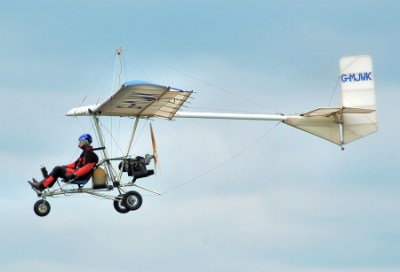
I heard today, rather belatedly, of the death of a young beekeeper. Jason Escapule was only 39. He lived south of us, down in Idaho, where he ran one of the largest round comb honey bee farms in North America. I was told his Harvard Yale Honey Bees farm, located in Princeton, Idaho, was turning out 50,000 combs of honey a year. Jason died in an accident – he was reportedly learning to fly an ultralight aircraft. It was a tiny plane with three wheels, and is sometimes called a trike-plane. Police say Jason was a student pilot, but his trainer, an experienced 58-year-old pilot, was with him when the little craft was seen spiraling downwards towards an open field. They both died on impact. That happened in November, about six months ago. Jason Escapule is survived by both his parents and several cousins. Our belated condolences to Jason Escapule’s family and friends.

I had a phone call a few years ago from Jason when he was new at his honey business. We chatted about strategies for expanding his operation, which he was just acquiring. I suggested he not get too big if he wanted to stay a comb honey producer – it is extremely labour-intensive and the beekeeper has to stay on top the entire operation. So he had only a few hundred hives – not several thousand as some western farmers operate. He liked the idea that he could produce a hundred combs from each of 500 hives and market 50,000 packages of honey. That’s about $300,000 in revenue. It takes a lot more bees to produce that much liquid honey, plus it takes big trucks and honey holding tanks. But comb honey making is a lot of hard work and takes smart beekeeping. My daughter Erika and her husband Justin produced 30,000 combs this year – so we know it’s a lot of work.

I’m not sure what has happened to Jason’s business. It is always hard to pass along a small operation of any sort when the spark plug is no longer there. But this young man was not even 40 and died unexpectedly, tragically.


Posted in Comb Honey, Friends | Tagged , | Leave a comment

80 Years in the Bees

adamsonWhat would it be like to keep bees for 80 years? You could ask 92-year-old George Birks, who started back in the 1920s. The price of a loaf of bread was 9 cents; a pound of sugar was 7 cents; gasoline was 30 cents a gallon. And honey retailed at about 5 cents per pound. You’d be happy earning a dollar or two a day. When George Birks began his 80-year beekeeping odyssey, he may have driven a used open two-seater 9-horsepower Adamson, a popular model in England where he lived.

George Birks was introduced to the sport of bee-dodging by his uncle. As a Brit, he would have experienced the bombs and sugar rationing of the Second World War, the demise of small farm holdings, and changes in climate. Mr Birks says he started more than 80 years ago. By the time he was 12, he was an experienced bee wrangler and became a founding member of the Hartlepool Boys High School Boy Scout group, where he earned his bee farming badge. By the way, if there is any doubt that he has been living in the English countryside, he was originally from Hartlepool, but now lives in Arkengarthdale, which is near Reeth, in Upper Swaledale, and he has chaired bee clubs in Yorkshire, Beverley, Cottingham, Alnwick, and Harrogate. This week, the Richmond and Beverley Beekeeping Associations presented to him a certificate commemorating his 80 years.

Posted in Culture, or lack thereof, History, People | Tagged , , | Leave a comment

Fire in the Shop

A couple of weeks ago, a warehouse fire destroyed a bee outfit’s shop at an old kibbutz in Israel. A dozen hives were lost, along with processing equipment and supers. The kibbutz was founded in 1934 by progressives from Poland and Croatia who planted orchards and made the desert blossom. The honey farm at Kibbutz Gat is mostly intended to help with pollination – Gat is home of Primor, one of Israel’s largest juicer makers. The pictures of all the wrecked equipment on the fire fighter’s website remind me of a honey house fire I once had. Or, rather, those photos show me what might have happened had I not been able to control the blaze. I was lucky, I was able to smother my flaming wax melter. If you jump over to the website with the burnt hive photos, you can see how bad things could get. I don’t know how many honey house fires happen each year, but I’m sure there are a few too many. A beekeeping colleague in Nipawin, Saskatchewan (Dr. Don Peer) years ago built a very long narrow honey shop: “Just in case of a fire,” he told me.

Posted in Friends, History, Hive Products | Tagged , | Leave a comment

Mount Everest’s Beekeeper

Mount Everest: photo by permission Luca Galuzzi

Today is the 60th Anniversary of The Conquest of Everest. It was 1953, Queen Elizabeth was just about to begin her first day on the job as queen of the world’s imperial empire. In 1953, a typical TV was a box bigger than the average ‘fridge. And it took 3 days before the world knew whether Edmund Hillary and Tenzing Norgay had climbed the peak of the mighty mountain, had died trying. Everest, named for a British Tea Company surveyor, had been attempted before Hillary and Tenzing, but all previous efforts ended in tragedy. As ABC news said today: “Sixty years ago, on May 29, 1953, a New Zealand beekeeper and a Nepali sherpa reached the peak of Mount Everest in Nepal.”

Yes, Sir Edmund Hillary was a New Zealand beekeeper. Not the backyard, one hive under an apple tree sort of beekeeper, but a real-life honey farmer. And for a few seasons after his famous conquest, he went back to tending the 1,400 colonies scattered around his island home. At the time, he didn’t think the climb was a big deal and he expected his moment of glory to fade quickly. It didn’t.

Hillary climbed Everest in 1953. Off season, he continued exploring remote corners of the Earth – in 1959, he wrote a book about his discoveries in Antarctica. 1959 was also the last year he was a commercial beekeeper. Here, from his book A View from the Summit are Hillary’s own words about his beekeeping experiences: “My brother Rex was a year younger than me and he, too, was part of our family beekeeping business. Rex and I worked well together as a team. He was smaller than me but very strong and vigorous. In the friendliest fashion we competed energetically with each other, often running side by side with heavy loads of honey to pile them on our truck…we actually enjoyed the beekeeping. Our thirty-five apiaries were spread out on fertile dairy farms up to forty miles away, so we were always on the move. The spring and summer, when the bees were gathering nectar, was a time of great excitement. The weather made beekeeping a tremendous gamble, of course. Each apiary we visited could have a substantial crop of honey in its hives or almost nothing. Rex and I reveled in the hard work.”

Posted in Beekeeping, Commercial Beekeeping, History, People, Strange, Odd Stuff | Tagged , , , | 1 Comment

Frightfully Slow

Canada’s spring has been frightfully slow this year. Snow was on the menu coast-to-coast-to-coast in April and early May. As seasoned beekeepers will admit, wintering bees at our latitude is not too hard until mid-March. In springtime, cold damp windy weather can take a heavy toll. Just when you feel you’ve done a great job packing and preparing the boxes, and losses don’t seem significant, you find fewer live hives with each spring inspection. This is when queen losses become apparent and small populations don’t achieve critical mass. Bees drift, the elderly succumb, the failing queens expire.

Things were not so bad in southern Alberta. Erika told me winter losses were around 15% down in Milo, Alberta. I haven’t been out looking at those bees – they are now Erika and Justin’s project to manage. But I have been listening to the results other beekeepers have posted, and it’s generally not so good. My friend John Gibeau, owner and operator of the amazing Honeybee Centre out near the Pacific coast, has told the Surrey Leader that things have been better. Mostly due to high winter losses several years in a row, blueberry pollination is in trouble. “…there’s not enough bees to go around,” according to the news pieces “Bee shortage stings farmers, beekeepers.” Mr Gibeau reported that new blueberry plantings, increased colony density on existing fields, and fewer commercial hives has meant “growers are out thousands of colonies.” Growers need about 4 hives per acres to assure a good fruit set.

Posted in Friends, Pollination | Tagged , , , | Leave a comment

Honey Massage

Here’s a new twist on the old fashioned Honey Massage. This one actually uses old-fashioned honey. The sticky massage seems to be increasingly popular in Europe, judging by the YouTube videos from Romania, Czech Republic, and especially videos such as this news clip (Was ist eine Honigmassage?) from Germany. In fact, the German Honey Massage videos outnumbered all the others when I did a search.

So what’s the point of a honey massage? According to numerous websites, honey is the only really natural massage ointment available. That is likely true. This series of ‘how-to’ videos will teach you how to do the massage and will tell you the purported health benefits: “It nourishes the skin, stimulates and moves lymph, frees up the fascia, and creates a space for stagnant fluid.” And many more things. I am always leery of multiple and diverse health claims, and I don’t understand what this instructor means by “moving lymph,” “freeing fascia,” and especially “creating spaces for stagnant fluids” – though I’m not really keen on hearing a definition for the last one. However, the video will teach you how to prepare and perform the honey massage.

We are always happy to see new uses for old honey. And I suspect it really does work magic on sore tired muscles. Certainly it helps beekeepers sell more honey. So, of course the honey massage is a great idea!

Posted in Apitherapy, Culture, or lack thereof, Strange, Odd Stuff | Tagged , , | Leave a comment

Bud Burst

Enjoying spring?. Soon you may have even more of a good thing. According to a detailed study published by a group of geophysicists associated with the American Geophysical Union, spring will start arriving 17 days earlier in the north, if we think of spring as the time flowering trees burst into blossom. Just so you are clear on this – spring will remain March 20 or 21 in the northern hemisphere (unless the Earth rolls over on its side); spring will continue to be the day that nights are 12 hours long, and then begin to shorten as we approach summer. But some smart geophysicists used their high power computers to model Future Earth, looking ahead to 2100 and found that climate changes already occurring will force tulip poplar and linden (basswood) as well as sourwood and acacia (black locust) to flower weeks early.

Alongside articles about dipolar magnetism and low-frequency seismic waves, the journal Geophysical Research Letters cites a simulation credited to four authors who projected budburst of deciduous North American trees, finding several troubling results. With a warmer climate, trees will blossom earlier (you don’t need your Princeton PhD to understand that). But according to the research, the various trees that once bloomed over a couple of months will cluster closer together, resulting in what the paper’s abstract euphemistically calls “the potential for secondary impacts at the ecosystem level.

This means your bees, of course. Instead of a long minor honey flow, they may have a more intense, short and sweet nectar rush. The change will happen over a few decades, so your management skills will have time to adapt. The other summary point the research makes: “We expect that these climate-driven changes in phenology will have large effects on the carbon budget of U.S. forests and these controls should be included in dynamic global vegetation models,” Ominously implying that the rate of climate change will accelerate, the so-called “Snowball Effect,” or, in this case, the “No Snowball Effect.”

Posted in Bee Biology, Climate, Honey Plants, Science | Tagged , | Leave a comment

Rattled Flowers

yellow rattle flowers and bees

Yellow Rattle Wikipedia Commons

Charles Darwin was a famous geologist before he published his revolutionary evolutionary treatise. He was also a well-rounded naturalist. It was Charles Darwin who discovered that some bumblebee species gnaw into the side of deep-throated flowers, cheating their pollination obligation. These are short-tongued bees. Their excuse is that they can’t reach the nectar, so they steal. The consequence is the flower loses its nectar without the benefit of pollination. (There are other bees, long-tongued sorts, who later correct the damage, so the flower can reseed.) Flowers have been trading food for pollination services with the animal kingdom for at least 100 million years. Darwin realized that the robber bee’s activity was not within the usual evolutionary scheme. Although the flower may have evolved deeper and deeper tubes while a compatible bee evolved a longer and longer tongue, neither expected an interloper to wonder onto the scene, perhaps blown in by a windstorm many generations earlier. With enough time, the flower may develop a toxic base to discourage theft. When Darwin discovered this bad bee habit – and wrote about it in a naturalist journal – he recognized, correctly, that the bee’s behaviour was learned, not inherited.

Recently, bumblebee expert David Goulson added to Darwin’s discovery. Goulson, at Britain’s University of Sussex, spent a couple of summers with his assistants in Switzerland. There they tracked bumblebees amid alpine flowers called yellow rattle, which hides its nectar deeply. Their observations took them to 13 different mountain meadows where they spotted the bumblebees and discreetly followed them, like undercover cops witnessing crimes. After each bee was seen robbing 20 flowers, a profile was written up and filed. As it turned out, novice bumblebees watch experienced burglars – and learn their techniques. They inferred this from the fact that most bees in the meadow poke holes into the same side of the yellow flower’s base, either right or left; not both, and not randomly. If you look at the picture, above, you can see that the flowers are rather tight to the stem. From an observer’s vantage, the right side is obvious. Although there is no advantage in selecting the right (or the left) for drilling, biting, and poking through to reach the nectar, the bumblebees tend to always work the same side as other bees are working. And it may change the following year, when everyone pokes left, for example. And it can vary from meadow to meadow. The point is, some original thief makes a choice each year, sticks with it, and everyone else copies. Learned behaviour at its finest.

Posted in History, People, Pollination, Science | Tagged , , | Leave a comment

The History of British Columbia Beekeeping

A Great New Book - BC Beekeeping History

A Great New Book – BC Beekeeping History

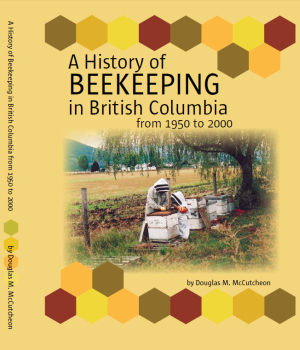
I found some time to read a book, A History of Beekeeping in British Columbia from 1950 to 2000, and have thoroughly enjoyed it. Like most prairie dwellers, I have trekked out through beautiful British Columbia as often as possible. So I am somewhat familiar with the areas the book delves into – places with the names Central Cariboo, Skeena Valley, East Kootenays, and Maple Ridge, among many others. These names always conjure great memories of gorgeous scenes and wonderful places. But I lingered longest among the dozen pages devoted to the Peace River Area. When I was but a teenager, I drove up to the Peace, thinking I should become a beekeeper there. The scenery is wonderful. The Peace River, a part of the Arctic-bound Mackenzie watershed, is dramatic and inspiring. But, of course, it was the rumours of 300 pound honey crops grown from packages of bees that really enticed me. As it turned out, an opportunity opened up for me in Saskatchewan, instead. But I’ve often wondered how my life might have evolved had I gone to work for Ernie Fuhr, or the Van Hans, or someone else up on the Earth’s rooftop, and then slowly began building my bee farm somewhere just off the Alaska Highway. When I read the BC Bee History and the clips about 430 pound averages, well it seems whimsical now. I’m glad that the author, Douglas McCutcheon, has collected the stories of the bees and beekeepers that belong to these places.

Part of the great beauty of British Columbia, and the great challenge in preparing a book like this, is centered on the extreme diversity of climates, agricultural regions, and environmental domains of the province. The author does a nice job of pulling it all together. From rocky-peaked mountains to foggy islands, bucolic pastures to rolling plains, BC hosts beekeepers everywhere, all with unique conditions, many with unusual forage crops, some engaged in a climate with Mediterranean bliss, others struggling in a severe continental environment. It all makes for an interesting compilation.

There is a lot to enjoy in the History of Beekeeping in BC. We tend to ignore our history too readily. And that condemns us to make blunders that might have been avoided. But the real joy in a book like this one comes from reading the dozens of sketches about the characters who were beekeepers last century. What would beekeeping be without “characters” anyway? Who would dare keep bees, if not the folks who live a tad bit differently from the rest of society? We are indebted to Doug McCutcheon and the editors and assistants at the BC Honey Producers Association who worked so hard to capture the memories, organize the stories, and publish the book. To them, many thanks.

If you would like to get a copy of this interesting book, you can order it by visiting the BC Beekeepers’ website. The book is large-format, contains 334 pages, over 100 photos, and covers a lot of interesting history. A bargain for $30. All proceeds beyond recovering the cost of production will be donated to the Boone Hodgson Wilkinson Trust Fund for Honey Bee Education and Research.

Posted in Books, History | Tagged , | Leave a comment

Honey is Honey

honey bear squirrel picnic

Organic Honey – (may contain a variety of organs)

Here’s a honey of a lawsuit. Target Corp has been targeted in a legal action by a Ms. Cardona, apparently of somewhere in California, who discovered from her on-line research that the $3 bottle of honey she purchased at a Target store had been filtered or processed to remove its pollen. The shopper filed a class action lawsuit claiming that the product was in violation of California laws, according to Forbes.

Target responded that the applicable federal rules provide no standard for what constitutes “honey” and that the Nutrition Labeling and Education Act requires companies to label their food products with “the common or usual name” which in this case would be honey. If Target were to call the product something like “Honey (without Pollen)” according to the presiding judge, such a label would then be in conflict with federal regulations, and would be illegal. On that basis, the suit was preempted.

Posted in Culture, or lack thereof, Honey | Tagged , , , | Leave a comment