

Why not? I’d love this!
I ran this piece last year, but it’s worth repeating. After the natural spring bouquet has begun to fade, honey bees may become hungry. The hives are (usually) strong with lots of brood. If there is a long gap between the last spring flowers and the first summer ones, bees are at risk of cannibalizing their brood (Yummy!) and then starving to death. Neither is desirable. I guess you know that. This week might be the most critical week for a lot of readers, so here’s my gap post.

If you travel metro in London (and many other cities) you might hear a polite admonition from the public address system, “Mind the gap!” It’s advising you not to get your footwear stuck between the train and platform while boarding. Beekeepers have their own gap to mind and it’s here now.
The June Gap is pretty common across the northern hemisphere. (Perhaps there’s a December Gap down in Chile.) The gap is so renowned among beekeepers that someone built a wikipage called “June Gap”. It relates mostly to the UK, but we also gap here, in western Canada, too. This is what the wiki says:
The June Gap refers to a phenomenon in which a shortage of forage available for bees occurs (typically in June) and has been observed in the United Kingdom and Ireland.
Subsequent to the massive volume of pollen and nectar produced by trees and hedges in the spring, there is a reduction in the amount of nectar available to the bees due to long grasses and dandelions suppressing many wildflowers.[1] Before the herbaceous “summer rush” of July-through-September which reinstates the high level of nectar, the high hive populations brought around by trees in the spring struggle to produce honey and may lay fewer eggs. Beekeepers need to pay special attention to the levels of honey in the hive as well as the level of water the bees use during this gap. Annual weather patterns can cause this event to occur later or earlier.
Some plants which can help provide nectar in this gap are Cotoneaster, the closely related Pyracantha, common garden [herbs], and perennial garden plants.
That’s all the Wikipedia entry says, then a few references are cited. The June Gap isn’t limited to England and Ireland. We also gapped in western Pennsylvania, where I learned to keep bees. In April and May, we saw a nice early flow from willow, dandelion, and fruit blossom. Most years, black locust (Robinia pseudoacacia) straddled late May and early June followed by tulip poplar (Liriodendron tulipifera) and basswood (linden, or Tilia americana). Then there was a (summer) gap until the autumn goldenrod and aster. Farther north and west, most beekeepers on the American plains and Canadian prairies suffer a real June Gap, a dearth between spring flows and our main summer honey flow.
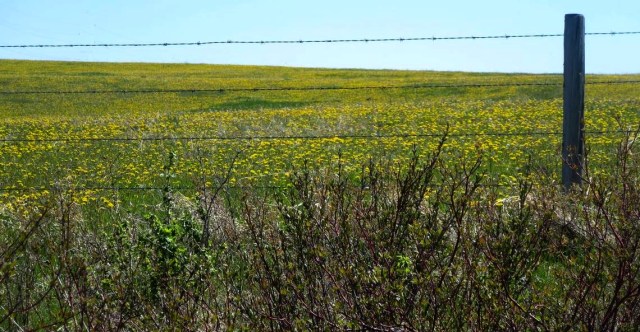
A great pasture for bees: dandelions, before the gap
What happens during the gap? There is often a little pollen coming in, but rarely is there much nectar. For those of us lucky enough to live in Alberta, Canada, we may have a good flow from dandelion (this year it peaked on May 25th, which is normal) but the drop after that major source is precipitous. We have sparse flowers (goat’s beard, buffaloberry, Siberian olive, caragana) which tease the bees a bit, but we can see hives lose weight, even on sunny mild June days. Most years, we have gaps (of varying significance) from about June 5th to June 25th. During those three weeks, queens curtail egg laying. Crucial workers that will help make the late July and August part of the honey crop might not materialize in the numbers you need.
Beekeepers have taken to feeding their bees up to a few days before honey supers go on. If the dearth is severe and hives have built up strongly on the early season flows, the gap will result in less brood rearing. But the gap can be so serious that bees destroy their developing brood and then, if it continues, they may starve. It’s possible to lose hives from starvation days before the main flow starts. Leaving plenty of reserve honey in the hive will, of course, prevent such a fate. But even a well-provisioned colony usually stops egg laying when the nectar shuts off and pollen becomes scarce.
The solution? Mind the gap. Keep a couple of eyes on your hives at this time of the year. The crop (for most of us) will start flowing in a few days. This is not the time to ignore your bees.
This is the first in a series of videos about a Victorian-era beekeeper who had the largest honey farm in England at the end of the 19th century. You can learn more about William Woodley on the Beehive Yourself blog site.

National Pollinator Week has arrived: June 18-24! Today, I’m re-running part of a blog I posted last week. It had some ideas on what you might do to celebrate Pollinator Week.
Pollinator Partnership tells us, “National Pollinator Week is a time to celebrate pollinators and spread the word about what you can do to protect them.” Eleven years ago, when colony collapse was at its peak and the end of civilization was near, the US Senate approved “National Pollinator Week” unanimously. Unanimously! Has the US Senate ever approved anything else by undissented decree? That’s a hundred out of a hundred. Congratulations to them for collaborating, for once, on something important. They wanted every American to recognize the pollination services provided by birds and bees and beetles and bats.

Birds and bats working saguaro. (USDA photo)
To help you celebrate, the pollinator people at Pollinator Partnership list some activities on their website. Here are some suggestions:
• Host an educational event at a local library
• Host a pollinator festival or native plant sale
• Plant habitat in your backyard using native plants
• Host a nature walk or pollinator expert lecture
• Screen a pollinator film
• Pollinator planting day at your school, office, local park, or library
• Build native bee houses
• Display pollinator artwork and outreach materials in your office lobby
• Encourage your governor to sign a proclamation
It’s a little late to ask your governor to make a pollinator proclamation, but most of them have already done it, apparently without your help. If you have time, read a few of the proclamations yourself. If you are in the USA, look up your own governor’s proclamation. If you like what you see, send your governor a note, or suggest changes if you must. And don’t forget to plant some native flowers this week.

(Credit: David Miksha, Calgary)

Me and the dog: handsome but dumb.
Calgary has a dry climate. After it rains, some of our bees celebrate by sucking cedar water from our deck. I’m not sure what the attraction is, but a few bees always sit on the wet deck and lap up whatever it is they are finding attractive. Maybe there are salts and minerals leaching from our year-old deck. Bees, as you know, need minerals. Some beekeepers, keeping colonies in monoculture areas, supplement their bees’ diets with mineral and vitamin supplements. I’m not sure that’s legal, but try to stop a beekeeper who thinks she is helping her bees.
Our colonies are sitting amid a diverse ecological landscape with quite a variety of pollen nearby, so I’m not sure why the bees would be collecting mineralized/salty water, but a dozen or so drop by and mop our deck. Of course, it could be that the only attraction is water – bees use water for cooling and for baking beebread. However, even though there is water everywhere after a rain, the only bees that I see gathering water are on our deck. (It’s possible that I simply don’t see bees that are in the grass or on nearby rocks.)
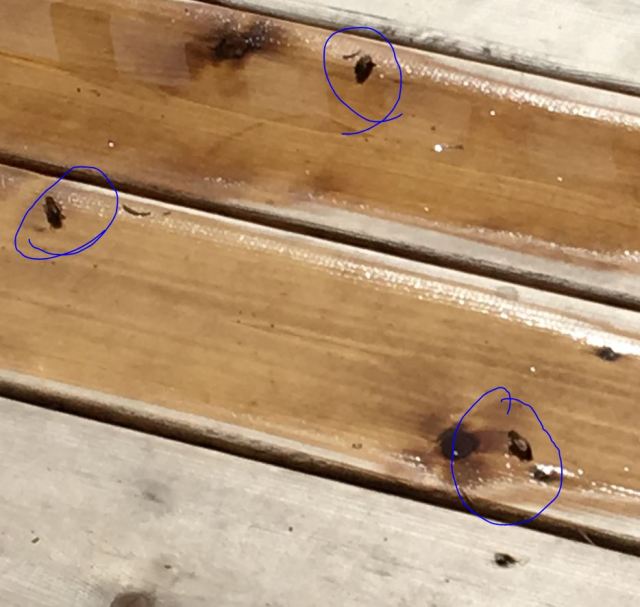
I don’t mind. There aren’t many. If there were hundreds, I’d try to figure out how to evict the bees. However, I have a minor concern for our dog. He’s a handsome yearling, smart when he wants to be, but sometimes dumb as a stick. He tries to sniff the bees. I’ve also caught him trying to pick one up with his teeth. He is yet to be stung, but it seems inevitable.
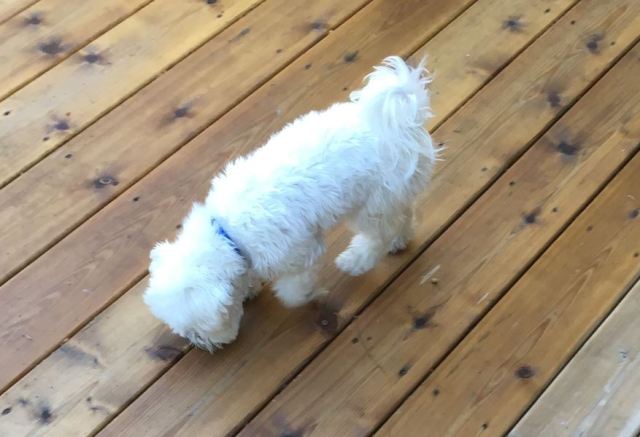
Close encounter with a honey bee.
I’ve asked beekeeper friends who tell me that pets can have similar reactions as humans, ranging from benign, but painful, learning experiences to severe systemic reactions. It’s the latter that I worry about, of course. If he only gets a big swollen face, we can feed him with a syringe for a couple of days. But if it’s a serious reaction, do we give the little fellow antihistamines and a stab from the epipen?
I’ve checked a couple of vet websites. The information is surprisingly familiar – try to remove the stinger to stop the injection of venom, monitor the amount of swelling, call a vet. All of that’s the same as I would do for a toddler, including calling a vet. If breathing becomes impaired, Benadryl is recommended (our dog is mostly fluff so the dose would be really small). I saw no mention of epinephrine, but I think I would steer clear of that, unless it looked like our puppy was about to cross the River Styx. I’d like to hear from readers – has your pet been stung? Have you trained your animals to avoid sniffing venomous insects? Do you have any suggestions that might reduce the risk of stings?
June 12th. I have an excuse to write a bit about the amazing Ethel Eva Widdowson, born in London on June 12th, 1912. By age 30, she had defended her doctorate in nuclear physics, begun to teach at Sheffield University, married stockbroker James Crane, changed her name to Eva Crane, and took home a beehive as a gift from a wedding guest.
It may seem odd to receive honeymoon bees, but it was 1942. England was at war. Sugar was rationed. Those bees were intended to help the newlyweds through the wartime food shortages. Unexpectedly, the bees led to a whole new career for Dr. Eva Crane.

Photo from cover of the book
Eva Crane : bee scientist 1912-2007
edited by Walker and Jones
Eva Crane studied the sciences. She was one of only two women earning a maths degree at King’s College London in 1933. This was followed by an MSc in quantum mechanics in 1935 and her PhD in nuclear physics in 1937. Shortly after, she began lecturing. She could have led an outstanding life as a theoretical physicist, but alas, her bees got in the way.
In the early 1940s, she moved from the male-dominated math and physics field to an amazing career in the arguably more male-centric world of bees. Today, with about half of new beekeepers female, we forget that bee clubs in Crane’s day were completely under the thumbs of men – usually fussy old gentlemen with starched collars. They tolerated women as organizers of beekeepers’ picnics and (sometimes) as secretaries of their clubs.
To suggest women had a subservient role is to make an understatement. During the 1940s, Gleanings in Bee Culture hosted a regular column about beekeeping titled ‘Spinster Jane Says’, which I presume was written by a female writer. In Dr. Crane’s day, women also appeared in bee magazines as authors of “Home Cooking” pages, as did ‘Mrs. Benj. Neilsen’ who explained how to make Christmas fruit cake with honey in the December, 1943, issue of Gleanings.
There were rare exceptions, as Kentucky Chief Apiarist Tammy Horn Potter notes in her books Bees in America, and especially Beeconomy. In many cultures, bees are a thing that women do, but in the west during the past centuries, it’s been largely a male domain. As late as the 1970s, when I moved to Saskatchewan to beekeep, I was appalled when the Saskatchewan Chief Apiary Inspector published a piece about the woman’s role in operating a honey house. In the July, 1979, issue of the American Bee Journal, he wrote,
“I maintain that women have a penchant or inclination towards tidyness and cleanliness. It is both part of their nature and part of their training. . . One of the prime answers to an untidy, unsanitary honey extracting set-up would be to get the man out of the extracting plant and into the field and put a tidy, neat and authoritative woman in charge of the extracting, for where cleanliness has become a habit it has ceased to be a chore.” – Ed Bland, 1979.
So, in 1979, an authoritative woman might have been running a honey kitchen, but few were researching and writing about bees. For example, roughly 300 of the volumes in my home bee library were published before 1960. Of those, only eleven were written by women. That’s about 4%. (I also have 550 bee books published after 1960 – 15% written by women.) My point is not to redress any historic bias against women in the western world’s beekeeping (I’m not the best person to do that!), but rather to describe the world of beekeeping when Dr. Eva Crane became part of it.
Upon receiving her beehive/wedding gift, Eva Crane subscribed to a bee journal and joined the local bee club. Three years into beekeeping, in 1945, she published an article about mead and another about honey.
True to the times, soon after acquiring her first hive, Dr. Crane became secretary of the British Beekeepers Association’s research committee. I assume they picked her because they figured that she would listen well, have good penmanship, and take notes accurately. Besides, she had a PhD in nuclear physics. Actually, I suspect that being ‘secretary’ of the BBA research committee was more akin to being the person who got things done. She quickly moved ahead.
By 1949, Dr. Crane was editing Bee World. She turned it into a prestigious place to publish. The same year, she was the founding director of the Bee Research Association, later renamed the International Bee Research Association (IBRA). From 1949 to 1962, the IBRA offices were in the Cranes’ living room in Berkshire. But it grew. The organization eventually ended up in Cardiff, Wales. Beginning in 1962, Dr. Crane edited the IBRA’s Journal of Apicultural Research, as well as Bee World (1949 to 1984).
Dr. Crane not only edited bee journals but wrote hundreds of research articles herself. I used to think of her as a master librarian, a person with an encyclopedic grasp on bee literature. I saw her 700-page books (which featured hundred-page bibliographies) as the tedious and conscientious work of a sequestered bookworm. Then I discovered her travels in pursuit of bee lore. From her New York Times obituary:
For more than a half-century Dr. Crane worked in more than 60 countries to learn more and more about honeybees, sometimes traveling by dugout canoe or dog sled to document the human use of bees from prehistoric times to the present. She found that ancient Babylonians used honey to preserve corpses, that bees were effectively used as military weapons by the Viet Cong, and that beekeepers in a remote corner of Pakistan use the same kind of hives found in excavations of ancient Greece.
The meticulousness of Dr. Crane’s research showed in her examination of ancient rock images involving bees and honey. She studied 152 sites in 17 countries from a register of rock art she established herself for her book “The Rock Art of Honey Hunters” (2001).
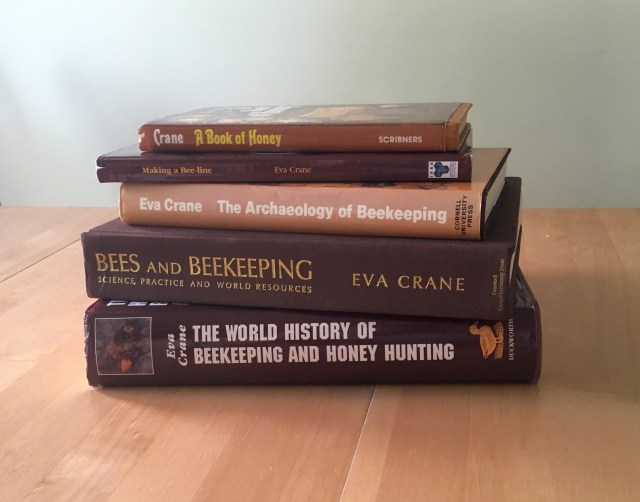
Dr. Crane wrote some of the most important books on bees and apiculture, including “The World History of Beekeeping and Honey Hunting” (1999). In a review in The Guardian, the author Paul Theroux, himself a beekeeper, called the book a masterwork “for its enormous scope and exhaustiveness, for being an up-to-date treasure house of apiaristic facts.”
Everywhere she went she sampled the life of local people, sometimes in the remotest areas of the world. She went to share her beekeeping knowledge and teach governments, NGOs and farmers, recording these travels in Making a Beeline (2003). Typically, she always claimed to have learned much more than she taught. She acquired a huge collection of beekeeping artefacts that, combined with other materials, constitute the IBRA historical collection. Some 2,000 items have now been digitally photographed and recorded while the actual items will be in an international museum, being established in Belgium.
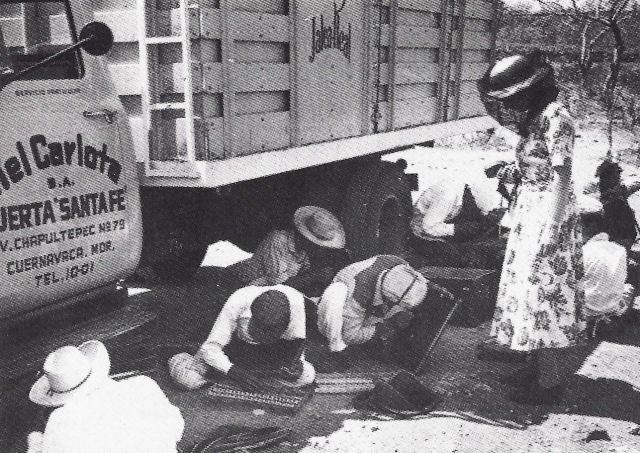
Eva Crane, 1957, at the world’s largest bee farm (Miel Carlota) in central Mexico.
From her own book, Making a Beeline, written in 2003 at age 91, Eva Crane summarizes her travels to 60 countries, always looking at bees. She recounts the people she met, the hives and flowers she saw, in Cuba (1957), the USSR (1962), Egypt (1978), India (1980), Nepal (1984), Pakistan (1993), Spain (1998), and dozens of other countries. In 1965, Dr. Crane was in my part of Canada. Here’s a small piece from Making a Beeline which will give you a bit of a taste of the way she saw the world:
In Edmonton [Alberta, Canada] we first went to the provincial TV station, where I was put on a programme “June is the ice cream month”. I was then interviewed at the national TV station, and finally gave a lecture in the university. From Edmonton I went by airbus to Calgary, then to the Federal Research Station at Lethbridge with Jack and Lorraine Edmunds. Dr. Geordie Hobbs was rearing the wild bee Megachile rotundata there, as a substitute for bumblebees which suffered too much from parasites in that area to be useful for crop pollination.
Next day I caught a plane at Calgary to fly east to Saskatchewan for yet another bee meeting and TV interview, at Saskatoon. With Doug McCutcheon the provincial apiarist and Everett Hastings, I went to Everett’s isolated queen mating apiary by Candle Lake. It was some 30 km north of the inhabited area, in forest which stretched uninterrupted to the tundra. To enter the apiary we had to disconnect the anti-bear fences from their batteries, and then unhook five separate strong wires. In the evening sunshine we also explored the edges of Candle Lake, where there were yellow water lilies that the moose liked to eat. Gulls and killdeer (a plover) were on the beach, many duck and mergansers were flying over, and a solitary loon – a diving bird– was just offshore. Moose, elk and bears all live here but none of them came our way.
Doug took me further east to Nipawin to visit Dr. Don Peer whom I had met in 1953 when he was a graduate student in Madison, Wisconsin. He had now developed large-scale beekeeping on scientific lines, and had 1,000 or more hives. He bought packages of bees each spring and made two-queen colonies from pairs of them. Each of these had 90 to 100,000 bees by July, and could store 20 kg of honey a day from the main flow – mostly from legumes, alfalfa and fireweed.
Lest we dismiss her life’s work as last century news, I would argue that the relevance of history is eternal. Dr. Crane’s endless travels, writing, and documenting played a role in understanding something of concern to almost every beekeeper today – varroa mites. During her travels in the 1960s in the USSR, she noted that western honey bees kept in Russia’s far east Primorsky Krai area (just north of Korea’s Apis cerana bees) had become hosts of varroa. The mite came from the local Asian bees which have had varroa for aeons.
You may know that varroa coexists with cerana without killing Apis cerana but when the mite jumped to our western honey bee (Apis mellifera), it was devastating. Dr. Crane noticed that some Russian Apis mellifera had managed to adapt to the parasites. She wrote about it. Researchers, reviewing the bee literature when varroa arrived in the USA, noticed Crane’s article. They sent scientists to Russia and came back with the (somewhat) resistant bee which North Americans now call ‘The Russian Bee’. If you have these, you can thank Dr. Crane. (And, of course, the USDA.)
 Dr. Eva Crane’s early affliction with the bee bug was total. She never recovered, remaining smitten sixty years later when she was still contributing articles to bee journals. You can access dozens of them at the Eva Crane Trust. They are free to download (but please read the rules). Articles cover subjects as diverse as Honey from different insects to English beekeeping from 1200 to 1850 and Import of Packages into Britain in 1963.
Dr. Eva Crane was 71 when she published The Archaeology of Beekeeping (1983), 78 when she released Bees and Beekeeping (1990), and 87 when her 700-page World History of Beekeeping and Honey Hunting (1999) was published. She died in 2007. By then, she had 312 publications. The last, “The beginning of beekeeping in Siberia”, was an article printed in Journal of Apicultural Research months before her death at age 95.
I have a type of motor neuron disease, similar to amyotrophic lateral sclerosis, which most people call ALS or Lou Gehrig’s Disease because that’s easier to say. Every year I do a post about the disease in order to thank, in a small way, the people who participate in annual runs/walks/rolls and other fundraisers held around the world. Things like The Ice Bucket Challenge have been phenomenal in raising money ($115 million) and awareness – a lot of good stuff has come out of that bucket.

Getting Soaked: My wife and I accepted the challenge. This was back in 2014.
It looks like my son is enjoying this a bit too much.

After: We were OK.
I was diagnosed with motor neuron disease 20 years ago. Lucky for me, my motor neuron disorder is atypical ALS, which means it’s not the typical fast-paced disease. Instead, mine has a much slower progression. Normally, ALS paralyzes within two or three years. All motion – walking, talking, breathing, everything – stops. Unless the afflicted chooses a respirator, feeding tube, and constant nursing care, the patient dies. However, the brain is unaffected.

Using assists like ventilators and aides is how Stephen Hawking survived to 76 – a respectable age for any man, but incredible for someone living with the ALS diagnoses for 50 years. His ALS started early and progressed slowly, but he had equipment and full-time nursing help.
When Stephen Hawking was diagnosed in his 20s with ALS, his doctors gave him a grim prognosis – they figured he wouldn’t see 30. Hawking said that he was devastated but decided to work on his PhD anyway. And get married. And have kids. And travel. And write. And, of course, he figured out a few things about the universe. Professor Hawking died earlier this year. We might not understand all of his maths and physics, but Stephen Hawking gave us all a lesson in perseverance and tenacity. I think that was his greatest gift.

No one knows why my form of motor neuron disease is so unusually slow. Mine started at age 44 so I’ve been living with my variant of motor neuron disorder for 20 years. Mine is progressive – I can’t walk much any more and my arms and hands are weaker every year, but that’s not too bad after such a long time. It will continue to get worse, but if the progression remains slow, I’ll be blogging for many years to come.
A friend asked me if all those thousands of bee stings I’d had over the years made the difference, but other beekeepers I’ve known (commercial beeman Ernie Fuhr from the Peace River country, up near the Yukon; and, Bill Turner from our own Calgary Bee Club) were both killed by this disease. Recently, a group looking at alternative treatments for ALS reviewed bee venom and found that it was unlikely to be helpful.
The discovery of a cure for ALS and the funding of equipment (motorized wheelchairs, ramps, beds, vans, ventilators) takes a bit of money. The Ice Challenge and all those fundraising programs contributed a lot. If you’d like to help, please give a few dollars to Margot and her family’s fundraiser. Margot, a geophysicist, has been a friend of mine since our days at the University of Saskatchewan. Here’s a link to the site where you may contribute ten or twenty dollars, if you like.
 Calgary’s biggest ALS Alberta fundraiser is called “Betty’s Run”. One of the corporate sponsors is a company called Pure Sweet Honey Farm, owned by my friends Stan and Willy. They have been supporting Betty’s Run for years. We owe a huge, huge thank you to these people. I met Stan and Willy when they kept bees in Florida and my hives were near theirs. We lived in the same cheap, rundown rental trailer park and we all owned our respective 20-year-old flatbed trucks. Business partners Stan and Willy went on to found the honey packing company, Pure Sweet Honey, and I disappeared to Canada, but we’ve been in touch ever since. As Gold sponsors of Betty’s Run, their name and logo appears on signs and two thousand or so runner’s shirts each year – a good reminder to participants to fuel up on honey for the run! You can see the logo, left, and below, my kids are modelling this year’s shirts.

Betty’s Run for ALS (actually, Betty’s Run against ALS) was held today, Sunday, June 10th. Not long after 58-year-old Betty Norman died of ALS in 1997, some of her friends decided to honour her memory and raise awareness and funds to fight the disease. This year about 1,500 people participated as walkers and runners. They raised $400,000 for ALS research and to help the organization that provides support (vans, motorized wheelchairs, home care equipment) and outreach programs. During the 22 years of Betty’s Runs, nearly eight million dollars were raised here in Calgary.
The walk/run/roll has become a social event with friends meeting and chatting. I was happy to have had my wife (who was an organizing volunteer for the local ALS society) and my four kids and three grandchildren on past walks. For the smallest kids, the bouncy castle was the main draw. For us older kids, walking 5 kilometres (or being pushed in a chair) gives an opportunity to think about people and the illness. Most participants wore tags that said things like “I’m Here for My Wife” or “I’m Here for Jim”. My tag said “I’m Here for Everyone” as a reminder that everyone is affected, directly or indirectly by this illness.
National Pollinator Week is coming, June 18-24. You have less than two weeks to get your affairs in order. I’m not always sure what a person is supposed to do when National (fill-in-the-blank) Day/Week/Month is celebrated. Well, it’s pretty obvious that National Honey Fudge Day is a day to eat lots of honey fudge without any thought about your islets of Langerhans. But what does one do during Pollinator Week?
We can take a clue from the Pollinator Partnership, which tells us, “National Pollinator Week is a time to celebrate pollinators and spread the word about what you can do to protect them.” It’s significant that eleven years ago, when colony collapse was at its peak and the end of civilization was near, the US Senate approved “National Pollinator Week” unanimously. Unanimously! Has the US Senate ever approved anything else by undissented decree? That’s a hundred out of a hundred. Congratulations to them for collaborating, for once, on something important. They wanted every American to recognize the pollination services provided by birds and bees and beetles and bats.
Birds and bats working saguaro. (USDA photo)
To help you celebrate, the pollinator people at Pollinator Partnership list some activities on their website. Here are some suggestions:
• Host an educational event at a local library
• Host a pollinator festival or native plant sale
• Plant habitat in your backyard using native plants
• Host a nature walk or pollinator expert lecture
• Screen a pollinator film
• Pollinator planting day at your school, office, local park, or library
• Build native bee houses
• Display pollinator artwork and outreach materials in your office lobby
• Encourage your governor to sign a proclamation
 Look at that last line again: “Encourage your governor.” I’m in Canada. We don’t have governors. We have a queen and a handful of English royalty on loan occasionally (the British queen is also the Canadian queen). The queen’s rep, when she’s not in Canada (and that’s almost always), is our Governor General, currently former astronaut Julie Payette. She’s the closest we have to someone called ‘Governor”, but not in the American sense. Canada has a National Pollinator Week which I think is on loan from the USA. Maybe we could ask our Governor General to issue proclamations about it.
Our lack of governors didn’t stop me from reading some of the Governors’ Proclamations that are posted on the Pollination Week website. I was impressed. Several of the supposedly conservative ‘red’ states have remarkably progressive governor proclamation statements. I’ve lived in some of those places and have long realized that rural areas are populated by a lot of people who work to improve their neighbourhood ecology. They’ve told me that the health of flowers depends on the health of pollinators. Here are a few proclamation excerpts. The full statements are worth a read:
Alabama: “Whereas, pollinator species provide significant environmental benefits that are necessary for maintaining healthy, biodiverse ecosystems, and…” Nice!
And look at Texas! “Few things in life are as beautiful as a field of native Texas wildflowers. And you can thank a bee for that – or a hummingbird, or even a bat. Pollinators come in all shapes and sizes. While the iconic honeybee is the most well-known, moths, wasps, beetles, butterflies and birds share the load of spreading the pollen that helps plants grow healthy and strong. These creatures help maintain a beautiful and healthy ecosystem.” The Texas governor even mentions ecosystems!
North Dakota: “Whereas, pollinator species provide significant environmental benefits that are necessary for maintaining healthy, biodiverse ecosystems, and…” Oh dear. That’s exactly the same line they used in Alabama. Ouch! Well, we live in a copy-paste world, don’t we?
Pennsylvania has a Pollination Week proclamation that might have been written by David Suzuki: “Whereas… contributing factors such as loss of habitat, chemical misuse, and invasive plant and animal species have affected our natural pollinators; and… Whereas, the domesticated honey bee, many species of butterflies, moths, birds, bats, and other pollinators are in retreat, threatening not only the production of commercial crops, but also a wide range of flowering plants, including rare and endangered species; and…”
In contrast, progressive California where left-leaning Jerry Brown is governor, has a rather subdued proclamation. What’s Jerry got against pollinators? Probably nothing, but his team could have written something more inspiring than “…the state of California provides producers with conservation assistance to promote wise stewardship of lands and habitats, including the protection and maintenance of pollinators on working land and wild lands…” and yaddah yaddah. Signed Jerry Brown.
If you have time, read a few of the proclamations yourself. If you are in the USA, look up your own governor’s proclamation. If you like what you see, send your governor a note, or suggest changes if you must. Although I tend toward cynicism, the statements seem more than trite political lip-service about good earthly stewardship. And that means something.

Releasing a package of bees in Alberta. (Photo: Miksha)
Yesterday, I wrote about bee populations in a hive that starts as a package. The original bees slowly die while the number of new bees, arising from eggs laid by the package’s queen, rapidly increases. In yesterday’s example, the immigrant bees were from New Zealand. They were a week or two old when they boarded the non-stop for Canada. Those bees began to die from overwork and age, but with a new queen, eggs were laid and new (Canadian) bees were born.
Starting colonies from packages is an old, but popular, system. Especially in cold climate areas such as Canada where many bees die over winter. Every year, Canadian beekeepers import tens of thousands of cages filled with bees. Stats show that 75,000 packages were brought into the province of Alberta last year. Most arrive from New Zealand, though a generation ago, they were brought to Canada from the USA.
Packages are cages, like the one above, which usually hold two pounds of worker bees and one queen. The screened cages are filled in a warm-climate, early season location, then sent by plane, train, or automobile to new owners. You may wonder how we know that each package has two pounds of bees. The packages are weighed, of course. Here is an old picture of my gang in Florida, shaking bees out of a collection cage, through a funnel, into a package which sits on a scale. When the scale hits two pounds the guy with the eye on the needle shouts “mind the doors” or something like that.
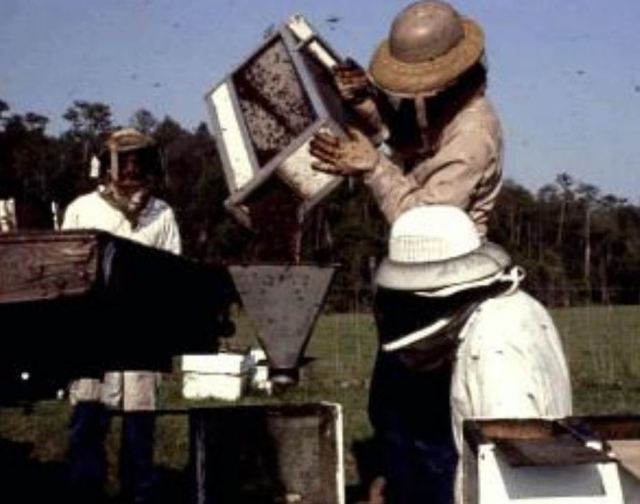
Filling a package cage with two pounds of bees. The cage, bottom, sits on a little scale (not shown in the photo). The guy standing (center) is handling the big collection cage while the fellow who is kneeling watches the scale. (Photo: Miksha)
For almost a hundred years, Canadian beekeepers brought truckloads of packages from the southern USA and released them into new homes in Canada. Packages were preferred because the queens were new, swarming almost never happened, the bees built up quickly, and honey crops were typically 150 pounds per hive, though some of us made closer to 300. Here’s what it looks like installing packages on the prairies. The bees in the cages on the truck are the same ones in the picture above. But here, they are 2,500 miles northwest.
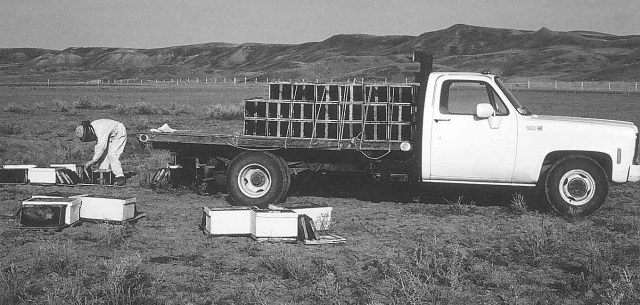
Late April. Installing Florida packages in Saskatchewan in 1979. (Photo: Miksha)
So, beekeepers obtain packages. They release the bees and queen in hive boxes prepared with drawn combs, honey, and pollen. Soon, some of the imported bees die. (Busy bees live around six weeks.) The queen starts to lay eggs. Not immediately, but a day or two after arrival. She can’t lay eggs in transit. Upon release, the queen’s body reacts to its new home by expanding and preparing to lay eggs. Those eggs take 21 days to develop into fuzzy young bees.
In my previous blog post, I mentioned that I counted the number of bees in a friend’s queenless package hive, five weeks after it was installed. The colony had started with 6,400 bees but now there were about 1,200. Without a queen, there were no replacement bees and the little colony was doomed to die.
In a normal package, new bees emerge about 22 or 23 days after the package arrives. Upon settling, the queen produces a few hundred eggs each day. The number picks up quickly as the workers clean spots for the queen to lay, pollen is collected from spring flowers, and the queen recovers from her trip. In one of my own packages this spring, I counted 16,000 brood cells on Day 17. That’s an average of 1,000 a day. Most beekeepers expect a queen to lay more than 2,000 eggs each day. At that rate, it would take just three days of egg-laying to replace the number of bees in that had started the colony.
I made a chart that summarizes the population dynamics of a package. There are three lines on the graph. (If you click on the graph, you should be able to see it at a larger scale.) The yellow line starts at about 6,000 bees at the end of week 1, toward the left side of the graph and then falls to zero by week seven. That’s the population of the original package bees. Meanwhile, the red line, which is the Canadian-born bee population, stays at zero until after the end of the third week, then adults emerge and the population grows quickly. The third (dashed) line is the total hive population from weeks 1 to 7.
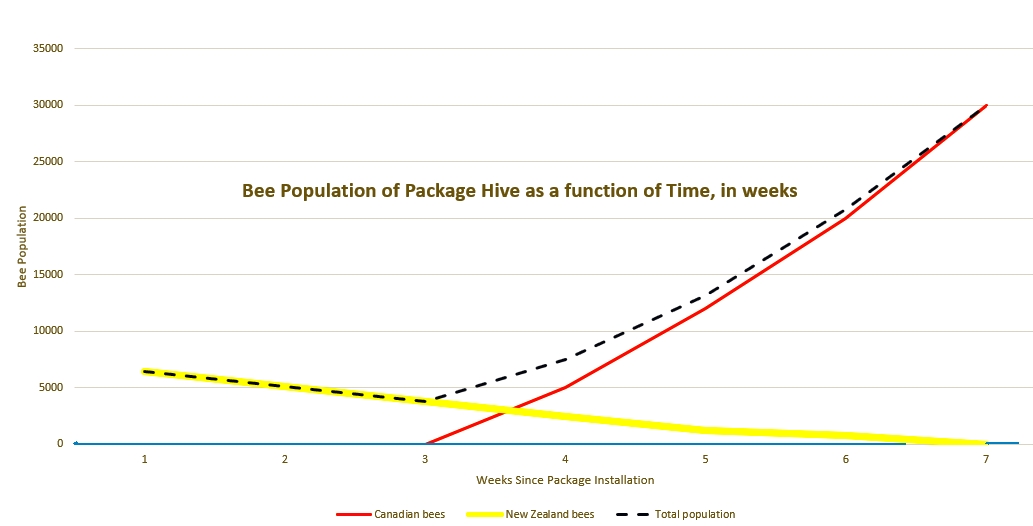
One thing to notice is that the bee population starts over 6,000 then goes down every day until enough new bees emerge during the third or fourth week. This is a vulnerable time for the hive. Its population is precariously low. The brood nest is expanding, the weather is cool. Meanwhile, several frames of brood must be fed and kept warm.
This low-population point – between three and four weeks – is the reason that beekeepers don’t want packages to arrive too early. It’s tempting to install bees early. We think that an extra month will give a stronger colony for the main honey flow. But if it turns cold (and it usually does), brood may chill and die, flowers are sparse, and bees can’t forage. The queen’s production falters. Sometimes her anxious workers supersede her. Since egg laying is cut back, new bee emergence is curtailed while the old bee population dies off. Things may spiral out of control with the package becoming weaker and weaker. Eventually it will recover but might be less populous than a package started at a more appropriate time.
Also on the chart above, you see a crossover in populations. New bees begin to outnumber the old. That’s also between three and four weeks after establishing the colony. From that point on, the hive population grows almost exponentially. In this case, you should set aside time to build honey supers. You’ll need them.

A few days ago, a friend invited me to visit her bees. In one part of her apiary, there were three hives, neatly lined, single-storey. These hives had started the season as packages five weeks earlier. Two were excellent. They had six frames of brood and two weeks’ worth of new young bees, the offspring of the queens in the hives. I’m guessing these colonies had about 12,000 new bees each. But there were other bees in the hives. Those were the honey bees that had arrived in the package. By now, they were old. They’d spent their first few weeks in the southern hemisphere, the last five here, in Canada.
I wasn’t sure how many of the bees were the original New Zealanders and how many were new bees, born in Canada. Of course, younger bees look younger – fuzzier and plumper than the darker, weary, hairless, aging non-fuzzy bees. Almost anyone could distinguish the young from the old. But I wondered how many of each type might be in those two hives, both of which had started with a queen and about 6,400 workers from New Zealand. Were half of the original bees still alive? One-third? Quarter? None? I got an answer of sorts when I opened the third hive. It was queenless. The only bees were old bees. The entire population consisted of the original New Zealand bees from the package which had been installed over a month ago.
Compared to the first two hives, the third one, at the far end of the line, was shockingly lethargic when I lifted the lid. Not a single bee flew up to greet my face. The bees on the tops of the frames moved slowly, mechanically. I could not help but engage in an unscientific anthropomorphism – rather than the happy buzz of her prosperous sisters, this colony whispered, “We are sad.” These bees, aged and facing the impending demise of their colony and themselves, had no way of continuing. They had no queen.
Their listless malaise lingers in my mind. They were a defeated population. I was immediately reminded of Leo Tolstoy’s War and Peace, his scene where he compared a queenless hive with Moscow when the abandoned city was approached by Napoleon’s soldiers:
“Meanwhile, Moscow was empty. There were still people in it, perhaps a fiftieth part of its former inhabitants had remained, but it was empty. It was empty in the sense that a dying queenless hive is empty. . . In a queenless hive no life is left, though to a superficial glance it seems as much alive as other hives.”
Tolstoy, verbose yet compelling, continues on and on, accurately describing the condition of a dying queenless colony, so similar to what I saw at this moment. Some day, I will revisit Leo Tolstoy, his bees, and his wife’s concerns for his sanity (she claimed that there were times when he could not be removed from his apiary, even for meals or visitors). I wrote a few words on Tolstoy’s description of a queenless hive last year. For now, suffice to say, I had opened a hive which Tolstoy could have described as suffering negodnost. It was in trouble.
It appeared that the queen which had arrived with the package had died immediately after release in her new home. She never laid eggs. There was no sign of hatched brood. And certainly no young bees. The colony was now queenless, but strangely quiet. It was not buzzing with the discordant tones of a typical queenless hive. It was populated by the murmuring elderly. Significantly, it had no brood, no queen.

Above, you can see what such a failing colony looks like. Below, I have zoomed in and I’ve numbered a few things on the picture so you can pick out what I’m writing about.


These are typical signs of a colony which has been queenless for a long time – scattered shiny pollen, unused pollen supplement, lethargic bees, small population, elderly bees, and, of course, no viable brood.
I took several pictures of the three frames which had bees wandering around the combs. At home, I counted the bees in the pictures. There were about 1,200. That’s a little less than one-fifth of the original number that was released in the box five weeks earlier. (But far better than Tolstoy’s Moscow analogue with just one-fiftieth of its population.)
1,200 gives me a rough estimate of how many original bees might be in a colony about a month after setting it up as a spring package. This is not a scientific test, just an observation of one hive. It’s possible that this is an unusually high number of original workers because a queenless hive doesn’t demand much work. The old bees were not gathering much pollen, didn’t need much honey, and certainly were not feeding any larvae. They were not working themselves to death. On the other hand, occupying a queenless unit, some of the old bees may have drifted into better hives, leading me to underestimate the number of old bees which would normally be in a hive five weeks after a package installation.
Nevertheless, the number (1,200) is probably representative of the population of elderly bees in a normal package on week five. Added to the new bees (12,000) that a queen-right package would generate, we have over ten times the population – 90% being new bees.
Using these numbers as a guide, I created a graph, giving us a look at the population dynamics in a hive started as a package. It shows the shift in bees as old ones die and the new queen’s young bees emerge. I’ll post it next time and explain why beekeepers should care about hive populations – and the quality of their queens.
 Bad Beekeeping Blog