

Her Majesty, the Queen. (Photo by Calgary beekeeper Stephen Bennett)
A friend left town for a few days. She had two queens, in cages, which she’d acquired for her hives. As it turned out, she used one of them but her second hive wasn’t strong enough to split. That meant that she had an extra queen. She didn’t know what to do. I told her that I’d babysit the queen until she returned.
My friend was surprised that I could watch the queen for a week. The concern was that the queen wouldn’t be very mobile and wouldn’t be laying eggs – for a whole week! I reminder my friend that during the winter, queens aren’t very mobile and aren’t laying eggs for a month or more. I could keep the caged queen and her attendants in my office. It should be fine.

Part of the queens I raised one winter in Florida, the day before handing them off to a northern beekeeper.
Queen breeders often have to keep queens in cages for a few days before shipping one to a new owner. When the queen arrives at her new home, the receiving beekeeper may feel obliged to use the queen the same day. Sooner is better than later for a couple of reasons. The queen might die while waiting in custody, though that’s unlikely. The main reason you want to quickly introduce the queen to her new colony is because each day in a cage means that a thousand or more workers won’t be developing in your new colony. Bee season might be short in your neighbourhood. You normally want to get your queen into the new split or into a hive with a failing queen as soon as possible.
But sometimes things happen. In this case, the hive wasn’t yet strong enough to nuc out and the weather was unseasonably cold. Splitting a hive too early and using the extra queen would be a mistake. So, I took the job of babysitting the queen for a week while we waited for the hive to strengthen, the weather to smarten, and my friend to return to Calgary.

The queen is the slightly larger insect, lower center. The other bees are her courtiers. The queen isn’t much larger than the workers but that will change when she finally gets her own hive – she’ll be about one-third larger when she begins egg laying.
If you have several queens to hold indefinitely, you should set up a bank hive and prepare the cages, queens, holding racks, and nurse hive appropriately. On another occasion, I’ll explain how to bank queens in a colony. But for now, here’s how to babysit her majesty.
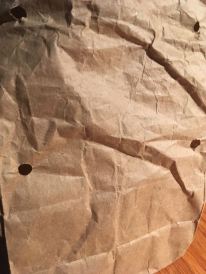 The queen was accompanied by eight attendant bees. It’s their job to groom and chat with the queen who would otherwise become bored and unkempt. I kept the attendants with the queen in her cage.
I made certain that the bees were always at room temperature and in the shade. (Not too hard to do in my office.) The queen was in a little brown bag. Someone had punched air holes into the little brown bag. I kept her in it, but the air holes amused me. Humans need lots of air so we tend to think that bees do, too. They don’t.
I’ve written about this before, but I’ll excerpt this piece, just in case you haven’t read every single blog post I’ve ever posted:
There must be some oxygen requirements, but I’m not sure what they are. Recently, researcher Stefan K Hetz studied insect respiration. Here’s a piece from The American Physiological Society regarding his work:
“. . . insects, which have a respiratory system built to provide quick access to a lot of oxygen, can survive for days without it.
“The insect respiratory system is so efficient that resting insects stop taking in air as they release carbon dioxide, according to research by Stefan K. Hetz of Humboldt University in Berlin, Germany. This allows them to keep oxygen and carbon dioxide levels in balance. Too great a concentration of oxygen is toxic, causing oxidative damage to the insect’s tissues, just as it does in humans. . .
“Insects are able to survive hypoxic environments,” explained Kirkton, the symposium chairman. “They can shut down and survive for hours or days. They have a low metabolic rate and can close their spiracles,” he said.
A queen and eight workers at the bottom of a brown paper bag are not likely to run out of air. A few holes punched in the side won’t exactly allow free air exchange anyway. But the holes make people feel better about the bees’ safety, so in that way, the air holes do perform a useful function.
OK. So, we have a queen, in a cage, in a bag, out of the sun, and at room temperature. Although I don’t overly fuss the queen’s access to fresh air, I do have a few other concerns. The cage has a bit of soft candy (made by mixing powdered icing sugar with syrup). This should keep the bees nourished for a week or so. But the soft candy sometimes turns hard in our dry climate and becomes difficult for the bees to eat. Or, if you save the caged queen for many days, the bees might actually eat all the candy and run out of food. To guard against these calamities, I collect a dab of honey on my fingertip and transfer it to the screen of the cage. The bees greedily take it. I just use a small drop – I don’t want the bees to get fat.

I picking up a bit of honey. In the cage, you’ll notice the white ‘candy’ used for bee feed. The bit that’s missing has been eaten by the caged bees.
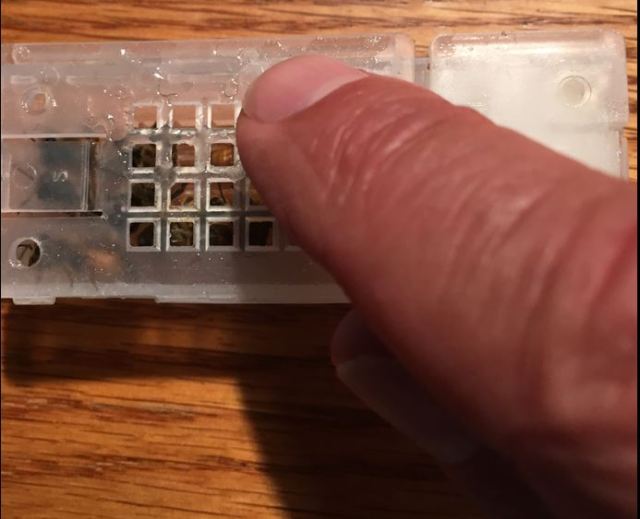
Lightly touching the screen on this cage. The dab of honey sticks to the screen where the bees will quickly find and eat it. A water droplet is put on the same way.
Next, I tap my finger into a bit of water so that a droplet sticks to my finger. Then I touch the screen again, this time with the drop of water. You will likely see the bees stick their proboscis into the droplet which will disappear in seconds. I don’t over-feed or over-water the queen and her attendants. Never let the bees become wet or sticky. If you somehow decide that it’s in the bees’ best interest, you might offer a second or third drop, but only after the preceding one has been thoroughly cleaned up. I usually just give them a drop each morning and evening though that’s far from a scientific calculation of the bees’ needs.
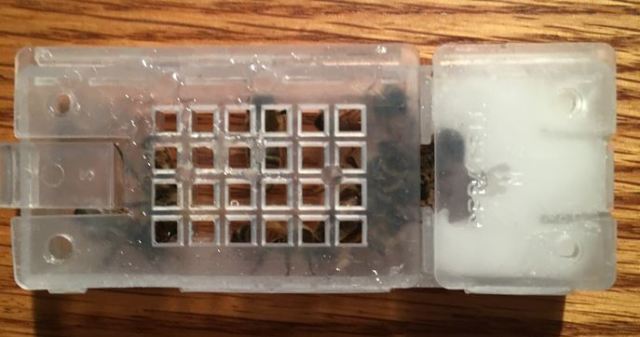
The bees quickly took the honey and water. I’ll feed them again in 12 hours.
By the way, when you feed and water your pets, you should take their cage out of the bag and place it flat on the table, screen side facing up when you do this. Indirect light is fine, just avoid letting the cage sit in direct sunlight. Also avoid too much heat such as might blow out of a heat vent. The feeding process takes about five minutes and, of course, completely refreshes the bees’ air – just in case you are still nervous about the queen’s oxygen supply!

 If you don’t love bees and don’t like hard physical work, don’t pursue bees for money. Almost any other occupation pays better. It takes discipline, hard work, and good money-management skills to make money from honey. If you have these talents and money is your main goal, don’t waste your time keeping bees for money. Drive a truck and build up a trucking company. Use a hammer and create a construction business. Work your way up from sales clerk to corporate manager at a chain store. If money is your main consideration, don’t plan on getting wealthy from beekeeping.


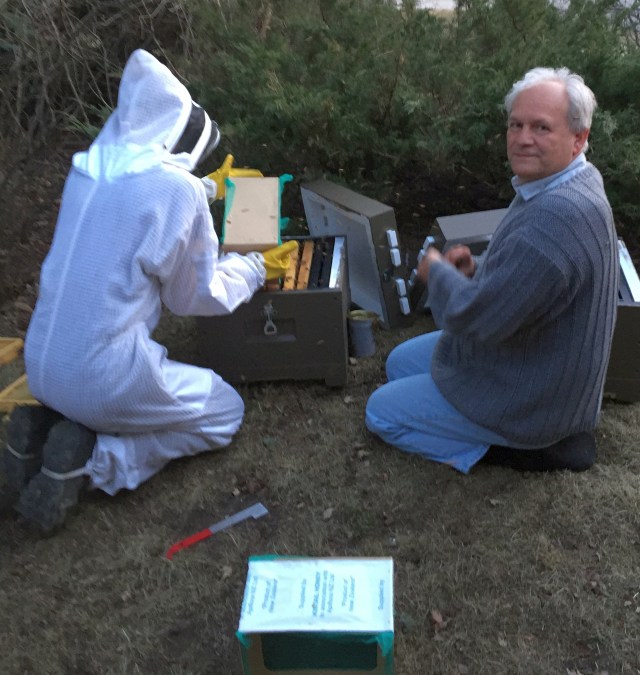
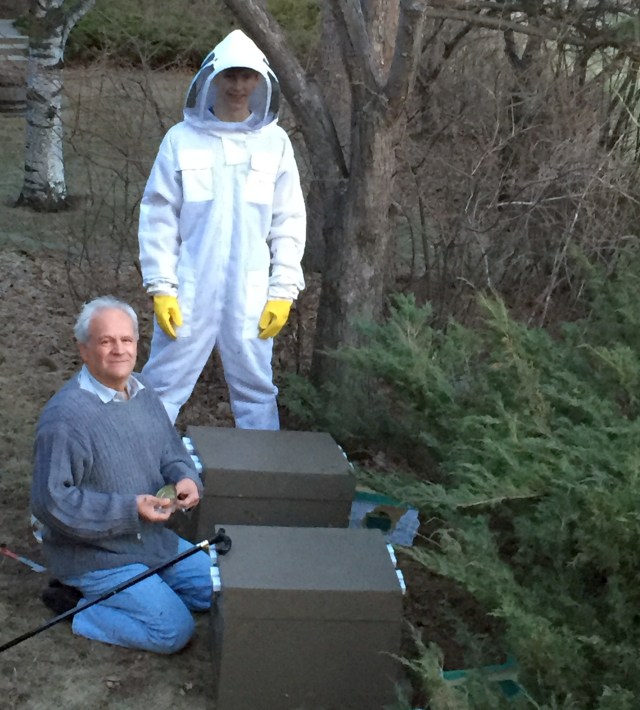
 By eleven in the morning, several deer entered our property (a frequent occurrence, even though we live in a central suburb amid a million Calgarians). The deer kept their distance, not from fear of bees, but out of deference to the humans in the back yard.



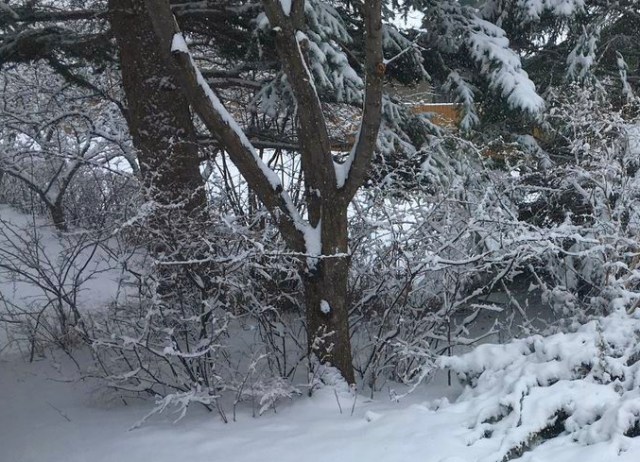

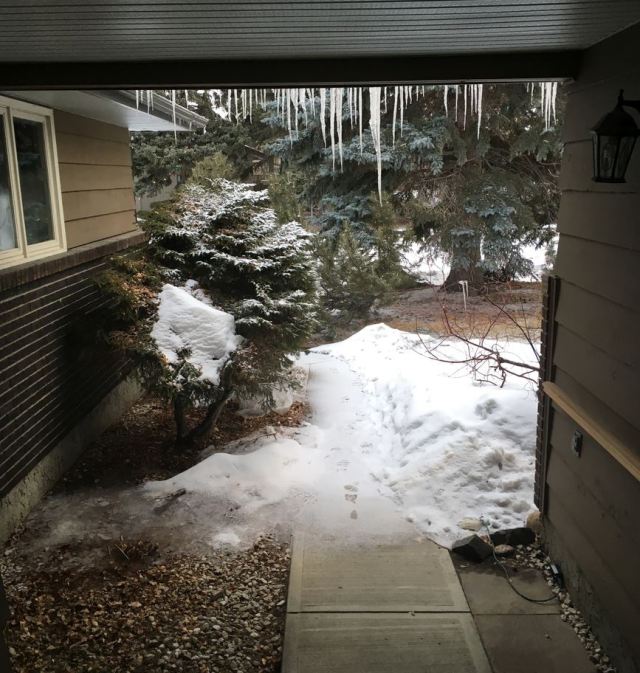
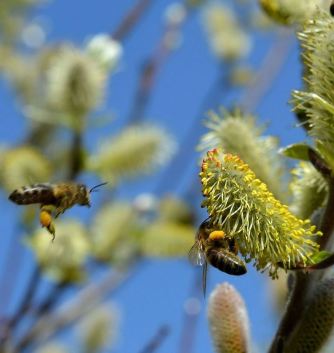 In our area, at this time of year, the pollen is mostly from crocus and willow. That’s what brightens the bare brown desolation of April in Alberta. Snow still chills the ground in icy mounds which litter our landscape, yet honey bees have found some food!
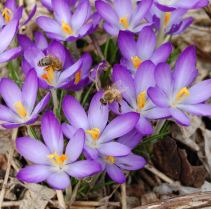 Thinking about this, the ecology seems rather puzzling. For millennia, North America had no honey bees. The continent’s native bees (bumblebees, masons, ground-nesting miners, wood-boring carpenters, hole-inhabiting leafcutters) start their season with a single, dazed queen and no workers. These bees become active later in the spring than honey bees. Our honey bees occupy nests of thousands, staying warm and active in their cluster even on cold days. In our area, they survive as a clustered, cloistered family for two hundred wintery days. When a mild spring afternoon finally arrives, hundreds of foragers race out to exploit scattered tufts of willow and rare prairie crocus blossoms. This might be a week or two before the first native bees rouse from their slumber. Honey bees have an advantage when it comes to a willow or crocus blossom. They jump it the moment it smiles.

 you see to the left. Then he spent a few hours making art and presented the result as a surprise birthday gift. As an artist, he is creative but methodical. You can see how he printed the photo in black and white, then gridded it to get the proportions. He kindly made my hair less gray but I think that he could have given me less forehead, too! You can see that he has an impressionist style, but for the forehead, he went for realism.



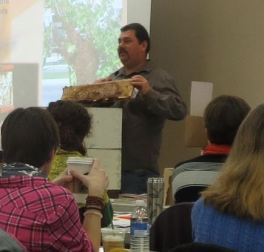 One of the panelists was
 Having three professionals on the panel, all of whom are hedging and interpreting questions differently, can be eye-opening for some new beekeepers. One of the harder things for novices to accept is that the world of beekeeping is loose and fast and everyone may be right and wrong at the same time – depending on the situation. Every question has multiple answers. Experienced beekeepers often respond with, “Well, it depends…” leaving the novice beekeeper wondering why there is no single correct answer. Although there are important “correct” concepts (“don’t kick the hive” and “bees don’t fill supers that are left in the shop”), most bee things are complicated. This is worth remembering if you are new to bees.
 Most folks I know reset their clocks last night. This is great for hobby beekeepers who race home after work to don gaudy bee suits and ignite smoker fuel, hoping to beat the setting sun. Not so fast, Beekeepster. You can slow down and still enjoy a whole extra hour of afternoon beekeeping.

 Bad Beekeeping Blog