
 I try to write at least one blog post every week. It’s not hard to find material. Honey production, honey chemistry, queen breeding, nectar sources, apitherapy, famous beekeepers, colony management, bee diseases, and on and on – it’s easy to find something interesting to describe. And, of course, beekeepers are always doing something horribly stupid. There’s no end to the delightful stories that can be told.
But during the past three months, my internet offerings have been slim. Several people (actually, just four of you) have sent me notes asking if I am OK. I really appreciated that. It’s no secret that I’ve had a serious progressive illness for years. It makes it hard for me to do a lot of things that others do easily – but it could be much worse. And, I hasten to add, my illness doesn’t seem to be life-threatening. So, to those who sent notes of concern, thank you! I am doing relatively well. Illness was not the cause of my writing hiatus. Instead, I have been busy as a bee in a honey pot this fall.
 My day job – as a geophysicist – suddenly became really hectic. I enjoy the earth science stuff that I do. Having lots of work is always great. But I was unexpectedly working more than I had in a couple of years and the work (from multiple clients) was urgent. That’s where most of my time went.
Meanwhile, I was invited to write a couple pieces (on bees) for an independence-movement magazine. If you saw my post a couple of days ago, you know about that. I also helped teach two different beekeeping programs this fall – one for our huge Calgary beekeepers’ association where I helped instruct a two-day beginning beekeeping workshop – and helped prepare and edit the talks and manuals. It takes a lot to make a workshop happen. My co-presenters do the hard work, but I’m involved in the whole thing.


My other workshop this autumn is something which my teaching partner and I call “Making Money from Honey”. It’s a full-day program where we guide people through the behind-the-scenes activity of making beekeeping into something more than a hobby. Preparing those workshops (and researching and editing a couple hundred powerpoint slides) along with my geophysics work has kept me busy. But wait! – there’s more!
Although I find geophysics fascinating (who doesn’t like a little seismic activity from time to time?), I felt that I needed some formal instruction in ecology. So, I enrolled in fourth-year ecology at the local research university. My first class was Ecology 425: Quantitative Biology II. Geez, was it ever hard! Not just understanding the statistics and modeling (ecological analysis) but also sitting for exams, maneuvering my wheelchair through the icy, snow-draped parking lot, and trying to fit in as a ‘normal’ student with youngsters less than half my age.
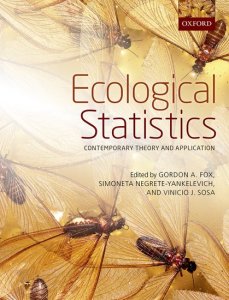 I enjoyed the work and mental exercise. But it was challenging. Along with my family and consulting duties, I worked extremely long days pulling everything together. The last time that I took a university exam was over twenty years ago. I had to remember how to study and how to prepare. But now I feel much more informed and more competent analyzing serious research papers.
I am hoping that this will make me better at leading workshops and writing and commenting about new bee science. But I have a lot more to learn. So, I’ll be back at university next semester, in January. Now that I’ve grown comfortable with my first efforts into the science of ecology, I think that I’ll manage to post more regularly again. (I’ve missed it!) I’ll stay busy as a bee, but I expect to have a bit more time for blogging.




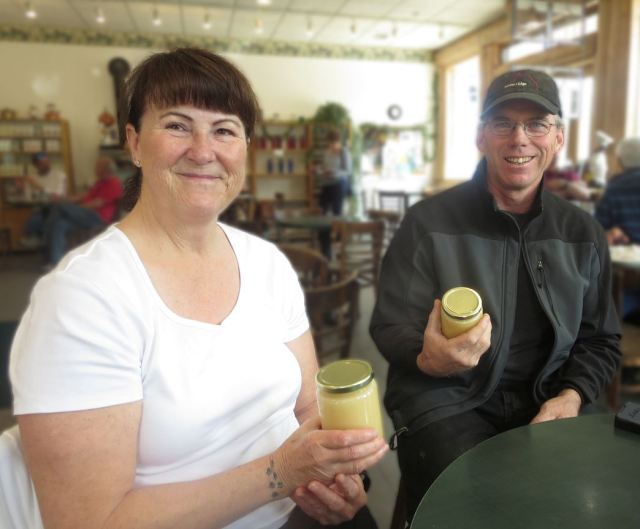


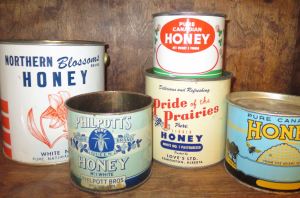 But granulated honey sometimes spoils because it’s usually not heated enough during packing to kill yeast. Another common problem is the growth of over-sized granulation crystals (if honey crystallizes slowly over several months, the crystals are bigger). Poor quality granulated honey was common in the early 1900s. At the time, most Canadian honey was packed in gallon-sized tins and sent off to England. After producing, packing, and shipping across the ocean, beekeepers sometimes weren’t paid – the buyers in London had to dump the stuff as it had soured or had a watery layer on top. A young Canadian ag-scientist,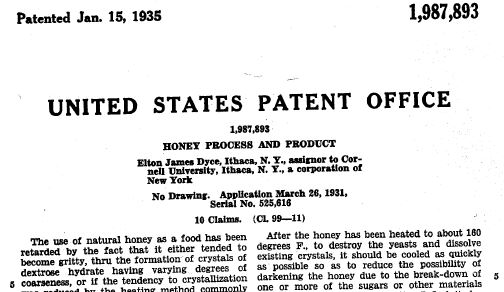




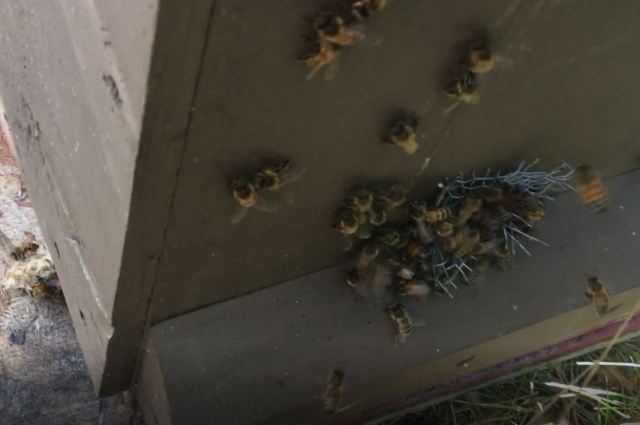


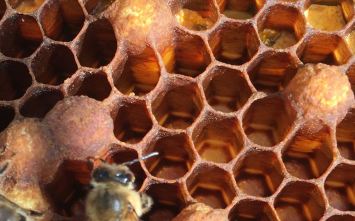 A few days after returning from summer in Hungary, we opened the hive, and saw a bit of new brood. But rather than the nice neat rows of uniform workers-in-progress, we saw the random and ugly brood of poorly-forming drones growing inside cramped worker cells. Beekeepers sometimes call this ‘bullet brood’ as the cells are sealed extra high, shaped like bullets, in order to accommodate the large body sizes of drones pupating in skinny worker brood cells. Our hive had laying workers.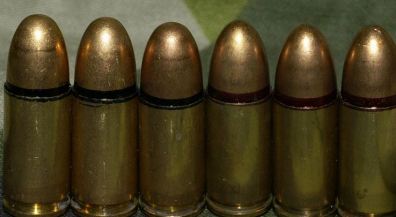
 If you think of drones as mobile DNA tanks which can easily move to a new hive and possibly mate and carry forward the dying hive’s genetic stock, then it does make sense. From an evolutionary biology perspective, a creature’s mission is to preserve and spread its genes. The laying-worker’s drones are samples of the colony’s DNA. It’s one last chance to send genetic missives out into the world, carrying the unique code of the colony before it’s gone forever. This also explains why laying workers often destroy a queen introduced by a beekeeper. The new queen represents foreign DNA. If introduced before laying workers take charge, such a requeening may be tolerated. But afterwards, there is the obvious conflict regarding dispensation of life codes.
