So, how’d the March for Science go? I’ll admit that it went better than I expected. My fear (expressed in Friday’s blog) that the effort to support science would be hijacked by a political agenda was only about one-third true. I looked at dozens of photos from the March. Signs for science trumped anti-Trump signs about two to one.
America has 21.5 million university grads with science degrees. About 12 million actually work in science while the rest are retired or resigned to spend their working days doing more lucrative non-science stuff (lawyers, doctors, administrators). Of the several million with ‘science’ degrees who work as ‘scientists’ I would guess only 5 to 10 percent participated in the March. I’m a geophysicist. Though I wasn’t tinkering with seismic waves this weekend, I was tied up teaching a group of 20 beekeeping enthusiasts some finer points of the economics of apiculture. I suspect that a lot of other scientists were dissimilarly engaged and, like me, were not marching.
Many (or most) of those supporting science on Saturday are non-scientists who either used the occasion to voice a political statement and/or they wanted to recognize that experimentation, observation, and deduction make healthier lives – and a better place to live our lives. One of my sisters marched in San Diego (some of her pictures are below) while other friends walked in D.C., Seattle, and Denver.
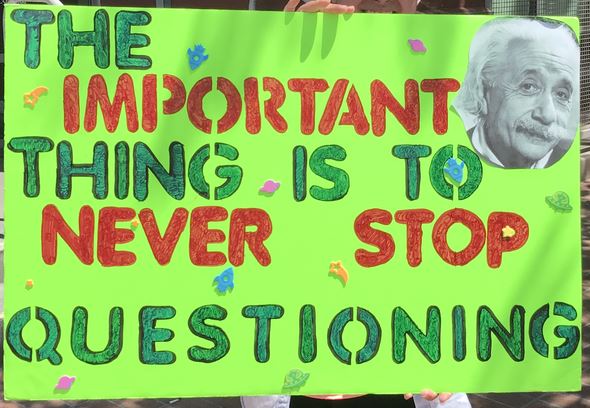
Here’s a bit of a photo essay that captures some of the weekend’s messages. Although at least a third of the messages were heavily political (and some were even anti-science), most were on target. You’ll even see a couple of placards prompted by concern for the plight of bees.
This weekend, we celebrate Earth Day. And why not? There are official days for glazed spiral ham (April 15), chocolate covered cashews (April 21!), and bee sting enthusiasts (March 30). So, Earth should have a day of celebration. As a professional geophysicist, I’d like more knowledge, interest, and respect for our grand old blue dot and her interconnected systems. But this year, Earth Day will be combobulated with a March for Science.
The Science March website says, “Science isn’t Democratic or Republican, liberal or conservative.” True. Scientific discovery means testing ideas and observing outcomes. Making guesses about what’s going to happen before an experiment is conducted. Attempting to separate one’s preconceived from one’s observed reality. That should be non-political. So, why is the March for Science convoluting support for science with the civil rights of marginalized people and attacking science for past failings (under-representing minorities, eugenics, unethical medical experiments)? A few weeks ago, The March declared that ISIS represents a marginalized people. Good God, one would hope so – the more marginalized, the better. The March has since retracked its implied sympathy for terrorists. But the fact that the idea would even surface within a group marching for science advocacy is discouraging, to say the least.
Officially, March for Science says it’s “a celebration of our passion for science and the many ways science serves our communities and our world.” Although ostensibly non-political, it’s apparent that the march grew from justified concern over the new president’s obvious disdain for science. Had it stopped with that symbolic (and subtle) political statement, I’d be writing quite a different piece here today.
Among the many gaffes already committed by Trump’s regime, we see muzzles on scientists, refutation of climate science, dismembering of environmental protection (EPA was started by Richard Nixon), and the delay of adding a fuzzy bumblebee to endangered status – not because its numbers have recovered, but because the cuddly as kittens creatures are apparently among animals not important enough to be urgently protected.
Entomologists will be marching. They are likely not marching in solidarity for marginalized terrorists. Instead, they are worried about the unhealthy, politicized (from both sides), under-funded state of science in today’s polarized atmosphere. It takes a lot of patrons to support research on varroa mites’ virus transmissions within a bee colony. Beekeepers don’t have ten million dollars to outfit gene sequencing gizmos, sterile incubators, and extensive apiaries dedicated to honey bee research. This takes a concerned public willing to ante up the cash that will eventually win the pot of tools that keeps pollinators alive.
Thomas Jefferson and Ben Franklin both had state of the art science labs in their homes. In the 18th century, their equipment could be bought with a few months’ wages. A lot could be learned from a kite, a key, and a thunderstorm. Even then, however, the new American government was allocating money to universities for ‘improvement of agriculture and animal husbandry’ and for pure research such as excavating the massive trove of mastodon bones at Bone Lick, Kentucky, in 1805.
Science has been the backbone of America’s strength and its progressive growth for centuries. If you are participating in the March for Science, you are showing commendable support for science and reason. Go ahead and wave your banner proudly – as long as the words on the banner convey support for science and not some confusing identity politics message. Make it a march for science. Something that conservative Christian scientists (and there are some) as well as rationalists can support. Then go back next week and march for greater equality and more diverse representation in science and society. If you can’t keep politics separate from science support, you risk alienating your potential allies. Saturday’s Earth Day March for Science should be a march for science.
🐝 🐝 🐝 🐝 🐝
PostScript: On Week Later. It’s now April 28, a week after I’d written the piece above. The March for Science bothered me a bit. I’m still grateful for support for the sciences, but my concern was for the party atmosphere that seemed to engulf the serious business of standing up for science. The shades of Huxley’s Brave New World became more clear to me when I read this article (Are We Having Too Much Fun?) in The Atlantic today. Read it yourself and you’ll see why Aldous Huxley, Neil Postman, and I are less than celebratory over the March for Science. And, there’s photographic evidence.
The April 2017 issue of the world’s best bee magazine (American Bee Journal) published a piece written by your favourite bee-blogger (me). My article is called America’s Sweetest Honey. In it, I describe why honey from different flowers tastes different. Ultimately, I show that some honey is sweeter than other varieties. With that in mind, my story tracks down America’s sweetest honey.
If America has a candidate for its sweetest honey, then so does the world. I presented a talk here in Calgary on exactly that: The World’s Sweetest Honey. Well, of course, I don’t know for sure which jar of honey is going to be the sweetest. I’d have to taste them all to be certain. But the journey of discovering some likely candidates is worth the effort.
Most beekeepers don’t know a lot about what’s in the honey they sell, so here’s a chance to learn about your product. Over the next month or so, I’ll write about some of the things every beekeeper should understand about the stuff they sell. For now, here’s a video of my January talk. It’s long. But at the end of the hour, you’ll know what you need to know about the stuff inside a honey jar. You’ll even gently learn some organic chemistry.
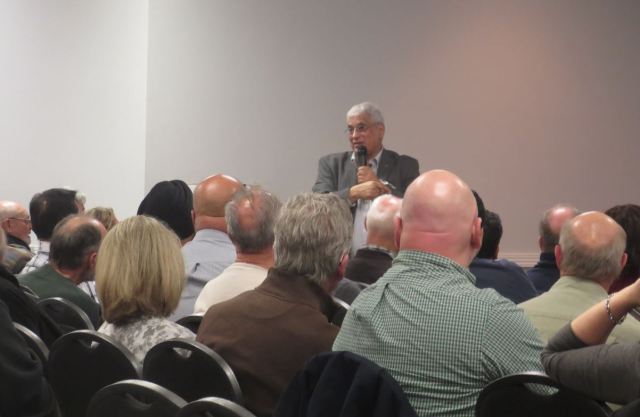
Liz Goldie, front right and Medhat Nasr, front left, addressing the capacity turnout for the monthly Calgary and District Beekeepers’ Association.
I thought that there can’t possibly be so many people curious about beekeeping. But there are. It’s great to see lots of folks interested in bees, ecology, the environment, and the sport of beekeeping. But the numbers amaze me.
New beekeepers keep signing up. In the fall, I helped teach an introductory beekeeping course which had 60 Calgary-area folks enrolled. During the 2-day course, I asked how many of the 60 already had bees. No one. None. Nary and not a single hand up. This spring, all will likely be beekeepers. And so it grows.
Last week, the Calgary and District Beekeepers held its monthly meeting. I’m not a director, executive, nor was I a speaker at last night’s program. Instead, I had a chance to relax, listen, learn, and count bees’ wings. I sat with 180 (!!) other beekeepers in attendance. Holy bee smokers.
Our keynote speaker was Dr Medhat Nasr. He’s our provincial chief apiarist. He has the unenviable task of satisfying the beekeeping needs of the keepers of 310,000 colonies of Alberta bees in the most productive honey jurisdiction in North America.
Dr Medhat Nasr, Alberta’s chief bee scientist.
A few highlights from Medhat’s presentation.
Biggest change:
Soon, antibiotics will no longer be sold alongside hive tools and smokers. This is a federal law – not specific to just Alberta. It affects beekeepers across Canada. In fact, this new regulation will help Canada align with American rules as well as the statutes in Europe, Latin America, and most of the rest of the world. Meds will need to be prescribed by vets. Diseases such as AFB and nosema and pests like varroa will need to be active and diagnosed before magic powder is dusted around the hive. This change recognizes that indiscriminate use of medications reduces their potency and promotes evolved resistance in pests.
Our chief apiary inspector has already met with veterinarian groups to help design a course of study for future grads which will include bee disease studies. This is new for us. Although honey bee health has long been part of the curriculum elsewhere in the world, North American vet schools are just beginning to teach it here.
Moving bees:
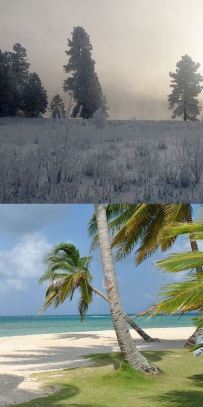
Winter: Alberta, top; BC, bottom
British Columbia is much milder than Alberta in the winter. Rather than letting bees sit on the frozen prairies, about 15% of Alberta hives spend the winter near the Pacific coast. An inaccurate contrast is illustrated in the photos to your left.
In the winter, it’s cool and rainy in BC’s lower mainland (the area broadly around Vancouver) but whenever the sun comes out, bees gather pollen. In Alberta in winter, whenever the sun comes out, bees cower ever more deeply in the dark nethers of their wrapped snow-clad hives. In BC, bees build up early, nucs can be spun off in April, and sometimes cash can be earned hauling bees into apple orchards. Bees in BC survive winter better and increases are made (rather than losses taken). However, BC’s milder weather and longer seasons can spread pests.
The chief apiary inspectors of each province enforce biosecurity rules for provincial bee movement. Before bringing nucs or hives from Saskatchewan or British Columbia, the following criteria need to be met:
Bees must be inspected in the originating province;
An import permit from the government of Alberta must be issued by Dr Nasr;
Colonies free of American Foul Brood;
Colonies must have varroa counts below 3%;
There must be no hive beetles;
Importing beekeeper needs an inspection certificate.
Packages:
Alberta beekeepers continue to import bees from abroad. Although valiant attempts have been made to develop a home-grown queen and nuc business, Canadian breeders continue to sell fewer than five percent of the queens sold in the country. The rest come in from Chile, Hawaii, and New Zealand.
One Alberta beekeeper imports tens of thousands of packages from New Zealand. At over $200 each, it starts to look like real money. One the companies that collects a bit of that Canadian cash is Arataki bee farm in New Zealand. This video gives you an idea of what’s involved in the production and shipment of bees from the other side of the world.
Pests:
Medhat told us that anti-AFB antibiotics have not been used at the government research apiaries for years. This is certainly encouraging. While we hear about resistant American Foul Brood, we also learn that bees can be kept in Alberta without AFB medications. It’s a lot harder to monitor foulbrood and clean up infections than it is to dump medications into the brood nest, but I’m sure we will learn to keep our bees clean.
The most memorable moment from Medhat’s bee talk was surely the clip of small hive beetle larvae running amok in an Ontario bee hive. The sheer yuck factor was 12.7 out of a maximum of 10. Good thing food wasn’t being served while the video played. But the little movie with all the wigglers was a good way to convince beekeepers to monitor for the messy beetle and not sneak uninspected bees into Alberta from BC or Ontario. At the moment, SHB has not been spotted in Alberta.
In discussing varroa, Dr Medhat Nasr reminded us that the real issue is the role the mite plays in spreading viruses. The mite is a nasty blood-sucking creature, but it also functions as a virus vector. This seems to cause the most harm. We don’t directly fight Zika virus (for example) but try to eliminate mosquitoes. Similarly, we want to eliminate mites to reduce bee viruses.
From this, we were walked through the problems with resistance to the varroa-fighting pesticides we’ve used in the past. Although they remain less difficult to administer and relatively cheap, the strips are being supplemented by somewhat natural treatment systems which aren’t likely to result in resistant mites. Medhat described screened bottom boards (which might kill 10% of the mites), essential oils (not very effective), oxalic and formic acids (may work quite well), and hops products.
As usual after a bee disease and pest management talk, beekeepers were a bit glum. But that passes quickly and we carry on better informed than before.
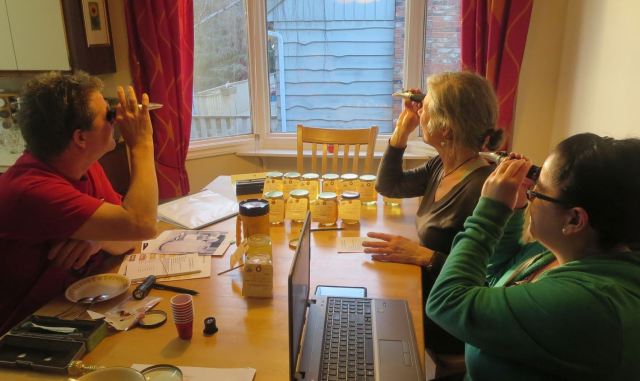
They look like pirates, don’t they? But these honey judges, under the direction of Chief Honey Judge Stephen, are checking honey viscosity (a proxy for the moisture level) of the entries in the “Aggie Days Honey Competition”.
Calgary (Alberta, Canada) has an annual “Aggie Days” with goat-milking, sheep-shearing, rope-making, corn-mazing, and bee-keeping on display. As our city becomes larger (about 1.2 million now) and less connected with its farming and ranching roots, it becomes almost a novelty to see farm stuff exhibited. But Aggie Days is wildly popular, even among those who have never carried the unmistakable odour of the countryside on the soles of their boots.
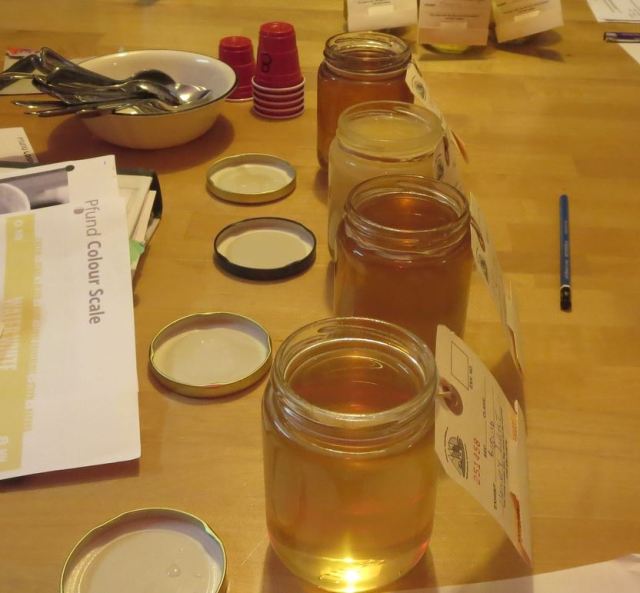
these are finalists for the special category, ‘Judges’ Flavourite” is the only time actual flavour is judged. For the main contest, honey is judged on non-taste-related elements (cleanliness, moisture, brightness, etc.)
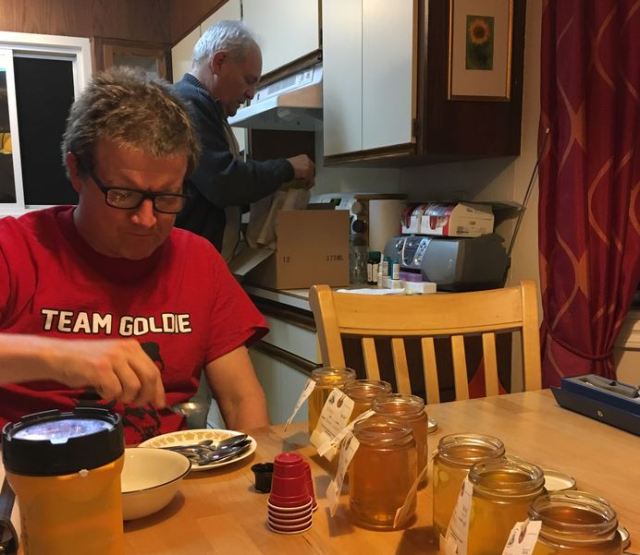
Several years ago, the local bee club started a big display to let city folks know a bit about commercial and hobby beekeeping in our area. Along with the cabinets of curios and yarns spun by real live beekeepers, there is also a honey competition. Judged on such qualities as ‘brightness’, viscosity, and some eight other critical elements, the best honeys are awarded ribbons. As a past chief judge, I have been involved in judging for quite a few years. The boss designation has passed on to my friend Stephen, but I am still allowed to help. Today’s posting is mostly a feature of photos taken during our judging process. Enjoy!
Very serious stuff. That’s Stephen in the front, me standing (!) in the back. (It was one of my ‘good’ days!)
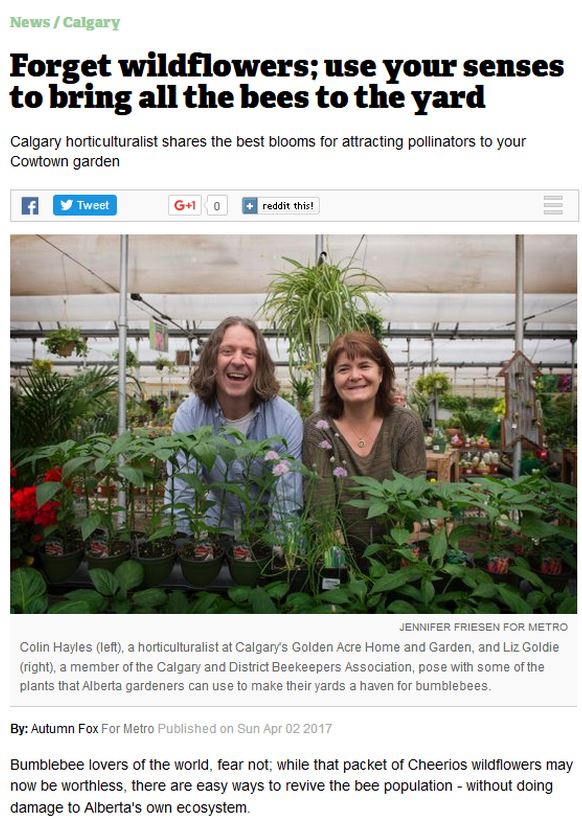
My friend Liz Goldie was in the news again. This time it was a good thing. She had dropped by a local greenhouse to set up delivery for July for some bee-friendly wildflower seeds to distribute at Calgary’s Stampede. Before she could think or blink, she was captured by a MetroNews photographer while she was chatting with greenhouse horticulturalist Colin Hayles.
Greenhouses such as Golden Acre Home and Garden in Calgary have hired bee specialists to help select appropriate plants to help native (and honey) bees. Liz, a beekeeping instructor and a bee expert herself, made Calgary-specific requests to help backyard gardeners who want to help bees. Here’s the lead to the article which you can read at this link.
Do you have a minute? You might enjoy this video, First exit of bumblebees, filmed (and scored) by Mukibrain.
When he sent me his link, the producer wrote, “I would like to share with you the latest video by Mukibrain, “First exit of bumblebees”. The first bumblebees in this early spring.” Early springs are likely our new norm – this pretty little mini-doc was filmed in France, but seasonal shifts are happening here in Canada, too.
Cherry trees in Washington bloom around April March first. Things are changing.
Erik, a beekeeper/writer/blogger in northern Virginia keeps a nice online calendar showing flowering dates in his neighbourhood. It’s only a couple of years old so it just gives us a small window into recent changes that may be happening to the climate in his area. I hope he keeps the calendar going for years and years to come. But already, it shows surprising drama.
On Erik’s calendar, dandelions are blooming a month earlier each year for three years in a row. In 2015, dandelions opened on April 10th. To me, that seems like the norm that I remember, growing up in nearby Pennsylvania, decades ago. But in 2016, the lions were roaring in March. This year they began flowering February 25th.
When ten of the hottest years on record have occurred within the past twenty (according to NASA) and carbon dioxide levels are at their highest in millions of years, only an ostrich would continue to enjoy the cool earthly delight of a head in the sand. These climate changes trouble me. Although I have been a lifelong beekeeper and have run commercial honey farms over the past 40 years, my job as a geophysicist keeps me interested and informed about earth-systems.
“The world has been hot before; it’ll be hot again.” Have you heard that one? It’s sort of right up there with, “House fires happen; they’ll happen again.” In the distant past, a build-up of CO2 was partly responsible for polar icecap melt which resulted in higher seas, heat, humidity, and dinosaurs. High levels of carbon dioxide trap the sun’s heat and the planet’s surface warms up. It’s elementary physics and not exactly rocket science. However, most scientists are amazed at the speed of the global meltdown. We really thought we could pass this problem along to our grandkids.
Rex Tillerson, now US Secretary of State, but formerly head of Exxon, has said that climate change is real and he directed Exxon to support the 2015 Paris Agreement on climate. Tillerson claimed that climate change was at least partly anthropogenic (human-activity driven). At his nomination hearings for his current job, he said that after 20 years as a scientist and engineer, he had concluded that “the risk of climate change does exist.” He also believed “action should be taken.” In the past, he has indicated that stopping climate change isn’t likely and he advocated that engineers will need to find ways for us to survive the inevitable.
If climate change is inevitable, what does that mean for farmers and beekeepers? Most of the commercial farmers and beekeepers whom I know are climate change skeptics. They tell me that climate change is natural and has happened before. They’re right to be skeptical. Personally, I think we should be skeptical about everything. On the other hand, if rejection of science is a political reaction and not a logical deduction, then it’s not skepticism but dogmatism that’s informing the discussion.
Farmers and beekeepers have to prepare for Tillerson’s inevitable climate change. Beekeepers are actually in a more envious state than other farmers because hives are mobile. Here are some suggestions to survive probably climate disruptions. I’m sure that you can think of more.
Pay attention. You might be a climate skeptic. But meteorologists are becoming better at predicting the next month’s weather. If they predict drought or an unusually wet winter, weigh the information with an open mind. They may be right, so take advantage of the warnings.
Look for more bee yards. If you are on the prairies, have some back-up yards at higher elevations or northerly places. Be prepared to move bees. Make arrangements with beekeepers in places that you might invade so they can help and profit from your arrival.
Own more supers. There may be years when your hotter bee locations are also wetter and huge bumper crops result. Expect wider fluctuations in crop size. No honey one year; manna from the gods the next. That’s likely to be the rule.
Pollinate. As farmers also suffer swings in rainfall and heat, they will depend more and more on bees for pollination. You may lose honey crops to drought but pollination contracts might keep you in the bee business.
Mind your pennies. Some people buy a Cadillac after a bumper crop. Those folks become ex-beekeepers. Saving money for famine years will be more important than ever.
Shut off the lights. Trivia waste of energy is part of the problem. On the other hand, beekeepers can be proud that their business is one of the few that (calorie-for-calorie) generates more food energy than it consumes in production of the food.
I’ll avoid the politics of climate change in today’s blog post. I understand that some libertarians see climate change warnings as a plot to undermine their freedom to pollute without consequence. But accepting science and making preparations to protect your business and your family are just exercises of common sense, not exercises in leftist manifestos.
I help teach a beginners’ beekeeping course here in Calgary. Two years ago, going through the sequence of nectar sources and their flowering dates, I told the class, “Dandelions reach peak bloom May 25th. You can set your calendar to it.” Then came the spring of 2016 with dandelions peaking in mid-April. Made quite a fool of me. In 30 years of Calgary beekeeping, it was the first peak bloom before May 15th. I think that I’ll be fooled rather regularly from now on.
Meanwhile, another look at the calendar that started today’s blog post. Erik has listed a favourite spring flower, the daffodil. Daffodils do little to help bees but they make a beekeeper’s life a bit brighter. Dabs of bright yellow on an awakening drabscape are always welcome. In 2015 in northern Virginia, daffodils were noticed in flower in April. In 2016, it was March. 2017, February. If that retro-trend continues in 2018, they should be out in January. In 2019, it’ll be daffodils in December. (No, I don’t really think so. But I’ve been fooled before.)
On March 30, we usually celebrate World Apitherapy Day at our house by eating fried drone brood seasoned with dandelion pollen and buckwheat honey while receiving a few intentional bee stings on our finger tips. What a fun day!
I first learned about apitherapy when I was 17. We had 300 hives scattered around the county. The bees were my job, assigned to me by my father who had enough other farm work to manage. Twenty of those colonies were on the edge of an abandoned hay field. In the fall, when I delivered honey/rent to the landowner, he told me that our bees had been stinging him. Of course, I felt awful. But the bees were a couple hundred yards from the old guys’ house so I was puzzled. “No, not your fault, don’t move them!” He explained that almost every day he trudged across the field to take a sting on his elbow. He said it had cured his annoying rheumatism. I’d never heard of such a thing before. The bees were practicing medicine and I didn’t have a clue about it.
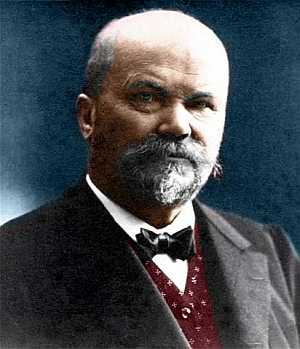
Well, today is World Apitherapy Day. It’s celebrated on March 30 because it’s my birthday. And, coincidentally, Filip Terč, the Father of Modern Apitherapy, shares the date. He was born March 30 1844, and I was not, so we are not the twins most people think we are. And my sporadically produced blog is more current than his.
Terč spent much of his scientific career in Maribor, Slovenia, exploring the benefits of bee-sting therapy on patients with rheumatoid arthritis and other disorders. He published his results in 1888 in a Vienna medical journal. This was the first modern scientific account of apitherapy.
Filip Terč, Father of Apitherapy 1844-1917
That’s Filip Terč glaring at you adjacent to this sentence. Terč was born in a remote Czech village in western Bohemia, but ended up in Slovenia where he worked as a physician. As a young man, he suffered badly from rheumatoid pain until, at age 22, he was accidentally stung by an aggressive mob of irritated honey bees. It changed his life. The pain was gone.
Terč began a serious study of the effects of bee venom therapy. He published the world’s first article on the clinical trials of bee sting therapy, the 1888 paper “Report on the Peculiar Connection between Bee Stings and Rheumatism”. He presented the results of his treatment of 680 patients with the collective application of 39,000 stings. 82% showed a complete cure, 15% had a partial recovery, while 3% had no relief from their rheumatoid condition. Those are an impressive number of trials and very impressive results.
His work was published 130 ago. His results have not been disputed, but the medical profession was slow at accepting the link between rheumatism, auto-immune dysfunctions, and bee venom. With the rise in cases of immune disorders (ranging from multiple sclerosis to lupus to allergies), the use of apitherapy treatments are becoming more widely available. If you’d like to learn more, there is a great collection of materials at the Bees for Life: World Apitherapy Network website.
Between 45% and 75% of British beekeepers are newbies – in their first four years. Only 10% have been at it for more than ten years. I guess it’s similar in Canada, Australia, and the USA. I saw the UK numbers on Chris Slade’s bee blog and he heard them from Margaret Murdin who gave a lecture on Becoming a Proficient Beekeeper. She says that we are novices for the first couple of years, improvers for two to four years, then (hopefully) we acquire enough skill to be ‘proficient‘.
I think turnover is highest in the first year or two. Beekeeping sounded like a good idea at the time: Save the Bees™, Help the Flowers, Get Some Honey. Perhaps you were going to be a hippie farmer, but you were born forty years too late. That’s lucky. The guys in this picture apparently wanted to be farmers – that’s why they were hanging out at Yasgur’s dairy farm. After the cow, it was going to be bees. It wasn’t. They were grateful instead.
But then your bees arrived. They stung the neighbour’s dogs (all of them) and your spouse wasn’t particularly impressed with the way bees eat sugar, queens, and money. And where was all that free honey you’d promised?
Beginning beekeeping can be pretty devastating the morning after the bees arrive. Or the evening after your first attempt at extracting. Or when a mite-infested laying worker has brood infected with foulbrood. It can be grim. But beekeeping can also be addicting. Like gambling. You may grow fond of the little fuzzies and decide to soldier forward. (With all those tight upper lips, I’m surprised that 90% of English beekeepers give up within ten years.)
Your best chance at success is to find a mentor and latch on tightly. Mentors don’t come cheap – you may need to serve pie with a beer and listen to old stories of by-gone beekeeping. Old beekeepers love to talk. If you make the mistake of feigning interest during an epic swarm-capture tale, expect to hear the same story again and again. With some modifications.
But your mentor will encourage you in a few ways. You’ll learn surprising tricks that will keep your bees alive. Maybe you’ll make some honey. However, the most significant lesson will come when you eventually realize that if that old geezer who has been talking your ears off can keep bees alive, well, so can you…


 America has 21.5 million university grads with science degrees. About 12 million actually work in science while the rest are retired or resigned to spend their working days doing more lucrative non-science stuff (lawyers, doctors, administrators). Of the several million with ‘science’ degrees who work as ‘scientists’ I would guess only 5 to 10 percent participated in the March. I’m a geophysicist. Though I wasn’t tinkering with seismic waves this weekend, I was tied up teaching a group of 20 beekeeping enthusiasts some finer points of the economics of apiculture. I suspect that a lot of other scientists were dissimilarly engaged and, like me, were not marching.









 “The world has been hot before; it’ll be hot again.” Have you heard that one? It’s sort of right up there with, “House fires happen; they’ll happen again.” In the distant past, a build-up of CO2 was partly responsible for polar icecap melt which resulted in higher seas, heat, humidity, and dinosaurs. High levels of carbon dioxide trap the sun’s heat and the planet’s surface warms up. It’s elementary physics and not exactly rocket science. However, most scientists are amazed at the speed of the global meltdown. We really thought we could pass this problem along to our grandkids.




 Bad Beekeeping Blog