Bee Rustling Undone

Stolen bees?

Ever been robbed? I have. It’s a pretty sick feeling when you realize that someone has broken in and taken your stuff.  Imagine how a Montana beekeeper felt when he entered his apiary to work his bees but almost 500 colonies were gone. Man, that’s gotta hurt.

But finally some good news from the world of bee rustling. Someone was caught. A full semi-load of bees (488 colonies) were lifted from Montana beekeeper Lloyd Cunniff’s operation while his bees visited California for almond pollination. Ag agents found the bees (estimated value $170,000) in a Fresno County cow pasture and drainage ditch. His were among ten other big bee thefts reported in seven California counties this spring.

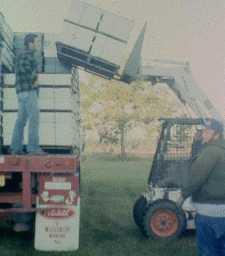
Loading my bees in Florida for a trip to Wisconsin clovers. Nothing stolen.

Pulling off a bee theft isn’t easy. At this scale, the thief has to be a commercial beekeeper with appropriate off-road forklifts, a flat-bed semi, and some bee knowledge. You can see what loading bees looks like – that’s me on the trailer in this picture. My bees and I were preparing to leave Florida, heading for northern clovers.

Big bee thefts take two or more people, and someone is always more willing to talk than go to prison. And the stolen property is usually easy to recognize. Although most beekeepers use similar Langstroth hives, most modify their equipment, many have unusual home-made pallets, operate 8-frame, or 10-frame, or double-deeps or triple-Illinois depths. Hives could be painted white, silver, camo, or rainbow. They are unique. Once stolen, beehives are hard to hide, even in drainage canals. Someone’s going to notice.  Finally, commercial guys brand their wooden equipment with a hot wood-burning tool that engraves their name, initials, or other marks. Frames, hive bodies, maybe even lids and pallets get branded.

Who owns this equipment? The name ‘MIKSHA’ burned into the wood is a clue.

My oldest brother was once stopped by state troopers while he was hauling is own bees on his own rig. The cop wanted his ‘Bill of Lading’ to identify whose bees were being trucked down the highway.

“Don’t have one. There’s no sale, so no bill of lading.  These are my own bees and hives.”

“Can you prove that?”

“Well, they are all branded.”

My brother meant that all the bee equipment was branded. The trooper thought he meant that all the bees were branded and the cop wasn’t going to start checking each one, so he let him go. Besides, maybe my brother looked honest.

Meanwhile, back in Choteau, Montana, a couple hundred miles south of my home in Calgary, Mr Cunniff reaquired most of his stolen hives last weekend. He put them in separate apiaries, away from his other hives, in case they came back to him with diseases or mites. But already he has lost a lot – he likely would have managed them better than the thief had. The Montana honey season is coming soon with alfalfa and sweet clover already opening. These bees, though finally back in their owner’s hands, won’t produce as well as his other colonies will.

Posted in Beekeeping, Commercial Beekeeping, Pollination | Tagged , , | 8 Comments

Field School at the Bees

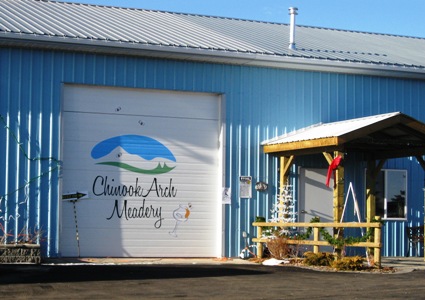
Chinook Honey – 20 minutes south of Calgary, near Okotoks, Alberta.

Last weekend, the Calgary bee club’s introductory beekeeping course wrapped up with our field school section. After 2 full days (15 hours!) of instruction, participants had a chance to observe, study, touch, and ask questions about the innards of live hives.  We were lucky to have great weather and a great venue this year.

Instructor Neil, unveiled. Did I mention the mountains?

We (over fifty of us) met at Chinook Honey Company, an outstanding bee farm owned/operated by remarkable folks who have been into bees for about 20 years. You might remember an earlier piece I’d written about Art and Cherie Andrews. With their honey shop, store, meadery, and some healthy hives nearby,  it was the perfect place to give newbies some bee exposure.

Overwintered single-story (yes, even on our cold windy Canadian prairies!), an unwrapped hive obviously enjoying a pollen flow. Note the entrance reducer. A syrup feeder, in black,  sits under the hive cover.  (Photo credit: Laurie McClure)

A (potentially) grave aspect to leading novice beekeepers to isolated apiaries are the risks of allergic reactions and panic attacks. Holding our field discussions at an apiary in the backyard of an established bee outfit (Chinook Honey) with good cell phone reception and just five minutes from a hospital helped relieve my anxiety. You never expect problems (and there weren’t any!) but the good beekeeper is always prepared. Before starting, we checked that participants were properly white-suited and veiled. We asked if everyone was comfortable and invited the students to be aware of their fears and to alert us of any stings. We allowed cool puffs to drift from a properly lit smoker before any hivess were opened and we worked calm, relatively weak colonies. Keep these things in mind if you take friends into the depths of your own hives.

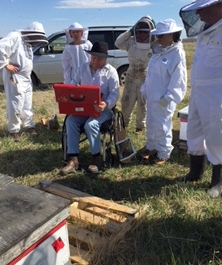
Students, left, examining a hive while Calgary bee club president Thomas gears up.

Photo Credit: Joycelyn Odney

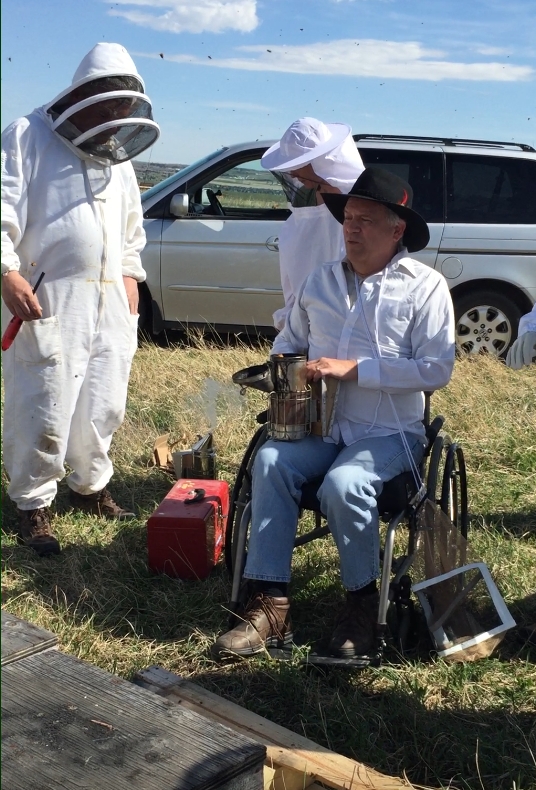
‘Tis I, to your right, in the wheelchair. I’m holding a red metal box which I picked up at Canadian Tire (a hardware/car parts chain). The box was part of our safety demonstration – 2017 is Prevent a Fire in Your Bee Yard Year.  Smoker safety is incredibly important. I haul my smoker inside the metal box where flames gasp for air and sparks fall on steel walls.  Consider such a box in your future.

After smoker-talk, we found queens. Since it’s still ‘early’ spring up here near Canada’s Rocky Mountains, the overwintered hives are just building up and queens were easy to spot. This is a thrill for new beekeepers – actually catching sight of her majesty, the mother of all bees. We discussed queen quality and techniques for releasing queens into packages  and for introducing queens in splits.  Part of the talk centered around helping the bees and queen accept each other. Young foreign queen bees are vulnerable to palace coups. This is a common issue this time of year. In a day or two, I’ll cover some of what we mentioned to the class about introducing queens.  For today, I mostly want to post photos of our day at Chinook Honey.  Enjoy!

Posted in Friends, Outreach, Tools and Gadgets | Tagged , , , , | 5 Comments

Metallica’s Beekeeper

James Hetfield: beekeeper and Metallica man

Last year, I wrote about the indomitable guitar man and bee guy Steve Vai. He’s a master of the strings and knows few equals. He’s also quite an experienced beekeeper.  Now it’s Mr Metallica, James Hetfield, who draws my beely attention. I wonder what happens to guys like these two when their wrists and fingers get lit up by defensive bees the day before a big concert. I suppose the show must go on.

Anyway, I rather like Steve Vai the Bee Guy, but was never enamoured by the loud, throbbing noise which Metallica generates. Well, not much, anyway. In moderation, I can take a little metal. (For example, I liked the Norwegian band, Miksha, but that’s mostly because they named themselves after me.)  So, it’s “Metallica in moderation”, which has a nice oxymoronic quality about it.

Nevertheless, kudos to Hetfield of Metallica. Hetfield, like thousands of other musical beekeepers, has discovered that spending time with bees can do wonders for pre-concert anxieties. It can also swell one’s ankle, as Hetfield describes in one of his bee adventures: “I had to move a hive one time… I’m in my beesuit, everything is fine… [but] one area of my ankle was exposed and, of course, I end up with about 20 bee stings.”

I like this admission from Hetfield, who had to submerge his fat foot in a bucket of ice water for a few hours. There’s something else to admire about the man with a rough childhood, a scary presence, and a long battle with alcohol. He said this about the real nature of manliness: “There’s a lot of machismo in this world, but I suppose the most manly thing you can do is face up to your weaknesses and expose them. And you’re showing strength by exposing your weaknesses to people. And that opens up a dialogue, it opens up friendships, which it definitely has done for me.”

If you need to know more about the iconic 80s metal-man, James Hetfield is the subject of a 2017 biography, So Let It Be Written. Written, not in stone, but in metallica, of course.

Posted in Culture, or lack thereof, People, Stings | Tagged , , | 4 Comments

International Workers’ Day

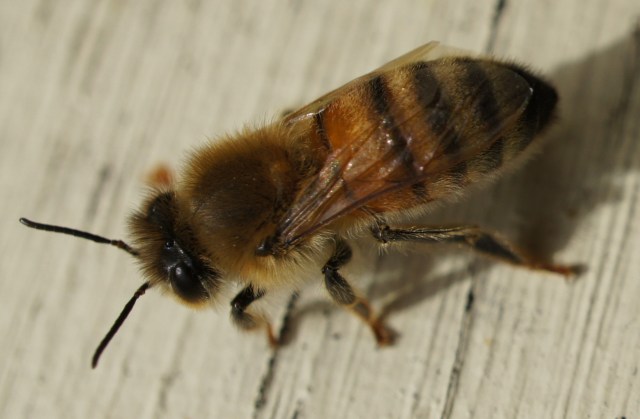
Worker Bee (Credit: Stephen Bennett, Bears’ Paw Honey, Calgary)

My home city of Calgary celebrated May Day (International Workers’ Day) by welcoming 1,176,334 foreign workers into our community last night, doubling our population. 196 packages of worker bees had arrived. A swarm of Calgary beekeepers greeted the immigrants. (The arriving bees were carrying New Zealand passports.)  Most beekeepers picked up just one or two cages of bees. For many, it was their first Apian experience. Dozens of newbies drove home with the seed of their first honey crop. The bees (and their attached beekeepers) will do an amazing amount of good for our community.

Package bees arrive in Calgary. 196 cages. 6,000 bees in each.

In our area, package bees grow into strong colonies in two months. By July, they blossom from their original colony of 6,000 bees to over 40,000. They will pollinate billions (yes, billions!) of flowers. The 196 packages should collectively provide ten tonnes of fresh honey this summer for the new beekeepers. They will also make enough honey to survive the winter of 2017-2018.

The future for a package?

A side-benefit of having all these new bees is that they come with a big group of new beekeepers who generally share laudable goals for our city’s health. Beekeepers encourage maintaining wild spaces and they usually favour reducing the use of herbicides and insecticides. This, in turn, assures that hundreds of millions of other bees – native bees like bumblebees, for example – will also flourish in our town.

Thomas, the Calgary bee club president, coordinated the big bee distribution. Then he arrived at my house with two of the 196 packages. In my old van, I drove all 12,000 of us to a friend’s place just outside town where Thomas and I helped some new beekeepers establish those packages. It was a chilly evening but things went smoothly. The bees were calm and appreciated their release into their new home of drawn combs with honey and pollen. I think they will do well. It’s a marvel that the two small clusters of bees and their queens will grow from no brood to ten or more frames and may make a hundred pounds of honey.

I hope that the other beekeepers who collected bees from the delivery truck last night had as much success and pleasure establishing their new responsibilities as we did.  Bee season has begun.


Posted in Beekeeping, Ecology, Friends | Tagged , , | 4 Comments

Fishing Bait That Eats Plastic

Wax worms in a honey bee hive. (Credit)

Hundreds of diseases and pests attack honey bees. One of the oldest known hive invaders is the wax moth. Aristotle had trouble keeping them out of his hives so maybe you do, too. 

Wax moths come in two flavours – lesser and greater. They are both of the same tribe, Galleriini. (Tribe is the scientific classification between Family and Genus.) The Lesser Wax Moth is the lesser of your worries. It’s smaller and less destructive. Its bigger cousin, the Greater Wax Moth, can kill colonies so we’ll take a moment to consider it.

If you are a northern beekeeper, as we are here in Alberta, Canada, you don’t fret much about the greater wax moth. Frost kills it. Beehive equipment stored in an unheated shed receive all the treatment necessary to destroy wax moths. In a hot climate, the wax moth is repelled by strong hives and the wax moth worms never take much of a bite out of a hive. But weak hives are vulnerable, as are honey boxes stored in warm places.

The wax moth sneaks into unoccupied comb or poorly defended hives and lays eggs. These become worms – larvae or caterpillars – which wriggle around on the combs, eating wax and pollen, weaving cobwebs, and crapping all over the place. They are nasty dirty. Not only do they eat your equipment, they leave behind a mess that can make you puke as you scrape and clean, then refit new sheets of foundation in the old frames. Welcome to beekeeping. The greater wax worm costs beekeepers millions of dollars worldwide in lost equipment, smaller honey crops, labour costs, and even defeated colonies that need restocked. But they have an upside.

Honey bees are susceptible to diseases such as American Foulbrood. A wild hive inside a hollow tree eventually picks up AFB, becomes weak, and succumbs to wax moths. The worms of the moths eat the hive’s wax, honey, and pollen while the sick colony dies. This eliminates old diseased combs that might contaminate other honey bee colonies for years.

The greater wax moth offers another bonus. For a couple of centuries, southern fishermen have set aside an old comb or two for the moths to invade, then they’d pick off the fat juicy worms for fish bait. I’m told that bass and catfish love the treats, though I have no idea how they acquired a taste for a worm that originally lived on wax combs in hollow trees. But I don’t question a fisherman’s success. I’ve enjoyed properly prepared, pan-fried aquatic craniates lured from ponds by plump wax worms.

Now there’s another use for wax worms. Scientists recently discovered that a wax worm puree dissolves plastic bags. The same chemicals used by wax worms to decompose complex beeswax carbon molecules enable digestion of polyethylene.

We – the humans of planet Earth – produce over 300 million tonnes of plastic each year. (That’s about one and a half kilos each week for each of us.) The stuff is made from carbon (mostly from petroleum) but it doesn’t easily convert back to its original natural state once it has been fashioned into shopping bags, yogurt containers, and Barbie dolls. Those products – so essential for to our modern society – last hundreds of years in landfills or bobbing around in the sea. But, as the wax moth discovery suggests, plastic may be eaten by worms. If so, the crappy mess found in beehives might perform a delightful garbage dump chore.

Credit for the observation that wax worms eat plastic bags goes to backyard beekeeper Federica Bertocchini, a Spanish biologist. Two years ago, she bagged some wax worms that had invaded one of her hives. An hour after incarcerating them in the baggie, they were eating their way toward freedom. This event was reported to fellow scientists at the University of Cantabria where they initiated a plastic-eating project. They soon discovered that 100 wax worms eat about 100 milligrams of polyethylene in twelve hours. A thousand such worms (not an uncommon number in a hive of bees overrun by wax moths) might eat an entire plastic bag every two days.

The next step was to figure out whether the worms were simply shredding the plastic to tiny bits (which would not really be breaking down the long carbon polymers) or converting the material into food instead (the ideal biodegradation of plastic).

It turns out that wax worms produce an enzyme that reduces polymers to edible compounds which are no longer plastic. They evolved the enzyme during their millions of years of cleaning up diseased honey bee nests. At the molecular level, beeswax and modern polymers share a similar carbon backbone structure. Wax worms actually digest beeswax and they do the same with plastic, using the worms’ same chemicals.

In their lab, the scientists made warm wax worm soup (or Worm Puree – you can make this at home with your own blender, if you like). Smearing the liquefied worms onto plastic, they observed the biodegrading property. It works, but application is slow, awkward, and messy. And it takes a lot of dead worms, which would raise eyebrows over at PETA. So, the scientists are studying the worms’ chemical compounds and hoping to graft enzyme-producing genetic alleles into bacteria (whose advocacy group is less vocal than PETA). The goal is to spray the engineered bacteria around our landfills, quietly converting plastic bags into grease puddles. Just don’t park your Saturn SL1 too close.

Let them eat plastic.

Posted in Bee Biology, Beekeeping, Diseases and Pests, Science, Strange, Odd Stuff | Tagged , , , | 9 Comments

Billy Bee and Doyon – Canadian Honey Forever

Professional Canadian beekeepers know the names of honey packers Jack Grossman and Paul Doyon. Jack started Billy Bee Honey; Paul’s label was regional (mostly Quebec) and his product was/is called Miel Doyon. During the 1970s and 1980s, I sold honey to both of them. I shipped semi-loads of premium, water-white, 15.5% moisture alfalfa-sourced honey from Val Marie, Saskatchewan. The business transaction was a phone call from me, an agreement on price, and then an 18-wheeler would show up, load up, and drive off.  I didn’t even get a signed bill of lading. A few weeks later, a cheque would arrive in the mail.

I never met Paul, but I saw Jack at a bee meeting. My favourite story about Jack was that he famously carried note cards to remind himself about different beekeepers. A Saskatchewan beekeeper friend – Don Peer – once asked Jack what was written on the Don Peer card. An address? Honey quality? Price last offered? Jack showed Don his card. All it said was, “Doesn’t need money.”  I was about 20 when I heard that story and it taught me a lot. There is power in those three words.  Doesn’t need money.  I tried to run my business that way – I wanted to never be desperate, never broke, never need money. The expression also means something else. Don Peer was well-off, but not wealthy – after all, he was a beekeeper. But he lived and ran his business in a way that he didn’t get into a jam with cash.
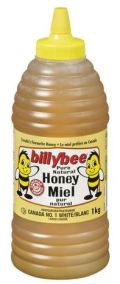
The Billy Bee man, Jack Grossman, was from Toronto. After serving in World War II, he kept a few hives behind his house. He packed honey in his garage and got into some stores. To meet demand in Ontario, he bought honey from other beekeepers. Business grew. His reputation for fairness and timely payment made him popular with beekeepers. His consistent, high-quality honey made his Billy Bee brand a big seller across Canada.  Paul and George Doyon started their packing operation in 1927. I suspect that their story is similar because that’s the way you build a business. Honesty, consistency, fairness.

Those men grew old. Jack Grossman passed away, age 92, on this day (April 27) in 2009. In 2008, the international food packer McCormick & Company bought Billy Bee for 75 million dollars.  With that purchase, McCormick got $37 million in annual sales plus the Doyon(R) label which Billy Bee had previously acquired. I’m sure that you know McCormick – they specialize in spices and are probably best known for their black pepper. It’s a big company. $37 million in sales is round-off error compared to McCormick’s $4.4 billion revenue last year.

As beekeepers, we depended on the Doyon and Billy Bee sales. They bought Canadian honey; sold Canadian honey. In recent years, stories of McCormick importing some foreign honey for jars of Billy Bee were disappointing, but not unexpected. Honey is cheaper when it comes from countries with lower wages and possibly lax sanitary requirements. Imported honey can be good quality (though there are some horror stories), but supporting Canadian beekeepers is the right thing to do.  Besides, our beekeepers use some of their honey money to buy McCormick’s paprika, cinnamon, and ground black pepper. Keeping the money at home allows Canadian beekeepers to buy McCormick products and to keep other Canadians working – building their shops, repairing their vehicles, making their skidoos. But, most important, honey produced in Canada can be readily inspected, traced back to source, and must reach high quality standards to satisfy customers.

So, today’s news – McCormick is committed to using 100% Canadian honey from June of this year and forever after. This is met with cheers and thanks from beekeepers and consumers. Here is part of the news story:

McCormick & Co. says Billy Bee and Doyon products containing all-Canadian honey will start appearing on store shelves in June, while the Billy Bee organic variety will arrive before the end of the year.

Previously Billy Bee products contained at least 85 per cent of the sweetener sourced from Canadian beekeepers, something that has been a source of frustration for the country’s honey industry as some beekeepers say they produce enough to negate the need for any imports.

Andrew Foust, the company’s general manager of Canadian operations, says Canadians have expressed a desire for made-in-Canada honey and the shift is responding to consumer preference.

He said the shift won’t come with a boost in price.

The company will also participate in the True Source Honey certification program, an industry-led effort to ensure the product is ethically and legally sourced.

This is big news.  McCormick’s Billy Bee and Doyon brands make up about 60% of all branded honey sales in Canada.  This story also shows the power of consumer activism. As Mr Foust said above, “Canadians have expressed a desire for made-in-Canada honey and the shift is responding to consumer preference.”   Way to go, consumers!

Ah, yes – this is sitting on my own dining table!
Great squeeze bee, eh?

Posted in History, Honey | Tagged , , , | 11 Comments

Burt’s Cabin Tour

Burt Shavitz, of Burt’s Bees, died two years ago. A photographer (for Life and Time) from Manhattan, he settled near Bangor, Maine, in the 1960s. There, he discovered beekeeping. Although Maine is one of the worst places in North America to keep bees (limited forage, cool temperatures, harsh winters), his beekeeping nevertheless led to a candle business with his eventual partner Roxanne Quimby. It was mostly she who developed the wildly successful business which was purchased in 2007 by Clorox for about one billion dollars. By then, Burt Shavitz was largely out of the game. But his image (and the myth of the man) have continued to sell the Burt’s Bees’ line of creams and balms and healthy beehive by-products.

The Burt Shavitz myth is more than an advertising gimmick. He was a real beekeeper, a real granola-sucking backwoods-cabin sort of guy. However, when Burt’s Bees general manager Jim Geikie tells us, “Burt was a living embodiment of our purpose to connect people to the wisdom, power and beauty of nature,” it does border on a myth in the making. For a realistic sense of the complicated Mr Shavitz, I suggest Jody Shapiro’s documentary, Burt’s Buzz. It does justice to Burt’s life while exposing some of the petty things that actually make him likeable and connect him to us, the non-mythologized. Watch the film and you’ll see what I mean.  Here’s a YouTube link to the documentary.

Meanwhile, the tall tale continues with the Burt’s Bees company’s release of a 360 Experience that “Takes You Inside Founder Burt’s 300-Square-Foot Cabin” where  “There isn’t even an alarm clock”.  Oh my. No alarm clock. How primitive. Maybe he used the reminder feature on his I-Phone.  Anyway, for those of us who do not own a 300-square foot cabin in a Maine forest, here’s Burt’s Bees’ invitation to voyeurism. Look around and enjoy the cracklin’ fresh atmosphere of a fireplace which generates its homey sound on a repeating 61-second audio loop. It would add to the surrealism if the 360 Experience mentioned that Burt’s cabin is no longer in the woods in Maine, but was moved to Burt’s Bees corporate headquarters at the American Tobacco Campus in North Carolina.

Here’s a link to Burt’s Nature, the 360 Experience of Burt’s cabin/monument. If you feel creeped out as you wander through the mythical dead man’s mythical Maine house, you’re not the only one who finds this ‘experience’ eerily similar to a Rod Sterling Twilight Zone episode. Don’t misunderstand me – Burt Shavitz was an extraordinary man. Ex-military, acclaimed photographer, beekeeper. But I think he’d agree – give him a rest.

Posted in Culture, or lack thereof, Hive Products, People, Strange, Odd Stuff | Tagged , , | 3 Comments

Supporting “Painting the Bees”

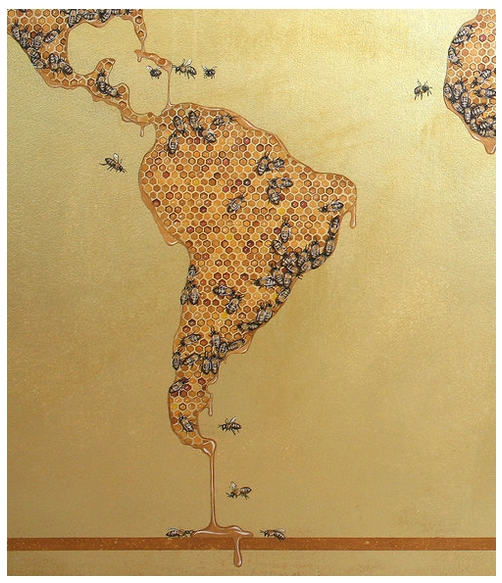
A bee mural, painted by Matthew Willey.
His goal: Ecology awareness through 50,000 painted bees.

It’s pretty hard to pry money out of my pockets.  Unless you’ve got something really great going on that can use a little support.

The Good of the Hive is one of the worthy ones. It aims to bring awareness of bees, ecology, and environment to the public’s eye with outstanding portraits of bees at work and play. This is being accomplished by the production of huge outdoor murals. The artist’s goal:  to paint 50,000 bees over his lifetime project!

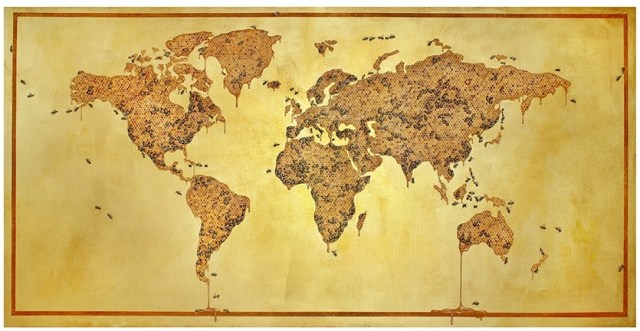
I wrote about Matthew Willey’s brilliant project back in February. He told me that there would be a small crowd-funding campaign in the spring. It’s on now and there are still a few days to contribute – plus there are some outstanding gifts you may qualify for. I couldn’t resist the “World Bees” Poster. It doesn’t show the range of Apis dorsata or Apis mellifera scutellea – that would miss the point. This is art. Instead, Matthew has chosen to draw the continents as honeycombs and populate them with artsy bees. It’s a grand concept that reminds us that bees are the world. We – you, me, the bee – are in this together. Here’s what my new World Bees poster will look like:

And this, close-up:

There’s less than a week left in this fund-raiser campaign. But that’s still plenty of time to send a little love over to The Good of the Hive.

Posted in Culture, or lack thereof, Ecology, Outreach, Save the Bees | Tagged , , , | 2 Comments

Have These Kids Found a Way to Kill Varroa?

Why not just brush off the mites?

I am a skeptic when it comes to ‘miracle’ cures to fight varroa. I think that the various expensive heat/sauna systems are a waste of time and money. A lot of natural treatments (icing/powdered sugar; essential oils; screened bottoms) are marginally helpful – they won’t keep a hive alive, but they might delay the funeral. When I heard about a system developed by some youngsters in Spain, I was not quick to don my credulity cloak.  I’m not sold on their invention, but I won’t disparage it outright.

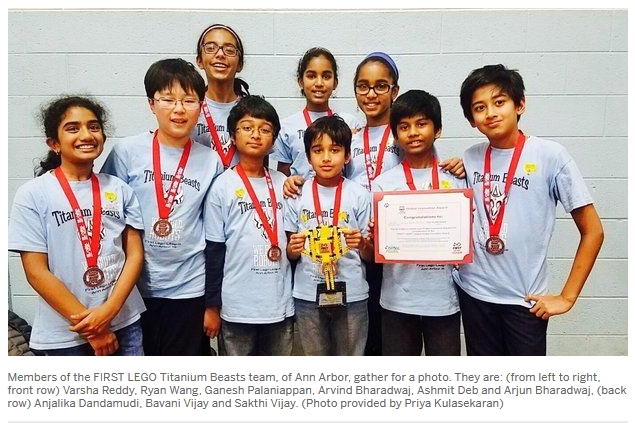
Here’s the story. A group of young scientists have engineered a 7-mm-wide beehive entrance reducer outfitted with tiny brushes. As bees return to their hive, they maneuver through the little doorway while brushes rub varroa mites off their backs. Mites are removed outside the hive. The student-scientists used a  3d printer to make the little plastic entrances. The youths, aged 14 to 16, live in Valencia, Spain. This summer, their device will compete at the FIRST LEGO Asia Pacific Open in Sydney, Australia. Presently, a crowd-funding campaign is raising the money to take them from Europe to Australia to participate.

Will it work? Perhaps. I’m sure that you can think of reasons it won’t. Even if some varroa are scraped off, it only takes one lucky mite to colonize a hive. Mites which do fall off could later crawl into the hive – they live a few days without a bee host and they are mobile. A side issue is the restricted entrance which reduces air flow and forager traffic. On the other hand, the inventors point out that their narrow entrance blocks wasps. Unchecked, wasps destroy colonies so this is a welcome side-benefit. Concerns about air flow and traffic control issues might be alleviated if beekeepers use a large number of the tiny doors on each hive.

The idea is cheap and it might reduce mites. I don’t think it will save honey bees from succumbing to varroa, but it could be one more weapon in the beekeeper’s toolkit. What do you think?

These are the kids with the 3d-printed mite brush.  Support them here.

Posted in Beekeeping, Diseases and Pests, Save the Bees, Science, Tools and Gadgets | Tagged , , | 14 Comments

March for Science (revisited)

So, how’d the March for Science go?  I’ll admit that it went better than I expected. My fear (expressed in Friday’s blog) that the effort to support science would be hijacked by a political agenda was only about one-third true. I looked at dozens of photos from the March. Signs for science trumped anti-Trump signs about two to one.

America has 21.5 million university grads with science degrees. About 12 million actually work in science while the rest are retired or resigned to spend their working days doing more lucrative non-science stuff (lawyers, doctors, administrators).  Of the several million with ‘science’ degrees who work as ‘scientists’ I would guess only 5 to 10 percent participated in the March.   I’m a geophysicist. Though I wasn’t tinkering with seismic waves this weekend, I was tied up teaching a group of 20 beekeeping enthusiasts some finer points of the economics of apiculture. I suspect that a lot of other scientists were dissimilarly engaged and, like me, were not marching.

Many (or most) of those supporting science on Saturday are non-scientists who either used the occasion to voice a political statement and/or they wanted to recognize that experimentation, observation, and deduction make healthier lives – and a better place to live our lives. One of my sisters marched in San Diego (some of her pictures are below) while other friends walked in D.C., Seattle, and Denver.

Here’s a bit of a photo essay that captures some of the weekend’s messages. Although at least a third of the messages were heavily political (and some were even anti-science), most were on target. You’ll even see a couple of placards prompted by concern for the plight of bees.

.

Posted in Culture, or lack thereof, Friends, Outreach, Save the Bees, Science | Tagged , | 5 Comments