Beginners’ Bee Course

2016-11-bee-club-2

Calgary’s bee club does an amazing amount of work for our area’s beekeepers. It’s great fun being involved. The volunteer opportunities are enormous – mentoring, hosting visitors (Saturday at the Hive), catching city swarms, and bunches more. My contributions over the years included serving as the club’s president, acting as the chief honey judge, and helping with a team of teachers. The most best-est is teachering, which I find marvelously edifying. This weekend, I had the privilege of participating in the beginners’ beekeeping course!

2016-11-bee-club-5

Me, teaching. My friend Lisa Reimer took the squirrel photo at a family picnic.

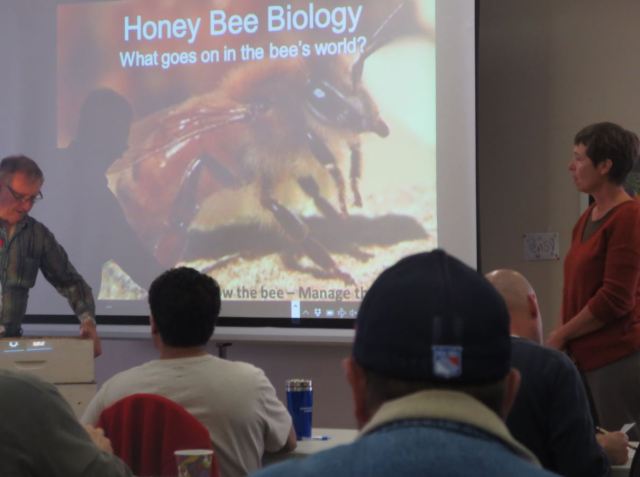
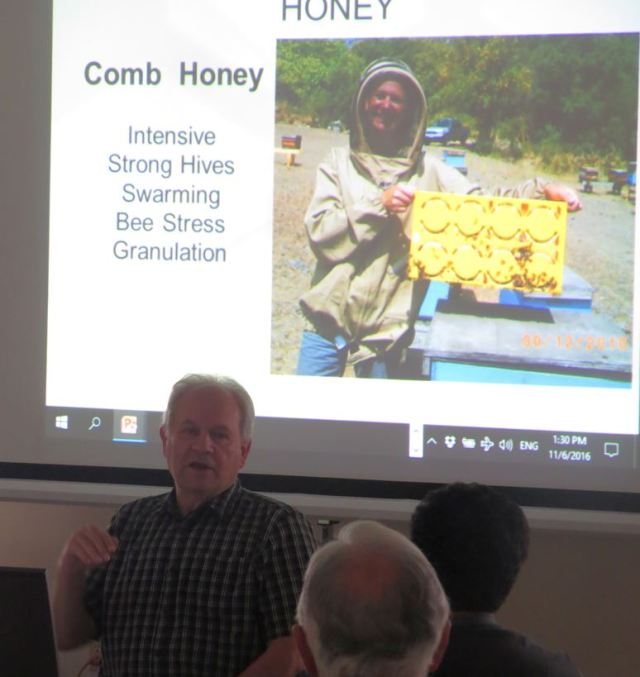
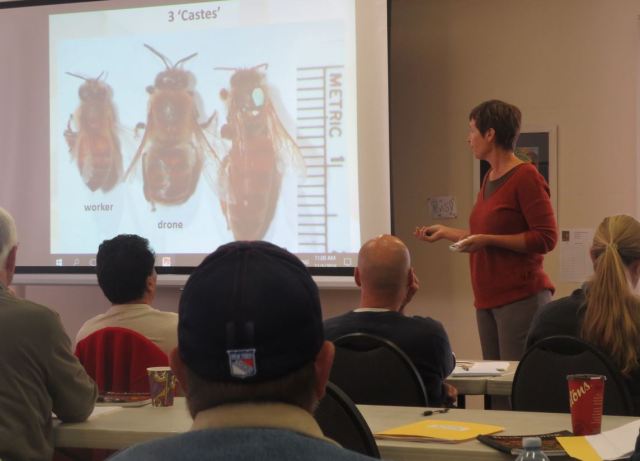
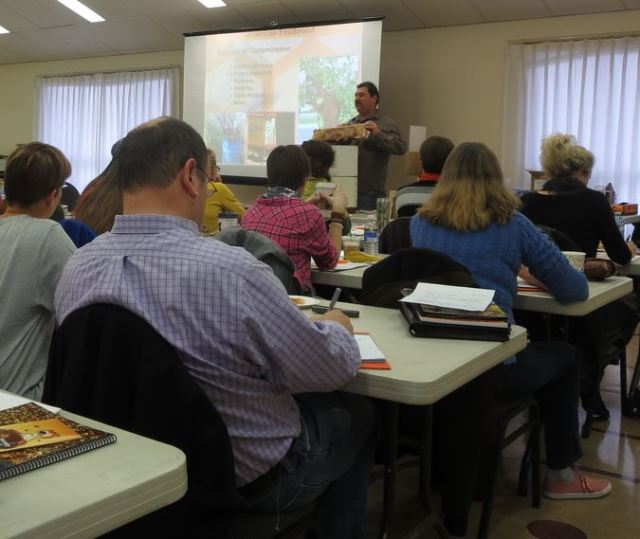
35 new beekeepers attended our two-day course. Our first day of sessions included an introduction to bees (Bee Biology), hive equipment and costs (Getting Started), and then our Spring/Summer and Fall/Winter management modules finished the day. The next day we covered the necessary stuff on bee diseases and pests, government regulations and inspections, and handling and removing honey. The second day ended with a recap presented as a calendar which led the students through a typical year of beekeeping.

2016-11-bee-club-9The photo, left, is such a quintessentially Canadian pic, don’t you think? You can see the flag and (look closely) a 40-year-old portrait of the queen and her husband on the far wall.  The hall is a community centre (Canadians are big on community stuff!) with basketball foul lines (basketball was invented by a Canadian) and a very old piano, used mostly to play Oscar Peterson jazz tunes. The place is obviously wheelchair accessible (very inclusive culture here), and you can even see a typical Canadian skep-head – me!

Here are a few more pictures from our very busy, fun (and exhausting) weekend:

2016-11-bee-club-7

2016-11-bee-club-3

2016-11-bee-club-1

Neil, Tom, Glenda, Bert, and (seated) Ron

Neil, Tom, Glenda, Bert, and (seated) Ron

Posted in Friends, Outreach | Tagged , , | 4 Comments

A Metaphysical Life

richard-taylor

Today is the  anniversary of the birth of one of my beekeeper-heroes, Professor Richard Taylor. He was an early champion of the round comb honey system, a commercial beekeeper with just 300 hives, and he was a philosopher who wrote the book on metaphysics. Really, he wrote the book on metaphysics – for decades, his college text Metaphysics introduced first-year philosophy students to the most fundamental aspect of reality – the nature of cosmology and the existence of all things.

Although his sport of philosophy was speculative, unprovable, and abstract to the highest degree, Richard Taylor was as common and down-to-earth as it’s possible to become. I will write about his philosophy and how it shaped his politics, but first, let’s celebrate his beekeeping.

Richard Taylor and his twin brother were born November 5th,  1919.  This was shortly after their father had died. That left a widowed mother to raise an impoverished family during the Great American Depression.  Richard was fourteen when he got his first hive of bees in 1934 – the year that a quarter of Americans were unemployed and soup-lines leading to Salvation Army kitchens stretched for blocks. He began beekeeping that year, and except for submarine duty as an officer during World War II, he was never far from bees. He respected honest hard work and the value of a penny, but he nevertheless drifted, trying college, then quitting, and taking on various uninspiring jobs.

Evenings, on his bunk in his navy sub, Richard descended into the gloomy passages of Arthur Schopenhauer. Somehow the nihilistic philosopher appealed to Taylor and ironically gave him renewed interest in life. Because of this new interest, Taylor went back to school and became a philosopher himself.

Richard Taylor earned his PhD at Brown University, then taught at Brown, Columbia, and Rochester, from which he retired in 1985 after twenty years. He also held court as a visiting lecturer at Cornell, Hamilton, Hartwick, Hobart and William Smith College, Ohio State, and Princeton. His best years were at Rochester where he philosophized while his trusted German shepherd Vannie curled under his desk. Richard Taylor sipped tea and told his undergrads about the ancient philosophers – Plato, Epicurus, Aristotle, Xeno, and Thales. In the earlier days, he often drew on a cigar while he illuminated his flock of philosophy students. Those who attended his classes remarked on his simple, unpretentious language. They also noted that he was usually dressed in bee garb – khakis and boots – he and Vannie quickly disappeared to his apiaries when the lecture ended and the last student withdrew from the hall.

The hippie beekeeper

It’s probably unfair to call Dr Richard Taylor a hippie beekeeper, but perhaps he was exactly that. As a beekeeper, he was reclusive. He refused to hire help. Rather than deal with customers, he set up a roadside stand where people took honey and left money on the honor system. Taylor disdained big noisy equipment. He claims to have sometimes taken a lawn chair and a thermos of tea to his apiaries so he could relax and listen to the insects work, but I doubt that he did this much.  Through the pages of American Bee Journal, Bee Culture, and several beekeeping books, he described best beekeeping practices as he saw them – and those practices required hard work and self-discipline more than relaxed introspection.
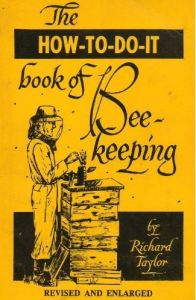
how-to-do-it-book-coverRunning 300 colonies alone while holding a full-time job and writing a book every second year demands focus. His bees were well-cared for, each producing about a hundred pounds every year in an area where such crops are rare. By 1958, he was switching from extracting, which he disliked, to comb honey production, which he loved. Comb honey takes a more skilled beekeeper and better attention to details, but in return it requires less equipment, a smaller truck, and no settling tanks, sump pumps, whirling extractors, or 600-pound drums. “Just a pocket knife for cleaning the combs,” he wrote.

Summit Comb in useTo me, it’s surprising that Richard Taylor embraced the round comb honey equipment called Cobanas. The surprising thing is that the equipment is plastic. Reading Taylor’s books, one realizes his affinity for simple tools and old-fashioned ways. Plastic seems wrong. But it’s not.

In the past, comb honey sections were square-shaped and made from wood. That required the decimation of forests of stately basswood (linden) trees, something that did not appeal to Taylor. Plastic lasts forever, a real benefit for a person as frugal as Richard Taylor. It’s light-weight, durable, and ultimately very practical for bee equipment. He advocated making comb honey and he was sure that the Cobana equipment, invented by a Michigan physician in the 1950s, would lead the way. He was so enthused that in 1958, living in Connecticut, he wrote his first beekeeping article about the new plastic equipment for the American Bee Journal. Here’s the photo that accompanied his story.

randy-with-combs

Richard Taylor’s son, Randy, packing round comb honey, 1958. (Photo from ABJ).

One final thing about Richard Taylor, the beekeeper. He was financially successful. In today’s dollars, his comb honey bee farm returned about $50,000 profit each year – a tidy sum for a hobby and more than enough spare change to indulge his habit of frequenting farmer’s auctions where he’d delight in carrying home a stack of empty used hive bodies that could be had for a dollar.

Taylor, the teacher

Richard Taylor immensely enjoyed teaching and lamented what he called “grantsmanship” which arose in America while he was a professor. Grantsmanship is the skill of securing funding for one’s projects while ignoring the fundamental duties of teaching. This, of course, can eventually lead to big dollars flowing to researchers who are willing to claim that sugar, for example, does not contribute to obesity and cigarette smoke does little more than sharpen one’s senses. Richard Taylor saw the conflict and regretted the demise of good faculty instructors replaced “largely by graduate students, some from abroad with limited ability to speak English. Lecturers who simply read in a monotone from notes are not uncommon,” he wrote.

Meanwhile, the (sometimes unethical) pursuit of grants was accompanied by the rise of the “publish or perish” syndrome. In his own field, Taylor pointed out that academic philosophers engaged in “a kind of intellectual drunkenness, much of which ends up as articles in academic journals, thereby swelling the authors’ lists of publications.” Taylor wrote extensively on this in 1989, saying that there were 93 academic philosophy journals published in the USA alone – seldom read, seldom good, but filling the mailboxes with material to secure a professor’s promotions.

This was not the academic world that Richard Taylor sought when he began his career in the 1950s, but it was the world he eventually left. Although he wrote 17 books – mostly philosophical essays but also several rather good beekeeping manuals – he didn’t publish many academic papers. He spent more time in the lecture halls and with his bees than he did “contemplating the existential reality of golden mountains” and writing papers about them, as he put it.

The philosopher and the bee

I am only going to give this one short passage about Richard Taylor, the philosopher. He studied and taught metaphysics and ethics. His essays on free will and fatalism are renowned and influential, even today. I’ve never taken a philosophy class, so anything I might say here will probably embarrass me. But five years ago, during a winter trip to Florida, I carried Taylor’s Metaphysics with me. I read every word and I think that I understood it at the time. For me, most of it was transparent common sense. Since it was well-crafted and interesting, Taylor may have lulled me into believing that I understood his metaphysical description of the universe, even with just this cursory introduction. At any rate, I felt that what he wrote wasn’t different than what I’d come to discover on my own, although it was much more elegantly presented than I could ever manage.

Taylor-made politics

taylor-c-1980When I saw Richard Taylor – just once, at a beekeepers’ meeting – I indeed thought that he was a hippie, a common enough form of beekeeper in the 1970s. His belt was baler twine and a broad-rimmed hat hid his face. I was surprised to later discover that Richard Taylor identified as a conservative and voted Republican. But he was also an atheist, advocated for women’s rights, and late in life (though proud of his military service) he became a pacifist, “coming late to the wisdom,” he said. I guess he would be a libertarian today. He valued hard work, self-sufficiency, and independence. He disliked Nixon, but gladly voted for Reagan. He even wrote a New York Times editorial praising Reagan’s inaugural address while offering insight on what it means to be a conservative.

At age 62, still a professor of philosophy at the University of Rochester, and the recent author of the book  Freedom, Anarchy, and the Law, he wrote a widely-circulated 1981 New York Times opinion piece. Taylor wrote that in Reagan’s inaugural address, Reagan reminded us that “our government is supposed to be one of limited powers, not one that tries to determine for free citizens what is best for them and to deliver them from all manner of evil.” Richard Taylor then goes on to warn that “political subversion . . . is the attempt to subordinate the Constitution to some other philosophy or creed, believed by its adherents to be nobler, wiser, or better.”

Taylor warned of anti-constitutional subversion in American politics, “if anyone were to try to replace the Constitution with, say, the Koran, then no one could doubt that this would be an act of subversion.” He continues, “Similarly, anyone subordinating the principles embodied in the Constitution to those of the Bible, or to those of one of the various churches or creeds claiming scripture as its source, is committing political subversion.”

Taylor tells us that conservative spokesmen of Reagan’s era – he mentions Jerry Fallwell and others – are right saying that “it is not the government’s function to pour blessings upon us in the form of art, health, and education, however desirable these things may be.” Nor, he claims, is it constitutional for “the Government to convert schoolrooms into places for prayer meetings, or to compel impoverished and unmarried girls, or anyone else, to bear misbegotten children, to make pronouncements on evolution, to instruct citizens on family values, or to determine which books can and cannot be put in our libraries or placed within reach of our children. . . it can never, in the eyes of the genuine conservative, be the role of Government to force such claims upon us. The Constitution explicitly denies the Government any such power…”
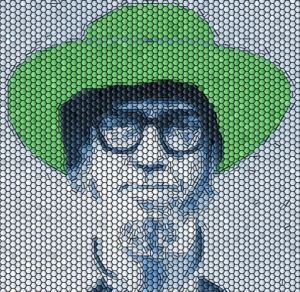
taylor-mosaicI think that Richard Taylor would be politically frustrated today. The Republicans have drifted ever-further from small government and have expanded their reach into personal affairs while the Democrats have pushed forward extensive safety nets.  A true libertarian party, such as Taylor seems to wish for, gathers little support in America today.

I hope that my summary of Richard Taylor’s political philosophy has not offended his most ardent followers. I’ve tried to distill what Taylor thought about good government – I agree with much of it, but disagree with some. It is presented as just one facet of his personality. Taylor was complicated. His last book, written in his 80s while he was dying from lung cancer, is about marriage – yet his own marriages had heartbreaks.

He showed other complicated and unexpected quirks. For example, he was an avowed humanist, yet showed a spiritual nature. In his office, he mounted a certificate which honored him as a laureate of the International Academy of Humanism, one of the few people chosen over the years. Others included Carl Sagan, Christopher Hitchens, Isaac Asimov, Richard Dawkins, Richard Leakey, Steven Pinker, Salman Rushdie, E.O. Wilson, Elena Bonner, and Karl Popper. Taylor belonged there among the other atheists, even if he once metaphorically wrote in his most popular  bee book, “the ways of man are sometimes, like the ways of God, wondrous indeed.”

Taylorisms in the bee yard

the-joys-of-beekeepingRichard Taylor was complicated for a simple man. It is said that he could not stand complacency, vanity or narcissistic behavior, yet he seemed to get along well in any gathering. He had a love of paradox and Socratic whimsy, yet he was disciplined and direct as a writer. He delighted in the pessimism of Schopenhauer, yet he was not a pessimist himself. Instead, he was quite a puzzle.

I will end this little essay with wisdom from Richard Taylor, beekeeper. Richard Taylor’s finest bee book, The Joys of Beekeeping, is replete with homey truisms that every aspiring beekeeper should acknowledge and embrace. The book itself is slim, entertaining, personal, and very instructive of the art of keeping bees. Or, as Taylor himself calls beekeeping, “living with the bees. They keep themselves”.

Here, then, are some select Taylorisms:

Beekeeping success demands “a certain demeanor. It is not so much slow motion that is wanted, but a controlled approach.”

“…no man’s back is unbreakable and even beekeepers grow older. When full, a mere shallow super is heavy, weighing forty pounds or more. Deep supers, when filled, are ponderous beyond practical limit.”

“Some beekeepers dismantle every hive and scrape every frame, which is pointless as the bees soon glue everything back the way it was.”

“There are a few rules of thumb that are useful guides. One is that when you are confronted with some problem in the apiary and you do not know what to do, then do nothing. Matters are seldom made worse by doing nothing and are often made much worse by inept intervention.”

. . . and my own favourites . . .

“Woe to the beekeeper who has not followed the example of his bees by keeping in tune with imperceptibly changing nature, having his equipment at hand the day before it is going to be needed rather  than the day after. Bees do not put things off until the season is upon them. They would not survive that season if they did, so they anticipate. The beekeeper who is out of step will sacrifice serenity for anxious last-minute preparation, and that crop of honey will not materialize. Nature does not wait.”

“Sometimes the world seems on the verge of insanity, and one wonders what limit there can be to greed, aggression, deception, and the thirst for power or fame. When reflections of this sort threaten one’s serenity, one can be glad for the bees…” – The Joys of Beekeeping

taylor-inscription

Posted in Books, Comb Honey, Commercial Beekeeping, Culture, or lack thereof, History, People | Tagged , , | 5 Comments

Teaching Bees and Beekeeping

cards-from-grade-1

I like to teach. If I could rewind and whitewash my life’s failings, I’d be standing in front of a chalkboard on some small campus right now. That won’t happen. I’m not a professional teacher, but I seldom pass up an invitation to talk bees in a classroom. Last week, I presented to 70 first-graders (tough crowd!), then on Saturday and Sunday, I’ll help others teach the local Calgary beginner’s beekeeping course (14 hours!), and in two weeks, I’m half the team at Making Money from Honey.

The elementary school is always fun, even if it’s getting harder each year to identify with 6-year-old people. My own youngest child is now 10, going on 20, so it’s a bit of an effort to remember how to communicate with very young students. I’ve written about this a few times in the past – here and here – so I’ll only mention a few things:

  • Use a big stuffed bee (like Benny, below) to point out the bee’s parts.
  • Show pictures on the white board while you talk.
  • Cut some pieces of foundation for the kids to take home. (I don’t give them honey.)
  • Halfway through is a good time to get the kids to stand and do a waggle-tail bee dance. Build that into a story about foraging, pollination, and communication – the kids will appreciate a chance to stretch and wiggle.

One more thing – kids at school (even in Grade 1) don’t need baby-talk. Don’t condescend; treat them as intelligent people. They’ll appreciate it and they will rise to meet expectations.

This Saturday and Sunday (November 5 and 6), I get to teach two modules on Beginning Beekeeping. This is a pretty big deal with four teachers, assistants, lots of demos, lots of lectures. The course is offered through the Calgary Beekeepers Club and is held twice a year. It always sells out. The students are keen, most are quite satisfied with the work we put into it – though it’s the Grade 1 kids, not the adults, who send me cards and drawings of bees such as my bounty in the photo at the top of this page.

Neil, explaining bee diseases and control

Neil, explaining bee diseases and control.

Finally, I am also preparing for the Honey from Money course coming up in two weeks. This course bridges a gap that’s missing in almost all bee courses. You know that there are beginner classes, queen rearing sessions, and master beekeeper programs, but few (if any) courses specifically designed to help new-ish beekeepers get a handle on the money that they may make (or lose) by keeping bees. Beekeeping is an unusual hobby when it comes to money – most keep bees with the expectation of getting some cash back. They may, but there are a lot of pitfalls between the hive and the bank. With a co-teacher (a very experienced commercial beekeeper), we try to help newbies navigate through the mistakes we have each made.

benny-and-the-cards

Thank you from Benny and me to the great kids at the school we visited last month!

Posted in Outreach | Tagged , , , | Leave a comment

The Clumsy Beekeeper

house-and-oak-tree

When I was much younger, my brother and I visited a world-renowned bee breeder who produced thousands of queens every spring. I don’t remember much about that trip to the north-Florida panhandle where every town had some elegant white clapboard homes shaded by mossy live oaks. The place was steamy and humid. Bee season was almost over for the year. I don’t remember the five-hour drive to see the beekeeper or the way he greeted us. But there is one thing that stood out on the visit.

humpty-2

Even Humpty had his moments.

The north-Florida queen breeder reached for a basket that held a half-dozen caged queens, knocked over a smoker, and dropped the queens. The reason that this stood out for me is easy to explain. Queen rearing is a very fine craft, requires great dexterity, and insists upon smooth gentle motions. It’s a very precise job, demanding keen observation and great patience. You don’t expect a champion of the trade to be clumsy. But he was, at least at that one moment that we saw him.

As they say, the proof’s in the pudding. The beekeeper that we met was very successful. He made money. Gave jobs to a lot of people. His queens were excellent. It’s possible that he had never had a clumsy moment in his life until the day we encountered him. When we left, perhaps he went back to being Mr Elegant again. Although I remember something rather surprising about him, it is almost certain that he’d had too much coffee that morning. Or something. We did not see the real guy during that one moment, that one meeting.

It works both ways. Regardless how presentable a beekeeper may seem when he/she is polished and shiny for a beekeepers’ meeting, you know that there could be an awkward buffoon lurking behind a thin veneer of coolness. With bee meeting season upon us, I’ll try to keep in mind the sage cowboy advice about the big-hatted Texan. It should take more than a chance meeting and bottomless braggadocio – or, on the flip-side, an ungainly motion – to form an opinion about a new acquaintance.

Bad Beekeeping, coverPeople who know me well might think I’m writing about myself when I write about a clumsy beekeeper. That would be true enough. When I wrote my book Bad Beekeeping, I listed some of my awkward moments, including queen bees that slipped through my fingers.

But the point to Bad Beekeeping is that we shouldn’t trust arrogant self-confidence. On the other hand, if I find myself underwhelmed by a great beekeeper, I stick around. I may accidentally learn something.


Posted in Beekeeping, Queens | Tagged , , | 5 Comments

A Two-minute Pollinator Break

Jonathan sent a link to this little video. It was filmed in northeastern France (in Marne) this summer. He says it took Mukibrain about a month to film, edit, and compose the accompanying music. In this lovely little piece called Morning Bees, bees and butterflies are caught doing their thing to wild flowers.

J’espère que vous apprécierez cette:


Posted in Culture, or lack thereof, Ecology, Pollination | Tagged , , , | Leave a comment

Drawing the Bee – Here’s an Idea for You!

Today, I’m repeating a post I made a few months ago. It’s about the importance of sketching and drawing stuff develops our observation skills. The reason I’m repeat this piece now is because tomorrow (October 26, 2016), the University of Newcastle is offering a MOOC on drawing from nature.

This is relevant to beekeepers because well-developed observation skills are essential to caring for bees. If you can’t notice that something is wrong, you can’t fix it. Drawing, as you’ll see in the article below, can help a person become a proficient observer. As sketching expertise grows, so does talent as a beekeeper.

A MOOC (Massive Open On-line Course) is a university course which includes lectures (videos), exercises, and interaction with other students and sometimes even the MOOC’s profs. Such programs usually don’t require prerequisites and tend to be free, though for a fee (in this case $49), you might get a certificate of completion or recieve some other privileges offered during the six-week session.

My very first stick-figure!

My very first stick figure!

Drawing Nature, Science and Culture: Natural History Illustration, from Australia’s University of Newcastle, is offered through EdX, an established purveyor of MOOCs. The course descriptions claims that we will  “Learn how to see and draw nature like an illustrator. Build observational and visual interpretation skills in an interactive and enjoyable way.” I have signed up for the free version. I am most definitely NOT an artist – my skills are abysmal, as you will learn if you have time to read the piece below. I can’t sketch a bee; I can barely draw a stick figure. Hopefully that will soon change!

                                        🐝 🐝 🐝 🐝 🐝 🐝 🐝 🐝 🐝 🐝 🐝 🐝

Here’s my piece from May, 2016:

Not long ago, Scientific American had a piece about drawing. The story, written by a biology professor, encourages us to look at nature and draw it. The case is made that drawing helps you understand what you are observing. But what if you can’t draw? What if every bee’s wing ends up looking like a bee’s belly button?

I appreciate that “anyone” can draw. But, unfortunately, I’m not just “anyone.” I have tried; I have failed. I can’t draw. Here’s my picture of an elephant, eaten by a boa.* People have told me that it looks like a poorly drawn hat. What do you think?

boa-hat

But the point to scientific drawing for the student is not a pretty picture to post on the mini-fridge in the dorm room. The purpose is to learn by engaging in the process. Anyone who spends 30 minutes attempting to draw a dead bee (for example) will come to know dead bees much more thoroughly than they had a half hour earlier.

Pencil on paper focuses the mind, according to Professor Jennifer Landin. She tells us that drawing used to be a standard of biology classes. But our modern focus is on products, not processes. In her article, she blames the end of classroom science drawing on the start of the Efficiency Movement Era. This is a philosophy that waste and repetition can be systematically eliminated through best practices that streamline production. That’s mostly a good idea. Beginning around 1890 and flourishing until the 1930s, the movement reformed factory and farm production, making growth and prosperity available to everyone. (The Efficiency Movement was popular until the Great Depression began, then some wag pointed out that it hadn’t delivered on all its promises.)

Efficiency Everywhere

Efficiency Everywhere

There is no disputing that improved efficiency delivers products with less cost and less waste. We want efficient energy use. We want to process honey with fewer movements. I’ve seen beekeepers stack honey several metres away from their extractor and then pace back and forth, walking one box at a time to the uncapping point. This isn’t just about money – it is also about wearing out the floor. And the worker. In the 1920s, the people who really promoted the efficiency movement (Frederick Taylor and the Gilberts) were quite concerned about reducing repetitive injuries and accidents in factories. Doing more with less effort, they assured us, was a healthy thing. (By the way, the efficiency expert husband and wife Gilberts may sound familiar to you – they are the ones who had the idea that big families are more efficient and even cheaper by the dozen.)

But other people pointed out that measuring efficiency of motions and footsteps does not take into account social aspects of the work environment. (For example, each time the beekeeper walked across the shop to get a box, he smiled at his toddler in the playpen.) There were other overlooked social considerations. The idea of efficiency quickly spread to places it does not need to be. One of these, as the author of the Scientific American article points out, is the classroom. Here’s Dr Landin:

In the 1920s and 1930s, as drawing was eradicated from public school programs, people cheered. No more long, drawn-out (sorry for the pun) lessons on form, accuracy and detail. The product could be prepared in advance, and students would not waste class time practicing outdated drawing techniques.

The camera generated perfectly accurate forms. New-fangled mimeograph machines allowed teachers to sketch an image and copy it for all their students to label. What time-savers!

So, sketching, drawing, and illustrating the natural world should be brought back to school. Such effort can train observers to see anatomical structures and to infer their importance and use. What if one is hopeless at drawing? “Observation skills are crucial. The abilities to see without bias and to focus on detail and pattern require training, not talent,” writes Landin. So, it could be that I was not inept – I was just not adequately trained. (Though I strongly suspect that I’m both inept and untrained.)

Here’s an assignment for you. Whatever your age. Get a scrap of paper and a scrappy pencil and take a stab at rendering a dead bee. Or an oak leaf. Don’t worry about the messy results – you can shred your artwork later. You should shred your work later because the product is not the prize – it’s the process.

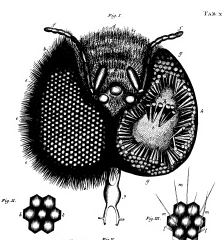
Jan Swammerdam's 1673 sketch helped him understand the bee's compound eyes

Jan Swammerdam’s 1673 sketch helped him understand the bee’s compound eyes

Professor Jennifer Landin might not care that my drawing* of a swallowed elephant looks like a lop-sided hat. But she would care that I submitted a finished product (found on the internet, of course) and skipped the process entirely. By the way, I really wanted to do an original drawing of a boa digesting an elephant, but the Calgary Zoo no longer has elephants. They were all swallowed by boas, I suppose.

______________

*(OK, the drawing of the elephant inside a snake is not mine. It’s actually from The Little Prince by Antoine de Saint-Exupéry)

Posted in Culture, or lack thereof, Science | Tagged , , , , , | 2 Comments

Why Vegans are Wrong

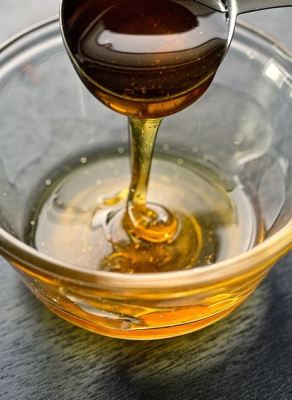
honey-dripping-from-spoon

Product of abuse?

I have a vegan acquaintance. He is a mild, considerate, and generally pleasant young man. He thinks that beekeeping is cruel and inhumane. He tells me that honey-eating encourages theft and the abuse, imprisonment and exploitation of insects. “Tell me more,” I said.

Vegans, my friend told me, feel that if you eat honey, you harm the environment and you injure your health. I think that my friend and others like him make these false statements because they don’t know how honey is made nor how bees are kept. Such narrow thoughts give reasonable vegetarians a bad name. Much misinformation is rooted in an almost cult-like adherence to dogma created by the revered Donald Watson, founder of the vegan movement.

Godlike, Don Watson leads the way

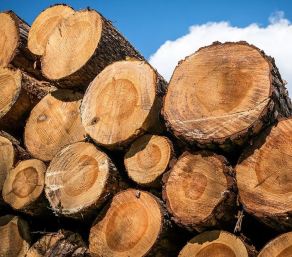
cut-trees

Defenseless and dead

75 years ago, Don Watson invented the word Vegan and constructed much of the philosophy that goes with it. Mr Watson was a very, very, nasty man. Whether he hated the plant kingdom, or just didn’t know any better, is up for debate. But he savagely attacked plants of all sorts. His profession was teaching woodworking. He encouraged untold thousands of British youngsters to destroy stately trees (many over a hundred years old). He inspired them to cut down living denizens of the forest,  strip off their bark, rip into their hearts with power tools, then hammer nails through their defiled bodies. He showed people how to turn beautiful elms, oaks, and maples into bookshelves and grandiose chairs upon which to seat their bottoms.

It’s as if Watson, the first vegan, had no clue that the plants he encountered are (were) living, breathing monuments to the diversity of nature. Agreed, they don’t breathe oxygen the way we do but does that give Watson and his minions the right to recklessly consume plants? Rather than taking sustenance from animals such as bees – which aren’t killed in the process of honey-making and which help, not hurt, plants – Watson rejected honey.

Instead, Watson encouraged boiling the seedy offspring of wheat and shredding the greenery of lettuce and then eating it. Plants are defenseless. They can’t run. They can’t sting. To suggest that it’s more ethical to consume plants instead of honey is farcical, disingenuous, and wrong. Most plants are still alive when they enter a vegan’s mouth. As disgusting as this is, it’s doubly disheartening that these same people portend to subscribe to a superior lifestyle and tell others to shun honey.

And yet, largely because of Watson’s philosophy, vegans claim the ethical high ground. Because of Watson, honey is strictly forbidden. I can understand opposition to concrete zoos, factory farms with warehoused pigs, and chickens caged in tiny pens. These are obviously, ethically wrong. But when Watson wrote the rules, his enthusiasm for the rights of all other living creatures (except plants) outdistanced his common sense. [Some Vegans seem to venerate Watson as a god (something that would probably have amused the deceased agnostic) so I expect to get some vicious e-mail from these gentle people.]  Watson hadn’t bothered to understand the way bees are actually cared for by millions of backyard beekeepers.

About bees

abandoned-nestUnlike plants, bees can defend themselves against wanton abuse. Most hobby beekeepers would never kill a single bee. Bees are absolutely free to range over kilometres of wildflowers. Bees return each night to their hives, which are boxes that keep bees safe, dry, and warm. If they didn’t want to return, they wouldn’t. But time after time, they come back to the beekeepers’ boxes. Beekeepers have experimentally placed empty beekeepers’ boxes alongside trees – bees select the boxes as their preferred homes. But bees can leave whenever they want.
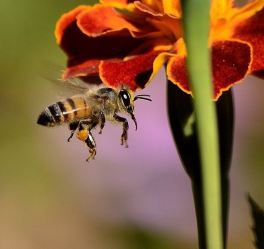
The fuzzy photo to the left shows wild combs, hanging in a birch tree. This was built by bees which died of exposure. I took the picture in Pennsylvania, years ago. I wish I had found them in time to put them into a safe dry warm bee box where they would have survived and flourished. On their own, subject to cold and rain, they died.

Bees produce thousands of grams of honey during a season but beekeepers remove just a fraction of it in exchange for giving the bees a safe home. Beekeepers don’t ‘take all the bees’ honey’ as I’ve read on various vegan sites because if they did, the bees would die. Dead bees are not the beekeeper’s objective. (Though dead trees are certainly a woodworker’s.)

Some vegan websites lament that beekeepers feed sugar and corn syrup to bees, which the vegans correctly tell us are not as healthy as honey. Those complainants should learn something about ecology. There are seasons when honey bees can’t find food on their own. Even in sunny Florida, where I worked alongside bees for about ten years, dearths happen in mid-summer when citrus trees, gallberry, palmetto, and pepperbush aren’t in bloom. Without a friendly beekeeper feeding the bees, the bees die. Now I live in Canada. Here, after seven months of cold and ice each year, hives often run short of food in April.  Without flowers, bees die. So beekeepers feed them. Without beekeepers, there would be no honey bees in western Canada.

Is honey healthy?

bee-in-flightVegans tell us that honey is healthier than sugar or corn syrup for bees; yet they also claim that honey is not healthy for people. Let’s remind them that honey is actually a healthy food. Bees collect nectar from flowers. The nectar is sucrose plus some fructose and glucose. Bees continue the job that flowers started, using enzymes to convert nearly all the disaccharides (sucrose) into simpler monosaccharides – fructose and glucose. These simpler sugars are much better for the diets of bees and humans (and bears, raccoons, badgers, and other mammals). Honey is healthier. Perhaps it’s the healthiest sugar people can eat. It’s certainly the least environmentally intrusive.

If honey is healthy, why do vegans say it’s not? Well, making such an unfounded claim (they hope) may reduce honey consumption, which (they think) will liberate enslaved honey bees from the hives of beekeepers. As we’ve already seen, honey bees are free to leave the beekeepers. They are already liberated. But without beekeepers, billions of honey bees would die – which, I guess, is a fate more acceptable to some vegans. So, vegan claims against honey as food are self-serving and unfounded.

And yet, many (all?) vegan websites advise against eating honey. “Even if honey were the healthiest food on the planet, there is still no reason for a vegan to consume it,” says this voice of veganism site. Alternatives are suggested. In those alternatives we find the real Achilles’ heel of veganism.

On this page, you will find approved alternatives to honey. These include coconut sugar and molasses. Want to really hurt the environment and kill animals? Then do what the vegans recommend and use coconut sugar and molasses. Have it processed in a food factory and shipped halfway around the world to reach you.

A vegan wants you to eat plants, of course. But, unless vegans are incredibly naive, and have no clue at all about farming (even ‘organic’ farming), vegans miss the point that trillions of insects – from worms to beetles – die in the production of the rice and barley syrup, and the beet and cane sugar which they think you should eat. Farmers must rip through the soil and control insects that would eat their crops. They dislodge mice and lizards to make way for the cane and beets that will end up as molasses. The pursuit of coconut sugar has led to deforestation and death for millions of animals. I know that some hope/think/pretend that they are buying ethically-produced food, but too often they are simply buying secular indulgences to assuage their conscience – they are still getting food that required the death of insects, and sometimes mammals. And these substitutes are produced on the other side of the globe while honey can be purchased locally, greatly reducing the environmental footprint.  Only honey can be produced without harming or killing animals. Yet vegans refuse to concede this because it would go against their tribal allegiance to the philosophical proclamations of Donald Watson – regardless of how wrong he may have been on some points.

No free passes

I was a vegetarian for over a year and it was a healthy, energized year. I was not a vegan. As a vegetarian, I ate honey. I used a little cheese and milk in some veggie dishes. Today, I eat fish. In a social setting, I might eat other meat, but sparingly. I think it’s smart for the environment and healthy for the body to eat a wide variety of foods, but only a little or no meat. It’s certainly healthier for the livestock.  However, zealous vegans drive away potential vegetarians. Vegan hypocrisy is a turn-off and has probably resulted in a bigger backlash against animal rights and against reasonable vegetarianism than it has resulted in new memberships in the vegan fan club. For that, I hold the woodcutter Don Watson and some of his followers responsible.

Nor will I give a free pass to all beekeepers everywhere. It’s true that some beekeepers – hobbyists and commercial – aren’t as careful with bees as they need to be. That’s what the vegans tell us when they raise their concerns. But most are not reckless and I’ve never met any beekeeper who disliked bees; they want the best for bee welfare – and I have met hundreds more beekeepers than any vegan ever has. Honey bees are thriving because beekeepers are keeping them alive and healthy. That’s what beekeepers want. Further, beekeepers don’t eat their bees, nor do they make furniture out of them. And that’s more than can be said about Don Watson and his relationship with trees.

Posted in Culture, or lack thereof, Ecology, History, Honey, Strange, Odd Stuff | Tagged , , , , | 104 Comments

Steve Vai, Beekeeper

Steve Vai, guitar wizard extraordinaire, performs in Calgary tomorrow night at the Jack Singer Hall. I won’t be there. I respect his talent immensely and as an ex-guitar guy myself (albeit, three or four orders of magnitude below Mr Vai), I would have enjoyed the show. But tickets are $47.75 to $359. For $359, I suppose you get to sit on stage with Steve.

If I sat on stage with Steve (me, in my wheelchair; he, in his beekeeper boots), I’d ask him how he plays after he’s been stung on the fingers. Steve Vai  is nuts about beekeeping. He’s been at it for 20 years, so he’s no newbie. Then I’d ask him what it was like to play aside Frank Zappa, in Van Halen, Spinal Tap, Ozzy Osborne, Alcatrazz. Then I’d ask if it was true that he sold 15 million solo records but blew all the money on beekeeping.

If you got bored of the video at the top of this post, you might like to watch Steve lighting a smoker and chatting up brood chambers, drawn comb vs foundation, and wildflower honey crops in the next video. I hope you’ll watch the video below – you’ll be amazed at what Steve does with his 1,000 pound annual harvest. This is one sweet guy.

Anyway, Steve, if you’re reading this before you go on, thank you for your music and welcome to Calgary. Enjoy the show – it’ll be a good one!

Posted in Culture, or lack thereof, Outreach, People | Tagged , | 4 Comments

The Golden Bee Award

golden-egg

Years ago, an American senator began handing out prizes that he called the Golden Fleece Award. Started in the 70s by Wisconsin Democrat senator Bill Proxmire, the Golden Fleece was an anti-science thing, intended to highlight how wasteful it is to give research grants to those splurging scientists who blow big wads of cash studying esoterics like the sex lives of the screwworm.

Why is the sex life of a screwworm funny?

Well, hello!

Well, hello!

The screwworm develops from eggs laid by a fly. It was once common in the southern USA. A fly could lay about 400 eggs in any cuts, wounds, or skin sores on a cow. The cattle often died from the parasitic worms that followed. Before 1980, cattle ranchers estimated that they lost 2 billion dollars a year because of the nasty worms. No chemical or pharmaceutical company was interested in finding a cure because most of the farmers could hardly afford hay, let alone medicines for their cows.

The USDA set some entomologists to work on the problem. They created sterile screwworms. By 1982, the fly and all its worms were eradicated from the USA. Since then, farmers (and consumers of beef and milk) have saved billions of dollars, just because someone did the research to rid America of the parasite. [This year, 2016, screwworm was found again in Monroe County, Florida. I think that’s the first spotting in the USA in 34 years. It probably arrived from imported horses. You can be sure that it will be eradicated again.]

The Golden Goose arrives

golden-gooseIn the 1970s, when the screwworm project was underway, it was easy to mock the scientists involved – after all, they were studying the sex lives of screw worms. Such research was often the target of funding cuts. To balance the mean-spirited effects of the Golden Fleece award, and to help point out the unexpected rewards of scientific research, the Golden Goose Award was created. The Golden Goose highlights research which might have easily been defunded but instead produced broad unforeseen benefits.

This year, the Golden Goose Award recognized a group of scientists who created The Honey Bee Algorithm. Here’s a short video that explains the algorithm and its significance.

Did you notice the scientist say that when a honey bee follows a waggle-dance, she usually doesn’t make it to a new flower patch on her first try, it takes her a little time for her to get efficient? Sounds interesting, but unimportant, doesn’t it? When you do research, you don’t know where it’s going to go. In the next video, you’ll see Senator Chris Coons, who tells us that honey bee research in the way bees forage led to an algorithm that IT companies use in their design of efficient servers  for the management of internet traffic. Too, me that’s amazing. You can be sure that the bee scientists who began unraveling the way bees learn to forage were not thinking about internet servers. Not at first, anyway.

The Golden Goose Award for the Honey Bee Algorithm was presented in September to John J. Bartholdi III (supply chain logistics), Sunil Nakrani (AI, computational science, mathematics), Thomas D. Seeley (a bee scientist!), Craig A. Tovey (industrial and systems engineering), and John Hagood Vande Vate (international logistics). Funding for their work included the National Science Foundation and the Office of Naval Research.

First, study bees

The story begins with Cornell honey bee researcher Tom Seeley. He became interested in understanding how thousands of honey bees efficiently forage – visiting millions of flowers within a 5-kilometre radius – without ‘benefit’ of a central organizing authority. This is similar to internet servers – they never know how much traffic there will be (similar to changing weather interrupting nectar flows) nor how much data will be carried at any moment (similar to the way flower density and nectar flows change).  Data distribution systems and nectar gathering systems both have only vague notions of future events. Colonies, like servers, have to be ready for the biggest flows imaginable but also for dearths. All of this without a boss.

To understand how this worked, Seeley and his grad students anesthetized  the population of a small nuc hive and glued ID labels to the thoraxes of 4,000 bees. Then they observed the bees foraging at pots of sugar syrup the researchers had distributed at various locations around the hive.

honey-bee-algorithm-title

Part of what Tom Seeley realized is that foraging honey bees make individual decisions that benefit the entire hive. This does not imply that bees have free will or high-level intellectual reasoning. But if a bee returns with nectar and readily finds a housekeeping bee eager to take and store it, then that ‘indicates’ the hive urgently needs what was found. In that case, the forager begins a waggle dance to draw attention to what she’s found. On the other hand, if the returning bee finds it hard to unload her fresh nectar, it probably ‘indicates’ that other bees have found plenty of nectar already. So a recruiting waggle dance isn’t necessary – in fact the returning bee may even change her own strategy and follow another dancer’s lead to a better forage spot. In human terms, a teenager catches up with friends at the mall and wants to tell them about a great dance spot he’s found but they’re all excited about another place – they are really, really excited, so he tags along with them and doesn’t even mention the lame place he’d just discovered.

Second, apply bee dances to optimal distribution networks

As Seeley was unraveling the hive foraging/communication system (“The Honey Bee Algorithm”) John Vande Vate was trying to optimize leaderless distribution. Serendipitously, he caught a National Public Radio interview of Seeley describing his findings. Vate realized there might be a useful application in his own work. So he traveled to Cornell to meet Seeley and to learn about the algorithm. It took years of collaboration with engineering colleagues at Georgia Tech (Craig Tovey and John J. Bartholdi III)  before Vate, Tovey, Bartholdi, and Seeley distilled the essence of the the bees’ activities and found a way to apply it to distribution and allocation puzzles. According to their mathematical model, bees transition through a sub-optimal ‘learning’ phase which opens avenues for discovery. Without discovery, new (potentially better) sources can’t be found.

It was a few years before the Honey Bee Algorithm was applied to the internet server distribution problem. Although the engineers and the bee biologist saw that the bee algorithm was a novel approach to solving some mathematical problems, it wasn’t until Sunil Nakrani asked Craig Tovey for advice on solving the internet distribution issue that everything came together. Companies that host websites have to be prepared for irregular demand and changing conditions. They would benefit from systems that ‘learn’ optimal, but dynamic, paths to relay data to customers. Nakrani developed the bee algorithm into his Ph.D. dissertation and it was quickly shortlisted as one of the best computational dissertations in the United Kingdom that year. The bee-based paper Nakrani and Tovey wrote describing their research has been cited hundreds of times. It’s been used as a basis for traffic flow, fuel economy, and work-efficiency studies. As goldengoose.org puts it:

“Today, web hosting services are implementing biologically inspired algorithms like Tovey and Nakrani’s to drive larger revenues and more efficiently operate server farms in the rapidly growing $50 billion global market for web hosting services. And the field Tovey, Bartholdi, and Vande Vate stumbled into – self-organizing systems and biomimicry – is a burgeoning area of research that includes everything from biologically-derived adhesives and fluorescent proteins to systems engineering solutions inspired by bees, ants and other social insects.”

So, this is what the Golden Goose laid: a beautiful Honey Bee Algorithm. Because funding came from federal government sources, the work immediately entered the public domain where it was shared by commercial developers and academic problem-solvers. Nakrani was largely funded by the UK government, the others were supported by grants from the National Science Foundation and the Office of Naval Research.  As Bill Gates says about the Golden Goose, “Government R&D budgets are very small, and yet they are absolutely critical to drive innovation forward.” Sometimes innovation advances one little bee-waggle at a time.

Posted in Culture, or lack thereof, Science, Strange, Odd Stuff | Tagged , , , , , , | 10 Comments

Podcasted

podcast

Today, Gary Fawcett, of Kiwimana Podcast spent a grueling hour listening to me drone on and on about bees and beekeeping and beekeeping and bees. It was undoubtedly grueling for him, but I had fun.

For those of you who don’t know, the kiwimana podcast, produced in the beautiful hills of the Waitakere Ranges west of Auckland, New Zealand, is a great source of bee chatter, knowledge, insight, and gossip. At Kiwimana, Gary and Margaret keep some bees, advocate for the environment, and produce their outstanding podcast.

In a typical interview show, Gary offers some lucky beekeeper somewhere in the world the chance to rant about their bees and beekeeping adventures. I like the format and the fact that Gary is so unobtrusive – the guests feel like it’s their own show and Gary is their friendly guide. Conversation includes advice, issues on bee politics, favourite books, and the like. Some of the past guests include Randy Oliver (the Scientific Beekeeper), Hilary Kearney (Keeping Bees Like a Girl), Bill Catherall (the Bee Vlogger), Australian beekeeper Victor Croker, and James Rogers  who keeps bees in Japan. I’ve left out a lot of other great names that you’ll find among the nearly 100 podcasts at kiwimana.

roncmptr

But today, was my turn, a lesser beekeeper. When the podcast goes live in a few weeks, I’ll let you know, give you the link, and you can hear my rambling enthusiasm for the hobby and business of bees. In the meanwhile, give Gary and Margaret a listen at kiwimana.

<— This is I, blogging and listening to great podcasts.

🐝🐝🐝🐝🐝🐝🐝🐝🐝🐝🐝🐝🐝🐝🐝🐝🐝🐝🐝🐝🐝🐝🐝🐝🐝🐝🐝🐝🐝🐝🐝

Posted in Friends, Outreach | Tagged , | 2 Comments