Hate Nation’s Bees

robo-bees-4

Mechanical bees’ nest – coming soon to a dystopia near you?

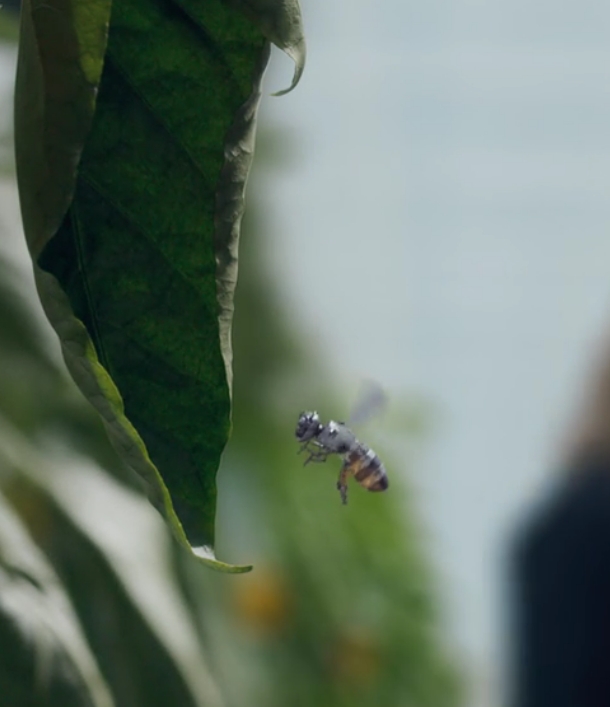
I’m pretty fussy about the shows I catch. Unless they include bees – then I’ll watch almost anything. The folks over at the London School of Economics beekeeping site mentioned a British dystopian thriller, Black Mirror: Hated in the Nation. Not my usual choice, but when learned it had murderous robotic bees, developed by the British to replace extinct pollinators, I was on to it. 

robo-bees-1

He’ll bee OK.

So here’s the deal. Black Mirror is a series of futuristic dramas – loosely related episodes about some bad karma  hitting us a few years from now. I was unaware of the show until yesterday, but I’m glad I saw this particular installment (Hated in the Nation:  Season 3; Episode 6; released October 2016). The world’s honey bees have colony-collapsed, so an aseptic ag-company develops swarms of robotic drones (actually, workers, I should think), to pollinate  England’s legendary flower gardens. It apparently takes just 23,000 swarms (each of 4,000 mechanical bees) to do the job – but I’m guessing that the solar-powered robotic avatars work day and night and don’t mess with nectar – they just pollinate and pollinate. It wouldn’t be much of a show if things didn’t go badly wrong, but for that, you’ll have to watch it yourself.

This isn’t my normal movie fare, but I liked it quite a lot. Be aware that there are a handful of gore scenes and some colourful language, but if you’re a rugged adult and make a habit of peeking at bees, you can probably handle it. The backstory includes intriguing thoughts on the way bullies use social media to cause grief and it offers one fellow’s solution to the problem. Now playing on Netflix (at least here in Canada).

robo-bees-3

Tireless and no stinger: What could possibly go wrong?

Posted in Culture, or lack thereof, Movies, Save the Bees | Tagged , , , , | 5 Comments

Lawsuits Amidst Toxic Allegations

Poisoned?

Poisoned?

Australia is having a food fight.  Well, a honey fight, actually, and there are lessons aplenty to be found in it.  First off, a Save the Bees gentleman, Simon Mulvany, of Melbourne, launched a name-calling campaign against Australian honey packer Capilano, disparaging the packer’s buying habits by claiming that Capilano bottles “toxic” imported honey and uses misleading labeling to sell it. At least, that’s what I’m hearing from the Australian Broadcasting Corporation.

Capilano sued Mulvany for spreading false stories about its honey, which Mulvany had declared “poisonous and toxic”.

Toxic, of course, is in the stomach of the consumer – persons with extreme diabetes may, indeed, find Capilano honey toxic, if consumed in large enough quantities. Simon Mulvany’s honey would also be toxic in such a situation – provided he produces enough to kill anyone.   The allegations, of course, are much broader than a diabetic overdose, as the accusation claims that Capilano’s honey is poisonous.

Calling another’s honey unfit for consumption does little to sell one’s own honey. In fact, the fear across Australia is that Simon Mulvany is causing honey sales to tank as consumers become wary of all honey. I’ve seen similarly stupid campaigns in the past – people don’t switch brands, they just quit buying. The average grocery customer doesn’t have enough time to bother with this and read all the background material. They hear the words “toxic” and “honey” in the same sentence and the message is clear, even if it’s wrong.

Mr Mulvany’s mission(s)

Mr Mulvany, though, is on a mission or two. Perhaps his goal is not to destroy all of Australia’s honey industry, that’s just a possible unintended consequence. Instead, his goal is to ‘Save the Bees’. According to his linkedin page, this has been a passion since, um, October 2014.

On Linkedin, Mr Mulvany tells us, “We are addicted to the short term disease of money. Compensation ought be paid out to major honey producers in the same way as the Government [sic] buys back fishing licenses when fish stocks are being impacted. Bees are so much more than honey. Indigenous bees are quite often better pollinators honey bees. [sic] More efforts needed in insuring [sic] indigenous insects.” In this, it seems Mulvany wants Australian commercial beekeeping abolished –  unless, of course, it’s done according to his rules.

If the single quote above doesn’t satisfy your craving for pearls of similar beekeeping wisdom,  you’ll find that Mulvany’s “Save the Bees”  Facebook page contains the “Universal spiritual wisdom of the bee”.  For even more nuggets, Mulvany runs a “Bee the Cure” website and an Instagram “Bee the Cure” page (where he writes about “bees dyeing” [sic] , though he doesn’t indicate which colours the bees use).

Mulvany’s personal Facebook page (November 30, 2016) greets you with a photo of Fidel (“Castro: The Making of a Legend”)  and carries insight about how GMO wheat caused the world’s obesity epidemic (“The biggest fat loss secret”).  Further down the page is a delightful story on the harmful chemicals in antibacterial soap. Beyond his personal site, we can learn about Mulvany’s view of his lawsuit with Capilano, Mulvany’s GoFundMe campaign (which has collected $7800 so far!), his Paypal Donation links, and his Change.org petition. By the way, the petition has a point – it’s a  plea to have country of origin as a legal part of every honey label. Go sign it if you’re Australian and you agree with this idea.

This fellow knows social media. However, Australian beekeepers believe that Mulvany’s damage to consumer confidence in Australian honey is hurting them. That’s why many beekeepers publicly support Capilano Honey Limited instead of Mulvany.

Beekeepers defend Capilano

According to ABC, “as news of the legal and social media battle spreads, some beekeepers told the ABC they were concerned about loss of business.” They should be concerned.  As misinformation flows, consumers are reaching for maple syrup and little bags of brown sugar, not honey. They are worried about the toxic honey which Mulvany claims is on some shelves.

Australia’s beekeepers have a lot of experience. They have been running good businesses, producing healthy food, and keeping their colonies alive long before the save-the-bees and honey-is-toxic folks came to their rescue. Trying to restore some normalcy to their industry, many commercial beekeepers have gone to Capilano’s support.

Capilano purchases some foreign honey and sells several brands which carry labels stating they are “packed in Australia from quality local and imported products”. Much foreign honey is packed in Australia and then re-exported. Capilano Honey Limited also packs millions of pounds of local Australian honey, buying from Australian family bee farmers, and selling it as purely Australian honey under the corporate brand name.

Following is a promotion video made and distributed by Capilano. It is, of course, corporate propaganda generated by Capilano, but the beekeepers are real and seem sincere. Some have been selling to Capilano for three generations. If they are like commercial beekeepers everywhere, they may occasionally feel underpaid by their packer and they likely have a love-hate relationship with the people who buy their honey. But they are seriously worried that the smearing of Capilano honey has become the smearing of all of Australia’s honey.

Imports and Exports

Australia’s honey producers are gravely concerned about the misinformation being spread about ‘toxic honey’. The Department of Agriculture issued a statement assuring consumers of Australia’s honey safety standards. The Australian Honey Bee Industry Council also found it necessary to use its time, money, and resources to try to mitigate the damage being done to Australian beekeepers by Mulvany’s campaign:

“Not only are these statements untrue, they are damaging to the wider beekeeping industry,” the council said.

“They also risk undermining Australia’s reputation as a producer of safe, high quality honey in growing export markets,” says the council.

Meanwhile, Simon Mulvany carries on his fight against Capilano and imported honey. The funny thing is, when I was a kid here in North America, we used to complain about imported honey coming from Australia – it typically undercut North American prices. Nevertheless, the beekeepers of Oz were revered as masters of the art – they often produced the most honey per hive of any place on Earth. Trade works in all directions. Here in Canada, we import honey from 30 different countries, but we export much more than we import. It’s the same in Australia.

Australia needs to export millions of pounds of its own honey to the world market. Total consumption of 10,000 tonnes/year is less than half the country’s annual production – obviously the excess must be exported. Shutting down international trade (Mulvany strongly opposed TPP) would hurt Australia’s beekeepers, just as the claim that some honey is poisonous has proven disastrous.

It’s not just Australian consumers who are nervous about allegedly toxic honey. Western Australian honey producer Fewsters Farm Honey, in business since 1898, says a Malaysian buyer suspended an order for 60 tonnes of honey per year due to concerns about Australian honey toxins. Likewise, Australian honey is having trouble entering Vietnam under a similar cloud of toxic and poisonous allegations.

The post-truth world

As we’ve seen, claiming that honey can be toxic may destroy honey sales for everyone. It’s doubly difficult to tolerate when the allegations are untrue. We live in a ‘post-truth’ world now. We can’t credit Simon Mulvany with the collapse of Australia’s entire bee industry, but unfounded claims amplified through adroit (albeit unsophisticated) manipulation of social media shows the deadly power of persistent spin. We have entered a world were facts don’t matter and where a person who has been “Saving Bees” since October 2014 can destroy beekeepers who have been quietly doing their job for generations.

Mulvany has tens of thousands of social media followers who enthusiastically gush their encouragement for his attacks on capitalism, big business, free trade, agribusiness, GMOs, neonicotinoids, and antibacterial soap. He has a responsibility to get facts right. The mud which is being slung at Australia’s honey industry may cost producers millions of dollars. Honey’s reputation as a healthy food is at risk. Calling any honey “toxic and poisonous” is a reprehensible mistake.

Posted in Commercial Beekeeping, Honey, Save the Bees, Strange, Odd Stuff | Tagged , , , | 9 Comments

Ending the Senseless Roadside Carnage (of bugs)

bugs-on-windshield

Roadkill on my van window, western Canada style

Bugs impact windshields from time to time. You’ve scraped off the gooey result. A lovely dégustation if there’s ever been one.  Placing a bee yard near a busy road makes you an accessory to the beeslaughter of millions. You are also losing honey money. Here’s what I figured:

This summer, my van clipped three bees while speeding past one fellow’s bee yard. I know that every two minutes or so another vehicle passed that bee yard at the same speed as my van.  That’s 30 vehicles per hour. If, like my van, they each kill three bees, then we’ve killed almost a hundred bees in an hour. That would be a thousand in the course of a long sunny summer day. During thirty days of peak honey flow, that amounts to 30,000 dead honey bees – over half the foraging population of a producing hive. The average crop at that apiary site is 200 pounds, so the beekeeper – over the course of a season – has lost at least 100 pounds of honey. Depending on your market, that’s between $125 and $800. It’s something to notice. Five kilometres down the road was another yard and another honey bee slaughter site.

An insect road-mortality study

I’m just making broad estimates. I don’t know for sure how many millions of bees (and other bugs) end up as road kill, but last summer some Ontario scientists did the real-deal survey. In a serious (?) scientific paper (Road mortality potentially responsible for billions of pollinating insect deaths annually) five (!) scientists did maths on windshield bugs and found that my estimate of millions was off by millions. It’s billions and billions. And here’s how we know.

roadkill-collection

Bagged bugs from 2015 road mortality paper

Writing in The Journal of Insect Conservation, authors James H. Baxter-Gilbert, Julia L. Riley, Christopher J. H. Neufeld, Jacqueline D. Litzgus, and David Lesbarrères report that they selected a 2-kilometre (1.2-mile) stretch of rural highway that traversed Magnetawan First Nation as a road kill collection site. Over two summers (2012 and 2013), 117,000 insects were scraped from asphalt and along the highway’s edges. At 10:30 each morning, rain or shine, two or three scientists-in-training (Grad students?) began walking along the roadway, stuffing road kill into ziplock baggies. The assumption is that bugs hit by vehicles land on the road and neither stick to the windshield nor bounce off into the surrounding tamarac. Such assumptions are untrue. Nevertheless, the bagged bugs do represent dead animals, likely killed by vehicles.

The vast majority (94,000) were bibionid flies, pesky little creatures that occasionally ‘bloom’, or cyclically erupt into massive populations. One such bloom occurred during the study, in May 2013. Stand in a bibionidae bloom and your hair becomes tangled in gnatties and your nose and mouth inhale unwanted protein. Of the 117,000 trophies bagged during the 2012 and 2013 roadkill-research expeditions, over 90,000 insects were caught during the May 2013 bibionidae bloom. Take them out of the mix and we are down to just a few dozen insects per day. This is not exactly unbridled roadside carnage.

hanoi-traffic

Congestion:  Hanoi’s solution to insect roadkill. (photo: Miksha)

Before we relax our ecological guard, the authors warn “Recently there have been drastic increases in both the size and density of road networks worldwide, with a 35% increase in road surface area over the last decade alone.” I was surprised with that high number, but I followed the source to a 2013 International Energy Agency paper which you can see here.  Yes, our planet is being paved, but the overwhelming majority of new roads are in Asia where drivers ignore posted speeds (90 km/hr) and instead drive at a more leisurely 30 or 40 km/hr, as I discovered recently going by van from Hanoi to Ha Long. That 120-km trip took over four hours on a good road. The point, if drivers go slowly, as I saw in Vietnam, even snails have a chance to avoid impact. A bigger threat to ecology in such environments is paved habitat, not vehicular impact.

The recent Canadian study into insect roadkill found 117,000 dead bugs in two years along the short stretch of roadway – just 2 kilometres out of Canada’s 900,000 paved kilometres. This extrapolates to 53 billion dead insects in Canada, though the 2013 bibionidae eruption gave an anomalously high value. On the other hand, there are no apiaries along the studied roadside and there are few grasshoppers/locusts in the bagged loot, so the research results might instead be low. Either way, the survey by the five scientists doesn’t represent what we would see in western Canada where the ecology is significantly different.  My guess is that the actual number is between 10 and 100 billion.

What’s next?

The 2015 Sudbury Roadkill Research Paper involved just five authors and the three or four assistants who collected and sorted the bugs. It looked at one tiny stretch of Ontario highway spanning non-agricultural Precambrian granitic shield. Clearly, dozens of similar studies should be done – in the Palliser Triangle, Saskatchewan wheat fields, eastern coves, northern tundra, and western alpines. Physicists might be employed to model vehicle shapes and determine if some insect species are more likely to be found on the asphalt. Other physicists could determine the ricochet coefficient for individual species, defining the roadside collection zones more clearly. Photographers might remotely snap the passing windshields of cars and trucks before and after crossing the study zone. Forensic scientists could then compare before and after windshield images.  I think geographers, statisticians, and maybe even neurologists could find roles in future studies. This would tighten the quantification from an arm-wavey ‘billions and billions’ to something more believable –  perhaps 37,394,663,212 +/- 50, nineteen times out of twenty.

Worldwide, the number of insects caught up in vehicular insecticide could be over a trillion. It’s enough to make even the most insectophobic realize we have a serious problem. Unless, of course we use a sense of perspective and recognize that a trillion is just 0.00001% of the world’s ten quintillion insects. Then it makes roadside insect kill insignificantly meaningless and any such studies terribly unnecessary. But let’s ignore that detail and carry on, shall we?

What’s after next?

After we have collected irrefutable data, we approach Congress/Parliament for mitigation funding. Auto makers may receive cash to redesign cars so they harmlessly flick bugs out of the way (air guns?) or employ braking mechanisms to limit top-end vehicular speeds to an insect-safe 40 km/hr. Maybe butterfly netting could envelope our freeways, saving insects as well as birds, children, and other small animals which may wander on the thoroughfares. Or possibly, insects could be genetically modified, replacing their carbon atoms with hardier silicon, making them rock-like and stronger than windshields. That would surely have interesting consequences.

Lessons from dead koalas

Lessons from dead koalas

Or perhaps the friends of insects could take a lesson from Australia, which has a potential solution to its koala roadkill problemDaylight Savings Time. Most koalas are struck by autos during twilight, so simply resetting clocks and decreasing twilight traffic can save koalas.

Limiting traffic to only those hours when the fewest insects are flying would similarly decrease insect carnage. These insect accident mitigation suggestions of mine are just the start  – I’m sure that smarter people than me will come up with more brilliant solutions than these.

With political will and sufficient cash, there are so many places we could take the challenge of stopping the roadkill of insects. Or perhaps we can study other stuff such as the effect of paved landscape on insect habitat. Even more seriously, Singer-like, we may give deeper thought to our allocation of resources –  perhaps scholarly investigation and public money could improve access to clean drinking water, adequate health care, and safe food at the native Ojibwe lands where the Canadian insect roadkill study was conducted?  Just a thought.

Posted in Bee Yards, Ecology, Humour, Science, Strange, Odd Stuff | Tagged , , | 4 Comments

Money from Honey 101

bee-eco-course-2016-11

Bee Economics: Course instructor Neil Bertram, November 2016

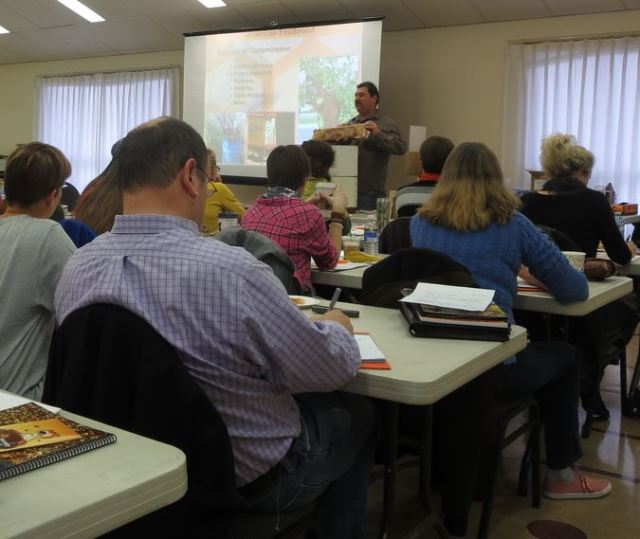
I’m still exhausted from co-teaching last weekend’s beekeeping economics course here in Calgary. Judging from the evaluation sheets of the participants, our full-day seminar about the business of the bee business went well. In fact, most of the evalu-forms were ecstatic, as were e-mails we received post-course. We’re sincerely happy for that – we put a lot of hours into course prep and the students put hard-earned cash into paying us for our work. It’s a relief that everyone comes away satisfied, albeit mentally drained.

bee-eco-course-2016-11-2Here’s how the Money from Honey course unfolds. My teaching partner, Neil Bertram, starts the day with introductions and a quick review of class safety and housekeeping rules. We then give about a half-hour background into teachers’ experiences. This is not an exercise in self-grandizing, but an opportunity for participants to see the possibilities of making money from beekeeping. Between the two of us, we’ve pollinated crops, raised queens, produced packages, sold nucs, made comb honey, and produced a boatload of honey. We discussed how we built our businesses, described physical and perseverance skills that served us well, and disasters that beset us.

From our personal experiences, we segued toward other beekeepers’ experiences – folks who have spent years building bee empires or who have been satisfied making a comfortable living caring for modest numbers of hives. For example, we describe how a friend (“The Stationwagon Beekeeper”) ran a hundred hives without a truck, honeyshop, or acreage – he sold nucs each spring. He didn’t extract, bottle, or sell honey.  We discussed another beekeeper who sort of accidentally fell into a nice beekeeping opportunity and built it into a large efficient bee business. Also mentioned were famous beekeepers Richard Taylor and Burt Shavitz who serve as examples. Then we reviewed a beekeeper who raises queens and another who runs a bee tourism business. All of this gave our participants ideas on the wide range of bee opportunities they might pursue.

After the beekeeping business examples, our course spends a couple of hours on very practical aspects of beekeeping – expanding from hobby to sideline to commercial: efficiently making splits, buying packages and nucs, purchasing strong hives or entire apiaries. Other practical stuff includes handling large crops, finding and keeping outyards, selection and care of equipment, honey house design, and a dozen similar topics. Even the temperament and skill-set required to succeed in bees is touched upon.

The afternoon is spent analyzing beekeeping spreadsheets – income and expenses, marketing, insurance suggestions, government inspections and  regulations, kosher/organic/export requirements, price projections. We also walk through a dozen issues that can sink a bee business.

As I’ve said, it’s an exhausting 7-hour course to teach, but if we can help a few beekeepers escape some of the expensive mistakes which we ourselves have made in our collective 70 years of beekeeping, it’s worth it!

bee-eco-course-2016-11-3

Posted in Commercial Beekeeping, Friends, Outreach | Tagged , | 2 Comments

Beginners’ Bee Course

2016-11-bee-club-2

Calgary’s bee club does an amazing amount of work for our area’s beekeepers. It’s great fun being involved. The volunteer opportunities are enormous – mentoring, hosting visitors (Saturday at the Hive), catching city swarms, and bunches more. My contributions over the years included serving as the club’s president, acting as the chief honey judge, and helping with a team of teachers. The most best-est is teachering, which I find marvelously edifying. This weekend, I had the privilege of participating in the beginners’ beekeeping course!

2016-11-bee-club-5

Me, teaching. My friend Lisa Reimer took the squirrel photo at a family picnic.

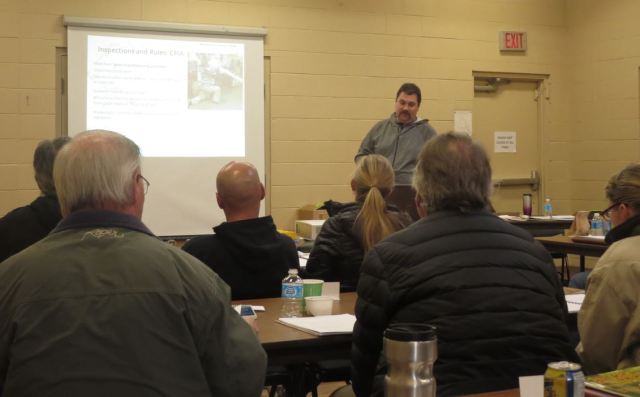
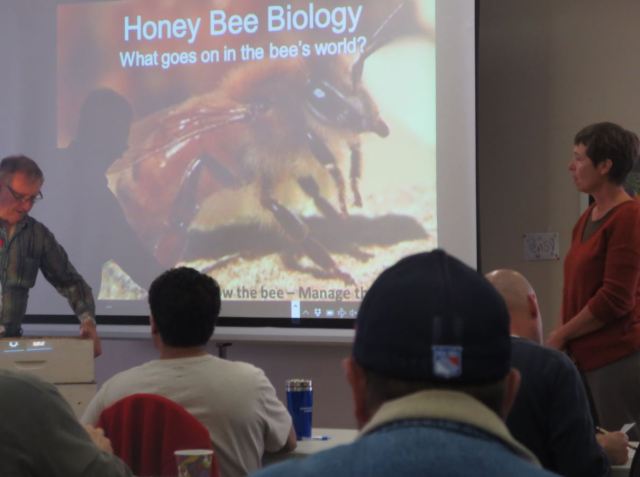
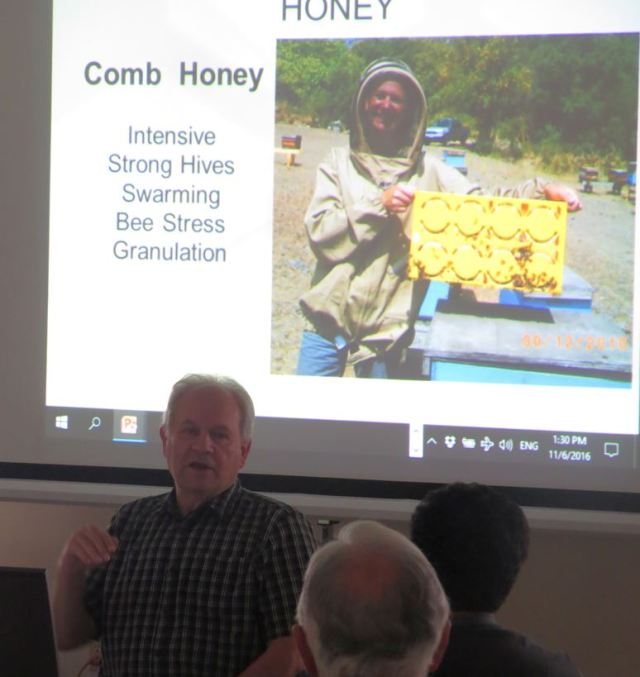
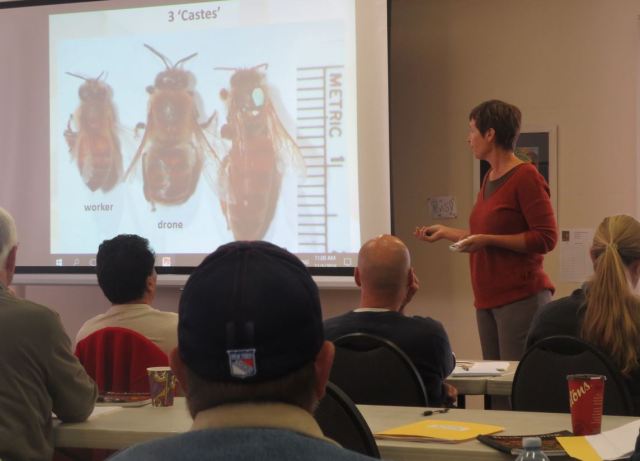
35 new beekeepers attended our two-day course. Our first day of sessions included an introduction to bees (Bee Biology), hive equipment and costs (Getting Started), and then our Spring/Summer and Fall/Winter management modules finished the day. The next day we covered the necessary stuff on bee diseases and pests, government regulations and inspections, and handling and removing honey. The second day ended with a recap presented as a calendar which led the students through a typical year of beekeeping.

2016-11-bee-club-9The photo, left, is such a quintessentially Canadian pic, don’t you think? You can see the flag and (look closely) a 40-year-old portrait of the queen and her husband on the far wall.  The hall is a community centre (Canadians are big on community stuff!) with basketball foul lines (basketball was invented by a Canadian) and a very old piano, used mostly to play Oscar Peterson jazz tunes. The place is obviously wheelchair accessible (very inclusive culture here), and you can even see a typical Canadian skep-head – me!

Here are a few more pictures from our very busy, fun (and exhausting) weekend:

2016-11-bee-club-7

2016-11-bee-club-3

2016-11-bee-club-1

Neil, Tom, Glenda, Bert, and (seated) Ron

Neil, Tom, Glenda, Bert, and (seated) Ron

Posted in Friends, Outreach | Tagged , , | 4 Comments

A Metaphysical Life

richard-taylor

Today is the  anniversary of the birth of one of my beekeeper-heroes, Professor Richard Taylor. He was an early champion of the round comb honey system, a commercial beekeeper with just 300 hives, and he was a philosopher who wrote the book on metaphysics. Really, he wrote the book on metaphysics – for decades, his college text Metaphysics introduced first-year philosophy students to the most fundamental aspect of reality – the nature of cosmology and the existence of all things.

Although his sport of philosophy was speculative, unprovable, and abstract to the highest degree, Richard Taylor was as common and down-to-earth as it’s possible to become. I will write about his philosophy and how it shaped his politics, but first, let’s celebrate his beekeeping.

Richard Taylor and his twin brother were born November 5th,  1919.  This was shortly after their father had died. That left a widowed mother to raise an impoverished family during the Great American Depression.  Richard was fourteen when he got his first hive of bees in 1934 – the year that a quarter of Americans were unemployed and soup-lines leading to Salvation Army kitchens stretched for blocks. He began beekeeping that year, and except for submarine duty as an officer during World War II, he was never far from bees. He respected honest hard work and the value of a penny, but he nevertheless drifted, trying college, then quitting, and taking on various uninspiring jobs.

Evenings, on his bunk in his navy sub, Richard descended into the gloomy passages of Arthur Schopenhauer. Somehow the nihilistic philosopher appealed to Taylor and ironically gave him renewed interest in life. Because of this new interest, Taylor went back to school and became a philosopher himself.

Richard Taylor earned his PhD at Brown University, then taught at Brown, Columbia, and Rochester, from which he retired in 1985 after twenty years. He also held court as a visiting lecturer at Cornell, Hamilton, Hartwick, Hobart and William Smith College, Ohio State, and Princeton. His best years were at Rochester where he philosophized while his trusted German shepherd Vannie curled under his desk. Richard Taylor sipped tea and told his undergrads about the ancient philosophers – Plato, Epicurus, Aristotle, Xeno, and Thales. In the earlier days, he often drew on a cigar while he illuminated his flock of philosophy students. Those who attended his classes remarked on his simple, unpretentious language. They also noted that he was usually dressed in bee garb – khakis and boots – he and Vannie quickly disappeared to his apiaries when the lecture ended and the last student withdrew from the hall.

The hippie beekeeper

It’s probably unfair to call Dr Richard Taylor a hippie beekeeper, but perhaps he was exactly that. As a beekeeper, he was reclusive. He refused to hire help. Rather than deal with customers, he set up a roadside stand where people took honey and left money on the honor system. Taylor disdained big noisy equipment. He claims to have sometimes taken a lawn chair and a thermos of tea to his apiaries so he could relax and listen to the insects work, but I doubt that he did this much.  Through the pages of American Bee Journal, Bee Culture, and several beekeeping books, he described best beekeeping practices as he saw them – and those practices required hard work and self-discipline more than relaxed introspection.
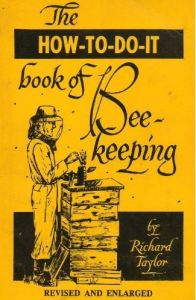
how-to-do-it-book-coverRunning 300 colonies alone while holding a full-time job and writing a book every second year demands focus. His bees were well-cared for, each producing about a hundred pounds every year in an area where such crops are rare. By 1958, he was switching from extracting, which he disliked, to comb honey production, which he loved. Comb honey takes a more skilled beekeeper and better attention to details, but in return it requires less equipment, a smaller truck, and no settling tanks, sump pumps, whirling extractors, or 600-pound drums. “Just a pocket knife for cleaning the combs,” he wrote.

Summit Comb in useTo me, it’s surprising that Richard Taylor embraced the round comb honey equipment called Cobanas. The surprising thing is that the equipment is plastic. Reading Taylor’s books, one realizes his affinity for simple tools and old-fashioned ways. Plastic seems wrong. But it’s not.

In the past, comb honey sections were square-shaped and made from wood. That required the decimation of forests of stately basswood (linden) trees, something that did not appeal to Taylor. Plastic lasts forever, a real benefit for a person as frugal as Richard Taylor. It’s light-weight, durable, and ultimately very practical for bee equipment. He advocated making comb honey and he was sure that the Cobana equipment, invented by a Michigan physician in the 1950s, would lead the way. He was so enthused that in 1958, living in Connecticut, he wrote his first beekeeping article about the new plastic equipment for the American Bee Journal. Here’s the photo that accompanied his story.

randy-with-combs

Richard Taylor’s son, Randy, packing round comb honey, 1958. (Photo from ABJ).

One final thing about Richard Taylor, the beekeeper. He was financially successful. In today’s dollars, his comb honey bee farm returned about $50,000 profit each year – a tidy sum for a hobby and more than enough spare change to indulge his habit of frequenting farmer’s auctions where he’d delight in carrying home a stack of empty used hive bodies that could be had for a dollar.

Taylor, the teacher

Richard Taylor immensely enjoyed teaching and lamented what he called “grantsmanship” which arose in America while he was a professor. Grantsmanship is the skill of securing funding for one’s projects while ignoring the fundamental duties of teaching. This, of course, can eventually lead to big dollars flowing to researchers who are willing to claim that sugar, for example, does not contribute to obesity and cigarette smoke does little more than sharpen one’s senses. Richard Taylor saw the conflict and regretted the demise of good faculty instructors replaced “largely by graduate students, some from abroad with limited ability to speak English. Lecturers who simply read in a monotone from notes are not uncommon,” he wrote.

Meanwhile, the (sometimes unethical) pursuit of grants was accompanied by the rise of the “publish or perish” syndrome. In his own field, Taylor pointed out that academic philosophers engaged in “a kind of intellectual drunkenness, much of which ends up as articles in academic journals, thereby swelling the authors’ lists of publications.” Taylor wrote extensively on this in 1989, saying that there were 93 academic philosophy journals published in the USA alone – seldom read, seldom good, but filling the mailboxes with material to secure a professor’s promotions.

This was not the academic world that Richard Taylor sought when he began his career in the 1950s, but it was the world he eventually left. Although he wrote 17 books – mostly philosophical essays but also several rather good beekeeping manuals – he didn’t publish many academic papers. He spent more time in the lecture halls and with his bees than he did “contemplating the existential reality of golden mountains” and writing papers about them, as he put it.

The philosopher and the bee

I am only going to give this one short passage about Richard Taylor, the philosopher. He studied and taught metaphysics and ethics. His essays on free will and fatalism are renowned and influential, even today. I’ve never taken a philosophy class, so anything I might say here will probably embarrass me. But five years ago, during a winter trip to Florida, I carried Taylor’s Metaphysics with me. I read every word and I think that I understood it at the time. For me, most of it was transparent common sense. Since it was well-crafted and interesting, Taylor may have lulled me into believing that I understood his metaphysical description of the universe, even with just this cursory introduction. At any rate, I felt that what he wrote wasn’t different than what I’d come to discover on my own, although it was much more elegantly presented than I could ever manage.

Taylor-made politics

taylor-c-1980When I saw Richard Taylor – just once, at a beekeepers’ meeting – I indeed thought that he was a hippie, a common enough form of beekeeper in the 1970s. His belt was baler twine and a broad-rimmed hat hid his face. I was surprised to later discover that Richard Taylor identified as a conservative and voted Republican. But he was also an atheist, advocated for women’s rights, and late in life (though proud of his military service) he became a pacifist, “coming late to the wisdom,” he said. I guess he would be a libertarian today. He valued hard work, self-sufficiency, and independence. He disliked Nixon, but gladly voted for Reagan. He even wrote a New York Times editorial praising Reagan’s inaugural address while offering insight on what it means to be a conservative.

At age 62, still a professor of philosophy at the University of Rochester, and the recent author of the book  Freedom, Anarchy, and the Law, he wrote a widely-circulated 1981 New York Times opinion piece. Taylor wrote that in Reagan’s inaugural address, Reagan reminded us that “our government is supposed to be one of limited powers, not one that tries to determine for free citizens what is best for them and to deliver them from all manner of evil.” Richard Taylor then goes on to warn that “political subversion . . . is the attempt to subordinate the Constitution to some other philosophy or creed, believed by its adherents to be nobler, wiser, or better.”

Taylor warned of anti-constitutional subversion in American politics, “if anyone were to try to replace the Constitution with, say, the Koran, then no one could doubt that this would be an act of subversion.” He continues, “Similarly, anyone subordinating the principles embodied in the Constitution to those of the Bible, or to those of one of the various churches or creeds claiming scripture as its source, is committing political subversion.”

Taylor tells us that conservative spokesmen of Reagan’s era – he mentions Jerry Fallwell and others – are right saying that “it is not the government’s function to pour blessings upon us in the form of art, health, and education, however desirable these things may be.” Nor, he claims, is it constitutional for “the Government to convert schoolrooms into places for prayer meetings, or to compel impoverished and unmarried girls, or anyone else, to bear misbegotten children, to make pronouncements on evolution, to instruct citizens on family values, or to determine which books can and cannot be put in our libraries or placed within reach of our children. . . it can never, in the eyes of the genuine conservative, be the role of Government to force such claims upon us. The Constitution explicitly denies the Government any such power…”
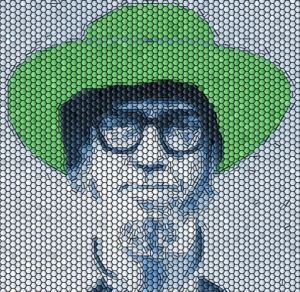
taylor-mosaicI think that Richard Taylor would be politically frustrated today. The Republicans have drifted ever-further from small government and have expanded their reach into personal affairs while the Democrats have pushed forward extensive safety nets.  A true libertarian party, such as Taylor seems to wish for, gathers little support in America today.

I hope that my summary of Richard Taylor’s political philosophy has not offended his most ardent followers. I’ve tried to distill what Taylor thought about good government – I agree with much of it, but disagree with some. It is presented as just one facet of his personality. Taylor was complicated. His last book, written in his 80s while he was dying from lung cancer, is about marriage – yet his own marriages had heartbreaks.

He showed other complicated and unexpected quirks. For example, he was an avowed humanist, yet showed a spiritual nature. In his office, he mounted a certificate which honored him as a laureate of the International Academy of Humanism, one of the few people chosen over the years. Others included Carl Sagan, Christopher Hitchens, Isaac Asimov, Richard Dawkins, Richard Leakey, Steven Pinker, Salman Rushdie, E.O. Wilson, Elena Bonner, and Karl Popper. Taylor belonged there among the other atheists, even if he once metaphorically wrote in his most popular  bee book, “the ways of man are sometimes, like the ways of God, wondrous indeed.”

Taylorisms in the bee yard

the-joys-of-beekeepingRichard Taylor was complicated for a simple man. It is said that he could not stand complacency, vanity or narcissistic behavior, yet he seemed to get along well in any gathering. He had a love of paradox and Socratic whimsy, yet he was disciplined and direct as a writer. He delighted in the pessimism of Schopenhauer, yet he was not a pessimist himself. Instead, he was quite a puzzle.

I will end this little essay with wisdom from Richard Taylor, beekeeper. Richard Taylor’s finest bee book, The Joys of Beekeeping, is replete with homey truisms that every aspiring beekeeper should acknowledge and embrace. The book itself is slim, entertaining, personal, and very instructive of the art of keeping bees. Or, as Taylor himself calls beekeeping, “living with the bees. They keep themselves”.

Here, then, are some select Taylorisms:

Beekeeping success demands “a certain demeanor. It is not so much slow motion that is wanted, but a controlled approach.”

“…no man’s back is unbreakable and even beekeepers grow older. When full, a mere shallow super is heavy, weighing forty pounds or more. Deep supers, when filled, are ponderous beyond practical limit.”

“Some beekeepers dismantle every hive and scrape every frame, which is pointless as the bees soon glue everything back the way it was.”

“There are a few rules of thumb that are useful guides. One is that when you are confronted with some problem in the apiary and you do not know what to do, then do nothing. Matters are seldom made worse by doing nothing and are often made much worse by inept intervention.”

. . . and my own favourites . . .

“Woe to the beekeeper who has not followed the example of his bees by keeping in tune with imperceptibly changing nature, having his equipment at hand the day before it is going to be needed rather  than the day after. Bees do not put things off until the season is upon them. They would not survive that season if they did, so they anticipate. The beekeeper who is out of step will sacrifice serenity for anxious last-minute preparation, and that crop of honey will not materialize. Nature does not wait.”

“Sometimes the world seems on the verge of insanity, and one wonders what limit there can be to greed, aggression, deception, and the thirst for power or fame. When reflections of this sort threaten one’s serenity, one can be glad for the bees…” – The Joys of Beekeeping

taylor-inscription

Posted in Books, Comb Honey, Commercial Beekeeping, Culture, or lack thereof, History, People | Tagged , , | 5 Comments

Teaching Bees and Beekeeping

cards-from-grade-1

I like to teach. If I could rewind and whitewash my life’s failings, I’d be standing in front of a chalkboard on some small campus right now. That won’t happen. I’m not a professional teacher, but I seldom pass up an invitation to talk bees in a classroom. Last week, I presented to 70 first-graders (tough crowd!), then on Saturday and Sunday, I’ll help others teach the local Calgary beginner’s beekeeping course (14 hours!), and in two weeks, I’m half the team at Making Money from Honey.

The elementary school is always fun, even if it’s getting harder each year to identify with 6-year-old people. My own youngest child is now 10, going on 20, so it’s a bit of an effort to remember how to communicate with very young students. I’ve written about this a few times in the past – here and here – so I’ll only mention a few things:

  • Use a big stuffed bee (like Benny, below) to point out the bee’s parts.
  • Show pictures on the white board while you talk.
  • Cut some pieces of foundation for the kids to take home. (I don’t give them honey.)
  • Halfway through is a good time to get the kids to stand and do a waggle-tail bee dance. Build that into a story about foraging, pollination, and communication – the kids will appreciate a chance to stretch and wiggle.

One more thing – kids at school (even in Grade 1) don’t need baby-talk. Don’t condescend; treat them as intelligent people. They’ll appreciate it and they will rise to meet expectations.

This Saturday and Sunday (November 5 and 6), I get to teach two modules on Beginning Beekeeping. This is a pretty big deal with four teachers, assistants, lots of demos, lots of lectures. The course is offered through the Calgary Beekeepers Club and is held twice a year. It always sells out. The students are keen, most are quite satisfied with the work we put into it – though it’s the Grade 1 kids, not the adults, who send me cards and drawings of bees such as my bounty in the photo at the top of this page.

Neil, explaining bee diseases and control

Neil, explaining bee diseases and control.

Finally, I am also preparing for the Honey from Money course coming up in two weeks. This course bridges a gap that’s missing in almost all bee courses. You know that there are beginner classes, queen rearing sessions, and master beekeeper programs, but few (if any) courses specifically designed to help new-ish beekeepers get a handle on the money that they may make (or lose) by keeping bees. Beekeeping is an unusual hobby when it comes to money – most keep bees with the expectation of getting some cash back. They may, but there are a lot of pitfalls between the hive and the bank. With a co-teacher (a very experienced commercial beekeeper), we try to help newbies navigate through the mistakes we have each made.

benny-and-the-cards

Thank you from Benny and me to the great kids at the school we visited last month!

Posted in Outreach | Tagged , , , | Leave a comment

The Clumsy Beekeeper

house-and-oak-tree

When I was much younger, my brother and I visited a world-renowned bee breeder who produced thousands of queens every spring. I don’t remember much about that trip to the north-Florida panhandle where every town had some elegant white clapboard homes shaded by mossy live oaks. The place was steamy and humid. Bee season was almost over for the year. I don’t remember the five-hour drive to see the beekeeper or the way he greeted us. But there is one thing that stood out on the visit.

humpty-2

Even Humpty had his moments.

The north-Florida queen breeder reached for a basket that held a half-dozen caged queens, knocked over a smoker, and dropped the queens. The reason that this stood out for me is easy to explain. Queen rearing is a very fine craft, requires great dexterity, and insists upon smooth gentle motions. It’s a very precise job, demanding keen observation and great patience. You don’t expect a champion of the trade to be clumsy. But he was, at least at that one moment that we saw him.

As they say, the proof’s in the pudding. The beekeeper that we met was very successful. He made money. Gave jobs to a lot of people. His queens were excellent. It’s possible that he had never had a clumsy moment in his life until the day we encountered him. When we left, perhaps he went back to being Mr Elegant again. Although I remember something rather surprising about him, it is almost certain that he’d had too much coffee that morning. Or something. We did not see the real guy during that one moment, that one meeting.

It works both ways. Regardless how presentable a beekeeper may seem when he/she is polished and shiny for a beekeepers’ meeting, you know that there could be an awkward buffoon lurking behind a thin veneer of coolness. With bee meeting season upon us, I’ll try to keep in mind the sage cowboy advice about the big-hatted Texan. It should take more than a chance meeting and bottomless braggadocio – or, on the flip-side, an ungainly motion – to form an opinion about a new acquaintance.

Bad Beekeeping, coverPeople who know me well might think I’m writing about myself when I write about a clumsy beekeeper. That would be true enough. When I wrote my book Bad Beekeeping, I listed some of my awkward moments, including queen bees that slipped through my fingers.

But the point to Bad Beekeeping is that we shouldn’t trust arrogant self-confidence. On the other hand, if I find myself underwhelmed by a great beekeeper, I stick around. I may accidentally learn something.


Posted in Beekeeping, Queens | Tagged , , | 5 Comments

A Two-minute Pollinator Break

Jonathan sent a link to this little video. It was filmed in northeastern France (in Marne) this summer. He says it took Mukibrain about a month to film, edit, and compose the accompanying music. In this lovely little piece called Morning Bees, bees and butterflies are caught doing their thing to wild flowers.

J’espère que vous apprécierez cette:


Posted in Culture, or lack thereof, Ecology, Pollination | Tagged , , , | Leave a comment

Drawing the Bee – Here’s an Idea for You!

Today, I’m repeating a post I made a few months ago. It’s about the importance of sketching and drawing stuff develops our observation skills. The reason I’m repeat this piece now is because tomorrow (October 26, 2016), the University of Newcastle is offering a MOOC on drawing from nature.

This is relevant to beekeepers because well-developed observation skills are essential to caring for bees. If you can’t notice that something is wrong, you can’t fix it. Drawing, as you’ll see in the article below, can help a person become a proficient observer. As sketching expertise grows, so does talent as a beekeeper.

A MOOC (Massive Open On-line Course) is a university course which includes lectures (videos), exercises, and interaction with other students and sometimes even the MOOC’s profs. Such programs usually don’t require prerequisites and tend to be free, though for a fee (in this case $49), you might get a certificate of completion or recieve some other privileges offered during the six-week session.

My very first stick-figure!

My very first stick figure!

Drawing Nature, Science and Culture: Natural History Illustration, from Australia’s University of Newcastle, is offered through EdX, an established purveyor of MOOCs. The course descriptions claims that we will  “Learn how to see and draw nature like an illustrator. Build observational and visual interpretation skills in an interactive and enjoyable way.” I have signed up for the free version. I am most definitely NOT an artist – my skills are abysmal, as you will learn if you have time to read the piece below. I can’t sketch a bee; I can barely draw a stick figure. Hopefully that will soon change!

                                        🐝 🐝 🐝 🐝 🐝 🐝 🐝 🐝 🐝 🐝 🐝 🐝

Here’s my piece from May, 2016:

Not long ago, Scientific American had a piece about drawing. The story, written by a biology professor, encourages us to look at nature and draw it. The case is made that drawing helps you understand what you are observing. But what if you can’t draw? What if every bee’s wing ends up looking like a bee’s belly button?

I appreciate that “anyone” can draw. But, unfortunately, I’m not just “anyone.” I have tried; I have failed. I can’t draw. Here’s my picture of an elephant, eaten by a boa.* People have told me that it looks like a poorly drawn hat. What do you think?

boa-hat

But the point to scientific drawing for the student is not a pretty picture to post on the mini-fridge in the dorm room. The purpose is to learn by engaging in the process. Anyone who spends 30 minutes attempting to draw a dead bee (for example) will come to know dead bees much more thoroughly than they had a half hour earlier.

Pencil on paper focuses the mind, according to Professor Jennifer Landin. She tells us that drawing used to be a standard of biology classes. But our modern focus is on products, not processes. In her article, she blames the end of classroom science drawing on the start of the Efficiency Movement Era. This is a philosophy that waste and repetition can be systematically eliminated through best practices that streamline production. That’s mostly a good idea. Beginning around 1890 and flourishing until the 1930s, the movement reformed factory and farm production, making growth and prosperity available to everyone. (The Efficiency Movement was popular until the Great Depression began, then some wag pointed out that it hadn’t delivered on all its promises.)

Efficiency Everywhere

Efficiency Everywhere

There is no disputing that improved efficiency delivers products with less cost and less waste. We want efficient energy use. We want to process honey with fewer movements. I’ve seen beekeepers stack honey several metres away from their extractor and then pace back and forth, walking one box at a time to the uncapping point. This isn’t just about money – it is also about wearing out the floor. And the worker. In the 1920s, the people who really promoted the efficiency movement (Frederick Taylor and the Gilberts) were quite concerned about reducing repetitive injuries and accidents in factories. Doing more with less effort, they assured us, was a healthy thing. (By the way, the efficiency expert husband and wife Gilberts may sound familiar to you – they are the ones who had the idea that big families are more efficient and even cheaper by the dozen.)

But other people pointed out that measuring efficiency of motions and footsteps does not take into account social aspects of the work environment. (For example, each time the beekeeper walked across the shop to get a box, he smiled at his toddler in the playpen.) There were other overlooked social considerations. The idea of efficiency quickly spread to places it does not need to be. One of these, as the author of the Scientific American article points out, is the classroom. Here’s Dr Landin:

In the 1920s and 1930s, as drawing was eradicated from public school programs, people cheered. No more long, drawn-out (sorry for the pun) lessons on form, accuracy and detail. The product could be prepared in advance, and students would not waste class time practicing outdated drawing techniques.

The camera generated perfectly accurate forms. New-fangled mimeograph machines allowed teachers to sketch an image and copy it for all their students to label. What time-savers!

So, sketching, drawing, and illustrating the natural world should be brought back to school. Such effort can train observers to see anatomical structures and to infer their importance and use. What if one is hopeless at drawing? “Observation skills are crucial. The abilities to see without bias and to focus on detail and pattern require training, not talent,” writes Landin. So, it could be that I was not inept – I was just not adequately trained. (Though I strongly suspect that I’m both inept and untrained.)

Here’s an assignment for you. Whatever your age. Get a scrap of paper and a scrappy pencil and take a stab at rendering a dead bee. Or an oak leaf. Don’t worry about the messy results – you can shred your artwork later. You should shred your work later because the product is not the prize – it’s the process.

Jan Swammerdam's 1673 sketch helped him understand the bee's compound eyes

Jan Swammerdam’s 1673 sketch helped him understand the bee’s compound eyes

Professor Jennifer Landin might not care that my drawing* of a swallowed elephant looks like a lop-sided hat. But she would care that I submitted a finished product (found on the internet, of course) and skipped the process entirely. By the way, I really wanted to do an original drawing of a boa digesting an elephant, but the Calgary Zoo no longer has elephants. They were all swallowed by boas, I suppose.

______________

*(OK, the drawing of the elephant inside a snake is not mine. It’s actually from The Little Prince by Antoine de Saint-Exupéry)

Posted in Culture, or lack thereof, Science | Tagged , , , , , | 2 Comments