

The best beekeepers are not the best grammarians, but that’s OK. There might be an inverse relationship between bee skill and word skill. So we overlook ads that say “Bees’ For Sale” or an e-mail suggesting that “you should of used more boxes on you’re bee hive’s!” But if you are writing for publication (a letter to the editor, a bee article, a bee blog), then you should try to follow some basic rules so that poor grammar doesn’t detract from the points you are trying to make.
I’ve certainly had my share of gaffes. I appreciate when a reader sends me a note or tweet letting me know that I have mistyped or poorly phrased something. I try to remember to keep “spell check” on and I try to put an hour or two between something I’ve written and the ‘Publish’ button. Whenever I give myself at least a bit of time between writing and sending, it always results in uncovering some confusing and rambling sentences – like this one, for example.
Occasionally, my wording is intentionally unusual or obscure for effect. However, I strive for clarity over comedy, even if that’s not always apparent. Sometimes I just can’t help but toss in a few bee puns. Nevertheless, if you find my prose bewildering, or if a typo makes something unclear, please let me know. [Last week, I wrote something about Alberta Einstein, and I wasn’t writing about Albert Einstein’s twin sister. A kind reader brought the typo to my attention.]
A few guidelines
If you write about bees, here are a few suggestions. First, our insects are honey bees – not honeybees. There is some confusion on this – according to Merriam-Webster’s Dictionary, “honeybee” and “housefly” and “bedbug” are all spelled as one word. However, according to the Entomological Society’s Common Names of Insects Database, they should be spelled as two words — “honey bee” and “house fly” and “bed bug.” Do the right thing and use two words if you are writing a bee story. This is the way honey bees are denoted in bee journals and beekeeping books. The explanation given by entomologists goes like this: dragonflies and butterflies are not actually flies so butterfly (Lepidoptera) would incorrectly describe the bug as a butter-type of fly, but it’s not a fly (Diptera) at all. A house fly (two words) describes a type of fly commonly found in a house while a honey bee is a type of bee found floating in a jar of honey.
We keep beehives in bee yards, not bee hives in beeyards. If you have trouble remembering these, try this: beehives are glued together, just like the word, but hives are scattered around the bee yard, separated like the words in “bee yard”.
Don’t capitalize queen unless Queen Elizabeth is your subject, then you should write Queen Elizabeth. But avoid the mistake made by the British branch of Reuters. Reuters insisted that ‘queen’ must always be capitalized and must always be referred to as Queen Elizabeth, not just the queen. A few years ago they mindlessly printed this sciency piece:
… tens of thousands of worker bees are commanded by Queen Elizabeth… Queen Elizabeth has 10 times the lifespan of workers and lays up to 2,000 eggs a day.
The queen, I think, was not amused and it must have been rather embarrassing for Reuters’ ex-employee. You could avoid such an epic mistake by being flexible in your rules and by reading over what you’re publishing before hitting the ‘Send’ button. For other relevant suggestions, peruse American Bee Journal’s Writers’ Guidelines.
N-Grams
Another set of words we often see misused involves hyphens. Centuries ago, it was fine to write about bee-keeping and queen-bees. You would have been dandy-smack in style a hundred years ago, but not so much today. To prove this, I direct you toward Google’s cool N-grams feature. N-grams counts all the times your target words appear in books, journals, newspapers, and magazines for any years you select. With this tool, we can compare the frequency of bee-keeping and beekeeping over the past two centuries. Here’s the graph from Google:

It’s a little hard to see, isn’t it? (This link takes you to a larger image.) The vertical axis is linear and shows frequency. It’s actually the percentage of times that the target word (“bee-keeping”, for example) appears in print. Both words appeared much more often during the 1940s than they do today (as a percentage of all printed material). The lower (blue) horizontal track shows how frequently bee-keeping was written in the past. Until 1910, bee-keeping was seen more often than beekeeping. But since that time, beekeeping has been the standard. You may continue to use the old hyphenated word if you prefer, but it will make your writing appear a bit archaic. I don’t always advocate the downward spiral that accompanies the common vernacular, but if you are striving for clarity and don’t want to distract your readers with old expressions and inappropriate usage, than your better-off using the write word’s! (Please don’t bother sending a note telling me that you’ve discovered mistakes in that last sentence.)

 In February, Toronto became Canada’s first
 In almost all respects, this pollination certification system is laudable. However, as I researched the Bee City mandate, I found an issue which causes a bit of anxiety for me. There is a strong emphasis on native plants as sources for native bees’ sup.

 There is, of course, no record that Einstein said that we’ll all die four years after the last bee sucks her last sip. He probably never drew pictures of bees on chalkboards. Nor did he write much about canaries, centipedes, or cats. Einstein was not known for his musings in ecology. (He did, however, attend
 Are bees indispensable to human survival? In our myopic world-view, we can’t imagine life without almonds and cranberry sauce, but (as one example) Canada’s Inuit have lived thousands of years in the Arctic without the benefit of bees. To claim the Inuit have no civilization and to dismiss their art and culture because it’s not like ours is simply wrong. They built a society and a civilization without honey bees. Although a third of our crops may be bee-pollinated, two-thirds are not – and that includes rice, wheat, and maize. However, if the bees go missing, it would be because something has gone dreadfully wrong on our planet and that would be the end of more than just bees.


 I’m confused about the price in the USA because every story I read uses different numbers. Here, Bernie Sanders says $600 for a set of two. According to
  We have an interest in the price of EpiPens. So should you, if you are a beekeeper or if you know someone with a milk, egg, peanut, bee sting, or other allergy. If you suffer from a typical bee sting reaction, you may get nasty swelling. Sometimes it’s so bad an eye may swell shut for a few days. This is not necessarily a severe allergic reaction but may be just a local response to venom in the skin. Things may go terribly wrong, however, when the victim enters a full anaphylactic shock with swelling throat, arrhythmic heart, and a general allergic response which can quickly be fatal. A


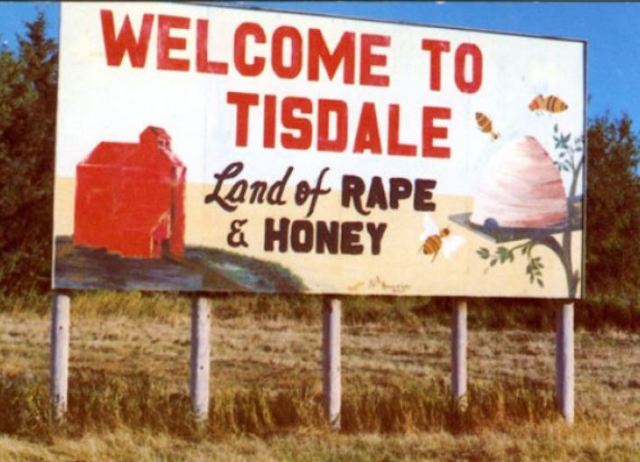
 The town debated changing their image (and their signs and stationery) for over a year and finally made the switch official today. I like the new slogan (Opportunity Grows Here) and congratulate the town for making it through this difficult (for them?) decision. Here’s one of the new signs, on the left. I photographed the old sign way back in 1976 when I was in Tisdale for a beekeepers’ meeting.
 Bad Beekeeping Blog