Black Pollen Day

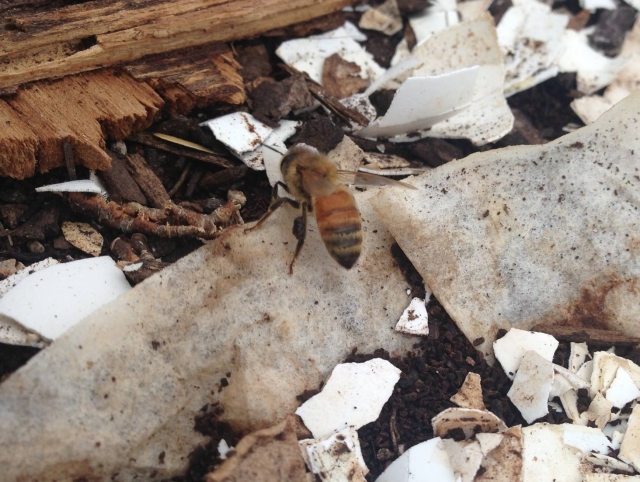
honey bee collecting coffee grounds in pollen baskets

Arizona honey bee collecting coffee grounds in her pollen baskets.

Some bees eat coffee when they get desperate. I suppose some people do, too. We usually think that bees are always gleefully buzzing flower to flower, happy as ducks in water. But when food is scarce, anything goes. When my niece, Monica King, sent a picture of one of her honey bees collecting coffee grounds in lieu of pollen, I was impressed. It’s a great photo. Let’s take a closer look.

https://www.pinterest.com/swexplorations/

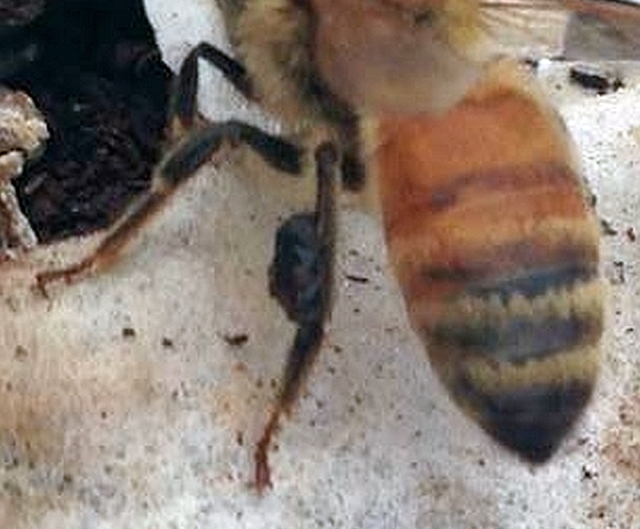
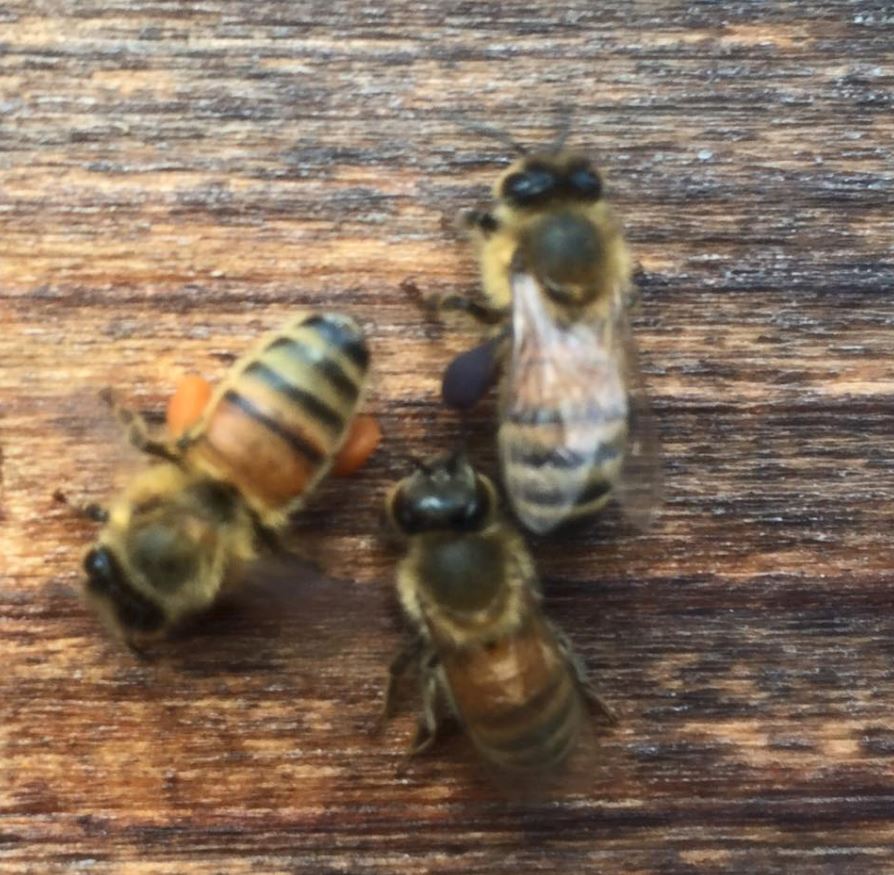
Close-up: Honey bee with coffee grounds on corbicula

Three things to notice. The tiny wad of pollen is tightly bound to the bee’s leg – it must have been stuck there intentionally by the bee; the bee has a bit of black dust on her abdomen; the pollen is black – that’s an unusual colour for a pollen pack. What’s going on here?

Last week, there was frost in southern Arizona where my niece lives. This wrecked most of the winter wildflowers, so yesterday this bee was one of many seen working the compost pile’s coffee grounds. Bees try to forage whenever the weather allows – even if flowers aren’t available. Monica found her bees gathering coffee granules. They were packing the bitter caffeine nuggets onto their legs. A couple months earlier, her sister in Florida had photographed two honey bees on a hive lid – one with orange, the other with black pollen. (Orange and black pollen in October – just in time for Halloween.) I tried to guess what Florida flower might yield black pollen, but couldn’t figure it out. Now we may have the answer. The bee with black pollen was likely carrying coffee, not real pollen.

bees arriving with pollen in AlbertaPollen is typically yellow or orange. I don’t think that I’ve ever seen red pollen – but I’m colour-blind, so I might have seen it but mistook it for green. Fireweed (which grows here) yields a rare blue pollen. Light green, brown, and gray/white are also seen, but black pollen is as rare as hen’s teeth. (Click here for a guide to some common pollen colours.)  Yellow and orange are the proper colours of pollen on posters at Save the Bees rallies. You can see correctly-coloured pollen in the photo above. I always get optimistic when I see scenes like this in Calgary in April.  The colony was still wrapped for winter (the wind had begun ripping the winter protection), but the bees had found pollen and they were their usual happy selves.
When bees get desperate, they scavenge almost anything similar to pollen (for protein) or nectar (carbohydrates). I’ve seen bees collect all sorts of odd stuff. People  have noticed honey bees rolling around in seed dust at bird feeders. Years ago, we were puzzled by bees that visited sawmills. They spent a lot of time hovering around the wet, freshly cut timber. Occasionally the bees lit and then sucked at the wood or moist sawdust. Other times they dove into it and got dusty.

 Sawdust, birdseed, coffee – they’re not necessarily bad.  Bees sometimes need salts and minerals beyond what they find in flowers. Often they don’t bother to stuff the pollen substitutes into their corbiculae. If the stuff doesn’t stick to the bee’s hairy legs, she may dive into the powder so that enough dust sticks and is carried home. Back at the hive, other bees pull it off and put it to use.   Monica’s picture clearly shows that the bee in the photo has tucked coffee to her leg – just a bit of her back is also covered in black dust.

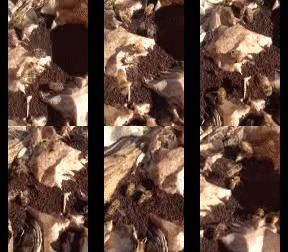
Monica also sent this video clip of how the bees fetch coffee grounds.
They look agitated. (Too much caffeine?) It looks as if they are ‘rolling around’ in the coffee grounds.  But if you focus on one bee at a time and watch her, you may see that she is packing coffee into her corbicula as well.

 I wonder how the brood reacts when caffeinated low-protein grounds are mixed with honey and fed to the larvae as bee bread. Scientists recently showed that bees prefer nectar that has low levels of caffeine over nectar that has no caffeine in it. (Citrus nectar, among others, contains naturally occurring caffeine.)  Tests indicated that a bit of caffeine is attractive – probably as a stimulant – when mixed with test sugar syrup. But mixing in too much repelled the bees -they don’t like strong bitter flavours. The same experiment (reported in Cell journal) claimed that when honey bees received caffeine-laced food, they danced more rapidly and communicated with more colleagues than average bees. If coffee grounds collected by desperate bees visiting compost ends up in the mouths of bee-babes, the house bees may have a daunting task controlling their super-charged little angels when they emerge from their cells as young, highly-caffeinated adults.

Posted in Bee Biology, Strange, Odd Stuff | Tagged , , , | 4 Comments

How the Honey Bee Got its Stinger

This will sound like a Rudyard Kipling  Just So Tale. But it goes back a lot further than the early 1900s. The Bee and Jupiter is credited to Aesop, of Aesop’s Fables Plus Punchline fame – and he lived 2,400 years ago.

Here’s the story:

cartoon bee with honeyA king bee visited Jupiter on Mount Olympus and gave him some delicious fresh honey. Jupiter was greatly pleased so he promised to give the king of bees anything he wanted.

“Give bees a stinger that kills so we can defend our honey from the race of man,” said the bee.

ZeusJupiter loved the race of man and didn’t want humans killed by bees’ stingers, but he had to keep his promise. Even today, bees have stingers that kill.  But clever Jupiter set things up so that the bee would be the one that the stinger kills.  Jupiter was true to his word, the bee got a sting that kills, and Aesop’s punchline, or moral, to his story is:

“Evil wishes, like chickens, come home to roost.”

Of course you know that this is just a tale and part of the story is wrong: Aesop was Greek, so the god would have been Zeus, not Jupiter. And bees have queens, not kings. Other than that, I suppose the story is pretty accurate, except from an evolutionary biologist’s point of view (but they like to use science to spoil everything).

You may have noticed that Aesop adds roosting chickens to the story, even though it’s a tale about bees and gods. I don’t know why he did that, or if it’s an apocryphal add-on, but now we know the reason that bees have stingers and chickens come home to roost. Sort of like killing two birds (or one bird and a bee) with one stinger. And maybe that’s where that old adage originated.

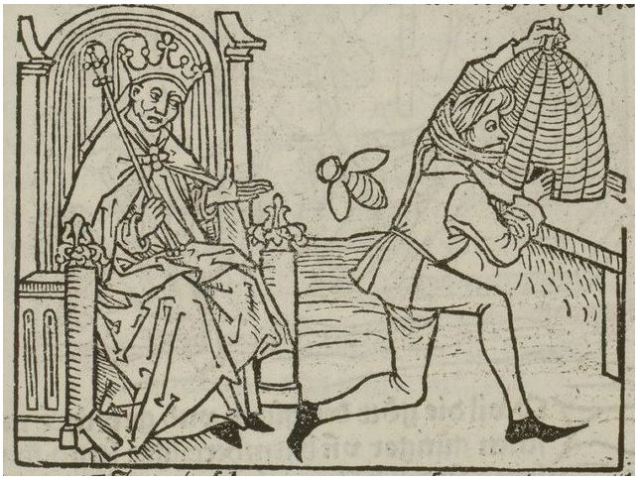
Jupiter and the Bee, from a 1479 woodcut in Aesop Fables

Jupiter and the Bee, from a 1479 woodcut in Aesop Fables

Posted in Culture, or lack thereof, History, Humour, Killer Bees, Stings | Tagged | 5 Comments

Beekeeping Promo Flashback

This video goes back about 15 years, but a friend asked me about the 6 minutes of local fame I experienced on the Dave Kelly morning show, so I looked up the film. The quality of the tape (and my acting) aren’t all that great, but it made me think about honey promotion and how we sometimes have to stick our necks out a wee bit to draw attention to something good. It was worth the effort to do the show!

I’m not sure how I got on The Big Breakfast, it wasn’t my choice. But I was head of the Calgary bee club at the time, so it must have been a favour to someone somewhere. Anyway, hope you have a smile from this. Don’t miss the expression on Dave Kelly’s face at about 3:00 into the video. He was quite a sport and a great host for the show.  By the way, the girl in the video is my older daughter, Erika. She’s still working in bees and honey.

Posted in Beekeeping, Comb Honey, Culture, or lack thereof, Honey, Movies, Outreach | Tagged , , | 1 Comment

Honey with Vibes

amazon rainforest

True story. In a small town along Brazil’s Amazon, there is a warehouse with barrels of honey stacked on pallets. It’s organic honey, certified chemical-free, and it was produced by Africanized bees – the so-called killers of the bee world. All of that is somewhat ordinary. The odd thing about this honey, packed in stainless steel drums destined for Japan, is that musical vibes have been imbibed into its sweet molecules. You see, the buyer has insisted that beautiful new age music must be played day and night in the warehouse – to, um, energize it.

Amazon cotton field.

Amazon cotton field   (Source)

I heard about this honey from a Brazilian beekeeper who was given a special MP3 file to broadcast to his own honey barrels, but, alas, my friend failed to get his crop certified as organic. Some of his bee yards were too close to commercial cotton fields, down along the southern edge of the Amazon rainforest. He envied the other beekeeper who was receiving a huge premium for his special musically-enhance honey.

I understand how organic honey may be desirable. And Amazon jungle honey must be the coolest thing since New Zealand’s manuka. But honey that has spent a few weeks listening to meditative tunes? It makes my inner geophysicist wants to scream.

The idea that liquids may remember music in their molecular souls is akin to the memories that homeopathic preparations are said to retain. Even diluted a billion to one, some homeopathic water is believed to remember the chemicals that once floated in it, thus imparting effects far greater than cold water. I’m a skeptic, but there are plenty of believers out there – homeopathy is a billion dollar business. I’m glad it’s not true, else the folks down river from us would be drinking some really memorable water.

Some New Age vendors have taken to exploiting the sound vibration memory idea. The Holistic Works website would like to sell you personal sprays that have been subjected to musical vibrations. The call the stuff Flutterbye (Did you catch the stupid play on the word butterfly? Their entire web page is just as clever, making me think it’s all a joke. But it’s not.)

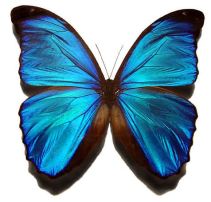
blue butterflyHere’s their advertising lead-in:  The flutterbye effect: healing resonance from butterflies, bees and dragonflies. These folks are selling “Sound Healing”. In a nutshell (and I really mean nutshell) the stuff you will spray in the air has been impregnated with the vibes of butterflies, dragonflies, and bees. They apparently record the 200-beats per minute buzz of a bee, then play that sound towards a jar of BioResonance Sound Spray so you can “build something very special into your energetic healing – the beating of the wings.” Two things you may need to know about these sound sprays: “Bioresonance Sound Sprays are great for spraying around your aura, as a personal spray”; and, “no tiny creatures were harmed in any way in making these resonant sprays.” Well, that’s certainly reassuring.
The butterfly spray’s vibrations will help you overcome your difficult past and bring peace and openness;  the bumblebee spray will help you overcome inertia and apathy and (as a bonus) you will be more able to relax into your etheric field. The cost for the spray, “made from new sound technology which encapsulates the vibrational sound of wings beating” is just $18.95 for 50 ml (about 4 tablespoons).   Sweet. Wish I had thought of it myself.

Posted in Apitherapy, Culture, or lack thereof, Hive Products | Tagged , , | 3 Comments

Does Royal Jelly Make Royal Queens?

School kids need a new lesson about royal jelly.

School kids need a new lesson about royal jelly.

The kids in the Grade 5 classroom knew all about royal jelly.

“The bees feed it to their babies and they turn into queens.”

And so it is. We think. Royal jelly – countless journal articles (and Wikipedia) tell us – stimulates the latent she-ness in a female larva. It removes her from a future life of weary drudgery as a worker destined to live six short weeks who then dies wedged between some dusty stigma and anther. Royal jelly gives the lucky larva a future life as a queen employed in monotonous drudgery as an egg-laying machine destined to deposit progeny for three years in a crowded dark den, then die in a palace coup.  There’s not much of an advantage in the queen’s life. But it’s longer. And there must be a crown or something that comes with the job.

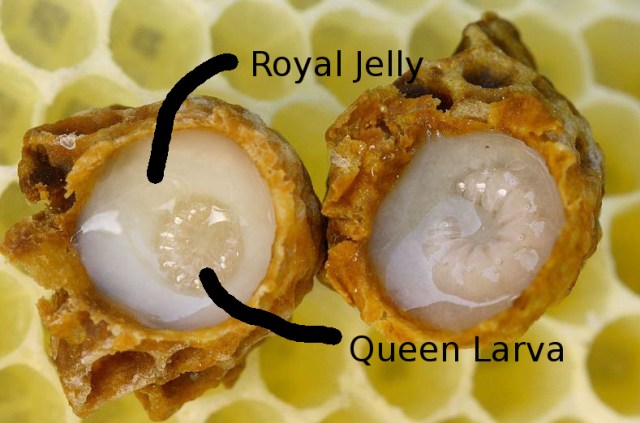
The Queen's Breakfast: Royal Jelly (Source: Wikimedia)

The Queen’s Breakfast: Royal Jelly (Source: Waugsberg)

The reason the queen lives three or four years instead a few weeks and lays eggs instead of stingers is because of nutrition. As a child, she was given the special food. At least that’s what I always thought. Now some upsetting scientists are trying to change the bees’ narrative.

In a nutshell, University of Illinois researchers have found that pollen-based food called bee bread, given to larvae that become worker bees, contains an acid that works as a DNA methylation agent. Methylation of DNA was discovered just a few years ago. It can shut off the way DNA makes proteins, changing the way living things look, grow, and function. Scientists think it controls epigenetics (the way the environment affects gene expression). This is nearly as important as DNA itself in changing the future of a creature. Environment affects DNA methylation which can turn off the way some genes work. So this new theory suggests that an important component of the environment – diet – turns off some genes in the female, suppressing their expression, resulting in worker bees.

My brother, David, feeding royal jelly to future queen bees.

My brother, David, feeding royal jelly to future queen bees.

Professional queen breeders, such as my brother, seen here grafting queen cells, know the value of keeping future queen bees swimming in a surplus of royal jelly. The new science changes nothing about that. But we now have a different way of thinking about what royal jelly actually does.

We used to think that royal jelly made queens and a lack of it led to sexually shriveled, stunted workers. Instead, it appears that bees provide their future workers with food which suppresses the natural tendency for a larva to become a queen. Worker larvae start off with royal jelly (for three days) but then the diet is modified to include honey and beebread (made from pollen). Honey and pollen are excellent foods for all of us, but they contain p-coumaric acid which works as an off-switch for bees.

The U of Illinois researchers, led by May Berenbaum,  confirmed their theory by raising queens in vitro, giving them the same amount of royal jelly that hive-reared larvae receive when they develop into queens. But by spiking the jelly with p-coumaric acid, less well-developed queens resulted.

This turns the bee world upside down and I like it. It’s great to challenge age-old assumptions about how things work. We naturally assumed that better nutrition results in better bees – in this case queens instead of workers. Some people carry this idea so far that they eat royal jelly so that they, too, may live much longer and lay insect eggs. The notion being promoted by this research is that the royal jelly isn’t what makes the queen. Instead, all fertile honey bee eggs will become queens – unless they are fed honey mixed with fermented pollen (bee bread).  Now that’s a game changer.

But this result (which you can read about here) is not without its critics. It is doubtful that it’s as simple as one chemical (p-coumaric acid) having full control over the sexual maturity of honey bees. Some scientists are pointing to different compositions of bee spit that gets mixed into the worker/queen foods in the bees’ kitchen. Others say they have been able to raise queens without using any royal jelly. However, the work by entomologists Berenbaum, Mao, and Schuler has opened a new look at the roll of royal jelly in the beehive. And this may lead to some revised lesson plans for the Grade Five kids at our local elementary school.

Posted in Bee Biology, Genetics, Queens | Tagged , , , , | 7 Comments

Bees, Beer, and Dead Mites

Bees and Beer (Source

Bees and Beer   (Source: YouTube)

Can beer save the bees? No, but with enough beer, bees may not care that mites are crawling all over them.  There have been headlines over the past month suggesting that beer will save the honey bees, but that’s not quite the real story.

Instead, there is a new natural miticide that kills Varroa mites. It’s based on hops, a product used to make beer.  A study from the Carl Hayden Bee Lab in Tucson showed that a solution of 1 per cent hops beta acid swabbed on worker bees’ backsides killed Varroa mites but not honey bees. Cardboard tabs dipped in a hops beta acid solution also eliminated mites when inserted into a beehive.

Alpha and beta hops acids are used in beer making. The beta acid is even more bitter than the alpha line. Bees avoid sipping bitter stuff, so they are unlikely to imbibe the brew material. Further, it appears to be safe for honey bees when used in the beehive. In the USA, the Environmental Protection Agency (EPA) recently approved the use of a commercially made hops beta acid application. This is important because it clears the way for yet another mite killer, this time a natural product, to be used inside the beehive.

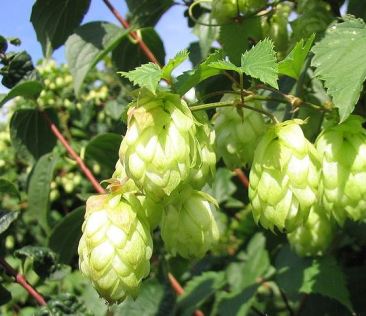
Flowering Hops Plant

Flowering Hops Plant Source: Wikipedia

The new product is a biochemical miticide, Potassium Salts of Hops Beta Acids, which is derived from the cones of female hop plants, Humulus lupulus. The EPA registration allows beekeepers to use it in the fight against varroa mites. Significantly, it should allow beekeepers to take a break from other chemicals, disrupting the mite’s cycle of resistance which grows if the same products are repeatedly used to fight mites. The registrant is Beta Tech Hop Products,  which will make plastic strips containing the biopesticide.  According to a news release from the EPA itself, a biopesticide is a “naturally-occurring substance with minimal toxicity and a non-toxic mode of action against the target pest(s). There are numerous advantages to using biopesticides, including reduced toxicity to other organisms (not intended to be affected), effectiveness in small quantities, and reduced environmental impact.” That sounds good.

It’s not surprising that mites succumb to hops acid. Some of the other standard miticides are also acid-based. Oxalic acid and formic acid are examples. All of these – hops, oxalic, formic, and other acids – even pass the test for “organic” in most cases. (It depends on who’s rules you’re following.) But the difficult thing about these natural acids is that you have to use them at high enough concentrations to kill mites but low enough concentrations to not slaughter bees. And that can be really tricky. Air temperature, draft, and colony populations need to be factored in when preparing to fumigate with acids. Plus, beekeepers are notoriously inept at following instructions. Although these treatments usually work, they can kill your bees. Perhaps hops acid will not be so finicky to apply.

Initial reports about the safety and efficacy of hops is encouraging. The December 2012 report from  the Arizona bee lab shows Gloria DeGrandi-Hoffman as the contact researcher. Dr Hoffman is noted as a careful and thorough scientist. Her work was made public three years ago and already a commercial product has been derived from the research and is now available to beekeepers. A big hurdle was EPA approval, which was granted in October, 2015. Here is a summary of the research:

“Hop (Humulus lupulus L.) beta acids (HBA) were tested for miticidal effects on varroa destructor Anderson and Trueman, a parasitic mite of the honey bee (Apis mellifera L.). When varroa were placed on bees that had topical applications of 1 % HBA, there was 100 % mite mortality. Bee mortality was unaffected. Cardboard strips saturated with HBA and placed in colonies resulted in mite drop that was significantly greater than in untreated hives. HBA was detected on about 60 % of the bees in colonies during the first 48 h after application. Mite drop in colonies lasted for about 7 days with the highest drop occurring in the first 2-3 days after treatment. There was a reduction in the percentages of bees with HBA and in the amounts on their bodies after 7 days. Bee and queen mortality in the colonies were not affected by HBA treatments. When cardboard strips saturated with HBA were put in packages of bees, more than 90 % of the mites were killed without an increase in bee mortality. HBA might have potential to control varroa when establishing colonies from packages or during broodless periods.”
.

In late October, the EPA released its ‘tolerance’ exemption for hops acid, apparently offering a free pass if any is later found in honey. Here is part of what the government released:  “This regulation establishes an exemption from the requirement of a tolerance for residues of the biochemical pesticide potassium salts of hops beta acids in or on honey and honeycomb for the control of Varroa mites in accordance with label directions and good agricultural practices. This is good news for beekeepers – they can use what they need without risking contamination to their honey by a harsh chemical. Hope hops works as well as a cold beer to reduce everyone’s concerns about mites.

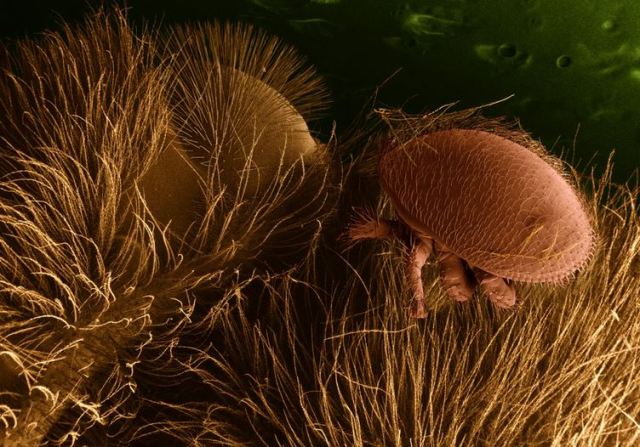
Varroa destructor on a honey bee, photographed by USDA Ag Research Service, using an electron microscope.

Varroa destructor on a honey bee,
photographed by the USDA Ag Research Service, using an electron microscope.

Posted in Diseases and Pests, Save the Bees | Tagged , , , , | 7 Comments

Bees Do the Darndest Things

Bees stuck below the mite screen. Janne cut an escape for them to move up.

Bees stuck below the mite screen. Janne cut an escape for them to move up.

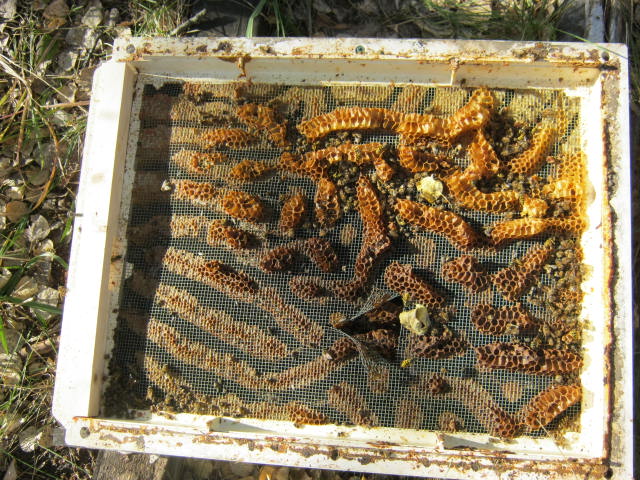
Janne, a bee-club friend, called one afternoon and described something weird that was going on in one of her hives. She told me that her queen and all the brood had somehow ended up in the tiny space below the mite-screen at the base of her hive. The bees were living between the screen and the base of her bottom board. That’s right, a space about two inches thick. Above that towered a two-story stack of bee boxes with some bees in them. As it was October and she was getting the bees ready for winter, she wondered what she should do. Find the queen among the burr comb? Cut out the brood and move it into frames? Put a strong hive over the little hive that lived in the bottom board?  What would you do?

I told her what I might do, but your answer is probably different because that’s the way beekeeping is. We all have ideas, based on our experiences and knowledge. Problem is, none of us has the same experience nor the same amount of information. That’s why beekeeping is an art, or craft, and not a science. Entomology is a science, of course, but not beekeeping.

I usually dread phone calls from new beekeepers. They tell me that they think their queen is dead or they wonder if they should feed their bees.  “How the heck would I know?” is the right answer, but I never say that. I ask for as much detail as possible, but this puts the new beekeeper in an awkward position as they struggle to find the vocabulary and make sense of what they have seen. With enough information from the newbee, I might come up with some answers. But to be honest, I often guess wrong even when it’s my own bees and even though I have access to everything I should need to know to figure out a way to help the bees.

But my friend Janne is not a new beekeeper. She is smart and articulate. She even took pictures and e-mailed them to me so I could be even more sure of what her bees were doing. I think she asked my opinion to get some ideas, but maybe she just wanted me to hear her really odd bee story. Bees do the darndest things and Janne knows that I love these tales of woe from the hive.

I told Janne to get a knife and cut the screen. This might entice the queen to move up into the lower brood box. She told me that it already had some bees in it. The queen generally moves upwards as she lays eggs, so I figured releasing her would get her laying in frames instead of the crowded comb the bees had made in the bottom space. I also thought she should reduce the hive to one brood chamber but leave her mutilated bottom board in place because the brood would hatch and the young bees would move up to care for the brood.  Winter is coming, so I told Janne to feed the hive heavily and wrap the single-story with a lot of insulation. Bees here usually need two deep brood chambers to winter well, but if she keeps an eye on the colony and then feeds it in early March, it might make it.

Well, two weeks earlier, Janne had actually cut a ‘T” shape incision into the screen of her screened bottom board. She had probably already mentioned that to me in our first phone chat but I had missed hearing it.  So, we were thinking alike about the remedy. The day after we spoke, she was back in her little apiary again. She sent me the pictures you see here and an e-mail describing what she saw.

brood nest below mite screen

Looking down into the bottom board. The queen had been stuck here for a few weeks,
building her entire brood nest in this narrow little space!

Before opening the troubled hive, Janne spent a few moments watching the hive entrance. This is always a good idea. When you work your bees, take the time to really look at their flight. Are the bees jumpy, as if robbing is going on? Are they listless, like sick bees might be? Is there a huge flight? Or no flight?  Janne saw lots of bees using the proper hive entrance and just a few bees using the false entrance – the gap that led to the little chamber between the screened bottom and the hive base.

Janne pulled off both brood chambers and set them aside. Since I had recommended that she reduce the two-story hive to a single because the population would be small, she pulled the cover off the top box to begin the consolidation process. That’s when she discovered brood in the top box. The queen had wandered up from the narrow bottom board space in the two weeks since Janne had cut the mite screen.

My beekeeper friend then had a dilemma. Should she consolidate everything into a single box, or leave the hive as a ‘proper’ two-story assemblage?  (I had recommended consolidation into one box because I figured there would be just a few bees in the hive and they would have trouble ‘heating’ a bigger home.)  Janne decided to reverse the hive (and consolidate all the brood into the lower chamber) and keep it as a two-story hive.  She has to make that decision herself.  She knows how many bees are there what shape things are in. She still has the option to trim it down to a single, using a bee escape to empty bees from the top box.

All of this was two weeks ago. Now it’s November, we are getting chilly weather, and bee work has to end for the season.  In a few months, I’ll let you know if this little hive makes it through the harsh Canadian prairie winter.


Posted in Beekeeping, Friends, Hives and Combs | 1 Comment

Time and Time, Again

Most North Americans moved clock hands back last night.  Others in the northern hemisphere did this a week earlier. Meanwhile, some folks in the southern hemisphere did the deed in the opposite direction. Others never changed to Daylight Saving Time, so they aren’t moving any time soon. It’s a gemisch of spinning clock dials, but the world’s biggest mess is in the United States, on the Navajo Nation in the state of Arizona.

We’ll get to the Navajo in a minute. But first, the whole notion of springing forward in the spring and falling back in the fall shall be examined.

Ben Franklin, America’s inventor/publisher/scientist/statesman/postmaster proposed the idea back in 1784 as a way to save money. His father was a candle maker. From an early age, Ben realized how expensive it is to light a house at night. Instead of “early to bed and early to rise” making a man wealthy, Ben figured that pushing the clocks ahead in the spring could do the same trick. Thus, he invented daylight Saving Time. While ambassador to France, Franklin told a Paris audience that their city would save 128 million candles a year if people simply moved their clocks one hour. But his idea wasn’t adopted anywhere until 1916, when Germany and Austria used clock setting as part of their war effort. The USA began saving time in 1918, but not every American state joined in.

Saving time really does save money. Roosevelt instituted War Time from February 1942 to September 1945 – non-stop Daylight Saving Time. In 1973, Richard Nixon decreed an extra-long summer savings of time during that year’s fuel crisis. That summer, people used Saving Time for an extra few months, saving millions of dollars and tanker loads of oil – 3 million barrels a month, according to the US Transportation Department. With such success, one wonders why we don’t move the clock back two hours and keep it there. But there are dissenters.

Maybe you don’t move your clocks at all? For a few years, I lived in  Saskatchewan, Canada. It’s one of the few northerly places that doesn’t bother with Savings Time. It’s a cow thing – Saskatchewan cows rarely wear wrist watches, so the cows of Saskatchewan saw the idea as so much BS. They knew when they needed milked and the farmers had no choice but to stay with natural time. But within Saskatchewan, there’s a group of timely dissenters: The Hutterites.  I was their Honig Mensch, many years ago.

Sask Hutterites

Saskatchewan Hutterites – from another time zone. (Image: Miksha)

Hutterites don’t use Daylight Saving Time, and they don’t use Saskatchewan Time, either. They use Slow Time, instead.  When I visited Hutterite colonies, I was careful not to show up at the communal farm during daily prayers, which were at 5 pm, slow time. This Mennonite-type group set their clocks to their own unique slow time, which is an hour behind the rest of Saskatchewan. This way they coordinated prayer time with other Hutterite colonies across North America. Slow Time put their clocks at the same time as Quebec, in the Eastern Time, 3,000 kilometres away, instead of Saskatchewan’s Central Time Zone which began at the edge of each Hutterian. 

Saskatchewan time, with immobile clocks that never experience ‘savings’ has apparent merits. Since Saskatchewan bees have the highest annual per colony honey production in North America (about 180 pounds per hive),  we need to consider that keeping the bees on a stable clock has its advantages, too.

Elsewhere, in August, the wizard of North Korea magically moved his country even further back in time, making news by shifting clocks back thirty minutes.  Supreme Leader Kim Jong-un created the new Jong-un Time Zone where un-time not only stands still, but occasionally even runs backwards.

Saskatchewan and North Korea are not the only places with idiosyncratic time shifting.  There are numerous enclaves of other-time peoples. Arizona does not change to Daylight Saving Time when the rest of the United States does. However, within Arizona, the Navajo Nation does move clocks ahead to Saving. However, within the Navajo borders, the Hopi Reservation does not change its clocks. However, living on a ranch in Hopi country is a family where the mother works on the Navajo Reserve, so that house moves its clock. This results in a complicated situation where a family’s clock is ahead of their neighbours’ clocks that are behind a surrounding community that is ahead of a state that is behind a country that moves ahead.

Mixed times on the Navajo Nation (Wikimedia)

Mixed times on the Navajo Nation (Wikimedia)


Posted in Culture, or lack thereof, Friends, History, Humour | Tagged , , , , , , | Leave a comment

Halloween Trick and Treat

halloween pumpkinIf you grew up in the British Isles or North America, you probably dressed as a ghoul or a super-hero each year on Halloween. For those of you outside the sphere of Celtic autumn rituals, you might not know that Halloween grew out of a pagan tradition that playfully invited participants to mimic zombies on October 31 (on the Reformed Interdenominational Celtic Calendar). That’s the day that dead people annually leave their graves and walk among the living. If you looked and acted like one of the undead grave dwellers yourself, the real dead folks would leave you alone. The church also got in on the fun. The church leaders didn’t stop the ancient tradition but instead created a new religious holiday, All Saints’ Day, to follow the day after pagan Halloween, then called Samhain. By All Saints’ Day, the dead have returned to the cemetery. There relatives and pious people would visit them, bringing candles.

An almost dead honey bee with two zombie fly larvae emerging near the bee's head. (Wikipedia)

An almost dead honey bee with two zombie fly larvae emerging near the bee’s head. (Wikipedia)

I don’t have any dead walking bees, but I can tell you about zombie bees. Zombees, as the poor creatures are lovingly called by entomologists, are just normal honey bees which have the larvae of a fly, the Apocephalus borealis, living inside the bee and feeding on the bee’s brain while the parasitic fly develops. Rather unfortunate, isn’t it? Female flies lay their eggs in the bees. The larvae grow and attack the bees’ brains. The result is out of control bees that sometimes fly in the dark and on cold, rainy nights when they would normally be sleeping. The zombie flies and their infected zombees have recently been found in San Francisco and Vermont. Why they showed up on opposite coasts is a mystery, but there are a few occurrences mid-continent, too. A website called ZomBee Watch documents discoveries and has a map here.

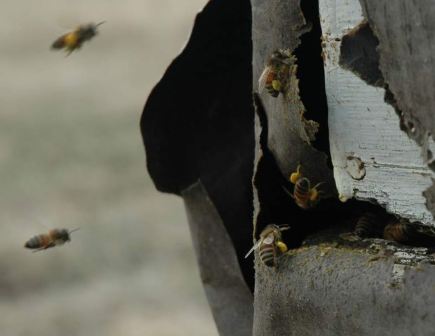
I don’t want to scare you with more tales of zombees, so I’m ending with a cute picture taken by my niece Martha in Florida earlier this month.  Halloween colours are orange and black – as are the colours of the pollen stuck to these bees’ corbicula.

Black Pollen - Martha Dresko

Posted in Culture, or lack thereof, Diseases and Pests, Strange, Odd Stuff | Tagged , , , | 1 Comment

Bee Time, for the Third Time!

It’s Bee Time!

Well, this is the third time that I’ve written about Mark Winston’s latest book, Bee Time: Lessons from the Hive. I don’t usually do three reviews on the same book – so I am not going to review it at length this time – but something really great just happened to the book.

I mentioned Bee Time this spring when it won the Canadian Science Writer’s award for the best book of the year. I was at the award ceremony in Saskatoon when the prize was announced. It bested some great entries, but Bee Time is a very good book.  I also wrote a bit about Winston’s book last fall when I read it.

Today, my comments will be brief. The book is in the news again because last night it won Canada’s Governor-General’s Literary Award for the best non-fiction book released in the past 12 months. Congratulations to Mark Winston. I’ll just add a few words about the book and remind you that it’s available at Amazon for about $20. If you haven’t read it yet, it might be time to put the book on your holiday gift list.  Now, about time for  Bee Time: Lessons from the Hive

It’s a personal story. I especially appreciated the last segment of the book, the Epilogue – Walking Out of the Apiary. But I will quote from the penultimate section, from Winston’s chapter called Lessons from the Hive. It’ll give you a bit of the flavour of the book:

“Bees can be the richest of guides to the most personal understandings about who we are and the consequences of the choices we make in inhabiting the environment around us. Conversations with beekeepers about how they are affected by their time in the bee yard show a remarkable consistency. Words like “calming,” “peaceful,” and “meditative” come up over and over again, and beekeepers visibly relax when talking about their bees.” – Mark Winston, 2014

Posted in Books, Culture, or lack thereof, People | Tagged , , | 1 Comment