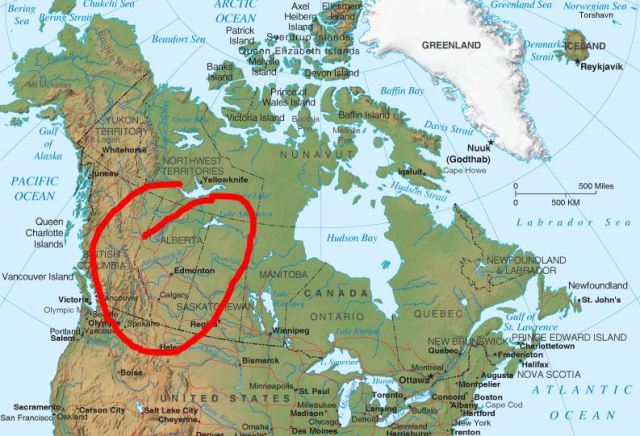
The numbers are in and the prize goes to Alberta. Alberta, a province in western Canada, has once again won the prestigious honey production award. For those of us who learnt beekeeping where 50-pound crops are the norm (in my case, Pennsylvania), the size of western Canadian honey crops seems the thing of fairy tales, right up there with fire-breathing dragons. Last year’s crop was 145 pounds. (66 kilos) That’s the average per hive from over 250,000 colonies in Alberta. Many colonies did much better. The average would have been higher, but about 30,000 colonies were rented to seed growers – pollination bees didn’t make much honey.
One of our more scenic yards, south of Calgary, in sight of the Rockies
If you don’t know much about western Canada, I’ll tell you this about Alberta. The place is big (bigger than France, for example). About half is forested. A large and scenic chunk is in the Rocky Mountains. Alberta’s two big cities (Edmonton and Calgary) each have over a million folks. We also have the ideal place for honey-making.
What makes a bee paradise? Sunny days help. Long, clear, warm days with just enough rainfall to keep nectar flowing but not so much that the bees are kept in their hives for days on end. The right sort of flowers. (Here, that’s canola, clover, and alfalfa.) Strong, healthy bees are also essential.
Canadian honey by the barrel.
Alberta keeps surprising me with its great crops and healthy bees. Our bees should have been killed long ago by neonicotinoids. Neonics are used heavily here. 99% of Alberta’s 6 million acres of canola oil seed crops are treated with neonicotinoids. Honey bees work canola enthusiastically. Yet, Alberta bees have not suffered the ruination that neonics are alleged to have caused in some other parts of the world. Neonicotinoids are undoubtedly poison to bees, but after continuous and almost ubiquitous use here for a decade, the insecticide has not yet destroyed Alberta beekeeping. Instead, the bees continue thriving, wintering well, and making bumper crops of honey. If neonicotinoids are killing the world’s bees, then this does not make sense. Maybe disaster is just around the corner, but after so many years, it should have already struck.
Here are the statistics for the Alberta honey crop, reported by StatsCanada and repeated in the Daily Herald Tribune:
Alberta beekeepers produced 42.8 million pounds of honey in 2015, up 20.4% from 35.5 million pounds in 2014, according to Statistics Canada. Nationwide production rose 11.4% to 95.3 million pounds.
According to Medhat Nasr, Alberta Agriculture’s provincial beekeeper, the weather in 2015 was so kind to the province’s bees that their winter mortality rate was the lowest in 15 years, at 10%.
“That compares to the national average of a 16% loss and the American average of 23%,” he said in a press release. Yields in Alberta rose from 125 pounds per colony to 145 pounds.
New figures from Statistics Canada show Canadian beekeepers produced 95.3 million pounds of honey in 2015, an increase of 11.4 per cent from the previous year.
The total value of the sweet stuff is up by 10.9 per cent to $232 million due to the increased production.
“The industry is successful and is growing. It really is a positive message,” Rod Scarlett, executive director of the Canadian Honey Council, said Wednesday.
Finally, the Statistics Canada summary. Notice that Canada has 800 more beekeepers than it had 5 years ago and 85,000 more colonies of bees.
When I was a kid growing up in western Pennsylvania, Groundhog Day was a big deal. It didn’t hurt that it was also our elementary school principal’s birthday. We didn’t get the whole day off (unless Feb 2 was on a weekend) but we did participate in many rousing games of ‘catch your shadow,’ ‘catch your friend’s shadow,’ and, of course, ‘catch your shadow’s shadow’ – looking back, I think the teachers used this time for a coffee break. Or maybe they were in the principal’s office, cutting cake. Here in western Canada, the day passes with barely a salute. My young children said that they don’t even draw pictures of groundhogs. It was ‘business as usual’. I wonder if their school is a bit too serious?
The groundhog tells us how our winter will end. With a bright sun and scary shadow, the overgrown rat runs back into its cave. Unless sadly, (and I need to get serious for a moment) the groundhog dies just before emerging, as Winnipeg’s Winnie the Groundhog did this year. Here’s a link, it takes you to The Weather Channel. The Weather Channel has a groundhog story? Not surprising – they have to get their long-range forecasts somewhere. Anyway, here in Calgary, winter will linger. If it’s cloudy, there’s no shadow and winter will end in, well, a month and a half. These creatures and their shadows are about as skilled as our best TV weather folks. But what about bees? What do they know about the weather?
There are plenty of stories of beekeepers standing around their bee yards and suddenly noticing that all the bees are heading home while none are going out to forage. The beekeepers look up and a cyclone or hail storm or lightning ball or wall of water or something is rushing towards them. The bees probably have responded to rapidly falling barometric pressure by heading for shelter. They don’t like being caught in the rain any more than a beekeeper does. They are just more aware of quick weather changes. And they fly home faster than people do.
But can bees compete with Pennsylvania’s Punxsutawney Phil by making a long-range forecast? Well, I have heard beekeepers claim that a tighter broodnest and extra bee glue (propolis) filling cracks between the boxes means a rough winter is ahead. I don’t know. A congested broodnest is likely because of a late-season nectar flow while excess propolis means the gummy parts of pines and poplars that secrete resin have been extra active – and the bees have been extra busy hauling the stuff home. Do they sense a tough winter? I’m not sure which clues our bees see that we don’t. But my mind is open on this one.
There is also the legend that honey bees will nest higher up in trees when they anticipate a winter with lots of snow. This one is extremely unlikely because wild bees swarm in the spring, many months before winter snows are expected. And here in western Canada, hives buried under a meter of snow actually survive better with the extra insulation than hives sitting out bare and exposed on the windy prairie.
By the way, the Calgary groundhog (or Richardson’s Ground Squirrel, in our case) faced a dark shadow all day. According to the myth, we will have only six more weeks of winter. That places spring near March 20th. No big surprise. That’s what the calendar says, too.
Sitting in traffic, smelling everyone else’s exhaust (you know yours doesn’t stink), you begin to worry about the bees out there. They smell the fumes, too. But if you look closely, you won’t see them gasping or coughing. That’s only because bees don’t have lungs. I just read a study about exhaust fumes affecting plants, so I’m less worried about the bees’ trachea and their spiracle outlets than I am about all the flowers and their ability to attract pollinators.
Researchers planted some mustard seeds in a greenhouse, then added the equivalent of a Hummer to the mix. The pollution does something odd to scents given off by blossoming mustard. At a distance of 4.5 metres (15 feet), scent molecules from Brassica nigra (black mustard) are about one-third fewer. They have disappeared by combining with the ozone and turning into something that’s not attractive to bees. Maybe it’s a boiled cabbage odour, I don’t know, but ozone interferes with a flower’s natural scent.
Oddly, close to the flower, there is no discernible reduction in the scent, even with the ozone as dense as it is four metres away. Further away, the concentration of the nice flowery scent falls more quickly than it does in clean air. This spells trouble for bees. Especially bumblebees, which are guided more by their nose than any instructions they may receive from their buddies back at the hive. Honey bees are less affected than wild indigenous bumblebees because honey bees fly further and depend on scent less than most other bees do.
What’s the solution? It looks like we may be headed towards cleaner air, especially with the popularity of electric cars (if they are powered by renewable sources, not coal). That will help the bees. And us, too, if we are stuck in traffic on a busy highway.
The Hive Mind,the idea that an entire colony operates like a single organism with one mind, is a notion that’s been picked up by people who don’t usually wear bee veils. Some of these folks are screenplay writers while others are economists.
On the TV tube, the mechanistic intergalactic Borg assimilated every culture they encountered, giving rise to their mantra “Resistance is Futile” – it was inevitable that the single-brained society of interconnected creatures which had been absorbed into the Borg super-colony would all eventual succumb to the super-being. Almost everyone encountered gave up their identity and become part of the greater good. Not that the Borg were portrayed as good on Star Trek. They were menacing and their chief claim to badness was that they ingested everyone else. Since words like colony, queen, and hive mind were tossed around, the Borg gave bees a bad name.
Does a honey bee colony have a Hive Mind or does it have a leader? The colony seem to have something like a collective mind, but we still don’t know what causes it to act as a community when there is no leader or decision maker. Similarly, we don’t know why birds flock, fish school, sheep herd, or crows murder. When a worker honey bee begins to build comb, it is an almost accidental incident. A flake of wax appears on her abdomen. She has to stick it somewhere. Another bee attaches a second piece, then another and another. When the second and third piece are fixed onto the first, it’s unlikely that the bees have an image in their mind about the final structure of the new wax comb. The image is not in any individual worker’s mind, but it does seem to exist in the collective hive’s mind, perhaps as an evolutionary habit, passed along in the bees’ DNA.
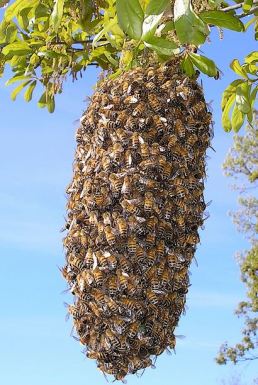
A similar thing happens when bees decide to swarm. There are lots of physical inputs. Days are getting longer. The colony population is growing. Less and less of the queen’s limited swarm-suppression pheromone is distributed among more and more bees. Swarming occurs during nectar flows – all available space is filled with honey, contributing to crowding and congestion. There are few places left for the queen to lay eggs. Her body shrinks from her egg-laying hiatus, allowing her to fly with a future swarm. Scout bees return to share their discovery of a hollow tree as a future possible home. A lot of natural triggers work simultaneously. Then, a brief spell of rainy weather keeps the bees stuck in their hive for a day or two. Finally, the sun comes out, it’s hot, humid, and flowers are dripping with nectar. The colony swarms.
Half the bees leave with their lighter, stream-lined queen. Scouts direct them to their new home. Which bees stay and which leave? It doesn’t seem to matter to the bees, except the queen has to be among the ones fleeing. Researchers have marked bees in a swarm, then returned them all to their original hive. A few hours later, they swarm again. About half the bees stay the second time, replaced by sister bees who make up the new swarm. Each individual bee seems to decide to go or stay. Neither too many nor too few exit with the swarm. The big decision is made by the hive’s mind, not the individual bees’ minds. For all we know, the ones which leave are the ones which are nearest the hive’s door when the swarming starts. It may be that simple.
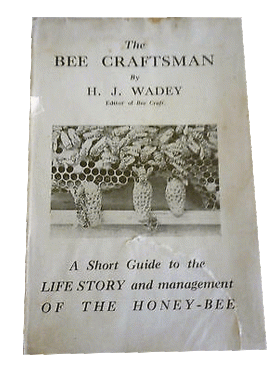
I first saw the phrase ‘hive mind’ years ago. It appeared in the 1943 book, The Bee Craftsman, by Herbert Wadey. The author was editor of a worthy British journal called Bee Craft. In his slim (116 page) book, Wadey asks, “What controls, guides, determines, the varying policy of the bee colony? Not the queen or a dictator; not a committee of elders.” Rather, Wade noted, “the bee colony has a collective mind….which determines the needs and which works out the way to satisfy them…often in less time than a human mind would need.” Throughout The Bee Craftsman, Wadey explains the organization of the colony in terms of the hive mind, telling us that “the Hive Mind is a strange and mysterious collective mentality.”
This idea comes back again and again. Books like The Mind of the Bees (L’Esprit des Abeilles, by Julien Francon) and Wisdom of the Hive (Tom Seeley, 1996), demonstrate how the collective acumen of the members of the colony makes decisions without designated decision makers. In the past, this approach has expanded to include other fields of study, notably economics.
Economists have long described similarities between honey bees and human activities. There is “an invisible hand” in the market place assuring enough shoes, socks, and karaoke machines are manufactured each year. And these things are sold at a price largely determined by collective free-market bidding among all the people interested in foot apparel or in bar tab receipts. As with the bee making comb in her hive, our improvised choices contribute to the operation of a larger society.
In his book, Hive Mind: How your nation’s IQ matters more than your own, Garett Jones tells us that the joint efforts of humans are similar to the efforts of bees. “Millions of small cognitive contributions…create each nation’s collective intelligence, each nation’s hive mind.” Jones explains how – by simply being part of a successful nation’s hive mind – we can be successful ourselves, even if rocket science isn’t our long suit. If you are fortunate enough to reside in a rich, creative country, you might still be comfortable, even if you have a habit of poor personal choices.
Looking at a bee hive again, every colony member (even the least able) benefits from the level of the colony’s collective health and prosperity – and suffers when things go poorly. If a colony starves because the hive runs out of honey, all the bees die on the same day. There is neither hoarding nor selfish gorging. Members share equally until the food runs out. The ultimate hive mind.
Being part of a colony’s hive mind is not a conscious choice for any individual honey bee. The bee simply obeys physiological rules governing her behaviour within the colony. Free will and choice do not exist for the bee. Resistance to cooperation – futile or otherwise – is not even an option for members of a colony.
Russia’s Vladimir Putin has suggested that anyone who sells or grows genetically modified foods on his turf should face a few years farming in Siberia. He has proclaimed Russia will be GMO-free and he’d like to see his farmers raise their crops organically. He has declared war on Monsanto and its ilk, equating the company to an international terrorist organization. And you thought Putin was all bad.
I remember when George W. Bush met Putin for the first time, about 14 years ago, and Bush told us that he “looked into Putin’s eyes, and saw a trustworthy man.” Now we see it’s an organically fed, free-ranging trustworthy man. From Donald Trump, we are reminded “It’s never been proven Putin murdered anyone.” So, let’s see if we can glimpse the same good things. Let’s see what the news out of Russia is telling us.
Russia’s steppes: lots of land
“Russia,” said Putin, will become “the world’s largest producer of healthy, ecologically clean, high-quality food.” For now, he is just trying to make his country self-sufficient in food, a goal he hopes to achieve by 2020, according to Farmer’s Weekly. Russian has seven million full-time farmers (the USA has one million), yet the vast expanses of the steppes don’t currently feed Russia’s dwindling population. However, the 2020 goal will be easier to achieve if Russia’s population continues to fall. Russia had 148 million citizens in 1991, but dropped to 142 million by 2014. (Capturing Crimea in 2015 boosted the number by over two million – annexing is a clever way to reverse a country’s population decline.)
Population and agriculture have both been sliding in Russia, so rejecting western technology may be just the thing the politboro ordered. Back to basics could be the trick. It should go better than when Russia rejected Darwin during the Stalin years. Stalin trusted Trofim Lysenko with the nation’s crops. He was nominally a geneticist, but Lysenko rejected Darwin’s discovery of natural selection in favour of Lysenkoism. This contributed to Soviet crop failures. [You may find “When the Soviet Union Rejected Darwin” interesting.] Lysenko, a favourite of Stalin, believed that genes will change in one generation if the progenitor experiences environmental stimulation. In theory, this is similar to epigenetics, but in Stalin’s Russia, it was practiced quite differently.
According to Lysenko, chilling a wheat plant with ice would make its seeds create a trait that would make future wheat frost-proof. Chopping the tail off a cat would give rise to bob-tailed cats. Starving millions of Soviets would lead to a new, hardy, pro-Soviet generation of citizens. Though easily disproved, the anti-Darwinian notion that environment directly changes genes was appealing to Stalin’s interpretation of Communist doctrine. The results were disastrous. Even today, Russian scientists (who excel in physics, engineering, geology, and chemistry) are dismal in genetics. In that field, they rank amid third-world countries in contributions and innovations.
Russia may eventually feed its shrinking population while abhorring genetic modification. If the Russians can also go organic, it will be their biggest agricultural experiment since Lysenko’s day. For Russia’s honey producers, it should be a huge boon. True organic honey is scarce, mostly produced in remote jungles and on rocky mountainous slopes. Russia is huge, so creating a vast organic range would be fantastic for bees. Getting rid of agri-poisons should be an even greater benefit to bees and wildlife.
Back to Vlad ‘Granola Bar’ Putin. Is he sincere and trustworthy on his commitment to an organic, GMO-free Russia? Farmers will likely go along with his plan, considering prison could be the alternative. Russia’s Parliament is writing a bill for a full ban on GM crops by July 2017. Meanwhile, Russian agriculture minister Nikolai Fyodorov volunteered that his government will not “poison its citizens.” Always reassuring words from any autocratic government.
What is Putin’s real motivation? Healthy, happy citizens? After nearly two decades in power, he has done little to achieve that. In 2012, Russia approved and registeredeighteen GM food lines (soybeans, maize/corn, potatoes, rice and sugarbeets) and fourteen GM feed lines (corn and soy for animal feed). Those 32 crop varieties were planted, distributed, and are somewhere in Russia’s ecosystem. Putin’s anti-GMO stance is intended to oppose the west (specifically the USA) which has placed targeted embargoes on Russia because of its actions in Ukraine and elsewhere. “Russia doesn’t need the west’s poisons” is part of the message. This is about power and politics, not the healthy lives of any poor saps toiling under the watchful eye of Moscow.
Maybe the result will inadvertently be positive. Beekeepers will definitely prosper if pesticides are banned. Russian organic honey should be much in demand when it hits grocery shelves in France and Britain in a few years. It will be interesting to see how this plays out – and whether Putin can be trusted after all.
1930s Spirit River (Alberta, Canada) threshing crew. Yup, we were still using draft horses here in the 1930s.
A century ago, threshing crews worked their away across the American and Canadian prairies, harvesting farmers’ grains. When I was rather young (not quite a century ago) one of my Saskatchewan buddies signed up for a threshing crew job. Maurice caught a bus to Texas where the wheat harvest began that year. He was one of fifteen young men who drove trucks and piloted swathers and combines for a custom harvesting company.
Like hungry locusts, the threshing crew would descend upon wheat fields and strip off thousands of acres of grain in a week. The farmers, of course, paid and fed the crew of custom combiners, but the farmer didn’t need to own big trucks or horrendously expensive harvesting equipment. Not every farmer used custom harvesting and today nearly all farmers own their own specialized machines. These are kept in sheds 46 weeks a year, then used by the farmer himself to gather the crop. I suppose – since the marketplace rules – it’s cheaper to own the equipment and do it one’s self than to hire custom harvesters. But in the days when bank credit was scarce and small farmers were struggling, hiring someone else to harvest was the only option for many.
There are a few reasons custom honey extracting was never a really big thing. Generally, the closest we’ve seen has been the sharing of an extractor, usually kept by one hobby beekeeper in his shed. Other hobby beekeepers would show up with a few supers and some pizza and extract at the friend’s shop. Typical pay for the guy who owned the extractor would be all the wax, maybe some honey, and all the pizza he could eat.
I used a similar system in Florida, forty years ago. It was on a larger scale, but the fellow doing the extracting was still paid in honey and pizza. Here was my situation: For about ten years, I produced a few thousand queen bees each winter. One year I unexpectedly also had a mess of honey. I took a couple truck loads of supers to a commercial beekeeper who extracted about 20 drums (12,000 pounds) for me. I drove almost two hours to get to his shop on Little Church Road and unloaded my boxes. He worked through the night processing my honey. I returned the next day to get my empty equipment, then a couple days later, I went back for my drums of honey, except for one that he kept as his fee. It was a lot of driving and it was modestly expensive. But I didn’t normally produce honey and didn’t own an extractor. The custom honey harvester had a neat, clean, and government-approved shop; I didn’t. And it had been an odd year with a nice surplus of orange blossom honey. Most years my mating nucs and cell builders were not so honey-bound. But that year, I had to handle some honey.
But, as I mentioned a moment ago, custom honey extracting never really caught on. There are reasons. First, the practice can spread American foulbrood. If infected equipment is extracted the day before processing your boxes, there is a chance of spreading disease to your equipment. The chance may be small, but foulbrood spores don’t always completely wash away with hot water. Even careful use of an extractor can spread disease.
The second reason custom extracting was never a big deals with timing. If my bees jam their supers, I need them off, extracted immediately, and returned to the hives as fast as possible. I’d be in trouble if the custom extracting shop is busy (because everyone else is also having a bumper crop and need boxes emptied quickly).
Cost, of course, is a consideration. Just as grain farmers have largely given up paying others to harvest for them, beekeepers would also be price wary. However, as honey house inspection requirements become more stringent and extracting equipment becomes more expensive, perhaps letting someone else handle extracting will become more cost effective. I was never happy looking at my expensive processing equipment in the off-season. From September to June, my uncapper, extractors, pump, and settling tanks just sat there, wondering if I had forgotten why I’d bought them.
A final reason that custom honey harvesting never really took off is because extractors aren’t mobile. They are not like the threshing crews of yore. You couldn’t expect a crew show up in your town with extractors in tow. Until now.
A Manitoba (Canada) beekeeper, working with an firm in Finland, has come up with a mobile honey extracting shop. Collin Stone’s company, International Honey Products Limited, could send a big van to your bee yard and extract your supers as fast as you pull them off the bees.
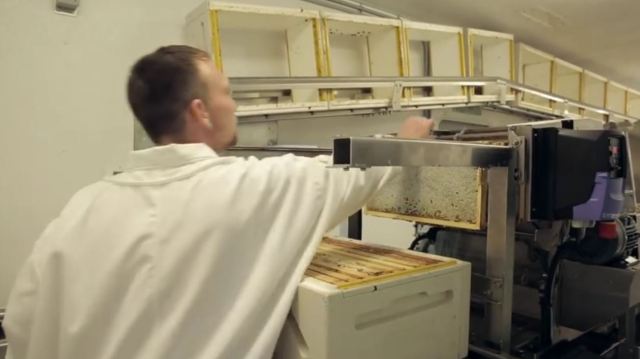
The system uses a crew of four who work inside the (CFIA/FDA) approved honey processing van. They handle 3200 pounds per hour. This is a hundred pounds from each of 32 hives in a typical yard. You remove the honey boxes, feed them into the magic van, then put the emptied boxes right back on the same hives. You can watch the video, below, to see how the thing works. The photo above is inside the mobile van in action. The picture to the left is the exterior of the extracting van.
A lot of beekeepers won’t recognize the advantage of extracting in the field. When I kept bees in Florida and Pennsylvania, a person never expected to pull honey and then rush empty boxes back for the bees to refill. The season wasn’t long enough and the flow wasn’t strong enough. You’d put a couple supers on the hive and consider yourself lucky if the boxes were filled once. But in some areas, the beekeeper is much more fortunate.
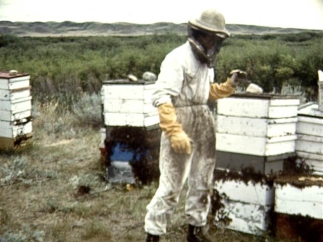
Four full supers off; four empties back on at one of my Saskatchewan yards in 1980.
In Saskatchewan, I usually pulled honey four times in the two-month summer. One year I had a 400-pound average. I gave the hives three or four boxes each. Every second week, I pulled off the full boxes and added three or four empties immediately. The empties were stacked towards the back of the truck. They came out of the extractor the night before. Fresh full supers were stacked towards the front of the flat bed while empties were set out. It was a lot to handle.
Advantages of in-field extracting include less wear on honey supers – boxes aren’t bounced down the dusty country roads where honey-laden frames sometimes break. The honey is cleaner (no road dust). There is less labour – you don’t load a truck in the field, unload at a shop, reload empties and then unload again at the bee yard. You can meet the honey wagon at your apiary – you arrive with just a passenger van and crew, not with a huge truck. The honey is extracted while it is fresh and warm, so you don’t need a hot room. Honey in the barrels is from one known apiary, not blended from many, so product tracking is easier. Fewer stray bees arrive to your house/farm – cutting down on the spread of varroa and family members’ stings at home. If you are just getting started in commercial honey farming, calling an inspector-approved mobile van reduces your initial investment. There are undoubtedly other advantages.
Will it catch on? Will there be a mobile extractor hot line that you can call? I don’t know. The issues I mentioned earlier – disease control, timing, and cost remain valid concerns. For disease issues, I would insist that the van operator inspect a few hives at each yard, check that the apiaries are certified inspected, and I would have the owner of the hives sign a waiver stating that he believes his bees are disease-free. This would help a lot.
The biggest hurdle with this system may be cost. The unit is priced at about $300,000. That may not be beyond the reach of large operators or companies that drive the honey wagon south to Texas or Florida for winter custom extracting, and then head to the plains and prairies for the summer crop. But for most of us, it just looks like a brilliant but perhaps unattainable solution to extracting.
The video below will answer some of your other questions. I particularly like the way they solved the potential problem of robbing in the field, one of the first issues that came to my mind when I saw the conveyor moving honey boxes through the open windows. Enjoy it!
Every month I try to meet friends in a village called Bragg Creek. It’s just a half hour drive from my home in Calgary. It gets me out of town and up close to the mountains. When I get there, three or four of us engage in mature, adult conversation. Bee talk.
The funny thing is that none of us actually live in Bragg Creek. We just meet there because it’s somewhat convenient for all of us (I’m the only one driving in from the big city.) And we like the Cinnamon Spoon (Alberta is known for its exotic spices and cutlery – all of it imported, of course). The Spoon has decent coffee and good pastries and is cheap enough. In the winter, it’s not hard to get a table, though that changes dramatically in the summer when hordes of vacationers and noise-makers descend on the small alpine-ish village. Bragg Creek is not quite in the mountains, though they’re pines are close enough to smell.
My buddies are all serious bee folks. One friend at our sessions is a descendant of one of Alberta’s great beekeeping dynasties, a prairie bee business with thousands of hives. Her ancestors started keeping bees on their farm about 140 years ago when Alberta was part of the Northwest Territories. It wasn’t until 1905 that Alberta became a province of Canada. My friend’s family transcends all of that and it’s lovely that she has such a keen interest in bees.
I spotted these animals on my drive west, about 15 minutes from Calgary.
Also among our Bragg Creek Bee Club coffee drinkers and beekeepers is a skilled professional carpenter who has an uncanny breadth of knowledge about natural sciences in general and physics in particular. He occasionally brings physics experiments to the coffee shop, puzzlers that I can only pretend to understand. And I am nominally a geophysicist. Our table is further graced with the presence of another science/bee buff, a friend who is also a geophysicist. But the coffee talk is usually bee talk, not geophysics, and it’s great to have friends to bounce bee ideas off.
I hope you also have a group of like-minded characters who share an interest and meet in a similar self-help group occasionally. I won’t detail our club’s latest conversation, but it had something to do with honey bees. Meanwhile, I’m posting a few pictures from my drive from the southern edge of Calgary westward to Bragg Creek. A wonderland of winter near the Rocky Mountains.
Today, January 6, is the fictional characters’ birthday. He would 162 years old, had he bothered to live so lived. In celebration of the great fictional detective’s fictional birthday, here’s a repeat of the piece I wrote to honour Sherlock Holmes. It’s a review of the recently-released movie, Mr Holmes.
Sherlock Holmes is more than an ordinary beekeeper – as you’ll find out in this summer’s new movie, Mr Holmes. I watched it at a Calgary theatre with my wife this evening. I’m glad we went. We don’t get out enough and generally find films too loud, too violent, too silly, or too sappy. Mr Holmes was none of these.
78-year-old actor Ian McKellen (recently the wizard Gandalf in the Lord of the Rings trilogy) plays 93-year-old Sherlock Holmes, a long-retired detective. As many of you know, author Sir Arthur Conan Doyle forced Sherlock Holmes into a beekeeping retirement in the south of England. According to Doyle, Holmes toiled at bee farming and even wrote a popular beekeeping manual. The drama-mystery movie Mr Holmes (2015, BBC Films, et al.) stays quite true to beekeeping. The last film I’d seen that ties bees so nicely and accurately into the thread of a drama was Ulee’s Gold (1997, Orion Films). If you’re a beekeeper you will appreciate the finer details – the distinction between wasps and honey bees, the mystery of some disappearing bees, and the way Holmes lights his bee smoker with a roll cut from an old burlap sack. At one point in the movie, Sherlock Holmes took a book from his shelf and removed a significant photograph of a young woman. The book was Root’s 1945 ABC & XYZ of Beekeeping. I recognized it – I have the same edition in my own home library.
But don’t let me mislead you. This is not a beekeeping documentary. Or even a beekeeping movie. It is mostly a story of the redemption of an old man who regrets many of the things of his past and who is struggling to revive old memories. It’s a touching, well-acted drama. It’s not likely to stay in the theatres long, so get out and enjoy it with a friend or spouse before its run is over.
It’s been quite a year. A lot happened to beekeeping in 2015. Early in the year, honey prices soared to unprecedented levels, making beekeepers exceedingly wealthy. (Or maybe not.) Since mid-summer, however, the wholesale price of honey has fallen dramatically, impoverishing those same beekeepers.
Meanwhile, in science, a new idea about royal jelly emerged, completely overturning what we thought we knew about the magical stuff. During the past year or two, genetics was big, too, with a German researcher splicing a gene into the bee genome that makes bees glow in the dark. Late in the year, bees were spotted with rare black pollen – it turned out to be coffee grounds. And, as has been the trend for twenty years, Saving the Bees continues to be the rallying call against GMOs, neonics, and multinational drug/chemical/seed cartels. Expect more of the same in 2016.
I know a little about bees, but certainly not everything. If you are looking for “How To…” beekeep pages, there are better websites than mine. My friend Allen Dick of Swalwell, Alberta, has been running one of the best of that sort for 20 years. Another great site (I like it so much that I donate) is produced by Randy Oliver. It’s mostly about bee diseases and sciency stuff, and is perfect for the intermediate to advanced beekeeper. There are, of course, a thousand other worthy sites to investigate as well.
As I said, this blog isn’t the best for everyday beekeeping stuff. Although I have worked with bees for over 40 years (and was a commercial beekeeper for 20), I really am one of the best examples of this adage: “Beekeeping is one of those things where the newbie feels like he knows everything. But as the years go by, he realizes that he knows less and less until eventually the bees show that the beekeeper doesn’t know anything at all.” Most days, that’s where I am.
What’s in my blog? For one thing, I’m big on learning from mistakes, having made so many myself. So, you will find some candid material that might show you epic fails to avoid. If you’re not keeping bees, you may still enjoy this blog because of my cynical tone, the warty growth of six decades of sardonic observations and musings. I am skeptical of everything, having seen all manner of promotions for better queens, better hives, and better beekeeping. I come down hard on these, especially when I smell hidden agendas and profiteering.
Here were the most popular Bad Beekeeping posts in 2015…
The most popular post for 2015 was Russian Plane Attacked by Bees. It’s not my best piece, but it was picked up by a big international news aggregator. I guess it was interesting to travelers and Russophiles. Maybe you liked it, too.
Number two in popularity was Mr Holmes’ Bees, my review of a gentle beekeeping movie about the Sherlock Holmes character.
I published Smoky Bees back in August when the American northwest forests were ablaze and Calgary bees were detained in their hives because of thick nauseating smoke. My piece looks at the old question of why bees gorge themselves with honey when they smell smoke, yet stay in their hives and burn when their hive catches fire.
Bees, the World’s Pollinators, was one of several book reviews I wrote over the past year. The book is a lovely photo essay about the various types of bees found around the world. In a cameo appearance, honey bees are given a two-page spread.
My fifth-most-popular blog post for 2015 was a look at “the forgotten disease” American foulbrood. AFB is ravaging beekeeping in South Africa. In other parts of the world, it’s mutating and becoming resistant to antibiotics. I remind people of this in Foulbrood: Still Smelling Foul.
Thanks for reading my blogsite about our most precious resource, our honey bees. (Kids are a close second.) I hope you have a great new year. I’m sure that 2016 will have even more entertaining bee stories. I’ll do my best to make you aware of them.
Ah, yet another revolutionary beehive. You know, it’s more suited to the needs of the bees, yet better for the beekeeper. In this case, an Edmonton (Alberta, Canada) designer has come up with a beehive that holds 8 frames instead of 10 and uses a 6-and-5/8-inch box instead of the deeper standard super. So, it’s narrower and shallower. It looks a lot like a hive that’s been around for over a century.
The 6-and-5/8-inch equipment has long been known as the Illinois-depth hive. It was invented by the Dadant company, in Illinois, about 100 years ago. 8-frame boxes have been around even longer. When I was a lad, I worked for a fellow who ran 1,200 colonies – all in 8-frame equipment with shallow Illinois-depth frames. That was over 30 years ago.
In 1894, the beekeeping journal Gleanings ran several issues describing the benefits of using 8-frame equipment – they listed 24 key advantages. I suppose that the Edmonton designer of the revolutionary hive, Dustin Bajer, knows that 8-frame equipment has been around for a long time. Bajer is also aware of the Illinois-depth box and frames because he calls them by that name on his equipment information web page.
The 8-frame Illinois box can be purchased from nearly all the larger bee equipment makers. Bajer claims to have “tweaked” existing equipment to come up with a hive which he describes as “bee-centric”, using shallower, narrower boxes that are more like the bees’ natural home, the tree trunk. This is exactly how the beekeeper I had helped 30 years ago described his system.
The Edmonton Journal says Bajer has a “novel hybrid hive design” which is better suited to our northern climate and better suited for urban beekeepers. Bajer seems to have taken existing equipment (plus a Warre section and a sloped lid) and presented it as the next big idea for northern urban beekeepers. Maybe he’s right. I certainly admire his salesmanship.
Narrow, shallow hive with sloped roof – at my cousin’s home in alpine Europe. In use for hundreds of years.
This leads to an interesting point. Old ideas are recycled over and over again in beekeeping. The top-bar hive (TB) is a good example. Aristotle described top bar hives 2,000 years ago. They were in continuous use in Greece for millennia. Yet most people think TBs are a recent invention.
Combining 8-frame Illinois-depth boxes, sloped lids, some Warre hive bodies and a screened bottom board may be the third-best idea since sliced bread, but such equipment is not new. However, it may be a unique fusion, like adding fried eggs to sweet potatoes and seasoning it with curry. The fused hive may be exactly what Edmonton’s beekeepers need.
Want to give the Edmonton equipment a try?Here is a link to Bajer’s site. He offers handmade equipment, which I assume means no power tools were used in their manufacture. The site lists 8-frame Illinois-depth boxes, “Integrated Pest Management” bottom boards (they include screen mesh), and sloped hive lids. Bajer seems to make and sell other bee supplies as well. I have not seen any of his output first-hand, but it all looks neat and sturdy.
The equipment to set up one hive is listed at $200 (plus tax and shipping) and does not include any bees, wax, or frames. For $200, you get the IPM bottom board, a Warre section, a Warre lid, and four 8-frame Illinois boxes (without frames). That seems pretty expensive, but maybe not – four 8-frame Illinois boxes from Dadant in Illinois cost $60 US, plus shipping. So perhaps Bajer’s handmade boxes, bottom, and lid are priced about right.
Dustin Bajer, the promoter of this equipment, seems like a nice guy. For example, he told the Edmonton Journal’s reporter, “My ideal day is sitting on the deck with a glass of wine, just watching the bees go back and forth.”
I get that. My ideal day has a lot more activity, but I realize not everyone is me. However, I am not comfortable with the promotion of a 100-year-old idea as an innovative tweak of existing bee equipment, newly designed for the northern urban (Nuppie?) beekeeper. Maybe someone will design a 2-wheel human-powered vehicle with pedals and chain and tweak it by making one wheel bigger than the other. You say it’s been done? In my mind, rebranding 8-frame Illinois-depth boxes as a new design is not too much different. (Even if it includes a cute sloping roof.)

 The numbers are in and the prize goes to Alberta. Alberta, a province in western Canada, has once again won the prestigious honey production award. For those of us who learnt beekeeping where 50-pound crops are the norm (in my case, Pennsylvania), the size of western Canadian honey crops seems the thing of fairy tales, right up there with fire-breathing dragons. Last year’s crop was 145 pounds. (66 kilos) That’s the average per hive from over 250,000 colonies in Alberta. Many colonies did much better. The average would have been higher, but about 30,000 colonies were rented to seed growers – pollination bees didn’t make much honey.


 When I was a kid growing up in western Pennsylvania, Groundhog Day was a big deal. It didn’t hurt that it was also our elementary school principal’s birthday. We didn’t get the whole day off (unless Feb 2 was on a weekend) but we did participate in many rousing games of ‘catch your shadow,’ ‘catch your friend’s shadow,’ and, of course, ‘catch your shadow’s shadow’ – looking back, I think the teachers used this time for a coffee break. Or maybe they were in the principal’s office, cutting cake. Here in western Canada, the day passes with barely a salute. My young children said that they don’t even draw pictures of groundhogs. It was ‘business as usual’. I wonder if their school is a bit too serious?
 Sitting in traffic, smelling everyone else’s exhaust (you know yours doesn’t stink), you begin to worry about the bees out there. They smell the fumes, too. But if you look closely, you won’t see them gasping or coughing. That’s only because bees don’t have lungs. I just

 A similar thing happens when bees decide to swarm. There are lots of physical inputs. Days are getting longer. The colony population is growing. Less and less of the queen’s limited swarm-suppression pheromone is distributed among more and more bees. Swarming occurs during nectar flows – all available space is filled with honey, contributing to crowding and congestion. There are few places left for the queen to lay eggs. Her body shrinks from her egg-laying hiatus, allowing her to fly with a future swarm. Scout bees return to share their discovery of a hollow tree as a future possible home. A lot of natural triggers work simultaneously. Then, a brief spell of rainy weather keeps the bees stuck in their hive for a day or two. Finally, the sun comes out, it’s hot, humid, and flowers are dripping with nectar. The colony swarms.
 I first saw the phrase ‘hive mind’ years ago. It appeared in the 1943 book, The Bee Craftsman, by
  Economists have long described similarities between honey bees and human activities. There is “an invisible hand” in the market place assuring enough shoes, socks, and karaoke machines are manufactured each year. And these things are sold at a price largely determined by collective free-market bidding among all the people interested in foot apparel or in bar tab receipts. As with the bee making comb in her hive, our improvised choices contribute to the operation of a larger society.



 What is Putin’s real motivation? Healthy, happy citizens? After nearly two decades in power, he has done little to achieve that. In 2012,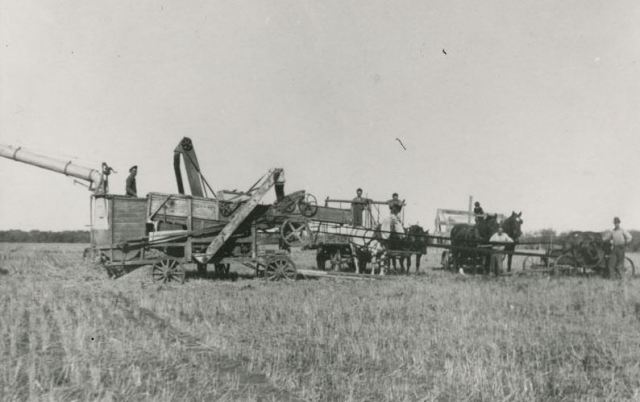





 It’s been quite a year. A lot happened to beekeeping in 2015. Early in the year,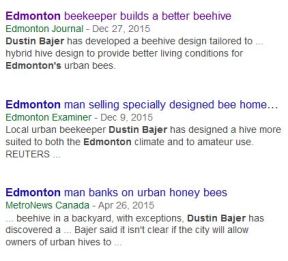



 Bad Beekeeping Blog