
The economist’s bees

Bees in New Jersey

Gary Shilling’s New Jersey Bee Yard

You can be one of the smartest economists in the world, and still not realize beekeeping is a lousy investment. The celebrated author and public speaker, Gary Shilling, who writes for The New York Times, Forbes, and The Wall Street Journal, and has apparently had a British coin named after him, nevertheless persists in keeping bees in his New Jersey back yard. A news team landed in his apiary and reported “It’s An Awful Lot Of Work To Raise Honey Bees In A New Jersey Backyard.” I imagine it’s an awful lot of work writing for the Wall Street Journal, too.

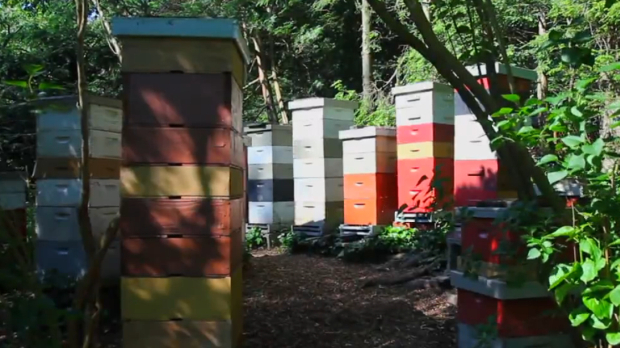
This guy, by the way, is a real beekeeper. The video news clip from Business Insider begins with Mr Shilling mixing something in a five-gallon bucket, workshop door wide open, and equipment stacked all over the place. Then it shows him igniting his smoker with a wildly flaming blow torch. Love the enthusiasm. The camera next swings up to his bee yard with a gorgeous shot of the hives, stacked higher than a basketball player and painted camouflage green. Except for some nasty creepy crawlers on the bottom board, things are neat and tidy. OK, maybe he is not a real beekeeper – things are too neat and tidy.

Does Shilling find beekeeping easy? After describing how the 85-pound boxes keep his tummy muscles in shape, he goes on to say that beekeeping is amazingly intellectually challenging. But you knew that already. What does Gary Shilling do with his 4,000 pounds of honey each year? He could probably retail it for $30,000, but he gives it away instead. Are we sure he’s an economist?

Posted in Bee Yards, Beekeeping, People | Tagged , | Leave a comment

Getting away with murder

A bee-kill decision in Florida. According to The Ledger, beekeepers Barry Hart and Randall Foti lost $390,000 worth of bees and honey production when one of Florida’s largest citrus producers sprayed pesticides. (The loss does not seem exaggerated. For example, Foti’s honey production was off by 200 drums of orange blossom honey and millions of dead bees were piled in front of his hives.) According to a Florida state investigation, the spraying was illegal. The grower, Ben Hill Griffin Inc, was ordered to pay a fine. Of $1,500. That’s the fine?? Destroy two beekeepers, pay $1,500? It would be bad enough if the pesticide use had been legal and all those bees were killed. But $1,500 for an illegal application of poison resulting in this sort of damage? This sends the signal that one might spray whenever and however it best suits the grower, then shell out the trivial fine. The state pointed out that the maximum fine is $10,000 per instance of abuse. The state says pesticide laws were violated by Ben Hill Griffin Inc on February 21, February 22, March 8, and March 19. That would sort of indicate four violations and up to $40,000 in fines. According to one of the beekeepers, Randall Foti, every four days they were spraying where his bees were working. The insecticide application occurred while the orange trees were in full bloom. Millions of bees died.

This is all very interesting, but, as it turns out, there is much more to this story. The company accused of using the pesticides is a green, natural citrus grower, indicates Florida’s Natural Growers, a marketing cooperative. The fellow in charge is a fourth-generation grower – apparently a gentleman with a deep love for the environment, for the aquifer, for wildlife. According to Florida’s Natural website, the groves’ operator, Ben Hill Griffin IV, “prides his grove operation on environmental stewardship, as it helps to recharge the aquifer, generate oxygen, and provide a home for an abundance of wildlife. Many of the family’s decisions in the groves are made to accommodate both the health of the citrus trees and the land they grow from.” I could almost hear frogs croaking and birds tweeting as I read about the way oranges are grown by Ben Hill Griffin Inc. What I read were all very nice words and who can doubt what Florida’s Natural Co-op says? Certainly not I. So, I wrote to Florida’s Natural and asked how the company that stands accused by the state of Florida (and is ordered to pay the pittance of a fine) fits with the Florida’s Natural brand. Natural, right? If they write back, I’ll amend this blog entry with their information.

In reading the family biography and the Ben Hill Griffin company details on the Florida’s Natural website, I felt compassion for the corporation. They love the land. They must be heart-broken about the tragedy they have apparently caused. They have a fleet of pickup trucks painted in “Griffin Green.” Green. The clean color. The present owner started in the family business at age 11, “working with the baby trees in the family nursery.” Sigh. But Ben Hill Griffin Inc is a huge corporation. The University of Florida’s football stadium is named after the founder of that huge corporation. Ben Hill Griffin Jr, now deceased, was majority share holder of a company that owned the land the Atlantic Coast Line Railroad was built on – and various sugarcane, citrus, cattle, forestry, and sod farms. He was on the Forbes List of richest Americans. When he died, his $300,000,000 estate was bitterly contested in court by his four daughters who seemed to feel the one son (Ben Hill Griffin III), who was the sole trustee, had grabbed the bulk of the money, according to the Orlando Sentinel. In the newspaper’s story “Drama Ends With Heirs Splitting Citrus Millions,” they describe the fight as tabloid stuff: “The closet door swung open and out fell the skeletons…” This is not your average grove-owning family. Among Griffin Jr’s grandchildren are several Republican politicians – you might remember Katherine Harris, a Griffin granddaughter, who was Florida Secretary of State in 2000 when the ‘hanging chad’ issue contributed to George Bush’s election. Other members of the family have been in the Florida Senate and House. This is a powerful family. So it is really reassuring that their company is so anxious to do good things for the environment.

Beekeeper Foti has said that he saw empty containers of Montana 2F insecticide in a burn pile in the groves. If this is true, what does it say about one’s love for aquifers, the land, the wildlife? Or maybe empty canisters of Imidacloprid stacked in a burning pile are OK? I have read Montana 2F’s label. (Montana 2F is 21.4% Imidacloprid, one of the neonicotinoid class of insecticides.) Surprisingly, yes, old containers may be burned if so allowed by the state, but the label also warns: “If burned, stay out of the smoke.” Always good advice. Stay out of the smoke. The label also says:

“This product is highly toxic to bees exposed to direct treatment or residues on blooming crops or weeds. Do not apply this product or allow it to drift to blooming crops or weeds if bees are visiting the treatment area. This product is toxic to wildlife and highly toxic to aquatic invertebrates.”

In issuing its fine the Florida regulators also said that in using insecticides, “The label is the law.”

Posted in Beekeeping, Culture, or lack thereof, People, Pesticides, Save the Bees | Tagged , , , , , , | 1 Comment

China car swarmed

Does this story remind you of Hitchcock’s Birds? According to this Metro news story, a Driver’s Ed instructor and two students were trapped in his car until fire fighters were called to pressure-wash the car. I suppose the bees were killed from all that blasted water. This is just one of the ways China’s rapid industrialization is wreaking havoc on the environment. This decade, it is one car and one swarm. Next decade, it might be two swarms. And then what? Three? Four? As I read recently in the Economist, people all over the world want to share in the West’s consumptive, gluttonous habits. So expect more of this.

Posted in Humour, Strange, Odd Stuff, Swarms | Tagged | Leave a comment

Windshield bees

Road kill. In this case, it’s bees. I was out of the city yesterday, cruising the Alberta back roads at 110. (The posted speed limit was 100, so maybe that was really my speed.) I passed a few bee yards tucked into meadows within small groves of trees. On one moderately busy paved road three honey bees spit up on my windshield. Big blobs of nectar were the imprint on the glass where those unfortunate bugs made contact with my van. I spent the rest of my trip calculating how much money this collision cost the beekeeper in lost honey. Not much, it turns out. But I wasn’t the only traveler out there.

How many bees does it take to make a dollar? These days, a dollar’s worth of honey (wholesale) is about half a pound. Well, those hapless bees that damaged my windshield were fat, but there certainly was not half a pound of nectar among the lot. And nectar cures into honey at a pretty high ratio. So we are talking partial pennies, of course. (Canada ridded herself of whole penny months ago.) The math (and the guilt of ending three promising foraging careers) was making it hard for me to think about my driving, so I decided to look at this in a different way. Yesterday, about two cars a minute passed that bee yard at the same speed as my van – or faster. (Alberta’s farmers drive quickly – their grandparents all raced horses at one time or other.) At a rate of two vehicles per minute, that’s 30 each hour. If, like my van, they each kill three bees, then we’ve killed almost a hundred bees. That would be a thousand in the course of each of our very long, very sunny summer days. Over a period of thirty days of peak honey flow, that amounts to 30,000 dead honey bees. This is just an estimate, but it represents something close to half the foraging population of a producing hive for the month. The average crop here is 200 pounds, so the beekeeper – over the course of his season – has lost about 100 pounds of honey, or 5 pounds from each of the 20 colonies in that apiary. One hundred pounds of honey, at today’s prices, is $200. That’s something to notice. And, five kilometres down the road was another yard and another honey bee slaughter site.

What’s the solution? Always a believer in the benevolence of a big cumbersome government, I could advocate for highway signs and strict enforcement. Why allow drivers to speed along at 110 when there are bees at play? We should have heavy fines for offenders. Or, perhaps we could have police checkpoints where kindly RCMP officers scrape windshields or otherwise count the road kill and drivers then pay a fee, especially if they’ve been killing without a license. To be effective, the fee would be much greater than the pittance of lost honey from the few bees clobbered – a prohibitive penalty, if you like. Then there is the libertarian’s perspective. The government stays out of this particular issue. The marketplace takes over. Honey prices soar because of the reduced crop. Or beekeepers, counting all those partial pennies lost, simply move their bees to safer spots.

There is some good news in this story. The squashed bees on my messy windshield indicate the Alberta honey flow (at least in our area) isn’t over yet. And with the forecast predicting warm sunny weather, maybe it will last into September.

Posted in Beekeeping, Humour | Tagged | 1 Comment

Chinook Honey Festival

Chinook Honey Farm’s Honey Harvest Festival was today, near Okotoks, just south of Calgary. As always, Art and Cherie entertained their hundreds of guests with lots of games, demonstrations, and programs. The farm has a great meadery with a wide variety of excellent honey wines which I think they’ve been making for at least five years now. But it is also a fully functioning commercial honey farm with an interesting visitor centre/store.

We try not to miss the various Chinook Honey festivals. Something new for this year’s Honey Festival was a bee-beard demonstration. Select souls donned a few thousand bees, partly to prove that bees are not vicious savages, and partly to prove it can be done. In this case, the bearded folks were able to grow full-length whiskers in the Abe Lincoln style. Not all bee-bearded wannabees are so lucky, as we’ve seen with 34-year-old Matthew Cruikshank of Burlington, Vermont. The poor chap has been trying for years – as you can see in this national web magazine’s article: “Man Has Trouble Growing Full Beard of Bees.” Fortunately, the participants at this year’s event didn’t have such problems.

Finally, what bee event would be complete without a donkey or two dressed up as a bee? My kids found Bee-ore, the reluctant worker donkey-bee, to be a docile self-effacing creature. No rides, fortunately, but plenty of delicate nose rubs.

Posted in Culture, or lack thereof, Friends, Humour | Tagged , , , | Leave a comment

CBC discovers CCD

CBC Evening News Blames Neonics for Colony Collapse… In a touching – and sad – news program from CBC’s National, we see the story of an Ontario beekeeper who is losing his bees. View the complete video on YouTube.

CBC News seems convinced that neonicotinoids are killing bees. Quite likely. Pesticides kill insects. Bees are insects and neonics are insecticides. Bayer, the makers of the stuff, dares to offer a differing opinion. It is unfortunate that neonics, as neonicotinoids are sometimes called by the spelling-impaired, are implicated in honey bee deaths. Unfortunate because it wasn’t supposed to turn out that way. Neonics were designed to be less environmentally harsh and were expected to replace the much more damaging families of organophosphates and carbamates that can be pretty indiscriminate in their slaughter sessions. Neonics are applied mostly to corn, rice, potatoes, and canola. (It is also applied in lesser quantities on a host of other crops.) Of those crops (corn, rice, potatoes, and canola), only canola is visited by honey bees as a foraging source. Southern Alberta has hundreds of thousands of acres of canola, and bees are rented by the tens of thousands for canola pollination. Neonictinoids are used here. But we have not seen the bee deaths described by others. The same might be said for Australia, which has apparently not yet experienced colony collapse disorder and has had neonic usage by the millions of kilos for years. Other places – Scotland and British Columbia come to mind – have either banned neonicotinoids or use them very sparingly, but CCD is still a big problem.

I am NOT saying neonics are OK. They are pesticides. They kill chewing and sucking insects. And, as I’ve heard some beekeepers say, bees suck. They can’t help but be hurt by neonictinoids. But does the stuff cause CCD? Not likely. If you watch the video that I’ve linked above, you will certainly have great sympathy for the beekeeper and his wife and six kids, living in their apartment above their honey extracting plant. The man is working hard and his losses are real. But we need to consider all possible culprits for his business’s demise. As a mathematician and scientist, I get irritated when I hear generalized statements like some of those in this news clip. It is stated that 85% of the dead bees in the apiary shown had neonic residue. Well, 100% of the bees had wings. Correlations do not guarantee causation.

Posted in Culture, or lack thereof, Pesticides, Save the Bees | Tagged , , , | Leave a comment

Time to say goodbye – or maybe not

Time?

Got Time?

Bees have made the cover of Time. Missing bees, that is. The cover announces “A World without Bees” and promises to disclose “the price we’ll pay” if we can’t stop the bee losses. I’m not sure exactly what triggered this week’s special coverage – bees have been vanishing off-and-on for at least a century. My father – a commercial beekeeper in Pennsylvania – told me about his spring of ’52 when every time he opened a hive there were fewer bees in it. He called it “No-See-’em Disease,” which he said meant the bees simply disappeared. You didn’t see ’em. The colonies had good queens, lots of healthy brood and honey, but the adult populations dwindled. Others had seen similar things happening. The cause was never determined. This sort of thing has been going on for a long time.

Back in 1900, most farmers – or their neighbours – had a few colonies of bees. In the USA, there were an estimated 10 million kept hives. By 1950, there were 6 million. Today, there are about 2.4 million colonies of bees. What happened to all those disappearing bees? Most kept hives became unkept when farms increased in size and farmers simply didn’t want to mess with stingers and honey anymore.

Particularly interesting statistics come from Oklahoma. The state had 60,000 colonies of bees in 1978; 10,000 in 1988; 3,000 today. (This happened before CCD.) Over those 35 years, agriculture was flipped on its head in that state. Oklahoma’s small farmers were gobbled up like turkey feed. Fewer farm families; fewer bees on family farms. This has been repeated throughout the industrialized world – Germany, France, eastern Canada, Japan, and of course, most of the USA. Meanwhile, the average number of colonies operated by the few remaining beekeepers has increased, but not enough to fully replace the diminished numbers. Many years ago, it was common for full-time farmers to handle no more than six colonies. A big commercial beekeeper might have 800 hives. In the 1950s, only two or three outfits in the world operated 10,000 hives (I can think of Mexico’s Miel Carlota and America’s Jim Powers and perhaps the Miller family.) When I immigrated to Canada (around 1975), the biggest Canadian bee holding (3,000 hives) was controlled by Homer Park who hauled packages up to the Peace River country from California. Today, there are a dozen Canadian beekeepers with at least 5,000 hives each. Not far from my home, there are two beekeepers with over 10,000 colonies each. My province of Alberta has seen a huge consolidation in beekeeping. In 1950, Alberta’s 4200 beekeepers held an average of 12 hives each. Today, there are only 800 beekeepers, but each operates an average of 353 hives. By the way, with 282,000 colonies of bees, Alberta now has about 50,000 more colonies than the province had when Colony Collapse Disorder was first in the news ten years ago. Economics has increased colony count here while decreasing it in places like Oklahoma.

Time to get back to Time magazine. I am aware that winter losses for most North American beekeepers are higher than keepers can afford. It used to be expected that 15% of colonies would die each winter, according to statements made in the 1970s by commercial beekeeper and research scientist Dr Don Peer. Losses of 30% are frightening. Especially when that is an average. It means some beekeepers lost a whole lot more. For some operators, there is no recovery. Since those 30% averages have been sustained in most parts of the USA, research is conducted to try to find the cause. Everything from varroa mites to neonicotinoids to genetic weaknesses have been implicated.

A few last words. I am always troubled when anyone oversells their product. In this case, Time magazine’s feature article is the product. On their website, you can link to a video they title: “Why Bees are Going Extinct” – honey bees are NOT going extinct. But perhaps beekeepers are. While the USA hive count fell from 8 million colonies in 1920 to 4 million in 1970, the number of people owning bees fell from 1.2 million to less than 100,000 in the USA today. A ninety percent drop. While it is true there are fewer hives in industrialized countries, the developing world has more honey bees today than it did 50 years ago. Vietnam, as one example, has gone from 7,000 colonies in 1996 to over a million today. Rather than going extinct, some researchers point out that the number of bee colonies worldwide is up considerably – in fact, according to Aizen and Harder, authors of an extensive study, managed bee hives increased 45% since 1961 globally.

I want to add that Time’s articles about the honey bees (sans the alarmist headlines) are mostly very accurate and well-written. The main author Bryan Walsh has done a very good job. I appreciate that even though he used Einstein’s image to attract readers, and he repeated the apocryphal Einstein quote, “If bees go extinct, humans will be dead in 4 years,” Walsh says Einstein probably never said this and the statement is not true, anyway. Humans can survive without bees. Not as nicely, but we could survive. The Time magazine article points out that with fewer honey bees pollinating crops, food prices may rise and food varieties may dwindle. It is great to see bees being noticed by such a high-profile publisher. But it is a complicated issue. With changes in agriculture (chemicals, of course, but consolidation, too), climate, and pollination habits (monoculture is not good for bees), the bee losses can not be explained simply. No wonder it has been a difficult puzzle for bee researchers to solve.

Posted in Beekeeping, Culture, or lack thereof, History, Save the Bees | Tagged , , , , , | Leave a comment

Movies

Another movie about honey bee deaths? Why not? It appears the public isn’t tired of hearing about dead bees yet. The latest installment is “More than Honey” which was filmed on location inside a beehive studio somewhere in Switzerland. Last year it was the BBC’s “Who Killed the Honey Bee?” a great flick with lots of words and phrases like catastrophe, frightened, incredible death rate, disaster… you get the picture. Other recent honey bee films have been Australia’s “Honey Bee Blues“, “Vanishing of the Bees” (narrated by Ellen Page), “To Bee or Not to Bee” (a David Suzuki documentary), “Queen of the Sun“, “Silence of the Bees”, “Dance of the Honey Bees” (from Bill Moyers), “The Strange Disappearance of the Bees“, and Emmy Awarded “The Last Beekeeper” – just to name a few of the best known. Too many? Probably – we risk desensitizing the public to the sting of bee disappearance. But it sure beats movies about Killer Bees like “The Swarm” from the 70s.

Posted in Culture, or lack thereof, Movies, Strange, Odd Stuff | Tagged , , , , | Leave a comment

Flooded

Flood waters at least knee deep to a bee. – photo: Miksha

My home town has been hit by a flood. We would call it the “once in a century flood” but we had that back in 2005. We are told, however, that this flood beat all records for high-water levels over the past 90 years. Calgary has a bit over a million folks living here. 100,000 people were evacuated from 25 neighbourhoods. The hundred or so skyscrapers in the downtown had their basement parklots filled with water – some of those big buildings had four feet of water in their lobbies. The zoo is built on an island that submerged. First time that’s happened in living memory. The animals survived, but the hippos were lifted by the swollen river and swam up out of their enclosures. We thought they were headed downstream for Saskatchewan, but they were caught before they were swept away. If you’d like to gawk at some astonishing pictures, here’s a good link.

I have heard almost nothing about the city’s beehives. The Calgary Bee Club sent out bulletins offering help with trucks and trailers to relocate unlucky hives, but it seems people here have very few (if any) kept colonies down by the riverside. South of town and out on the prairie, there were likely a few yards hit by the high water. Beekeepers will need to sterilize equipment flooded by city water. It wouldn’t be smart to skip that chore. (By the way, the photo above is one of my yards during an earlier flood, along the Frenchman River in Saskatchewan. Look closely, you won’t see the hippos.)

A half hour south of Calgary is a town aptly named High River. A week after the flood, High River still had 13,000 people homeless. There is one large bee outfit in High River, the Greidanus family. They lost at least 300 hives, washed away in the river, and they reportedly had close to a foot of water on their honey house floor. According to the farm paper, the Western Producer, their extracting equipment wasn’t ruined, but they have layers of silt and mud on the shop floor. The biggest loss will be the hundreds of hives and the lost honey crop.

What caused the worst flood in Calgary’s history? A storm slid up from Colorado, then became trapped in the foothills of the Rockies just to the west. There were 14 inches of rain in a bit over a day. That deluge, plus mountain glacial melt and runoff from snow, overloaded the Elbow and Bow Rivers which meet in the city’s downtown. The rest, as they say, is misery.

Posted in Beekeeping, Climate | Tagged , , | Leave a comment

Teaching Bees

I presented beekeeping to my daughter’s Grade 1 class today. It worked really well. I have two kids at the same elementary school, the older already in Grade 5. So he helped carry in the materials we used, and both he and his little sister were a big part of our hour-long discussion of bees and beekeeping with the little people. If you’ve forgotten, first graders are about 6 years old in the North American system. I was really encouraged by the enthusiasm the class has for nature in general, and bees in particular.

If you have had to talk about bees to any group, then you know the biggest problem is trying to figure out what not to say. Most of us could talk for hours. Pollination, honey, beeswax, queen bees, bee stings, bee hives, bee yards, flowers, sunshine, drones, workers, swarming. And then the kids want to know if bees sleep or if they talk, and you’ve got another two hours of material. The biggest challenge when talking about bees is deciding what to leave out.

We began when my 6 and 11-year-old assistants (my kids) entered the class room clad in veils and white suits. One carried an (unlit) smoker, the other a big black garbage bag which was handed to me. “Want to see a bee?” I asked, shaking the big bag. The audience wasn’t too sure. I didn’t let them wait long. I opened the bag and pulled Benny the Bee out. He’s our big stuffed mascot. You’ve seen him up at the top of this web page. A stuffed bee is an excellent model for children – we talked about insects, numbers of legs, body segments, and eyes and realized that Benny the Bee is not really a bee. The prop helps kids remember 6 legs and 3 segments, though. Then we realized that Benny has no stinger, which makes him a drone. That leads to some family history (What? 50,000 sisters?? Yuck!), and introduces the queen, though we steered clear of discussing haploids and parthenogenesis. After ten minutes, we used the Smartboard for a bit to show real bees, leading up to nectar collection. By then, even the most enthralled post-toddler is waning, so everyone stood up to do a bee waggle-tail dance. It is enough for kids this age to dance quickly if the flowers are close, and turn around and dance slowly if the flowers are far from the hive and in the opposite direction as the sun. Beyond that, you are just meddling with developing minds. After standing, stretching and dancing, the children are refreshed and ready for another ten minutes of bee talk. We ended by handing out little 4 x 4 (inch) pieces of brand new wireless foundation. The kids loved the take home gift, it isn’t messy and sticky, it smells like wax, and it has the great hexagonal pattern. Do it again next year? You bet!

Posted in Friends, Outreach | Tagged , | 2 Comments