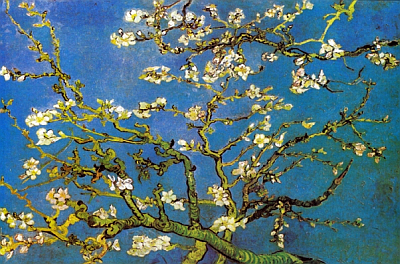
Almonds by van Gogh
Almonds need bees. And beekeepers need almonds – to pay their bills. In California – which produces about 80 percent of the world’s almonds – hundreds of thousands of acres stretch from Red Bluff to Bakersfield. Each acre ideally has 124 trees, spaced 16 by 22 feet. The Almond Board of California estimates the grower spends close to $4,000 per acre per year to grow those nutty trees. In the past, the typical pollination fee was $280/year to set the seed on one acre. It will be more this year. This is arguably the most important cash outlay the grower pays. With enough good pollinating honey bees, the harvest goes from perhaps less than a 1,000 pounds per acre to as much as 2,600 pounds per acre. With wholesale prices bouncing around $1 – $2 per pound, the gross revenue can be as low as $2,000 in a year when prices are down and bees are lazy, all the way up to $5,200 per acre when the bees, weather, and prices all hit by California’s karma. Growers need strong hives with oodles of stamen-shaking pistil-poppers available. Or, they go broke.
According to several news stories, there will be a shortage of managed beehives available for almond pollination chores this spring. With 760,000 acres of almonds, roughly two million colonies of bees need to show up for the bloated blossom fest. California has half a million. 1.5 million hives will arrive from other states – from Maine to Florida and Dakota to Dakota. Actually, from almost every state in the States. The big draw for all those bee hives which will be chained to diesel-belching flatbeds is, of course, money. Beekeepers are paid for taking care of those hives, keeping them strong and healthy against all manner of environmental threat. Hives will rent for about $200/hive this year – an all-time high – because of the bee shortage. Eric Mussen, UCLA Davis, says the reason for the higher price is a paucity of bugs this year. “Bees across the country are not in as good shape as last year,” Dr Mussen told ABC News. He says bees are under stress, hives are consequently weaker, colony count is down. Among the stresses have been droughts in the Mid-West and the conversion of land from nectar-producing alfalfa and clover into ethanol-producing corn fields (corn doesn’t give nectar to feed bees).
Almonds have been around forever – so why the problems now? It’s true. Egypt’s pharaohs, and China’s Q’ins and Hans knew about almonds. We are told that when the Biblical Aaron’s stick was stuck in the muck, almonds bloomed in Israel. From there, the Romans spread the nuts throughout their empire, so that eventually southern Europe, north Africa, and the Near East all had almond groves. By the time Vincent Van Gogh painted the theme picture on this web page for us that you see above (1889, in southern France), Franciscan priests had already brought the first almond trees to California. In all those places, almonds somehow managed to attract enough pollinators to keep their gene pool from dwindling. There were enough bees – usually feral bees – and tree densities were perhaps a handful per acre, not hundred. In such cases, bees don’t need trucked thousands of miles. Part of our problem today is the sheer density of monocultured crops.
About thirty years ago, when almond groves first began to spread like California art studios, growers started to invite thousands of hives into the Great Central Valley, recognizing that bees doubled their nutty yields. Beekeepers were paid a modest fee. Now that fewer young people can be convinced to keep bees, and now that we’ve done such a dandy job on our climate and environment, the resulting bee scarcity has jacked up rental fees. As we saw with the numbers, above, growers sometimes have a little wiggle room to pay more. But not much. The California Nut Board says the average profit has been around $400/acre, but that’s without paying for the land and property taxes and interest – and now, the increased pollination fees. At any rate, surviving beekeepers will do OK this year. Hope the same can be said for the growers.

 Canada’s spring has been frightfully slow this year. Snow was on the menu coast-to-coast-to-coast in April and early May. As seasoned beekeepers will admit, wintering bees at our latitude is not too hard until mid-March. In springtime, cold damp windy weather can take a heavy toll. Just when you feel you’ve done a great job packing and preparing the boxes, and losses don’t seem significant, you find fewer live hives with each spring inspection. This is when queen losses become apparent and small populations don’t achieve critical mass. Bees drift, the elderly succumb, the failing queens expire.