
I’m not a grammarian, I don’t have the most hugest vocabulary, and I have been known to produce some pretty bad spells of whetther – but even I appreciate the right word, used and spelt correctly. Without rules, confusion reigns (and rains and rains). I’m glad when someone points out errors I’ve made – it gives me a chance to learn.
I’m coming back to something I’ve written about before and then I’m moving on to something I’ve never written about. Honey bee – it really should be two words, not one. I think the single word honeybee is just plain wrong. But I notice that some dictionaries disagree with me. Webster’s, for example. Webster’s has also allowed yellow jacket instead of yellowjacket, which is just plain ridiculous. But then, Wikipedia also has an entry for ‘yellow jacket’ instead of yellowjacket, so maybe the whole world is coming to a spectacular illiterate end.

Snodgrass’s bee’s tracheal system, 1910.
Snodgrass is our final authority.
If you can’t trust Wikipedia or the dictionary, who can you trust? How about the ESA – the Entomological Society of America? They are the keepers of the bugs’ names and should be our final authority on this. They have adopted the ideas of Robert Evans Snodgrass (a bee anatomist!) for their rules on the common names for all insects.
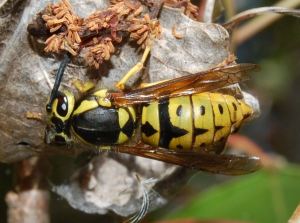
In the etymology of entomology, R.E. Snodgrass makes sense. If it’s a bee that carries carpentry tools, it’s a carpenter bee. A wasp may wear a yellow jacket, but such a creature is called a yellowjacket (one word) according to the ESA. Finally, since our honey bee is a bee that makes honey, let’s give her that bit of credit and acknowledge her efforts: honey bee. Two words.
Snodgrass, who wrote “Anatomy of the Honey Bee” in 1910, says:
“We have such names as house fly, blow fly and robber fly contrasted with dragonfly, caddicefly and butterfly, because the latter are not flies, just as an aphislion is not a lion and a silverfish is not a fish. The honey bee is an insect and is preeminently a bee; ‘honeybee’ is equivalent to ‘Johnsmith.’”
So, don’t Johnsmith me. Go with the American bee expert and the Entomological Society of America instead of Webster (who also misspells colour, plough, and centre). Snodgrass and the ESA use honey bee (the type of bee slathered in honey) and not Honeybee (the name of Steam Powered Giraffe’s honeyed melody).
The Entomological Society of America calls honey bee and silverfish “common names”. There are a million bugs, but in English, only a couple thousand have common names. To name all the ones lacking common names, we use uncommon names – official latinesque scientific nomenclatures.
For the honey bee, the scientific name is Apis mellifera. Note the italics – that’s expected, but often ignored. Apis is Latin for bee while mellifera is a Greek-Latin hybrid of honey (meli) and carry (fero), hence, the honey-carrying bee. We also have a few dozen subspecies of honey bees (Italian bees, Apis mellifera ligustica; German black bees, Apis mellifera mellifera; Africanized honey bees, Apis mellifera scutellata). Only seven species of Apis are recognized. These include our mellifera plus the Eastern honey bee (cerana), the big south Asian dorsata, and florea, the dwarf red bee.
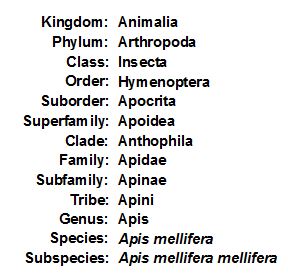 Working up the ranks, from subspecies (mellifera) to species (mellifera) to genus (Apis), we reach the family (Apidae) which again means bee. So, in the case of Europe’s original ‘black bee’, we have the scientific name Apidae Apis mellifera mellifera, which means ‘bee bee honeycarrier honeycarrier’. It’s probably best not to give taxonomists a lot of credit for imagination. Apidae, by the way, lumps honey bees together with bumble bees, stingless bees, carpenter bees, orchid bees and a few others.
Overseeing the family of Apidae, there are the clade and superfamily of bees which account for all of the known 20,000 or more bee species in the world. Above this is the suborder Apocrita containing bees, wasps, and ants which in turn are all part of the Hymenoptera (‘membrane-winged’) order. Hymenoptera are among the million plus Insectas which are spineless Anthropoda. They are members of the kingdom Animalia, which means that they are animals and not rocks, paper, or scissors.
So we have it, the old world black honey bee that you may still find skepped in isolated parts of northern Europe is properly identified as Animalia Anthropoda Insecta Hymenoptera Apocrita Apidae Apis mellifera mellifera. If you say “honey bee” I’ll know what you mean. But if you write “honeybee” I’ll know that you haven’t been properly schooled about our favourite animal.

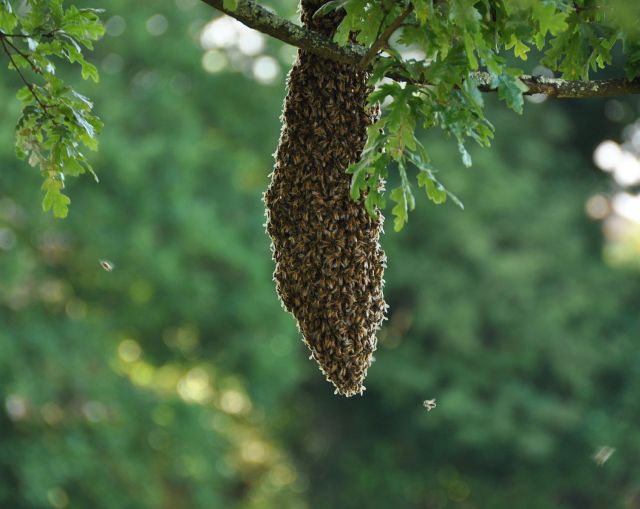 A swarm of bees (Image credit: Nilfanion,




 It’s holiday season. And if you’re normal, you’re thinking about beekeeping books for everyone you know. Even the non-beekeeps. I spent a few minutes today scanning the Amazon.com site to see what was bee hot. Not that the best sellers are always the best books. (
 This list includes one Bible and two books for dummies and idiots. It also includes two (!) books by Kim Flottum, long-time editor of Bee Culture and a gifted writer. I own several of his books and can recommend them – they are well-written, printed with quality, and reasonably priced. The seventh book on the list above (“
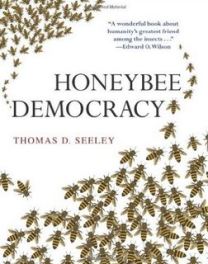 If you are buying for someone who is contemplative and beyond basic bee books, I strongly recommend Tom Seeley’s
 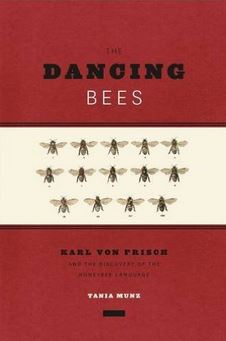 Another historical book (definitely not a fiction) is Tania Munz’s
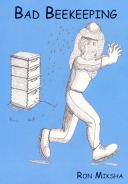
  Finally, I’d be untrue to myself if I don’t include my own book from ten years ago –









 Here’s how the Money from Honey course unfolds. My teaching partner,
 Bad Beekeeping Blog
