Dr Seuss’ B-Day

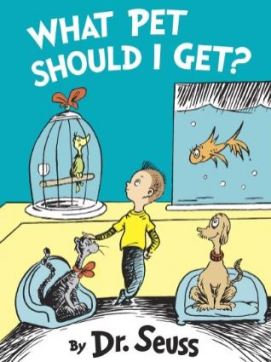
What Pet Should I Get? Available from Amazon.

What Pet Should I Get?
Available from Amazon.

Today is Dr Seuss Day, according to my 9-year old, who was once a big fan of fables like Oh The Places You’ll Go. She has (temporarily) outgrown the good doctor, but like many of us may rediscover him in later years. I think my daughter would particularly enjoy What Pet Should I Get? – the newly discovered Seuss book written 50 years ago, but lost in a trunk in La Jolla until last year. I might like What Pet? myself, if the pets include bees. I haven’t seen this new, posthumous story. Perhaps bees are indeed in there.

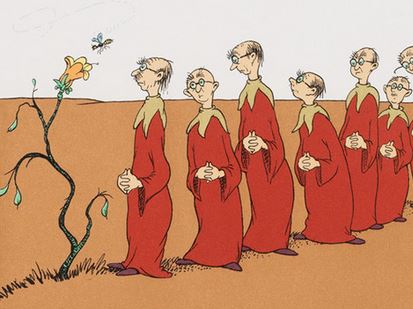
Dr Seuss, or Theodor Geisel, as he was once known, was neither a doctor nor a Seuss. Nor, I suppose, a keeper of bees.  But Seuss occasionally allowed bees to flutter within some of his stories. As we remember the 112th birthday of the great artist (and our children enjoy their celebratory day off from school), we note Seuss’s  bee-watcher watcher, watched by watcher-watchers.

bee watcher

The story, a didactic for libertarianism, goes like this:

Out west near Hawtch-Hawtch
there’s a Hawtch-Hawtcher Bee-Watcher.
His job is to watch…
is to keep both his eyes on the lazy town bee.
A bee that is watched will work harder, you see.

Well… he watched and he watched.
But, in spite of his watch,
that bee didn’t work any harder. Not mawtch.

So then somebody said,
“Our old bee-watching man
just isn’t bee-watching as hard as he can.
He ought to be watched by another Hawtch-Hawtcher!
The thing that we need
is a Bee-Watcher-Watcher!”

Well…

The Bee-Watcher-Watcher watched the Bee-Watcher.
He didn’t watch well. So another Hawtch-Hawtcher
had to come in as a Watch-Watcher-Watcher!
And today all the Hawtchers who live in Hawtch-Hawtch
are watching on Watch-Watcher-Watchering-Watch,
Watch-Watching the Watcher who’s watching that bee.
You’re not a Hawtch-Watcher. You’re lucky, you see!”

                                                                     – Dr Seuss, 1973

Of course, the bee-watcher is a fable protesting those who idly watch others create, labour, and produce. Political radicals of differing stripes have used the poem to disparage totalitarian overlords and capitalist shareholders alike.  But be aware, bees actually work harder when not watched.

Posted in Books, Culture, or lack thereof, Humour, Strange, Odd Stuff | Tagged , , | 1 Comment

Manuka Recall

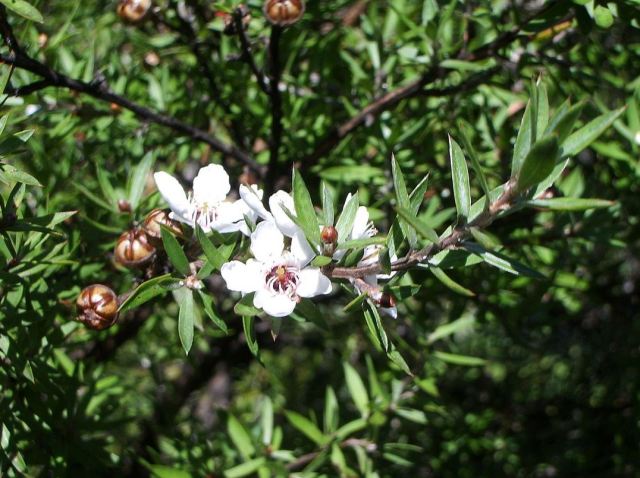
Manuka in bloom. (Source: Wikicommons)

New Zealand manuka in bloom.  (Source: Wikicommons)

For years, I’ve been thinking that manuka honey is over-rated. And maybe overpriced, though every beekeeper’s honey should sell at $80/pound retail, as manuka sometimes does.  Why is manuka honey so expensive? It could be partly due to brilliant marketing. Having the gimmick that manuka has also helps.

Manuka’s gimmick is methylglyoxal, which adds to honey’s naturally high anti-bacterial activity. To hear some reports, if you drop either a super-bug or a Volkswagen beetle into a tub of manuka, the bug goes poof and it’s dead. All honey kills bacteria, most of the time, but some honeys are more effective killers than others. Diluted, the enzyme glucose oxidase in honey becomes hydrogen peroxide which kills germs. Honey also has an osmotic effect, drawing moisture out of bacteria to kill it. These and a few other factors  came to the attention of researchers looking for antibiotics to stop methicillin-resistant Staphylococcus. They found that honey is effective, as you may read in this paper from the US National Institutes of Health (among many other reports).

Manuka honey goes one step further. It has naturally occurring methylglyoxal, yet another potential bactericide. Unfortunately, there is evidence that all of this breaks down in heating and processing, so people serious about pursuing manuka honey seek raw, unfiltered, unheated samples. However, they may be wasting their money as there is no evidence that eating a bit of manuka will specifically kill bad bacteria, for example inside a diabetic ulcer. In raw form, manuka is likely very effective applied topically on wounds. But so are buckwheat, canola, and alfalfa honeys (to name just a few). If we have a cut or a burn in our household, we often treat it with honey.

With all of this in mind, it is disappointing to read about the recall of some manuka honey. Evergreen Life Limited, which makes “100% Pure New Zealand Honey”, “Evergreen Manuka with Pine Bark & Royal Jelly MGO 150+ mg/kg (including product labelled as Methyl Glyoxal Level 150+)” and “Evergreen Manuka with Royal Jelly & Kiwifruit”, is recalling those and many other products because they contain contaminants. The honey is sold in New Zealand and abroad (including Amazon). An advisory posting on New Zealand’s Ministry of Primary Industries (MPI) website says that non-approved substances may have been used during the processing of the honey. Specifically, the Ministry has announced: “There is information to suggest non-approved substances, dihydroxyacetone and methylglyoxal, may have been used during the processing of the honey.”

In most parts of the world, including New Zealand, it is against the law to add anything to honey. We mentioned one of the allegedly added materials in question, methylglyoxa, just a moment ago as the special natural antibiotic found in manuka honey. The other ingredient, dihydroxyacetone is found in manuka nectar and breaks down to become methylglyoxa.  If these were added to the honey, as alleged on the MPI website, what could be the reason?

We don’t know why the honey was contaminated, of course. Evergreen Life Limited is a large and reputable company. If a less reliable organization had added methylglyoxa to their products, we might conclude that real natural manuka was in short supply so other honey was used (at $2/pound), fortified with methylglyoxa, and then sold as manuka (at $80/pound). You see, manuka is inspected for its level of methylglyoxa. Without enough methylglyoxa, honey can’t be certified as manuka honey. And once certified, it fetches a higher price if the methylglyoxa level is higher.

It is unlikely that Evergreen would have intentionally jeopardized its reputation and called into question the purity or naturalness of its products. The company may have been the victim of sabotage from a recalcitrant employee. Or the investigating ministry may be mistaken and methylglyoxa might not have been added after all. Managing this recall is surely a nightmare for the people managing Evergreen.

Product sample recalled, as displayed on MPI website.

Product sample recalled, as displayed on MPI website.

The NZ government food safety website stresses that there is no food safety risk associated with the recalled products, which are listed as 18 different labeled items. No health risk, but the MPI does tell the public “if you have consumed this product and have any concerns about your health, contact your doctor or seek medical advice.”

The New Zealand Ministry of Primary Industries adds, “Customers should return the product to the retailer for a full refund.”

Getting a refund should be easy as Evergreen’s website says they guarantee their products: “Every step of our manufacturing process not only meets, but exceeds domestic and international statutory requirements. At Evergreen, we only use top quality natural resources and the quality of our products are always guaranteed.”

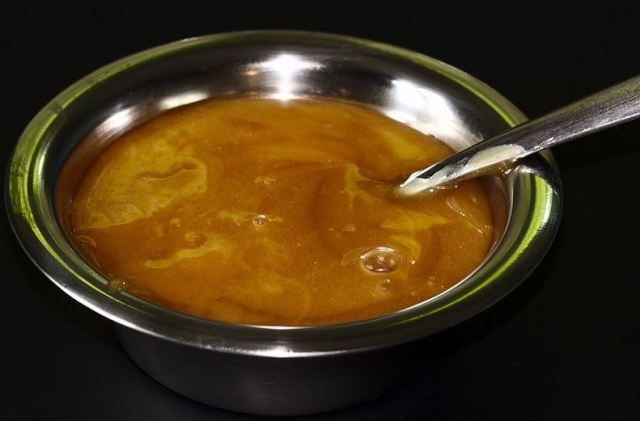
Pure, raw manuka honey. Whenever possible, but directly from the farmer's hive. S(Sourse: Wikimedia)

Pure, raw manuka honey. If possible, buy directly from the farmer’s hive.
(Source: Wikimedia)

Posted in Apitherapy, Hive Products, Honey | Tagged , , , , | 3 Comments

Almonds, Water, and Bees

February is almond pollination month in California. A couple of nights ago, the CBC aired a story about almonds, water, and bees. They try to cover everyone involved – the consumer who loves the heart-friendly food, the almond grower who is trying to juggle water and trees and bills, the beekeeper who would rather not drag hives across the country but needs the money that pollination gives him, and finally, the bees themselves – they’d rather not be in a California almond grove in February.

I’ll  write more about this later – and the environmental impact this is causing – but for today, here’s How the High Demand for Almonds is Affecting California. It’s  quite an interesting story about almonds, water, and bees.

http://www.cbc.ca/news/thenational/how-the-high-demand-for-almonds-is-affecting-california-1.3462764

Clicking on the link will take you to the story at CBC’s news site. The 12-minute clip starts with a chicken crowing like a rooster and you’ll find the Canadian reporter’s accent endearing. The bees make their appearance about half way into the report. Don’t be discouraged. It’s a good video. Here are a few images:

CBC bees among the almonds

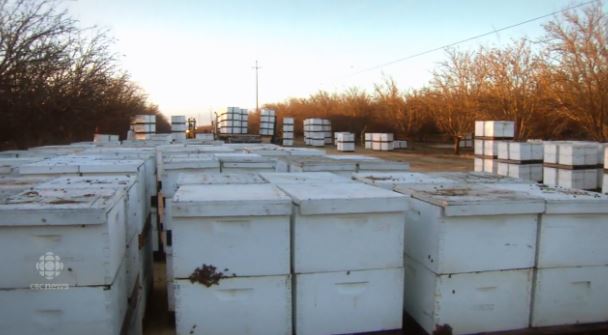
A staging yard in an almond grove. 2,000,000 colonies are paid for pollination. From here, they’ll be distributed at a rate of about 2 hives per acre.

CBC migrant bees

Colonies arrive every February from as far as Maine and Florida to pollinate California’s 800,000 hectares of almoonds.

CBC one almond

The heart of the CBC story is water. It takes 5 liters (about 1 gallon) of water to grow each almond. That’s right. One gallon, one almond.

CBC almond parade

Everyone knows the value of bees. These puppeteers are part of the annual Ripon, California, parade. Ripon? That’s the “Almond Capital of the World“.

CBC almonds and bees

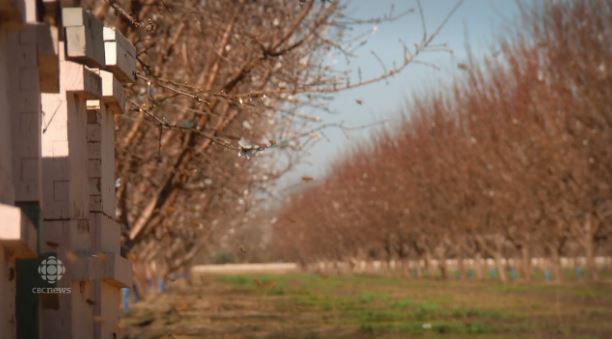
Bees in an almond grove. Watch the CBC video.

Posted in Bee Yards, Beekeeping, Commercial Beekeeping, Ecology, Honey Plants, Pollination | Tagged , , , | 2 Comments

Big Brain, Small Brain, Bee Brain

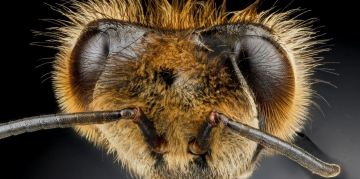
There's a big brain behind those big eyes.

There’s a big brain behind those big eyes.

A bee brain is bigger in the summer, when there are more things to learn, experience, and think about. It shrinks in the winter, which must be a blessing because bees spend weeks on end doing nothing – an active brain might lead to boredom and depression if you are one of thirty thousand bees assigned the job called ‘cluster’ for six weeks. You and I know that the same bee who experiences the bliss of spring and summer is unlikely to be alive in mid-winter, so this would be an average. As such, it is possible that there is something fundamentally different about summer versus winter bees (like nutrition), but researchers think that the variation in brain size is due to the lack of meaningful thought during the winter months.

Researchers at Monash University (a huge campus of 65,000 students in Melbourne, Australia) found something else, too. Professor Charles Claudianos at the Monash Institute of Cognitive and Clinical Neurosciences thinks he and his colleagues have discovered part of the controls which influence bees’ aggression.

Beekeepers know that smoke and certain scents (like lavender) calm bees while other odours (human sweat, expensive cologne, whiskey breath, and perfume) agitate them. Using this knowledge, Claudianos studied bee brain chemistry and neurological function. According to a news release issued by Monash University, “the team has shown that odours such as lavender block aggressive behaviour not by masking the alarm pheromones, but by switching the response off in the brain.” This is different from what I thought. I figured that my smoker provided a camouflage odour that hid my own manly scent. Maybe not, says the research.

The resulting report (“Appetitive floral odours prevent aggression in honeybees“) was published in Nature. There is more work to do, of course, however, the entire field of examining bee brains and neurological function is an exciting and potentially mind-altering way to understand both honey bees and humans.

Benny readingHumans? The human application of bee brain discoveries is potentially huge. Bee genetics is relatively simple. Despite their intricate social behaviour, bees have fewer genes than most living creatures, even including plants. Working with a highly developed social insect which displays advanced community and language activity – but which possesses a limited number of genes – is a smart choice to analyze aggression, nurturing, and cooperation. Applicable human corollaries are being investigated, including the bees’ ability to learn, remember, and read The ABC & XYZ of Bee Culture, which seem similar to our own.

It speaks volumes that Dr Claudianos, one of the authors of the bee brain research paper, is actually a brain scientist focused mainly on human neurology. His university biography tells us “his research topics include the molecular basis of learning and memory, human DNA variations associated with autism, RNA and epigenetic regulation of brain plasticity.” And now, bee brains.

Posted in Bee Biology, Genetics, Science | Tagged , , , , | 6 Comments

Cuba’s Organic Honey

A beekeeper's paradise?

A beekeeper’s paradise?

Long before the embargo and before the Castro brothers, Cuba was a beekeeper’s paradise North American gringos operating Cuban honey farms. Spain ruled Cuba for almost 400 years, but the United States took it as a trophy after the Spanish-American War (1898). The USA quickly granted Cuba independence (1902), but claimed the right to control Cuba’s foreign affairs and its finances. For the next 50 years, Americans built businesses on the island. The biggest money makers were rum, casinos, and resorts, but beekeepers also set up shop. Cuban honey farms owned by beekeepers in New York and the US midwest were once a big thing.

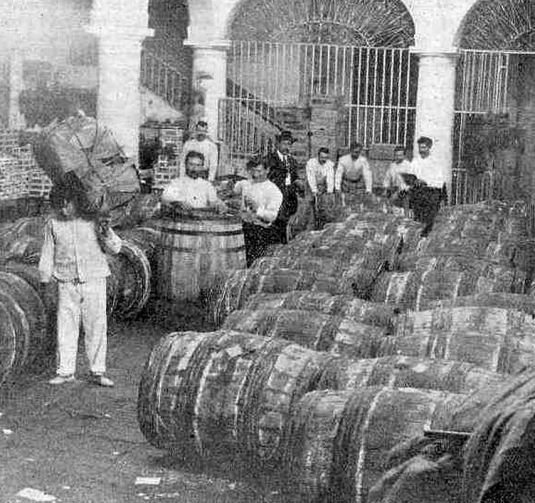
American-owned honey warehouse in Havana in 1902.

American-owned honey warehouse in Havana in 1902.
(from American Beekeeper, May 1902 issue)

Well, it may happen again. Not that Cuba’s beekeepers are suffering. Last year, they produced 15 million pounds of honey. Not only that, but at $23 million, honey was Cuba’s 4th most valuable export crops in 2015, passing both sugar cane and coffee!

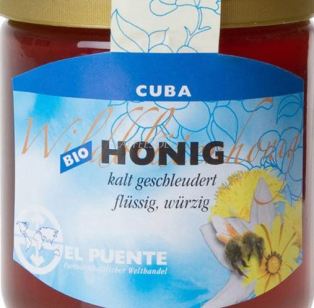
Cuban organic honey from Campilla blanca. Trade Fair label and priced at about $8/pound. Here's a link to the German vendor.

Cuban organic honey from Campilla blanca. Trade Fair label and priced at about $8/pound. Here’s a link to the German vendor.

Cuba may have a special edge in honey markets. According to an article in The Guardian, Cuba is the world leader in organic honey production. As the newspaper sees it, the absence of pesticide makers (such as Bayer and Monsanto) has left Cuban farmers without poisons and GMOs, resulting in pristine pastures for honey bees. I’m not so sure.

Perhaps there are some isolated areas in Cuba which don’t receive pesticides, herbicides, or other farm chemicals. But it’s likely Cuban farmers use locally produced and sometimes harsher chemicals from the old DDT days – things like arsenic, cyanide, and the ‘thion series. According to International Bee Research science director Norman Carreck, in Cuba “the overall use of pesticides has been fairly controlled,” putting a damper on The Guardian’s implication that Cuba is entirely pesticide-free. It is not.  The Guardian also suggests that Cuba, as a home to organic foods, has healthier bees. Perhaps, but it’s also possible that the embargo has stopped bee imports and their attached varroa partners. Being economically isolated can have ecological advantages.

What will happen when Cuba can finally import stuff from the USA again and beekeepers build new honey empires on the island? With the Pope and perhaps the president visiting, American beekeepers are sure to follow.  Undoubtedly, Cubans will replace donkey carts with pickup trucks and they’ll have finer toys and stuff. Life, I hope, will improve for ordinary folks. People will be free to criticize their government and subscribe to the Guardian and New Yorker, and freely post their opines to the web. But with open borders, things like pests, modern pesticides, and increased bee mortality may also arrive.  It will be interesting to see how this unfolds.

Posted in Commercial Beekeeping, Ecology, History, Honey, Pesticides, Save the Bees | Tagged , , | 13 Comments

TV Bee Outreach

How does your bee club reach the public? TV interviews are difficult, nerve-racking, and can go seriously wrong. But when Liz Goldie of the Calgary Bee Club took to the air with a local station, everything went seriously right.

From having good props and answering questions smartly to promoting bees and her local club, my friend Liz did a great job.  Watch this video and take notes so you can be as prepared as she obviously was!

Posted in Beekeeping, Friends, Outreach | Tagged , , | Leave a comment

Clipped and Marked? Part 2

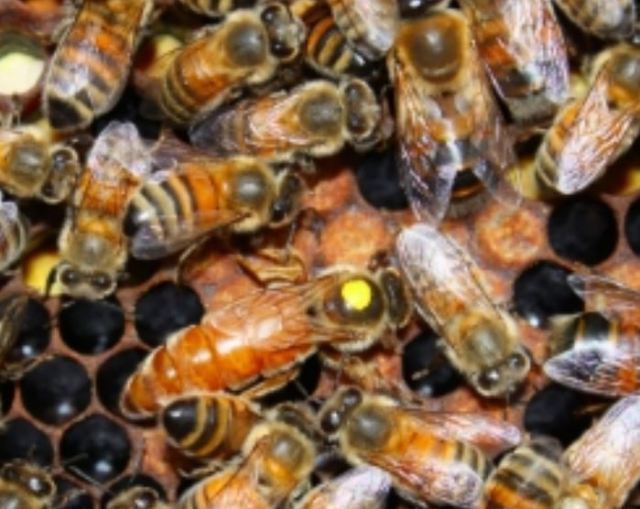
This queen, with the yellow mark, was reared in 2012.

This queen, with the yellow mark, was reared in 2012. How do we know?

(Image credit goes to The Bee Informed Partnership)

I’m not going to suggest how you should hold a queen and a paint bucket when you mark your monarch. For that, I added a video, which you’ll find below. Instead, when your favourite queen supplier gives you a choice (“Marked?”) and you agree to a dab of paint on the queen’s thorax, here’s what you should know about the colour.

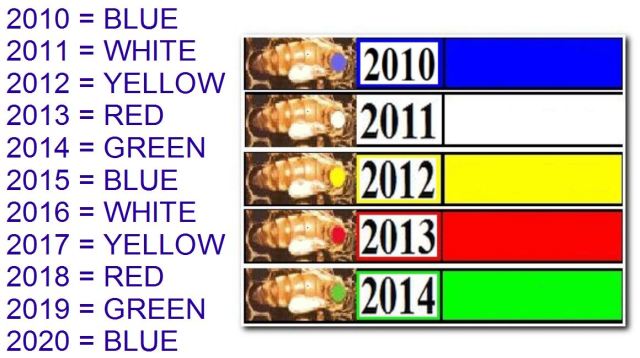
Queen breeders use a different colour to mark queens each year. The system, called The International Queen Marking Color Code system, has been around for a couple generations. This year, 2016, they are repeating the colour used 5 years ago – white. Queens reared in years ending in a ‘1’ (as 2011) or ending in a ‘6’ (as 2016) are supposed to be marked with white paint. Next year, the colour is yellow, just as it was in 2012. If, perchance, you notice a queen with a yellow mark on her thorax this spring, then she is over 4 years old. It’s a smart system, but it’s hard to remember colours that rotate like this:

Colour your queen brightly and rightly.   (Image adapted from Matica)

I find this hard to remember. You might use some pithy little mnemonic
(“Wow! You’ve Really Got Bees!”) using the first letter of each colour
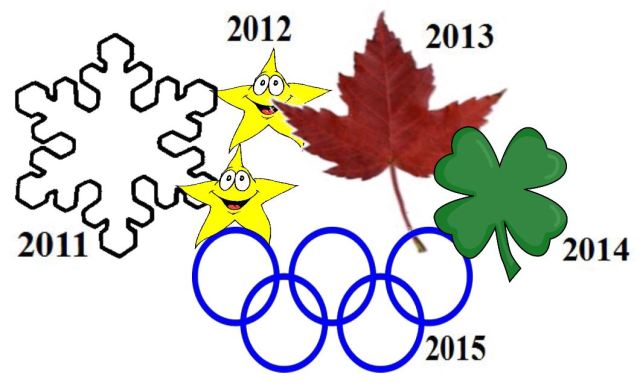
(White, Yellow, Red, Green, Blue) in the order 1, 2, 3, 4, 5. But for me, a visual image is stronger. So, I created this image. Take a full minute to study it and you will never forget it:

queen colour memory chart

Here’s the way that I remember the colour order:

2011 – One WHITE snowflake.
2012 – Two YELLOW stars.
2013 – Three RED points on the maple leaf.
2014 – A GREEN four-leaf clover.
2015 – Five BLUE Olympic rings.

For me, this works as a memory aid.  The colours repeat for the next five years. This year, 2016, is the year of the snowflake. Queens are marked white, just as they were 5 years ago, in 2011. By the way, if you have trouble subtracting 5 onto 2016 and getting 2011, reminding you of the ‘1’ white snowflake, you can probably remember that one white snowflake has 6 sides, matching the year 2016.

Finally, if you are thinking of painting your own queens, it’s perhaps best learnt by watching someone else. Here’s a short YouTube video clip:

Posted in Beekeeping, Queens | Tagged , , , | 4 Comments

Clipped and Marked? Part 1

If you live north of the equator, you’ve noticed the days getting longer. Your bees have noticed, too. Maybe you’ve already had your first late-winter inspection.  Hopefully, you are not peering into hollow tombs, but instead you’re seeing bustling little cities. Either way – good hives or dead hives – you will probably need to buy some queens. You’ll need to requeen some hives and split the strongest to replace the deadest.

I will write more, later, about recognizing queen quality, selecting a queen breeder, raising your own queens, and  introducing queens. For today and tomorrow, I’d like to write a few words about a question you may be asked when you order queens: “Clipped and marked?”

Look closely, you’ll see the queen’s left wing has been neatly clipped.

Tomorrow, we will look at marking queens. The question for today is: “Clipped?” When you are asked this, it means that the queen supplier is offering to clip a wing on the queen they will ship to you. The questions you may be asking yourself are “Does it hurt? Does it damage the queen? Why would I want that?”

As far as we know (and we don’t know everything) snipping the queen’s wing tip does not cause any more pain than a hair cut or nail clip causes either you or Fido. There is, of course, the possibility of making a mistake (a queen breeder I know complained that his toughest, strongest hired man sometimes clipped a queen’s leg by accident) so if you are really worried about contributing to a clip culture, you can tell the queen breeder, “No, thanks.” But if you do request clipping, you will almost certainly receive an uninjured queen that will live as long as any other queen.

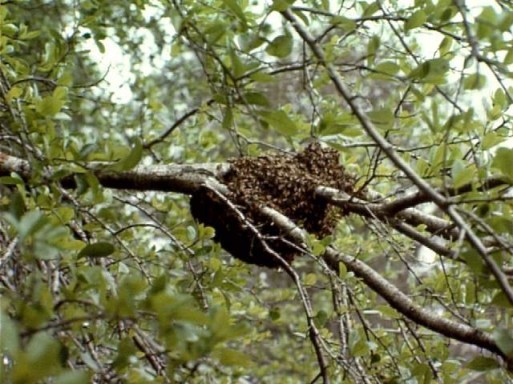
If there is a possibility of injury, why get a clipped queen? Some beekeepers think that clipping will prevent swarming. If your bees get ready to head for the trees, a clipped queen is stuck. The queen begins to head for the sky with her hive mates. Then, embarrassingly, she crashes at the hive’s lighting board. Irritated, the bees all fly back, encourage her to try flying again, but she just turns around and ambles back to the nest. Defeated. The bees wait a few days and then take off when one of the ripe swarm cells ruptures and a new queen emerges. The new queen (still a virgin and quite energetic) will likely kill the hive’s clipped and disgraced queen. At this point, the bees may wait for the new queen to mate, then swarm with her. Or, they swarm when the virgin takes flight, causing a lot of confusion. Either way, you still lose a swarm. Clipping is no substitute for good colony management that prevents swarming.
Bees - May Swarm at the Lot

Clipping: no substitute for good colony management.

So, if clipping doesn’t prevent swarming, why is it done? Do I recommend it? If you are a new beekeeper and do not yet have a lot of experience handling queens, you should consider clipping. Your queen could fly away during hive manipulations.  This is not common, but new queens are energetic, light-weight, and eager to escape – especially during their first few days on the job.

If you are installing packages and quick-release the queen by opening her cage so she can quickly get to work (a good practice), she may dart out of the cage and take to the air. As another example, you may introduce your caged queen using an introductory screen. You need to move her from the cage to the screen and she may fly away at that point.

Sometimes, during the first few weeks after establishing the new queen in a nuc, you may pull a brood frame from the hive and then see a flash – your biggest and most valuable bee has taken to the sky. These things are rare, but all beekeepers eventually get to experience the sickening thrill of seeing the hive’s mom vanish n thin air. All these episodes are prevented by a simple, delicate snip of the tip of the queen’s wing.

There is yet another reason some beekeepers prefer clipped wings. It helps identify the queen’s age. Queens rarely last longer than three years. If your queen is clipped, the breeder will likely cut the tip of the queen’s right wing this year because 2016 is an even-numbered year. Last year’s queen should have been clipped on her left wing. If, next April, you find a queen with a left-clipped wing, you will know at a glance that she is entering her third year and she is not the homegrown progeny of a swarm or supercedure. She is a queen which you purchased in 2015. You might consider replacing her, especially if her brood pattern is poor.
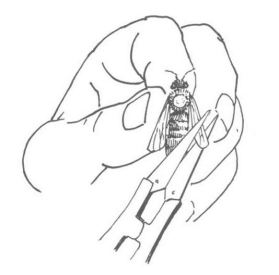
Don't hold her legs; don't use garden shears.

Don’t use garden shears.
– from Sanford and Bonney’s Keeping Bees

You may wish to clip your own queens’ wings when you spot a new, fully mated, queen in your hive.  Some beekeepers always carry neat, sharp wing clippers which may be purchased from equipment dealers.

Others use fingernail scissors. You need sharp scissors for a clean cut. If you tatter or pull on the wing as you cut, you risk muscle injury to the queen. Be careful. Don’t use garden shears, but don’t be afraid to clip if you have valid reasons.
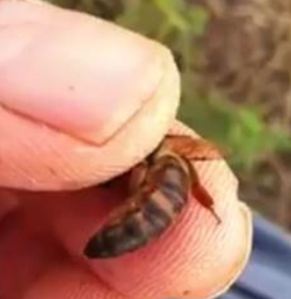
holding queen 3Should you clip your own, use bare hands, gently (gently!) hold the queen’s head and thorax in your non-dominant hand, and ease the open scissors around the tip (one-fourth inch, or 6 mm) of both wings on one side and snip. Some beekeepers hold the queen’s legs, but I’ve felt the queens wiggle and try to pull loose and have worried about damaging a leg. And believe me, making a splint for a queen bee and getting her to use it is a lot of work that care and caution could have prevented!

Posted in Beekeeping, Queens | Tagged , , , | 2 Comments

Bees are Meaner if Childhood is Miserable

girl on bike chased

Some aggressive honey bees were raised to be mean. Some bees, it seems, grow up on the wrong side of the honeycomb. Or, as one experiment shows, in the wrong sort of hive.

Illinois and Pennsylvania researchers conducted a brilliant little experiment. They seem to have discovered that worker bees reared inside a mean-spirited hive will be more aggressive.

First, they categorized 38 colonies as aggressive, neutral, or passive. Then they took frames of worker brood eggs and placed the good-natured brood into hives of nasties. In the mean hives, the eggs hatched into larva that were fed and nurtured. Before the new adults emerged, the brood was allowed to emerge in an incubator.  In lab conditions, these newbies were tested for personality traits related to aggression. As it turns out, bees reared by meaner bees show slightly higher aggression. Coincidentally, they also showed greater resilience to immune challenges and mites. They were both meaner and tougher.

Why? Well, we know, of course, that nutrition of developing youngsters is vitally important across the animal kingdom. Better food, better health and growth. But this is a bit different. It’s a study of the temperament, or personality, of the offspring. Certainly, these may also be related to biological and biochemical conditions ultimately controlled by nutrition. But it says a lot about how this all ties into social behaviour.

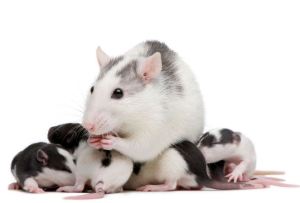
ratsYou may have heard about dozens of lab-controlled observations of mother rats grooming and licking their newborn pups. Genetically identical pups that were treated to this sort of attention during their first week grew up to be calmer adult rats. Rats with less caring moms grew into life-long anxious neurotics. The difference is an epigenetic (not genetic) manipulation in the newborns’ DNA. Certain genes are switched on or off, depending upon environmental conditions. These have life-long effects. The bee experiments don’t necessarily imply the nurse bees’ actions were epigenetically changing the new bees’ behaviour. But something was certainly happening.

The research team (Clare Rittschof, Chelsey Coombs, Maryann Frazier, Christina Grozinger, and Gene Robinson) produced the evocatively labeled paper “Early-life experience affects honey bee aggression and resilience to immune challenge” which you may read on Nature’s open science site. Here is an excerpt:

We report for the first time that a honey bee’s early-life social environment has lasting effects on individual aggression: bees that experienced high-aggression environments during pre-adult stages showed increased aggression when they reached adulthood relative to siblings that experienced low-aggression environments, even though all bees were kept in a common environment during adulthood. Unlike other animals including humans however, high-aggression honey bees were more, rather than less, resilient to immune challenge, assessed as neonicotinoid pesticide susceptibility. Moreover, aggression was negatively correlated with ectoparasitic mite [mainly varroa] presence. . . . Because honey bees and humans share aspects of their physiological response to aggressive social encounters, our findings represent a step towards identifying ways to improve individual resiliency. Pre-adult social experience may be crucial to the health of the ecologically threatened honey bee.

This elegant little experiment may open a whole new avenue of research into social insect behaviour and will likely have direct application to keeping healthier (if less happy) bees in our apiaries.  I encourage you to read the paper in its entirety.  We also thank Nature for allowing the on-line publication, rather than hiding this important paper behind an expensive firewall.

Posted in Bee Biology, Genetics, Science | Tagged , , , | 1 Comment

Bumper Crop

honey prize ribbonThe numbers are in and the prize goes to Alberta. Alberta, a province in western Canada, has once again won the prestigious honey production award. For those of us who learnt beekeeping where 50-pound crops are the norm (in my case, Pennsylvania), the size of western Canadian honey crops seems the thing of fairy tales, right up there with fire-breathing dragons. Last year’s crop was 145 pounds. (66 kilos) That’s the average per hive from over 250,000 colonies in Alberta. Many colonies did much better. The average would have been higher, but about 30,000 colonies were rented to seed growers – pollination bees didn’t make much honey.

One of our more scenic yards, south of Calgary, in sight of the Rockies

One of our more scenic yards, south of Calgary, in sight of the Rockies

If you don’t know much about western Canada, I’ll tell you this about Alberta. The place is big (bigger than France, for example). About half is forested. A large and scenic chunk is in the Rocky Mountains. Alberta’s two big cities (Edmonton and Calgary) each have over a million folks. We also have the ideal place for honey-making.

Alberta on a map

What makes a bee paradise? Sunny days help. Long, clear, warm days with just enough rainfall to keep nectar flowing but not so much that the bees are kept in their hives for days on end. The right sort of flowers. (Here, that’s canola, clover, and alfalfa.) Strong, healthy bees are also essential.

Honey by the barrel.

Canadian honey by the barrel.

Alberta keeps surprising me with its great crops and healthy bees. Our bees should have been killed long ago by neonicotinoids. Neonics are used heavily here. 99% of Alberta’s 6 million acres of canola oil seed crops are treated with neonicotinoids. Honey bees work canola enthusiastically. Yet, Alberta bees have not suffered the ruination that neonics are alleged to have caused in some other parts of the world. Neonicotinoids are undoubtedly poison to bees, but after continuous and almost ubiquitous use here for a decade, the insecticide has not yet destroyed Alberta beekeeping. Instead, the bees continue thriving, wintering well, and making bumper crops of honey. If neonicotinoids are killing the world’s bees, then this does not make sense. Maybe disaster is just around the corner, but after so many years, it should have already struck.

Here are the statistics for the Alberta honey crop, reported by StatsCanada and repeated in the Daily Herald Tribune:

Alberta beekeepers produced 42.8 million pounds of honey in 2015, up 20.4% from 35.5 million pounds in 2014, according to Statistics Canada. Nationwide production rose 11.4% to 95.3 million pounds.
According to Medhat Nasr, Alberta Agriculture’s provincial beekeeper, the weather in 2015 was so kind to the province’s bees that their winter mortality rate was the lowest in 15 years, at 10%.
“That compares to the national average of a 16% loss and the American average of 23%,” he said in a press release. Yields in Alberta rose from 125 pounds per colony to 145 pounds.

CBC news had similarly good reports:

New figures from Statistics Canada show Canadian beekeepers produced 95.3 million pounds of honey in 2015, an increase of 11.4 per cent from the previous year.
The total value of the sweet stuff is up by 10.9 per cent to $232 million due to the increased production.
“The industry is successful and is growing. It really is a positive message,” Rod Scarlett, executive director of the Canadian Honey Council, said Wednesday.

Finally, the Statistics Canada summary. Notice that Canada has 800 more beekeepers than it had 5 years ago and 85,000 more colonies of bees.

stats canada bees 2

Posted in Beekeeping, Honey | Tagged , , , | 4 Comments