Bumble Bees and Free Will

Bombus terrestris, under the radar.

Bombus terrestris, under the radar.

Much is made of a human’s ability to make free choices. It’s an illusion, of course, but if people should be awarded this mysterious power, then why not bees? To bolster this notion of bees and free will, we’ll look at a series of maps created by researchers in the UK. Using radar, they monitored the flights of bumble bees (Bombus terrestris).

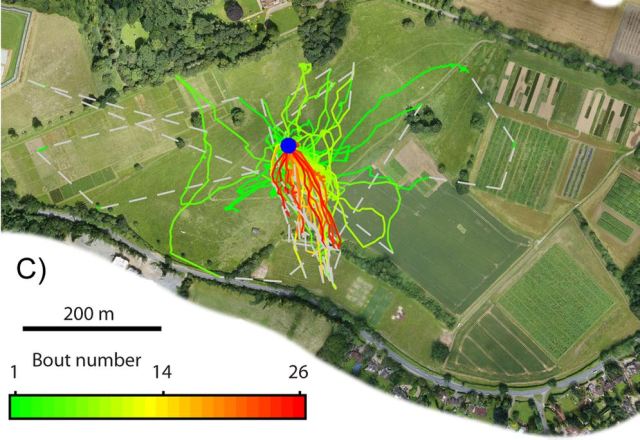
From the variety of foraging paths shown below, it appears that the bees exhibit unique personalities. Some forage close to home, some make multiple exploratory trips, some find a good foraging spot and persistently return to it. None of the bees behave the same. They each use different learning strategies during exploratory stages and differ in foraging style during exploitation. Does such variation imply that bees exercise free will? First the maps, then the free will. See if you can resist looking ahead, but your choice (study the map or go for the goal) is already predestined.

Here are the maps generated by Woodgate, Makinson, Lim, Reynolds, and Chittka in “Life-Long Radar Tracking of Bumblebees“. The blue dot is the nest location for all four of the observed bumble bees. Bee A engaged in 156 recorded flights, mostly close to the colony. Bee B seems to become less and less focused with each successive flight, scattering her attention across the fields, while Bee C and Bee D likewise display rather different foraging patterns: C makes few excursions while D going farthest, even beyond the researchers’ map.

bumble-bee-paths-a

bumble-bee-paths-b

bumble-bee-paths-c

bumble-bee-paths-d

Researchers explain their project:

“Every flight ever made outside the nest by four foragers was recorded. . . We identified how each bee’s flights fit into two categories—which we named exploration and exploitation flights—examining the differences between the two types of flight and how their occurrence changed over the course of the bees’ foraging careers.

“Exploitation of learned resources takes place during efficient, straight trips, usually to a single foraging location, and is seldom combined with exploration of other areas. Exploration of the landscape typically occurs in the first few flights made by each bee, but our data show that further exploration flights can be made throughout the bee’s foraging career.

“Bees showed striking levels of variation in how they explored their environment, their fidelity to particular patches, ratio of exploration to exploitation, duration and frequency of their foraging bouts. One bee developed a straight route to a forage patch within four flights and followed this route exclusively for six days before abandoning it entirely for a closer location; this second location had not been visited since her first exploratory flight nine days prior. Another bee made only rare exploitation flights and continued to explore widely throughout its life; two other bees showed more frequent switches between exploration and exploitation.” – “Life-Long Radar Tracking of Bumblebees

A bee’s free will

In 2012, Gene Robinson at the Carl R. Woese Institute for Genomic Biology in Illinois compared behaviour in honey bees as they scouted for new homes for their swarms and as they scouted for food. Robinson says that a test of behaviour where the same task (in this case, scouting) is performed under different conditions (scouting shelter vs scouting food) potentially reveals existence of personality. In the case of honey bees, about 5% are willing to perform ‘scouting’ tasks.  For either food or shelter, it tends to be the same 5% of the bees which are ‘scouts’.

Having determined that ‘personality’ differences exist in honey bees, the researchers set about studying the cause. Could bees simply be choosing (‘free will’) to be adventurous thrill-seeking scouts, or is that activity due to some neural chemical stimulus? The answer was tentatively discovered at the molecular level. Similar to humans and other vertebrates, hormones and proteins are linked to thrill-seeking. Glutamate,  catecholamine, glutamate, γ-aminobutyric acid, octapamine, and dopamine are among the chemicals which control whether a particular honey bee may be one of the 5% willing to seek a new home or a new patch of clover. The results of this research and the experiments conducted can be seen in “Molecular Determinants of Scouting Behavior in Honeybees”.

We are just beginning to unravel the decision-making process. All signs point to molecular biochemistry. The hapless bumble bee fumbling around the English countryside is simply a victim of a particular surge of proteins and hormones released into her tiny brain. She has no choice but to cooperate. Whether that results in wide-arcs of adventurous flower-seeking or careful and measured foraging is beyond the bee’s willful control.

Posted in Bee Biology, Ecology, Science | Tagged , , , , | 6 Comments

Bearspaw Honey Harvest

A friend sent these pictures of some of his honey harvest. It was part of his second pull, taken September 4th.  He says there’s more to gather and he’ll collect it in a couple of weeks. Looks like great quality!  Stephen’s a skilled photographer (he took these pictures and I’ve used others on this site before), but we have to also give credit to the honey containers who were willing to line up so nicely for the photos.

SJB Honey Crop

Water-white honey; 16.2 to 16.4% moisture.
(Note to self: buy some of this guy’s crop!)

Bears' Paws

The honey farm is called “Bearspaw Bounty” and is just outside Calgary.
The label on the lid is a detachable coffee coaster and honey-order reminder.

Posted in Friends, Hive Products, Honey | Tagged , | 8 Comments

Does the FDA Think Honey has ‘Added Sugar’?

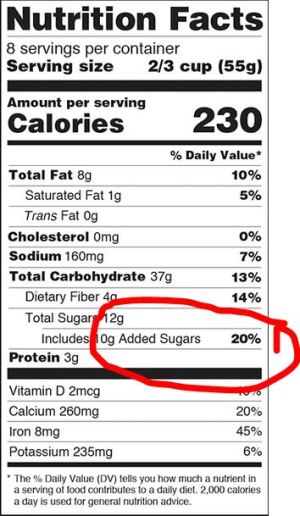
added sugar labelI just got off the phone. I was chatting with a buddy who lives in the USA. (I am in western Canada.) He tells me that the FDA is completely revising US label laws. In the near future, Calories will appear in big bold font on nutrition labels. And (something new), the FDA wants consumers to know how much added sugar is in the food they buy.

Maybe an ADDED SUGAR alert is a good thing. But it includes honey, which the FDA considers a sugar that consumers need alerted about. If honey roasted ham has 1% honey, the “Added Sugar” will be labeled as 1%. In the past, honey would have appeared in the list of ingredients and the calories per serving would reflect the bit of honey in the food. But the news gets worse.

Added sugar usually means ‘added by processing or manufacturing’ – therefore, fruits and vegetables are exempt, as are some sugars used in making jams, jellies, preserves, and fruit spreads.  Take a look at how the new guidelines define added sugar and see what’s missing:

“The definition of added sugars includes sugars that are either added during the processing of foods, or are packaged as such, and include sugars (free, mono- and disaccharides), sugars from syrups and honey, and sugars from concentrated fruit or vegetable juices that are in excess of what would be expected from the same volume of 100 percent fruit or vegetable juice of the same type. The definition excludes fruit or vegetable juice concentrated from 100 percent fruit juice that is sold to consumers (e.g. frozen 100 percent fruit juice concentrate) as well as some sugars found in fruit and vegetable juices, jellies, jams, preserves, and fruit spreads.”

I’m sure that you noticed “honey” is not mentioned as an exempt food. But honey is not manufactured – bees make it in their hives. Honey has no added sugars, however, as things stand today, the new Nutrition Facts label would show that the “Added Sugars” in honey is 82% (the other 18% of honey is water).

I’m hoping that the new rules will be amended to exempt honey. My guess is that American beekeepers are talking to FDA rule-makers even as you read these words. But if this goes unchallenged, honey jars would need to list the natural sugars in honey as “added” sugars on every jar of honey sold.  To most consumers, this would imply honey is manufactured. Consumers would think that the natural fruit (fructose) and grape (glucose) sugars coming from nectar are somehow “added” at the packing shop. And that’s just simply wrong.  What do you think? Maybe I don’t have the story right – if you know more about this, weigh in with a comment or send me a note [miksha(at)shaw.ca] and I’ll add more to this blog piece.

Posted in Beekeeping, Culture, or lack thereof, Honey | Tagged , , , , | 16 Comments

Climb Every Mountain; Raise Every Dollar

Save the Bees: It's where we get our honey. And money.

Save the Bees: That’s where we get honey. And money.

It seems that Saving the Bees has turned into quite a nice little cottage industry. Although honey bees are more numerous today than any time in history, some people seem intent on telling other people that the honey bees are all dying and if you send them some money, beepocalypse can be avoided. I’ve kept bees for 40 years – both commercially and as a hobby – and I’ve written a book and dozens of magazine articles about bees. I’m committed to their health, welfare, and future prosperity. I like the way people have taken to bees lately and that’s often parlayed into an interest in farming, ecology, and environment. That’s all good.

But it bugs me that there are so many appeals for money to “reverse the decline of honey bees” – even if honey bees aren’t dying en masse. I keep worrying that the public will feel saturated by all the bee pleas. There will be a backlash when the hoax of the disappearing honey bee is exposed. Instead of a sympathetic public wanting to Save the Bees, we may end up with a cynical public telling us to forget about our stupid bees. All because they’ve heard one hyped pitch too many.

At our house, we get daily calls from the Heart, Lung, and Tongue people, the Friends of the Firemen, and Save the Whales (or Whalers) advocates. Most of the callers are paid shills who could just as passionately and persistently sell used cars.  I’m not totally hard-hearted. We give to several charities. I’ve got motor neuron disease, so we know a lot about ALS and give support (plus we contribute to Breast Cancer and Heart-Stroke drives).  These diseases are real, they affect families we know, and we vet charities before handing them our money. Save the Bees NGOs also need vetting.

Ha Ling - one of the mountains to be conquered by the Eco Not Ego fundraisers.

Ha Ling – one of the mountains to be conquered by the Eco Not Ego fundraisers.

This weekend, I heard about yet another bee-saving group. This one is climbing mountains here in my backyard (Calgary, Alberta, Canada) to raise awareness of bee plight. The organization is Eco Not Ego International. The collective (as it calls itself) seems to consist of two people – Spence and Josie. They are new beekeepers who guide Eco Not Ego with actionables that include: “Have Fun” and “Be Impeccable with your Word.” Their vision is to achieve “A world where humanity lives in harmony with nature and every individual is proactive with all aspects of their health.” One of their first awareness-raising campaigns involves climbing some mountains in my neighbourhood while wearing a bee costume and carrying a load of honey.

I became aware of Eco Not Ego because of this CBC news story: Calgarians to climb mountain peaks to highlight plight of ‘stressed’ bees”

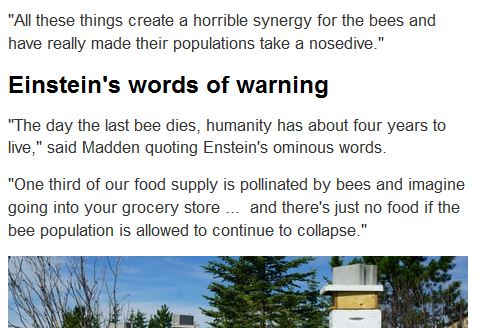
The news tale quotes one of the couple “quoting” Einstein:

CBC Einstein quote

“The day the last bee dies, humanity has about four years to live,” said Einstein never. The quote was created by some European beekeepers 40 years after Albert Einstein died. Roni Grosz, curator of Einstein’s papers at Jerusalem University, says he “could not remember even one reference to bees in Einstein’s writings.”  You may also notice that the article, captured in the blue box above, says, “a horrible synergy for the bees [has] … made their populations take a nosedive.”  It hasn’t. Maybe “Being Impeccable with your Word” is an aspiration, not a rule.

The Eco Not Ego money site begins with this sentence: “IN 2015, North America experienced a dramatic decline in honeybee population due to Colony Collapse Disorder (CCD).”  No, No, No! CCD has not been reported in five years, according to Dr Dennis vanEngelsdorp, who discovered it and conducts a survey twice a year searching for CCD.  The number of honey bees in North America increased in 2015: Canada’s numbers grew from 697,000 colonies in 2014 to 722,000 in 2015; in the USA it was 2.69 million in 2014, 3.18 million in July, 2015.  The honey bee population grew a lot – North America did not experience “a dramatic decline”.

Meanwhile, there’s a bizarre collection of organizations involved in the Eco Not Ego websites. I have not figured out the relationship between Eco Not Ego International, which has a gofundme.com fundraising page for the climb, Project Doublebee (which has a goal to double the world’s bee population), the Bee Aware AB campaign (mentioned in the CBC story) and yet another, Save the Bees Canmore Mod-Quad, – but it looks like all roads (and links) eventually lead to the same fundraising site.

bee suit presenter

Part of our school program, offered without charge.

The projected $2,000 to be collected from this bee-plight-awareness campaign would be used in two main ways: bringing bees into schools and showing the public real beehives. These are laudable plans, but people all over our community already do this, as volunteers, for free. In my case, I go (in my wheelchair) to the local elementary schools, take little squares of beeswax, colouring books, a big stuffy bee named Benny, a Powerpoint show, and I spend an hour with the kids. I wouldn’t want paid for this or the materials I give away – raising awareness and teaching kids about bees is payment enough. As far as letting the public meet and greet honey bees in a bee yard, we do that gratis, too, but the CBC News site says that the $2,000 raised by the Eco Not Ego mountaineers will be used for school programs and for “giving people the chance to  interact with bees at [Spence] Madden’s apiaries.”

The pair running Eco Not Ego International, Project Doublebee, Bee Aware AB, and Save the Bees Canmore Mod-Quad are undoubtedly concerned about the environment. They have lofty goals. They are climbing four mountains in 24 hours – much better than sitting on bums, consuming non-renwable resources on exotic holidays, or chugging Moosehead.

But knowing more about biology and using less hyperbole would be helpful. In the Calgary Herald, one of them tells us, “If we don’t have bees, nothing lives.” Really? Nothing lives? The planet had life for 3 billion years before bees evolved. It will have life long after humans and bees are gone.

I’m concerned that misinformation will lead to a backlash. Our environment is a mess, wild bee populations are in danger, and society is going to hell. That’s all true. But we don’t need misspoken words confusing the public. We need verifiable fact or our credibility is bankrupt. We need impeccable words.

Already we see the negative result of overly dramatic appeals to urgently save the bees. The gofundme.com campaign for the mountain climbing publicity escapade has been open for two months. It has not reached its modest $2,000 goal. Not even half. Not even a quarter. As of 3 o’clock this afternoon, $355 appeared in the pledges, yet the mountaineering begins tonight.

Maybe the public’s saturation point has already been reached and the backlash has begun. Inundated with pleas to come Save the Bees, perhaps the public is starting to think go F*@k the Bees.

Posted in Culture, or lack thereof, Outreach, Save the Bees | Tagged , , , , | 9 Comments

Beekeep or Bee-keep?

youre bees

The best beekeepers are not the best grammarians, but that’s OK. There might be an inverse relationship between bee skill and word skill. So we overlook ads that say “Bees’ For Sale” or an e-mail suggesting that  “you should of used more boxes on you’re bee hive’s!”  But if you are writing for publication (a letter to the editor, a bee article, a bee blog), then you should try to follow some basic rules so that poor grammar doesn’t detract from the points you are trying to make.

I’ve certainly had my share of gaffes. I appreciate when a reader sends me a note or tweet letting me know that I have mistyped or poorly phrased something. I try to remember to keep “spell check” on and I try to put an hour or two between something I’ve written and the ‘Publish’ button. Whenever I give myself at least a bit of time between writing and sending, it always results in uncovering some confusing and rambling sentences – like this one, for example.

Occasionally, my wording is intentionally unusual or obscure for effect. However, I strive for clarity over comedy, even if that’s not always apparent. Sometimes I just can’t help but toss in a few bee puns. Nevertheless, if you find my prose bewildering, or if a typo makes something unclear, please let me know. [Last week, I wrote something about Alberta Einstein, and I wasn’t writing about Albert Einstein’s twin sister. A kind reader brought the typo to my attention.]

A few guidelines

If you write about bees, here are a few suggestions. First, our insects are honey bees – not honeybees. There is some confusion on this – according to Merriam-Webster’s Dictionary, “honeybee” and “housefly” and “bedbug” are all spelled as one word. However, according to the Entomological Society’s Common Names of Insects Database, they should be spelled as two words — “honey bee” and “house fly” and “bed bug.” Do the right thing and use two words if you are writing a bee story. This is the way honey bees are denoted in bee journals and beekeeping books. The explanation given by entomologists goes like this: dragonflies and butterflies are not actually flies so butterfly (Lepidoptera) would incorrectly describe the bug as a butter-type of fly, but it’s not a fly (Diptera) at all. A house fly (two words) describes a type of fly commonly found in a house while a honey bee is a type of bee found floating in a jar of honey. 

We keep beehives in bee yards, not bee hives in beeyards. If you have trouble remembering these, try this:  beehives are glued together, just like the word, but hives are scattered around the bee yard, separated like the words in “bee yard”.

Don’t capitalize queen unless Queen Elizabeth is your subject, then you should write Queen Elizabeth. But avoid the mistake made by the British branch of Reuters. Reuters insisted that ‘queen’  must always be capitalized and must always be referred to as Queen Elizabeth, not just the queen. A few years ago they mindlessly printed this sciency piece:

… tens of thousands of worker bees are commanded by Queen Elizabeth… Queen Elizabeth has 10 times the lifespan of workers and lays up to 2,000 eggs a day.

The queen, I think, was not amused and it must have been rather embarrassing for Reuters’ ex-employee.  You could avoid such an epic mistake by being flexible in your rules and by reading over what you’re publishing before hitting the ‘Send’ button.  For other relevant suggestions, peruse  American Bee Journal’s Writers’ Guidelines.

N-Grams

Another set of words we often see misused involves hyphens. Centuries ago, it was fine to write about bee-keeping and queen-bees. You would have been dandy-smack in style a hundred years ago, but not so much today. To prove this, I direct you toward  Google’s cool N-grams feature.  N-grams counts all the times your target words appear in books, journals, newspapers, and magazines for any years you select. With this tool, we can compare the frequency of bee-keeping and beekeeping over the past two centuries. Here’s the graph from Google:

N-gram bee-keeping-2

It’s a little hard to see, isn’t it? (This link takes you to a larger image.) The vertical axis is linear and shows frequency. It’s actually the percentage of times that the target word (“bee-keeping”, for example) appears in print. Both words appeared much more often during the 1940s than they do today (as a percentage of all printed material).  The lower (blue) horizontal track shows how frequently bee-keeping was written in the past. Until 1910, bee-keeping was seen more often than beekeeping. But since that time, beekeeping has been the standard. You may continue to use the old hyphenated word if you prefer, but it will make your writing appear a bit archaic. I don’t always advocate the downward spiral that accompanies the common vernacular, but if you are striving for clarity and don’t want to distract your readers with old expressions and inappropriate usage, than your better-off using the write word’s!  (Please don’t bother sending a note telling me that you’ve discovered mistakes in that last sentence.)


Posted in Culture, or lack thereof | Tagged , , | 3 Comments

Millions Dead

Millions of bees are dead following aerial spray of the neurotoxin Naled. The spray was released Sunday morning between 6:30 and 8:30 by a South Carolina county trying to control mosquitoes which may or may not spread Zika and West Nile viruses in the area. Unfortunately, it was hot, bees were bearded out, and many were in the air when the spray planes circled and repeatedly dropped the poison. One witness said she saw the pesticide plane make three separate passes over her farm.  She described the aftermath near her bees as being as quiet as a morgue after the bees had “been nuked”.

Neortoxins, anyone?

Neurotoxins, anyone?

Dorchester County says they warned beekeepers with a newspaper ad two days earlier (who reads newspapers anymore?) and with a Facebook posting one day earlier (Facebook?).  Beekeepers said they hadn’t heard or seen the warnings. Even with warnings, precautions are difficult to implement. Hives need screened so bees are stuck inside, then they need cooled so they don’t die of heat exhaustion.

Moving hives is an option, but beekeepers need access to emergency temporary safe locations and need trucks and equipment for moving their hives. Again, that’s not easy to pull off on short notice.  Some places register beekeepers and send them direct alerts when pesticides are imminent so counter-measures can be attempted, but I suppose that Dorchester County, South Carolina, is not one of those places.

The South Carolina experience reminds us how vulnerable honey bees are to conventional pesticides. Naled was invented in 1959 and kills immediately on contact. The EPA says it is quick-acting, kills immediately on contact by torturing animals (including people) with a complete nervous system shutdown. Beekeepers used to see a lot of this sort of poisoning and death in the 70s and 80s, with entire bee yards wiped out. Commercial beekeepers here in Alberta, Canada, have told me repeatedly that they have not seen such losses from neonicotinoids. Neonics are used ubiquitously on canola in western Canada. They say that farmers used to use millions of tonnes of organophosphates like Naled to control canola-consuming beetles. Before neonics, pesticide bee kills in western Canada were common. This does not absolve neonicotinoids of all guilt in bee deaths elsewhere, but it does indicate why large-scale prairie beekeepers don’t want neonics banned.

Posted in Beekeeping, Commercial Beekeeping, Pesticides | Tagged , , | 4 Comments

The Worker Who Would Be Queen

queen v worker ovarioles

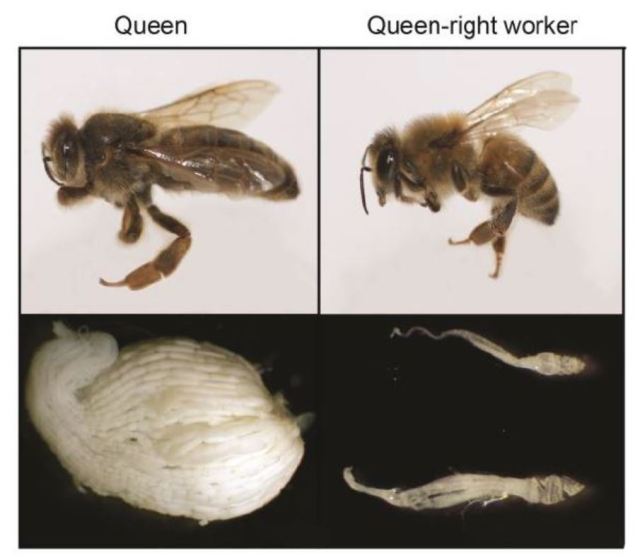
   Queen vs Worker ovariole development. Bottom slide shows ovaries dissected from a healthy queen and a worker from a queen-right colony.
(Creative Commons: Dearden, et al.)

Bees have a complicated social structure which some political scientists have sought to embrace. In the old days, people assumed that the King Bee ruled with an iron fist that imposed order, harmony, sacrifice, and unflinching duty. Now that the curtain has been pulled back, we see that drugs do the trick of maintaining colonial order.

Why waste energy?

In the awkward honey bee society, there are two classes of female – queens and workers. If a queen unexpectedly dies, some workers lay eggs. But workers never mate, so their unfertilized eggs develop into males. I’m not sure what the point is – when a hive is dying from lack of a queen, the last thing the colony needs is a bunch of drones to feed. Why waste energy on drones? I’m sure that an evolutionary biologist could explain this better than I can, but my sense is that the drones – which are little more than cutely packaged gametes – are the dying colony’s last attempt to disperse some genetic material of their once flourishing civilization. The hive will die anyway, so why not scatter some seed to the wind?  You may have seen this in the plant kingdom – after an injury or a killing frost, an enfeebled orange or apple tree will sometimes have a ‘shock’ bloom. It looks pathetic. A sick, weak tree without leaves, but thrusting forth a few bouquets of pungent white flowers. Maybe fruit will grow before the plant dies, perpetuating the tree’s idea of perfect fruit – its own.

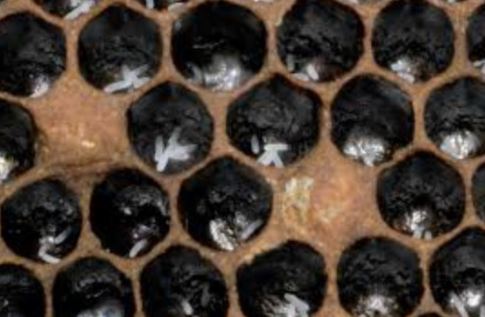
laying worker drone brood

Developing drones warping worker cells.

In the hive, the scene is no less pathetic. A queenless colony has a distinctly anxious hum and a disorganized assembly of bees that any experienced beekeeper recognizes immediately. Yet, workers who would be queens optimistically drop eggs into worker cells. Developing drone bees will warp the cells out of shape, squeezing their over-sized bodies into under-sized worker cells.

Signalling sterility

We have long known that the queen’s drugs force workers into placid acceptance of their unfertile state. Once absent, nothing represses the worker females. They begin laying their unfertilized eggs. The main drug – queen mandibular pheromone, or QMP, suppresses the workers’ egg laying. How and why QMP has this power was a mystery until a few days ago.

Researchers at New Zealand’s University of Otago found the actual chemical pathway in cells that suppresses workers’ egg laying. The presence of QMP prevents a Notch signalling response. Notch signalling involves a protein that can cause a change in the way certain cells in an animal develop. In humans, Notch signalling has several roles, including control of how neurons and adult stem cells develop. In fruit flies, Notch signalling enables reproduction. Normally, Notch signalling is essential for the development of cells. But in the worker bee, lead researcher Peter Dearden says, the team was surprised to see just the opposite – “Without active Notch signalling taking place, the worker bee eggs are now able to mature. This contrasts with its role in fruit fly reproduction in which the signalling is vital for fertility.”

Notch signalling is degraded in the presence of QMP, resulting in maturation of eggs in a worker. If signalling is stopped, egg production can begin. Whether the signalling starts when the worker creates eggs or when those eggs begin to grow is not perfectly determined.

According to the research, it’s also not clear if the signalling is inhibited at the bee’s antennae, brain, or ovaries. Nevertheless, the study – published in the scholarly Nature Communications – shows that this protein signalling mechanism is the key to the worker bee’s ability to lay eggs: “…chemical inhibition of Notch signalling overcomes the repressive effect of queen pheromone. This promotes ovary activity in adult worker honeybees. The removal of the queen corresponds with a loss of Notch protein in the germarium…” This study is the first direct link of a molecular mechanism for ovary activity in adult worker bees with the presence of the queen.

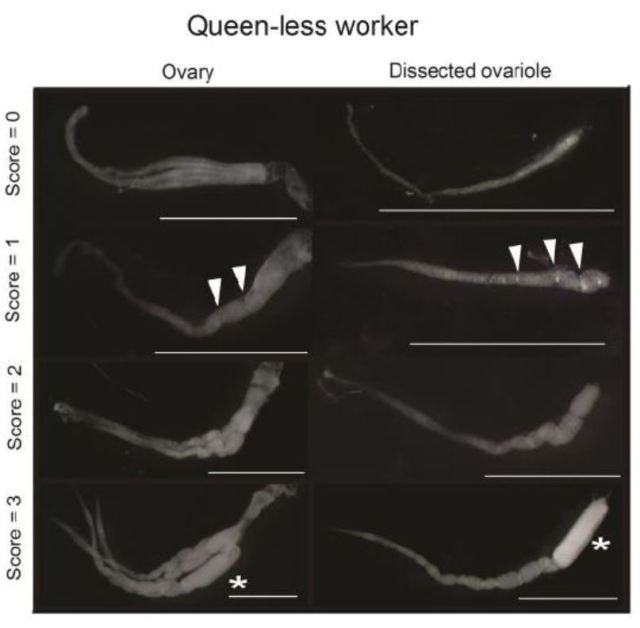
queenless worker development

In a queenless colony, workers have different levels of ovarian development.
Here the researchers graded their dissections from undeveloped (Score=0)
to sufficiently developed to lay (unfertilized, haploid) eggs (Score=3).
(Creative Commons: Dearden, et al.)

The scientists say that understanding the mechanism that controls eusociality in honey bees (i.e., the caste system that allows one queen as sole reproducer and a supporting cast of suppressed workers) is important to evolutionary biologists seeking to determine when the caste system first began. The results of this research point to an early adaptation because the Notch signalling system is universal across the animal kingdom. It’s not determined from this, however, exactly when Notch was coerced into its unusual reverse role. I think eusociality’s evolutionary history will be determined in the fossil/amber record, not in biochemistry – but biology is not my long suit.

What’s in it for beekeepers?

To me, some of the supplementary data is more immediately interesting to beekeepers. To test their hypothesis, the scientists conducted experiments with adult worker bees by depriving them of QMP. In absence of the queen pheromone, they noticed that one-third of workers develop egg-laying capacity. In the presence of QMP, 5% of workers are not fully inhibited and can lay eggs. I wasn’t aware of either statistic and was surprised at how high these rates are.

If 5% of workers in a normal queen-right colony are able to lay eggs, do they? That could mean thousands of laying workers in a queen-right hive. Well, in addition to the eusocial biological control (fully developed mated queen vs unfertilized laying workers), the bees have mechanisms in place to deal with errant egg laying. Most worker-laid eggs are disposed by house-keeping bees. As queen pheromones would not be present in eggs laid by workers, other bees treat the eggs as they would treat any bits of garbage.

The other statistic – one-third of workers in queenless, broodless hives can be laying workers, is equally surprising.  I had previously assumed that “a few” workers in a queenless hive become laying workers. My assumption was based on the evidence that I’d seen – rarely are there more than a few hundred worker eggs in a depleted queenless hive. So, my hunch was that ovarian development among workers wasn’t common, even in a fully queenless hive. But the journal paper tells us that “In a queen-less environment, if there is no opportunity to make another queen, approximately one-third of honeybee workers activate their ovaries and lay eggs. These eggs are unfertilized and haploid, and they generate fertile male offspring.”

laying worker eggs

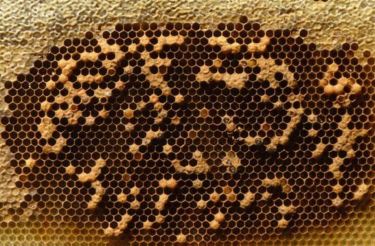
Eggs produced by laying workers. You will rarely see such dramatic production, but multiple eggs in single cells, and cells glued to cell walls instead of bottoms, is common. 
Photo by Michael Palmer/Beesource.com

One-third is a remarkable number. This enlightens the challenge beekeepers face when trying to establish a queen in a hive which has laying workers. Our standard advice is to move the boxes a few metres from the old stand and shake all the workers from the combs. Most laying workers will remain a few metres from the old spot and will not fly back. At the old location, you may reuse the equipment and add some young bees, some brood, and a queen. You won’t always be successful, but you’ve increased your odds of re-queening success from nearly zero to perhaps 70 or 80 percent.

Posted in Bee Biology, Genetics, Queens, Science | Tagged , , , , , | 5 Comments

Should a “Bee City” Ban Honey Bees?

city of the bees by stuartIn February, Toronto became Canada’s first certified Bee City. This week, a bedroom community just outside Calgary became Canada’s second. I heard the news last night on a CBC radio interview of Dr. Preston Pouteaux, a hobby beekeeper who apparently got the bee city project going in Chestermere, Alberta.

Dr. Preston Pouteaux told the radio audience that he became involved in the certification process to raise awareness about the plight of bees. He became interested in bees because he was burned out and he apparently needed some soul comfort (though he didn’t say it quite that way) which he found inside a beehive. He was weary, Dr. Preston Pouteaux explained, partly because of his many years of study. Indeed.  He put quite a few semesters into his education, attending 5 colleges: Covenant College, Briercrest College and Seminary, Regent College (a graduate school of Christian theology), Jerusalem University College, and Tyndale Seminary. After cycling through these Bible schools,  Dr. Preston Pouteaux ended up with his doctorate, likely in something Bible-related.  Today, Dr. Pouteaux is a pastor at Lake Ridge Community Church in Chestermere and he describes himself as “a bumbling backyard beekeeper” with two hives of bees.

chestermere bee cityIt is remarkable that Dr. Pouteaux, a hobby beekeeper with just three years experience, was able to get the community of Chestermere certified as a Bee City. It must have taken a lot of work, especially in his dynamic community. Chestermere has an interesting history. I remember it as a farming village in the 1980s, scattered around an irrigation lake built upon a swamp. From 4,000 people in 2001 to 10,000 in 2006, to 20,000 in 2016, it’s one of Canada’s fastest growing towns. Growth like this, of course, consumes a lot of land that used to be home to a lot of birds and bees.

If groups like Bee City raise awareness of lost bee habitat and try to mitigate the natural disaster caused by runaway population growth, then they are definitely doing an ecological service. Bee City began in the USA in June 2012 when a group within the North Carolina State Beekeepers Association formed Bee City USA and the city of Asheville became certified as America’s first bee city. The project spread across the states and now into Canada.

To become certified by Bee City Canada, a 6-page application is submitted to some Bee City auditors somewhere who assess the applicant city. Applicants need city council approval to proceed and are bound by a set of resolutions and procedures that include

1) establishing a liaison with local government and a facilitator organization;

2) developing a municipal plan that encourages planting native species of flowers;

3) and meeting specific measurable targets of hectares set aside for native pollinators;

4) celebrating National Pollinator Week; and,

5) showcasing “the municipality’s commitment to enhancing native pollinator health through biodiversity and habitat”.

6) documenting all this for annual renewal of the certification.

Of these, having an annual pollinator festival in late June would be the easiest to pull off. But meeting specific measurable targets of hectares set aside in a fast-growing community will be very challenging.

chestermere offical siteIn almost all respects, this pollination certification system is laudable. However, as I researched the Bee City mandate, I found an issue which causes a bit of anxiety for me.  There is a strong emphasis on native plants as sources for native bees’ sup.

This is an initiative about pollinating insects, not honey bees: for example, on the Bee City Canada website, honey bees are never mentioned. Instead, we are told “1 in 3 bites of food we eat is courtesy of insect pollination”. The fact that 95% of those pollinating insects that feed us are honey bees is missed. Projects like Bee City – espousing native plants and native bees – could be hijacked into an anti-honey bee movement. If you’ve forgotten, honey bees are not native to North America. Or South America. Or Australia, New Zealand, India, China, and a whole bunch of places that depend on honey bees for crop pollination and where a whole bunch of people who love ecology, nature, outdoor activities, and communion with buzzers have been keeping honey bees.

Regular readers of this blog may know that I’ve sparred off and on with a brilliant bee research scientist who works at the University of Calgary. Dr Ralph Cartar says this about urban beekeepers: “It is not as rosy as they think. Every joule of honey that they get on their plate or in their jars is a joule that has been robbed from native bees” and urban beekeepers “swamp the world with bees and the competition becomes intense and you risk losing those native pollinators.”

Honey bees are not native to North America. I worry that well-intended policies like Bee City may lead to unforeseen consequences. It may be hard to turn a Bee City initiative (which was started by honey bee keepers in North Carolina) into a honey bee liquidation program, but there are those who will try. Within the resolutions that cities must accept to be designated as a “Bee City” is this ominous requirement: “municipality’s commitment to enhancing native pollinator health”. Note, it says native pollinator.  Enhancing native pollinator health includes banning non-native pollinators. Such as honey bees.

Perhaps the saving grace for the Bee City mandates which are popping up around the country will be that the very people who bring the project to their towns – hobby beekeepers such as Dr. Preston Pouteaux – like honey bees.  As long as the pastor finds solace and sanity in the depths of his hives’ brood chambers, he (and others like him) are unlikely to allow the Bee City movement to turn into an eviction of honey bees from designated bee cities – even if that violates a Bee City resolution.

Posted in Ecology, Outreach, Save the Bees | Tagged , , , , , | 8 Comments

It Doesn’t Take an Einstein

Einstein fake quotes

You’ve seen the memes. Albert Einstein is pictured with a caption that says “if honey bees disappear from earth, humans would be dead within 4 years!”  I got tired of seeing this repeated and decided to dig deeper than  the hyperbole-infested reports on sites like Mind Blowing Facts.  I found an obscure connection to someone other than Einstein for the possible origin of the quote. But Albert Einstein gets popular credit at places like the Agronomist and Huffington Post. Even Time magazine used the quote (with the disclaimer that maybe Einstein didn’t say it), though UK’s Telegraph was more brash.  If you search any variation of Einstein’s purported quote, Google will return over a million relevant links in less than a second.

Einstein search

einsteinbeeThere is, of course,  no record that Einstein said that we’ll all die four years after the last bee sucks her last sip.  He probably never drew pictures of bees on chalkboards. Nor did he write much about canaries, centipedes, or cats. Einstein was not known for his musings in ecology. (He did, however, attend Karl von Frisch’s Princeton lecture on bee language in the spring of 1949. So, he had a little exposure to honey bee science – albeit, very little.)

The Einstein bee quote is tough to disprove. Any quote is hard to disprove – just because we haven’t yet found the source, that doesn’t mean it was never said. But according to Gelf Magazine, Roni Grosz, who takes care of the Albert Einstein Archives at Jerusalem’s Hebrew University, says: “There is no proof of Einstein ever having said or written it,” and Grosz “could not remember even one reference to bees in Einstein’s writings.” You can read links that analyze the unlikelihood of Einstein equating bees with coal mine canaries here, here, and here, so I’m not going to repeat all the known facts.  But this is a superb example of the ‘Halo Effect’ at work:  being greatly talented in one area makes some people believe that the greatness is boundless.

Einstein’s creativity and math skills were amazing and his physics was brilliant beyond reckoning for mere mortals. In my second year of university physics, I learned how to derive Einstein’s concept of the photoelectric effect. It’s beautiful and challenging and worthy the Nobel Prize which Einstein won for it. It’s math intense. People make much of the rumour that young Albert failed mathematics in elementary school, but if the story is true, it says more about the teacher than the grammar school student. (By 15, Einstein had mastered integral calculus.) Even today, we can be amazed by his fluid logic and precise reasoning. His physics was not a haphazard ramble of thought experiments,  scribbles and sketches. Look at the disciplined neatness of this derivation, for example, in Einstein’s own script:

Einstein's notes

One of the reliable sources about the origin of “Einstein’s” bee quote claims that it actually began forty years after Einstein died. In 1994, in Belgium, a beekeepers’ protest erupted over tariffs and honey imports. To strengthen their case, the beekeepers invoked Einstein in their promo materials. I will speculate that those beekeepers confused Albert Einstein with another gifted European – also a Nobel Laureate and also renowned for his philosophical musings. The Belgian Symbolist Maurice Maeterlinck, who won the Nobel Prize for Literature in 1911, was a beekeeper. The location of the beekeeper riot and Maeterlinck’s home (both in Belgium) makes the confusion feasible. Maeterlinck used his book The Life of the Bee as a platform to symbolize human civilization. I’ll paraphrase his chapter, The Progress of the Race, in which he conjures the evolutionary history of the Apinae.  Part of it sounds decidedly Einsteinian:

“The Apinae has characteristics so distinct and well-marked that one is inclined to credit all its members with one common ancestor. The disciples of Darwin, Hermann Müller among others, consider a little wild bee, the Prosopis, which is to be found all over the universe, as the actual representative of the primitive bee whence all have issued that are known to us today.
“The unfortunate [primitive] Prosopis compares to the inhabitants of our modern hives as cave-dwellers to those who live in our great cities. You will probably more than once have seen her fluttering about the bushes, in a deserted corner of your garden, without realising that you were carelessly watching the venerable ancestor to whom we probably owe most of our flowers and fruits (for it is actually estimated that more than a hundred thousand varieties of plants would disappear if the bees did not visit them) and possibly even our civilisation, for in these mysteries all things intertwine.”
– Maeterlinck, 1901, The Life of the Bee, pp 388-389.

einstongueAre bees indispensable to human survival? In our myopic world-view, we can’t imagine life without almonds and cranberry sauce, but (as one example) Canada’s Inuit have lived thousands of years in the Arctic without the benefit of bees. To claim the Inuit have no civilization and to dismiss their art and culture because it’s not like ours is simply wrong. They built a society and a civilization without honey bees. Although a third of our crops may be bee-pollinated, two-thirds are not – and that includes rice, wheat, and maize.  However, if the bees go missing, it would be because something has gone dreadfully wrong on our planet and that would be the end of more than just bees.

It doesn’t take an Einstein to know that the sudden extinction of the world’s 22,000 species of bees would be a grim day. One could imagine a nuclear war or an asteroid impact as the cause of such an annihilation. With a global catastrophe, humans would have much less than 4 years to think about the disappearance of the Earth’s bees. Those who use the Einstein quote are trying to remind us that the planet is fragile and our activities are threatening ecology, bees, and ultimately human life and civilization. Although Einstein never said what they say he said, the absence of evidence for Einstein giving us the quote doesn’t change the importance of the message.

AE disappearing

Posted in Culture, or lack thereof, People, Save the Bees | Tagged , , , | 10 Comments

Making Creamed Honey

Brenda and Mike with some of their creamed honey.

Brenda and Mike with some of their creamed honey

If you get the American Bee Journal, you may have seen my article about creamed honey in this month’s issue. I wrote the piece because I think smooth creamy honey is a great product and because some friends of mine make some great creamy honey. My friends are Brenda and Mike. Mike mostly works the bees, some of which are kept at Mike’s place in the Rocky Mountain foothills. Brenda mostly handles the honey smoothing at her home.

I don’t know what you might call this extra smooth honey – some people call it creamed (though no dairy products are involved), spun (though no spinning is involved) or smooth (which it certainly is!).  My article goes through a lot of details which I won’t cover here, but I’ll give you Brenda’s recipe:

smooth honey recipe

It’s actually pretty simple. Heat the honey until it’s completely liquid with no granulation crystals left in it. Cool it to room temperature and stir in some creamy ‘seed’ honey. Stir and stir and stir. Pour it into the final containers and store it in a cool place.  The seed can be creamed honey from your previous batch of creamed honey. If this is your first year making the stuff, you’ll have to get some creamy (“spun”) honey at the grocery or from a friend. After that, keep some in reserve for the next crop. People use from 5 to 20 percent seed, but most add about 10 percent.

creamed honey

Once ‘creamed’, the honey will stay this smooth for months – or even years.

Posted in Friends, Hive Products, Honey | Tagged , , | 8 Comments