Bumblebee Honey For Sale?

My brother was at a farmer’s market in North Carolina this weekend. A vendor was selling a thimble-full of honey for $10. Maybe slightly more than a thimble. The seller told my brother that you wouldn’t smother a pancake with this special honey. It was medicinal. It was made by Central American bumblebees. I forgot to ask why it was ‘medicinal’ – was there some particular illness it was intended to cure? But that’s off-topic for today’s blog post.

I’ve never eaten bumblebee honey. Nor has my brother – he didn’t buy it. The man selling the honey claimed that he himself kept bumblebees in Latin America. He harvests a few pots from each nest. Perhaps, but even a few pots seems excessive and, I think, would deplete the bumblebees’ pantry. I could be wrong, of course. Perhaps bumblebees fill their little honey pots with wild abandon. Meanwhile, the beekeeper protects them and gives them a safe nesting spot. That would be OK by me,  if it’s true.

Bumblebees don’t make much honey. They gather nectar and pollen like honey bees do, but there are far fewer bumblebees in a nest and they save much less honey/nectar for rainy days.  You can see the problem in this picture of a bumblebee nest:

A highly immobile bumblebee nest.

Florida bumblebee nest. Photographed by the author in the Ocala Forest.

You can see the pots. Each is smaller than a bumblebee. Most of these hold developing larvae, but in time there may also be a few containers of nectar. Bumblebees never store kilograms of honey as honey bees. Bumblebees store mere grams. This is because they have quite different life cycles and don’t need big reserves.

To get through bad times (winters, droughts, nectar scarcities), honey bees eat some of the huge surplus of honey they’ve stored. Even in the winter, there are thousands of honey bee mouths to fill. Bumblebees, however, have a different survival strategy. The have fewer members per colony so they need less stored honey. During really bad times, only a single mated female, a queen, survives in hibernation. When the season improves and flowers bloom, that solitary bumblebee makes a new nest, completely on her own. She fashions a few pots, lays a few eggs, collects a bit of food for her offspring. When her brood becomes adults, they help expand the nest, adding a few more pots. This allows yet more workers to emerge.

By late season, a bumblebee nest may have grown from the solitary queen who established the colony to a group of two or three hundred bees. Meanwhile, the honey bees have built a huge population (50,000 or so). Honey bee workers expand the nest, not the queen. The workers gather the food and feed the larvae, the queen’s main function is egg-laying. She does little else. Honey bees specialize, using divisions of labour, splitting tasks between queens and workers. Bumblebees don’t, at least not on the same scale. Honey bee workers collect a big surplus of food; bumblebees produce a mere pittance.

Bumblebees are threatened. Their numbers are dwindling. If there really are bumblebeekeepers, maybe they can keep those bees alive. But I’d still be uncomfortable partaking more than a few drops of bumblebee honey on the tip of my tongue (just to know what it’s like). For that, I’d gladly pay ten dollars – if I knew a bumblebee colony somewhere in Central America was getting part of the money, at least in the form of a protected nesting site.
Posted in Apitherapy, Bee Biology, Ecology, Friends, Honey, Save the Bees | Tagged , , , | 11 Comments

Packages Arrive in Calgary!

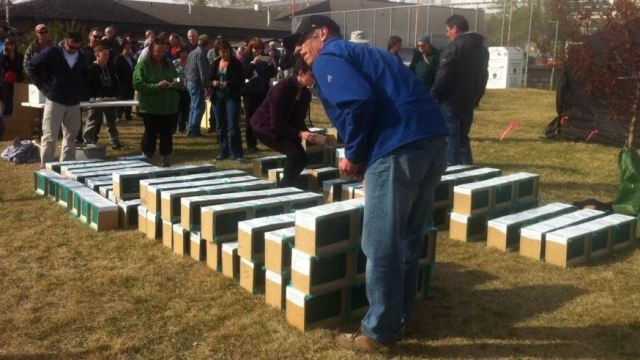
Calgary has a hyper-active bee club. Members help members with all manner of thing. Equipment exchanges, educational programs, disease control. The latest big event was the arrival of 160 packages of bees from New Zealand. By the way, 160 packages contain 160 queen bees and about 1,008,047 worker bees.

This is an exciting, albeit anxious, event for new beekeepers. For many of the folks picking up their bees, this was their first encounter with their own honey bees. Most of these novices had taken the Calgary Bee Club beginner’s bee course. They’ve paired up with mentors (or will when the season starts), and they have spent the winter reading bee books and attending bee club meetings. And yet. There they are, grasping cages of bees, nervously loading the back of a truck or the trunk of a car with thousands of living, buzzing insects.

brisebois 1

The bees speed off with their new servants, inexperienced beekeepers whose lives have suddenly flipped upside down. From now on, these beekeepers have new masters – masters with stingers.  Already there are internal e-mails between new beekeepers and old beekeepers, further exposing trepidation.  One beekeeper may have lost a queen while installing the package. Now what?  Another’s queen cage fell to the bottom of the hive box. Cork open, but no guarantee the unseen queen crawled out. What to do? Others were concerned that the weather is turning cool. Is that good or bad? And on it goes.

Reassuring answers bounced back to the newbies. In most cases, the bees will be fine. They will settle down in the cool weather (though they will need easy access to feed) and the queens will soon be laying eggs. (Unless she took flight during installation. In that case, a new one is needed yesterday or even sooner.)

Here in western Canada, we can still get some cold weather, hopefully some wet weather, and there will be sunny days. Packages installed this weekend should build into fully productive hives by late June. They will likely make over a hundred pounds of surplus honey this summer. It all happens fast and even oldster beekeepers are impressed and surprised by the production of packages.

In today’s blog, I’m not going to go into the politics about Calgary beekeepers getting their bees from New Zealand (12,ooo kilometres away) instead of the more sensible source next door in the USA. And I won’t discuss the reasons that Canada – after 30 years of gallant attempts and much ballyhoo – never succeeded in being bee-independent. Instead, we’ll just celebrate the return of the robins from the States and the arrival of the bees from the south Pacific!

I wasn’t at the package pick-up point Friday afternoon where angst was in oversupply. But at least one club member took pictures. Their photos were used in this blog post – I give thanks and full credit to www.briseboisbees.com.

brisebois 2 New Zealand package

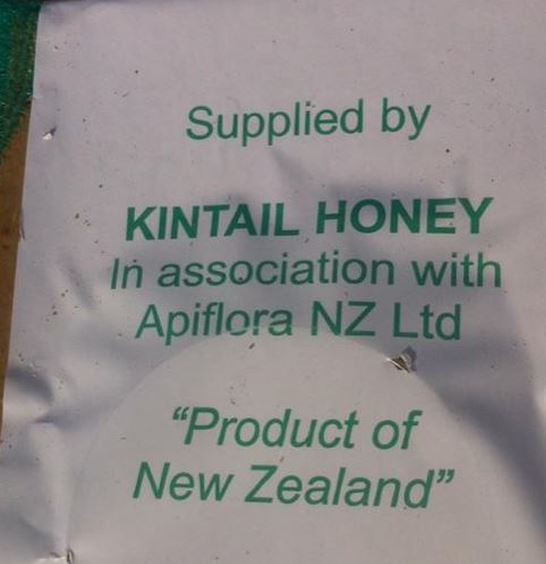
brisebois kintail

Posted in Beekeeping, Friends, Outreach, Queens | Tagged , , | 2 Comments

Weird Spring

stark desert sun 2We are having weird, weird weather here in Alberta. It’s dry as a desert and almost as hot as one. Since January, our temperature has stayed well-above normal. Ten  degrees above normal, in fact. And that’s embarrassing.
It’s embarrassing because when I helped teach a couple of beginner’s bee courses this winter, I told the new beekeepers what to expect in the spring.  I led a session about nectar sources and their blooming periods in the Calgary area.

“Around April 15, you can expect the first pollen. It’s from crocus and pussy willow. The peak dandelion is May 25 and it’s our most important spring flow.”  Well, I sure didn’t anticipate anything like this season. So far, this year is proving me seriously wrong. We’ve had pollen since early March, over a month too soon. Bees collected frames of pollen by April 1. This week, I spied patches of dandelion. Not a full-blown dandelion nectar flow yet, but there is some yellow on south-facing hillsides. A month early. It’s probably not a good thing.

April dandelions in Calgary. The grass should be lush green from spring showers, but the drought has left it brown. Even the dandelion flowers look stressed.

April dandelions in Calgary. The grass should be lush green from spring showers, but the drought has left it brown. The dandelion flowers look stressed.

Unusual heat has advanced our season. This week we broke a hundred-year-old record. It reached 28C (83F) on Tuesday. That’s the warmest it’s been on this date in recorded history. Maybe that’s not so hot for you, but up here in Calgary, Canada, we’re getting summer temps. At this time of year, our normal high is 13C and our typical overnight low is below freezing. It has been warm for weeks. Our flowers are confused. We may have to get used to this erratic weather if climate change continues. (And that  looks likely.)

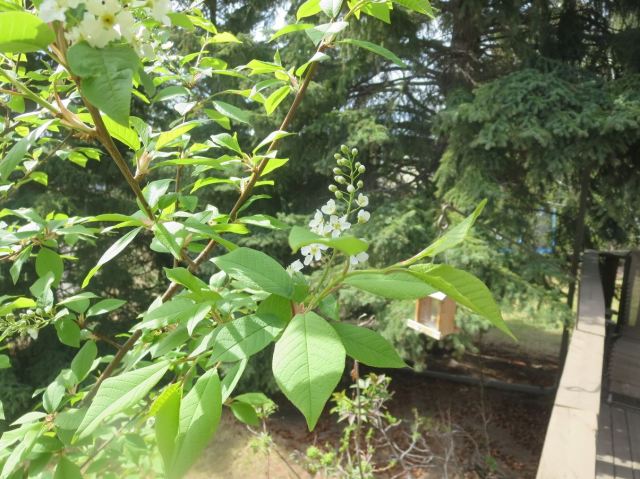
Our backyard cherry is also blooming a month early. This isn't good.

Our backyard cherry is also blooming a month early. This isn’t good.

What does a warm spring mean for bees? It might mean trouble later this year. Although the spring helps marginal colonies recover from the winter, the long-term consequences of all this heat can be bad. We will get a longer “June Gap” – the dearth between spring flowers and the main honey flow. This may force beekeepers to scramble to feed hungry hives during the gap. Further, with the early spring, bees may peak too early – already Calgary beekeepers are collecting swarms. When the summer flowers begin (clover and alfalfa for us), they may not last long. They may stop giving nectar in the heat and drought.

But the nice thing about all of this is that I could be completely wrong. Today’s Friday and it’s cool and cloudy for the first time in a days. By Monday it might be cold and rainy (or even snowy). And that would slow down the earlier blossoms, freshen the soil, and hold back the peak dandelion flow until May 25th or so. One can hope.

Posted in Beekeeping, Climate | Tagged , , , , | 2 Comments

The Queen, or Her Majesty Queen Elizabeth the Second

queen elizabethQueen Elizabeth commands tens of thousands and lays up to 2,000 eggs a day? That might be an editing error. Dan Graur, a biologist in Houston, discovered that Reuters News Service once required that all stories about “the queen” should henceforth refer to her majesty as Queen Elizabeth. Thus, instead of “the queen and her horse boarded the queen’s yacht,” reporters must write “Queen Elizabeth and her horse boarded Queen Elizabeth’s yacht.”  Well, that’s good, respectful policy. In theory. In practice, it threw a spanner in the works.

Soon after setting the standard, Reuters ran this cock up:

queen and reuters

If you’re not able to read the science news piece above, it says in part:

With its highly evolved social structure of tens of thousands of worker bees commanded by Queen Elizabeth, the honey bee genome could also improve the search for genes linked to social behavior.

Queen Elizabeth has 10 times the lifespan of workers and lays up to 2,000 eggs a day. Despite having tiny brains, honey bees display honed cognitive abilities and learn to associate a flower’s color, shape and scent with food, which increases its foraging ability.

Queen Elizabeth has 10 times the lifespan of workers?  I guess that depends on their type of work. Nevertheless, she will outlived a lot of us.  Today (April 21) marks her majesty’s 90th birthday. Grand celebrations are sweeping the Commonwealth as royalists pay homage to the lucky lady who has (as Reuters says in their piece, above) a genome that could improve the search for genes linked to social behaviour. Jolly good of her.

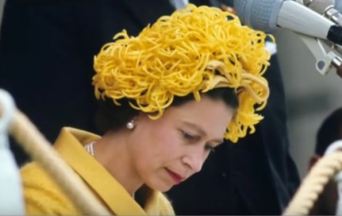
QE II hat-2

Posted in Culture, or lack thereof, Humour, People, Queens, Strange, Odd Stuff | Tagged | 3 Comments

Hive Materials

Yesterday an e-mail arrived from a European beekeeper. He is new at bees and wanted my opinion about bee things (hive types, honey plants, eco-tourism). One of his questions particularly stood out.  He had found an ad for “honeycomb material” designed for the aeronautic industry. Rigid, light-weight, and made of synthetic materials. You can see the ad at this link. Here is a picture of the material. It looks like bees made it, doesn’t it?

The advertisement reads:

Aramid Honeycomb is a lightweight, high strength, nonmetallic honeycomb manufactured from aramid fiber paper. After the honeycomb is formed, it is coated with a heat resistant phenolic resin to increase its strength. The core material exhibits high strength to weight ratio, low density, and is very bondable. Aramid honeycomb is becoming increasingly used in high-performance non-aerospace components due to its high mechanical properties, low density and good long-term stability. The Standard Cell honeycomb is manufactured with the typical hexangular cell shape.

You are all welcome to comment below, but my first thoughts are that the material is likely not approved food-grade, the cell-size might not align with a bees’ knees, it may emit fumes toxic to bees inside a hive, and honey bees are reluctant to use fully-drawn artificial combs. That’s how I answered the person who wrote. I also told him that I could be wrong – I often am.

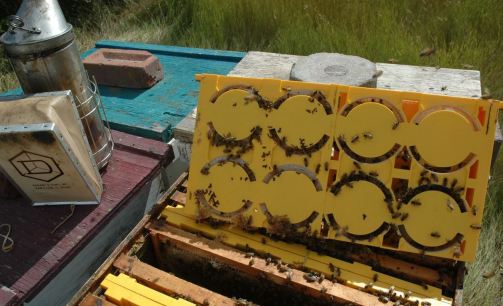
I appreciate innovation and I think that plastic bee supers and frame parts are fine. Our own 8-comb honey frame, pictured here, makes great use of durable, re-useable plastic. We have been making and using these for 10 years.

Summit Comb in use

honeycombpacking

I haven’t always used plastic, of course. Nor are all our hive parts plastic – most are made from western softwoods. The first bee boxes I ever hammered together (rather poorly, I hasten to add) were made from an aging tulip poplar tree that grew on our Pennsylvania farm. We milled it with saws we had set up just outside our cow pasture. Tulip poplar (also called American poplar and tulip tree) is neither a tulip nor is it a poplar in the sense of the aspens or Walker poplars that are common out here in western Canada, where I’ve lived for the past 40 years.

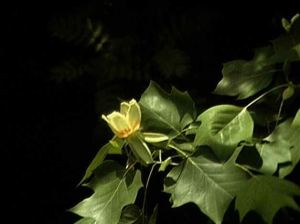
Tulip poplar in bloom

Tulip poplar in bloom

The tulip poplar tree has magnificent tulip-shaped flowers as big as teacups. At night, those teacups refill with about a teaspoon of fresh nectar in each. There are hundreds of these flowers on a mature tree (which can reach 200 feet, or 60 metres). Bees love tulip poplar trees, but most seasons the skies are gray and drizzly. The nectar is often washed out by raindrops, not bee tongues, leaving little for the beekeeper. With cooperative weather, the beekeeper may get about 40 pounds of tulip poplar honey during the brief flowering season, but that’s about it.

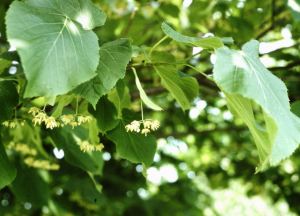
trees in bloom: Tulip poplar, left; basswood, right

Basswood (Linden) in bloom

In Pennsylvania, near my family’s farm, beekeepers and mill-operators chopped down thousands of the beautiful basswood (linden) trees that once dominated the eastern landscape. Beekeepers used the soft pliable basswood to make squares for comb honey sections. From 1880 to 1920, they used one million of those basswood boxes each year for packaging comb honey. So many trees were cut for comb honey that basswood trees almost disappeared from the eastern forests.  Ironically, basswood is a nectar fountain, prolifically yielding white mild honey when few other sources are available in the Appalachians. Cutting the tree to make the package for the tree’s honey was about as sensible as killing a goose that lays golden eggs.

Old-fashioned honey section, made of basswood. Thousands of trees were destroyed to make these.

Old-fashioned honey section, made of basswood. Thousands of trees were destroyed to make these.

When I lived in the east in the early 1970s,  I felt it was a bit rude to turn nice (honey-producing) trees into tulip-poplar honey supers and basswood section-boxes. I was uncomfortable with the idea then and even more uncomfortable today. This is why using plastic (especially for hive parts that may last a hundred years) has some appeal to me.

But this does not mean that we can experiment with every construction material we encounter. My plastics are food-grade, tested and certified. The aramid honeycomb construction material that started this blog post (non-metallic and “coated with a heat-resistant phenolic resin“) is probably not so great for holding honey. The Estonian beekeeper who wrote to me and inspired today’s blog post knows this and was not planning to use it as frame material. He was just curious, as we all should be.

Posted in Hives and Combs, Tools and Gadgets | Tagged , , | Leave a comment

Rhodo Poison?

Rhododendron bushes

The rhododendron is a beautiful plant, but it’s rumoured to intentionally maim and kill honey bees.  My mother had a favourite rhododendron bush in the yard by our house in the Appalachian foothills. Now that I am older and presumably wiser, I’m surprised that we had rhododendrons on our farm at all. If its nectar kills honey bees, the plant would have been cursed by the  dozens of hives stationed on the hillside behind our house.

But rhododendrons are nice. They include over a thousand species and 28,000 cultivars, according to the International Rhododendron Registry. Almost everyone in the right temperate zone wants one.  The extensive family of ‘rose-trees’ (as the Greek name ‘rhodo-dendron’ translates) includes tree-like shrubs with rose-like flowers. It also includes the common azalea, a smaller and less showy type of rhododendron.  When I was in northern Kentucky last month, azaleas were beginning to bloom. The ridge line of the Appalachian mountains is erupting in rhododendron scent at this moment.

People have long noticed the sweet honey smell of rhododendron flowers and wondered why bumblebees liked them but honey bees didn’t. Here, for example, is a description of the plant  from John Lovell’s 1926 book, Honey Plants of North America: (1)

Lovell on Rhododendrons

Do you notice how Lovell begins by telling us that rhododendrons are bumble-bee flowers?  Although beekeepers reported sweet nectar falling in large drops from the rose-shaped flowers, they claimed that honey bees ignored the plant.  Bumblebees, however, were seen working it. Lovell does not elaborate and does not mention that for honey bees, rhododendron nectar may be poison.

There is some debate about whether honey bees actually visit rhododendrons. If the nectar is toxic, we might guess that scouts which return with the stuff are looked upon rather disapprovingly by their fellow bees. Or maybe the scouts simply die in the field, never reporting their finds to their hive-mates. However, bees must store some of it because there are accounts of people becoming sick from rhododendron honey. With over a thousand species, it is likely that some rhododendrons produce stronger potions of poisons than others. This, I think, could explain the discrepancies in the reports.

For example, a European variety of rhododendron (R. ponticum) is visited by honey bees. Those bees produce a mildly toxic honey that was once allegedly used during wars to poison invading enemy troops. Stories tell of soldiers finding rhododendron honey left by fleeing citizens. According to legend, the invaders sometimes ate enough of the tainted honey to become too sick to fight.

Maybe it was something he ate.

Maybe it was something he ate.

These days, it is the European rhododendron itself which has become the invader, occupying vast stretches of Wales and some of England’s southern heaths. It displaces native vegetation when it escapes backyard gardens. It is spread by prolific seed production and maintained by stubborn suckers and green-thumbed blokes. You can read a delightful and informative piece about the European rhododendron at Emily Scott’s site, Adventures in Beeland.

To me, the existence of toxic nectar is a scientifically intriguing puzzle. Why would plants generate nectar that poisons pollinating insects? That sounds counter(re)productive. We have come to believe that flowers evolved to attract pollinators with nectar. Happy bees make happy flowers. Dead bees don’t.

cartoon bee with honey

The favoured pollinator.

The answer may be in an article in the journal New Scientist. It’s a piece called  Bitter sweet nectar: Why some flowers poison bees.  Why do flowers do this nasty deed? One of the answers is clever and may even be correct. According to Stephanie Pain in her 2015 report, some ecobiologists think the rhododendrons are selecting a certain subclass of pollinators – bumble beesthat have evolved to tolerate rhodo-poisons called grayanotoxins. These have different effects on different bees. “They have no apparent effect on worker bumblebees.  Mining bees show short-term symptoms of malaise. They lie on their backs with their legs in the air but recover later.  But honeybees die within hours.

It seems that European rhododendrons have been poisoning honey bees as a favour to bumblebees. The bumblebees tolerate the toxin and pollinate the flowers. This assures a surplus of food for the preferred pollinator. Other bees are simply dispatched – dead or wounded – leaving more food for the true friends of the flower.  This would explain why, a hundred years ago, John Lovell wrote “The Rhododendrons are bumblebee-flowers.”  Indeed they are.

(1) 1926. John Lovell, Honey Plants of North America, p 194. Since the reproduction above may be hard to read, here is what the text says:

RHODODENDRON.  The Rhododendrons are bumblebee-flowers. The following report from a beekeeper at Divide, West Virginia, is noteworthy : “I am reasonably sure that honeybees never visit the Rhododendron in this locality.  Last season tons of nectar dropped from the flowers by my apiary, but I was unable to find a single bee on the bloom. The nectar fell in large drops, was pleasant to the taste, and very sweet. The Rhododendrons cover the land for mile after mile, and when in blossom present a most beautiful appearance.”   A number of observers have reported visits to the bloom by several species of the larger bees, but the Rhododendrons are not listed as honey plants in any state. The flame-colored azalea (R. calendulaceum) is exceedingly abundant in the mountains of North Carolina.

Posted in Bee Biology, Ecology, Honey Plants, Pollination | Tagged , , , , , , | 3 Comments

Cher Justin Trudeau…

Regular readers of this bee blog know that I avoid politics with as much self-discipline as most people avoid lounging on sunny days on a south-facing deck. This is a bee blog, not a political blog. If I ever mention liberty, secularism, or social justice, you know it’s just common sense, not politics  – right?

But with the viral eruption of the Canadian prime minister’s quantum physics lecture (now shared by a million Facebook users), I thought I’d be safe saying a few words about Justin Trudeau’s politics of personality. If you missed it, here’s the former science teacher’s explanation of quantum computing, delivered on Friday at Canada’s theoretical physics lab:

Canada’s prime minister was likely briefed, but he skillfully carried the day. At his press conference, the question that prompted Trudeau’s science lesson actually was about Canada’s role in fighting ISIL terrorists. At first, Trudeau side-stepped the question and responded to the reporter’s joke, which was about quantum computing.  The prime minister proceeded to describe the difference between binary and non-binary systems. It was a cute and charming retort, drew laughs, and astonished non-scientists. But the shared videos (including the one above) sell the prime minister short because at the press conference, his jest was just a prelude to his explanation that fighting terrorism is not an on/off or yes/no binary challenge, but is more nuanced – sort of like quantum physics. The attention he got for his prelude, which received far more attention than his more serious second point, tells us much about politics, successful politicians, and the susceptive public.

It takes work to be a successful politician.  A few years ago, a friend of ours met Justin Trudeau in southern Alberta. Trudeau was not the prime minister of Canada at the time. Our friend – Jacques – presented a comb of honey from our honey farm to the young politician. Jacques loved bees, had helped with our honey farm regularly, and was a part of our circle of friends. He once told me that bees (along with his wife and six kids) were one of the few pleasures he had as his days were becoming more and more difficult. Here you can see Jacques in a picture I took of him a year before he died of a long-term illness. As you can see, Jacques was something of a bee-charmer.

Jacques, at one of our apiaries, in 2011

Jacques, at one of our apiaries, in 2011

When Jacques met Justin Trudeau, the future prime minister spoke a few words in French, thanking Jacques for the honey and telling him that his father (Pierre) regularly bought comb honey for the family when Justin was a child.  A week after they met, we received a hand-written letter which arrived in the mail at our honey farm. It was from Justin Trudeau, addressed to our farm, and directed to “Jacques”.  I think that Trudeau’s staff used the label on our honey comb to look up the mailing address on our website and then Trudeau wrote his thanks, commenting about how long it had been since he had eaten such good comb honey. To a beekeeper, a honey compliment ranks with a strong handshake. (In turn, Jacques gave me the letter –  I treasure it.)

I’ve met other politicians but few make such efforts to be gracious. Some will forget you as soon as they turn away.  You can be sure that my accolade is not intended as validation of everything Justin Trudeau’s government is doing. But the man’s wit, charm, and grace are a genuine reflection of his effort to do his job as a politician and are probably an accurate depiction of his personality.

trudeau letter

Justin Trudeau’s gracious note of thanks for the honeycomb.

Posted in Comb Honey, Friends, Outreach | Tagged , , , | Leave a comment

Ecology 1,2,3

bee with pollen

On Friday, I led an ecology program at the local elementary school. My 32 students ranged in age from 6 to 12. They were part of an experimental class where kids in their school could select their interest and indulge for a couple hours each Friday.  One of the school’s teachers invited me to lead a 2-hour honey bee ecology session. Bees, flowers, little kids. What could go wrong with that?  Actually, it went much better than I expected so I’ll share what I did and what worked best.

dani-comb2We started the program inside a classroom. I made a 30-slide Powerpoint which featured bees, flowers, and children working with bees. (For a kids’ Powerpoint, use just one picture per slide and just two or three large, simple words. Don’t clutter the slide with wordy details and excess photos. This advice goes double on presentations for adults – they have even shorter attention spans.)

The pictures were a backdrop to the more active hands-on presentation which I conducted simultaneously. It began with a big plastic garbage bag. Meanwhile, the first slide showed someone’s palm covered in bees. The kids squirmed and one youngster demanded to know why the hand in the picture wasn’t getting stung. In answer, I held up the plastic bag.

“I have a bee in this bag.  Is everyone OK if I take the bee out and show it?”  A few kids slid away from me. I didn’t let their anxiety build. I promised it would be OK if I took out Benny the Bee.

Benny in veil 2Benny is a big, stuffed, adorable bee. He’s a boy, just like the bees causing concern in the picture on the white-board behind me. “Boy bees, like Benny and the drones on the screen, don’t have stingers.”  I used this as a starting point for bee safety. (“Girl bees can sting if they feel threatened.”) I began a quick overview of bee anatomy. Even the smallest of the kids knew that bees have three main body parts. I described the head as the brain, eyes, and mouth of the bee while the thorax is like a huge muscle that powers the wings and six legs. The abdomen (for the kids’ presentation) is mostly a stomach and a stinger.  The kids were fascinated that bees have three sets of eyes. I didn’t go into the way polarized light can be sensed by a bee’s third eye, but I did touch on ultraviolet, comparing the bee’s extra colour vision with the high-pitch sound perception of their pets – something these kids understood.

bee suit presenterThe presentation continued like this. After a few more slides, the teacher dressed a child in the little bee suit which I’d brought. Meanwhile I passed around a new Pierco frame and a new small copper smoker. We talked about these, but mostly I wanted the kids to physically connect with what we were doing.
We had pictures and discussions of bees on flowers and the idea that bees communicate their discoveries. It was time for the waggle-dance. After half an hour of patiently sitting and listening, the kids needed a stretch, so they waggle-danced. They stand, wiggle quickly, walk forward, turn around, and repeat. I strongly recommend this activity if you are talking bees to small kids for any extended period. The kids need to stretch and they’ll remember that bees dance to communicate.  At all times, I try to give simplified but directionally accurate information. This is not the time to point out that debates exist regarding the precision or utility of bee dance communication. On the other hand, respect the kids, use intelligent language, and don’t coo and giggle. They’ll respect you as an adult and pay attention if you treat them as smart young people.

I mentioned flowers and pollination. At this point – with little tots as your audience – you want to select your words carefully so you might be invited back another day and not spend the afternoon explaining yourself at the principal’s office. I never use the words ‘sex’ or ‘reproducing’ – it’s enough to say “bees help flowers make seeds. Without bees, there would not be flowers, seeds, or fruits like apples and blueberries.”  The kids never ask for more details so you can generalize.  Show pictures of bees dusted in pollen. Talk about the way flowers attract bees with nectar. But genetics can wait until junior high.

At this point, the teacher led the children outside. Benny the Bee accompanied the youngsters, carried by a shy-looking kid whom I’d spotted.

q-tip

I had three outdoor activities planned. Since the focus was bees and ecology, I wanted the kids to 1) notice flowering trees, bushes, and annuals; 2) look for places where bumblebees might winter (cracks in the ground) or where honey bees might nest (cracks in the school building’s masonry); and, 3) collect pollen.  I distributed Q-tips (cotton swabs) from a new, unopened box which I’d brought. The kids each got one new Q-tip and (gently!) attacked flower blossoms, dabbing pollen, pretending to be bees. Soon, almost every child was thrusting a Q-tip towards my face and asking, “Is this pollen?” They always received an affirmative, even when the swab looked like it was covered with dirt.

The kids become rather confident of their knowledge about bees and any fear they may have had abates a bit. So it’s good to use the outdoor setting to remind them again to be careful and respectful of bees. Too much exuberence may lead to stings.

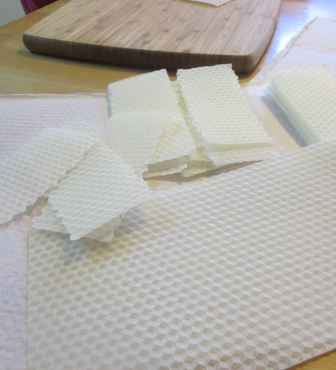
wax rectanglesBack inside the classroom (where the children were counted), I distributed handouts with bee cartoons to be coloured and trivia questions to be answered. The kids liked these but were even more interested in the small rectangular strips of new wireless foundation I gave them. This is always a big hit because they notice the waxy odour and hexagonal pattern right away. I caution them not to eat it, but I know that some will and I know that wax is harmlessly ingested. Giving wax is better than giving honey (which beekeepers sometimes distribute) because it’s not sticky and parents are not going to call with complaints about their youngster’s blood sugar and dietary restrictions.
All of this lasted about two hours. In two hours, you reach over 30 kids and, indirectly, a few dozen parents. It takes a few hours to prepare, but if you use some of my tips (especially the wag-dance stretch break, the wax gift, and the outdoor activities),  you will find that the kids will enjoy learning and the message about the importance of bees will get out to the schools.

Posted in Ecology, Outreach, Pollination, Save the Bees | Tagged , , , , | 2 Comments

Saving Honey

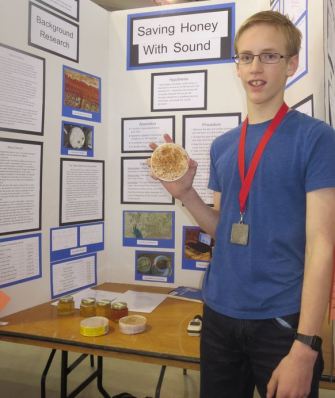
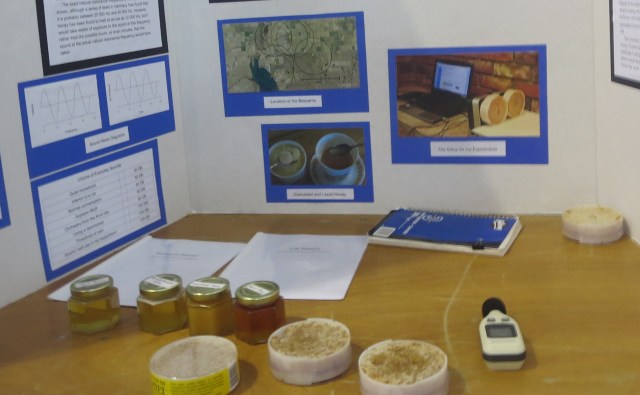
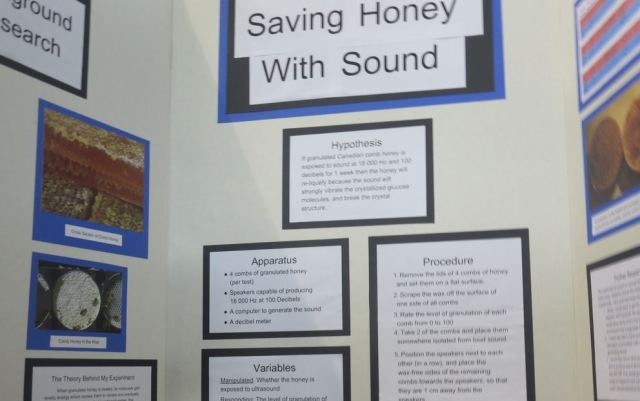
SciFair-2Brag time.  We just got home from the big Calgary science fair competition. My 13-year-old won three awards. Here’s the kicker: his project was called  Saving Honey with Sound.  His experiment was based on sending ultrasonic energy waves into combs of granulated honey, attempting to liquefy the honey without using heat and without melting the wax comb.
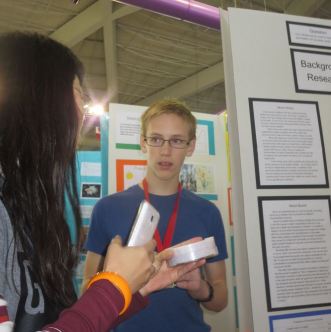
His awards included a gold metal for creating a great original experiment, an award from a home economics group, plus the Consumers Economics Prize from the Haskayne School of Business. Also, the University of Calgary presented him the Hunter Centre Secondary (ie., high school)  Consumer Science Award.  Being recognized meant competing with 902 other students, all of them there by invitation because they had placed well at their local school events. Across Canada, over half a million kids participated in this year’s science fairs. That’s the same number that participated in hockey this year. So it’s a big deal.

SciFair-3

My son wanted to help beekeepers who face trouble when honey begins to crystallize in the comb. For experts, he talked to some Alberta beekeepers and he interviewed a major honey packer. For background, he studied physics books. For coaching, he relied on his mom, who is a physician, not a keeper of bees, and who is a skilled public speaker. I stayed entirely out of his project. This was our son’s experiment – he spent about 60 hours in the basement working on it and we are happy that he put such effort into the science.  For example, he learned that it’s largely the glucose/fructose ratio in honey that causes granulation. This varies flower-to-flower, which is why some honeys crystallize more quickly than others. He explored heat-induced honey damage and investigated cheap ways to generate high frequency sound waves. He also learned about resonant frequencies and how they can cause molecular vibration which in turn can phase-change solids to liquids.

SciFair-6Here is what I learned from him. The idea of using ultrasound to reverse granulation works, at least as part of a small-scale experiment. It may even have commercial application, but my son is not totally convinced. He used speakers which emitted 18,000 hertz sound waves at just over 100 decibels. (By the way, at such a high frequency, the sound is inaudible to humans. There is no risk of hearing damage – we asked an auditory physician before we allowed the boy to start.)  After seven days, there was some liquefying. He told me that if he had bigger speakers and if he had an amplifier that could generate a higher frequency, the results would have been more spectacular. That’s what he thinks would be required in a honey operation if a beekeeper wants to extract any combs which are crystallized.


SciFair-5

You can see the benefits.  If the idea actually can scale up, hot rooms might be replaced with sound rooms. Honey sold in the comb could be restored. The science fair judges recognized this, hence the economics award for an experiment that combined the physics of sound and the chemistry of honey.

SciFair-8c

Posted in Comb Honey, Hive Products, Honey, Outreach, Tools and Gadgets | Tagged , , , , | 12 Comments

Too much to do…

During the past two weeks, I flew from Calgary to Cincinnati (and back again); organized, prepared, and co-presented a day-long beekeeping economics program; ran a 2-hour ecology school at the neighbourhood elementary; was an invited “expert” at ask-an-expert night at the bee club; and co-judged all the entries for the Calgary Stampede’s first-ever honey show. Somehow I even completed a geological mapping project for a Colombia, South America, client. The last on the list represents my day-job and it’s not as exciting as it sounds.

So, two weeks ago, I flew back home to Calgary from Cincinnati. It was my first trip to the USA in almost ten years. If a person visits The States after a decade’s absence, you’d think they’d go to Florida, or Manhattan, or San Francisco, right?  Well, this impromptu trip arose from a benign but indomitable set of circumstances – I was pulled along by circumstance.

My wife and our two school-age youngsters were enjoying spring break with family in central Europe. They took a quick, one-week, pop-in/pop-out trip. I’d been there last summer, so I thought I’d stay home and write blog posts or something.  But then I thought I should fly to San Diego to see my sister. She comes up to Calgary every year, so I certainly needed to return the visit. But during spring break, my sister would be travelling to Cincinnati to see her twin, a young lady about the same age as she, as you can see in the pic below:

My sisters and I at Cincinnati's Krohn Conservatory

My sisters and I at Cincinnati’s Krohn Conservatory

I went to Cincinnati to see two sisters with one flight, so to speak. Then more family started to appear, like robber bees scenting spilt honey. Well, actually more like spring flowers gracing an alpine meadow – these are wonderful people whom I’d not seen in years. It was all good.

I had been to Cincinnati a few times in my younger days. I already knew about its enticing lack of tourist attractions and its disquieting weather. But there is now a new Freedom Museum (celebrating  dreadful stories about the Underground Railroad and America’s escaped slaves who, making it across the Ohio River, into Cincinnati, connected to routes north to Canada) and there is the old architecturally stunning and historically inspiring Plum Street Temple where the American Judaic Reform movement began. So, even if five of my siblings had not shown up to greet me, there would have been things to see and do.

cherry treesAlthough the Ohio River’s Queen City is known for icy winter roads, gray gloomy skies, and sweltering summers, I knew that spring in Cincinnati could be delightful. Except for a day of tornadoes, it was.

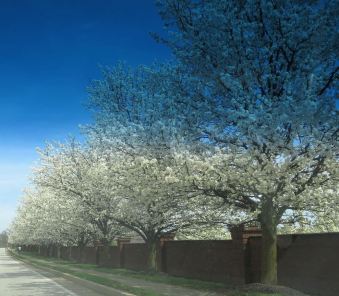
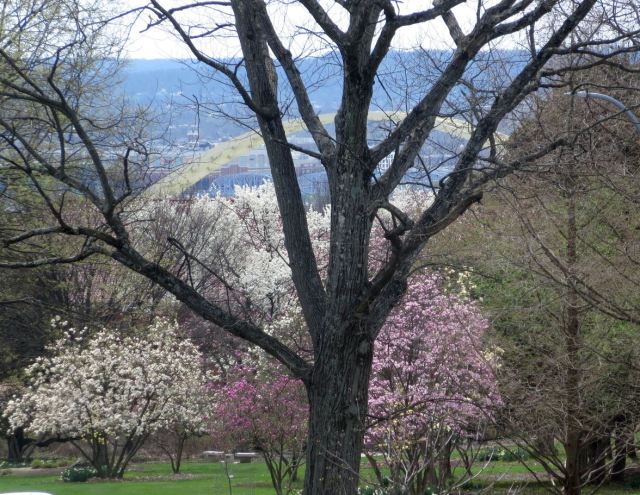
My first glimpse of the rolling hills as my plane dropped towards the airport revealed thousands of stunning white trees – dogwoods and cherries sporting glorious blossoms. Driving towards my sister’s home, I snapped dozens of pictures of tulips, daffodils and forsythias. The next day, at the Krohn Conservatory, we were regaled by exotic tulip-flowered magnolias in pink and purple costume. The grass was green and the sun shone sweetly.

I didn’t see honey bees. There were a few bumblebee types and some butterflies, but the honey bees were notable for their absence. I knew that on this brief visit I wouldn’t have time to track down local beekeepers, so I didn’t even try. If you are not a beekeeper, you’d think that honey bees would do well among the tulips and daffodils, but you’d be wrong. Not every flower feeds honey bees.

Beekeepers in this area are intrepid souls, keeping bees for the love of it, not for any certainty of wealth. Changeable weather, acidic soils (which turn clover and alfalfa into weeds rather than fountains of nectar), and extensive corn fields all conspire against the beekeeper.  In my younger days, I parked two hives of bees in an oak grove near Florence, Kentucky, ten kilometres south of Cincinnati. I did this so that my oldest sister’s family could experience bees. The bees died within two years. Not due to neglect or mites (this was in the days before either neglect or mites existed) but instead due to the relentless wearing down of bees kept where bees do poorly.

Very pretty, but not a honey bee's paradise.

Very pretty, but not a honey bee’s paradise.

At our four-day-long reunion, the laughter and stories were warm and nostalgic.  I am a middle child of ten kids so I had the mediator’s position of watching four older and five younger siblings grow up, then disperse across North America from our childhood subsistence farm on the edge of Pennsylvania’s Allegheny Mountains. There was much to reminisce, some of it charming, some of it tragic.

Too often,  there is too much to do. Connecting with an extended family gets sublimated to the duty of nurturing one’s closer family. I left Cincinnati and flew back to Calgary, where my wife and youngsters were arriving the same evening from Europe. Then it was back to preparing the bee course, the ecology lesson, the honey judging, the geology mapping. These were all interesting, entertaining, and successful and will be subjects of future blog posts. But the journey into America’s heartland and the time spent with far-away family will remain in my memory for a long time.

Posted in Friends | Tagged , | Leave a comment