Buzz the Bee is on Vacation

Buzz sweetens cereal

Benny suitcase standing up

General Mills is sending Buzz the Bee, their cheerful Honey Nut Cheerios spokesbug, on vacation. Or into hiding. In a campaign bound to raise awareness for the world’s suffering bees, and maybe to inadvertently sell more Cheerios, packages of the breakfast cereal will temporarily be gloomy boxes of oats without happy Buzz images. The hapless bee left without saying “Goodbye”, “So long”, “Ciao”, or even “Cheerio”. Buzz simply left us one cold dreary morning.

Diphaglossa gayi

Diphaglossa gayi   (Source)

General Mills (GM) says they have sequestered their happy bee so that bloggers such as I might write about the world’s missing bees, bringing attention to the plight of bees. No one doubts that bees are plighted. With climate change and our chemically soupy environment, it’s getting rough for all sorts of creatures. There were once about 25,000 species of bees in the world, now there are hundreds fewer. The honey bee is just one  species of bee (Buzz the Bee is a subspecies of honey bee, technically it is Apis mellifera generalfoodi). Humans are preventing honey bees from going extinct, but less celebrated bees, such as Diphaglossa gayi are pretty much on their own – and are becoming rare.  (When was Diphaglossa gayi, the Chilean Valdivian Forest Forked-Tongue Bee, last seen on a box of cereal or a carton of milk? Huh?)

GM’s people tell us that “Buzz is missing because there’s something serious going on with the world’s bees . . With deteriorating bee colony health, bees everywhere have been disappearing by the millions and it’s time we all did something about it.”  To bring back the bees, General Mills is giving away packages of seeds. Put a few seeds in the ground and before long you’ll have bees. Not directly from the seeds, by the way, but from the wildflowers that may grow from the seeds that will feed the bees.  Why not?

The free seeds seem to be a Canadian give-away. This  offer might not be available if you don’t naturally say ‘eh’,  eh?  Anyway,  the free wildflower seeds are at the other end of this link.  “With ongoing losses in bee populations being reported across Canada, we’re issuing a call to action to Canadians to help plant 35 million wildflowers — one for every person in Canada,”   says Emma Eriksson, Director of Marketing for General Mills Canada.

What can you do to bring the General Mills cartoon bee mascot back from its hiatus? Buy cereal! Let GM know that you miss their goofy bee. With enough of us stocking up on Honey Nut Cheerios (We bought 3 boxes!),  it will send a loud and clear message. We want Buzz back!  And hurry – we won’t survive long (Einstein says 4 years.) without Buzz the Bee on cereal packages.

Benny with Cheerios


Posted in Humour, Save the Bees, Strange, Odd Stuff | Tagged , , , | 4 Comments

Location, Location, Vocation

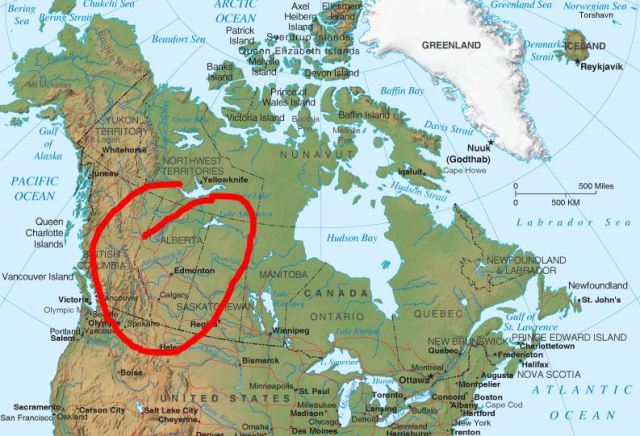
Alberta on a mapMy last two blog posts (Alberta is Beekeeping and Canada’s Hive Beetles) were unseemly braggadocious pitches. I wrote about how great beekeeping is on Canada’s western  prairies. Alberta, Canada, has not had CCD, but instead has increasing numbers of kept bee colonies (twice what it had in 1987, and still growing), and has production that averages around 150 pounds per hive. Winter losses have been around 10%.  In my writing, I may have implied that Alberta beekeepers are universally hard-working, intelligent, god-like souls who create peppermint-scented gas after heavy meals. Granted, that perfectly describes most of us. But I should lay due credit and burnt offerings before the altar of the well-designed western prairies. Good beekeeping is a function of good location more than anything else.

One of our more scenic yards, south of Calgary, in sight of the Rockies

One of our more scenic yards, south of Calgary, in sight of the Rockies and amid alfalfa

Alberta, a western-Canada province with 4 million people and 300,000 colonies of bees, has millions of acres of canola, alfalfa, and sweet clover. All three of these honey plants do well on Alberta’s sun-drenched alkali soils. They secrete millions of tonnes of water-white nectar, of which honey bees gather a small percentage. Alberta beekeepers produced about 43 million pounds of honey in 2015.

The western prairies is a good honey place. It’s easier to be a good beekeeper when you have money from honey and can do all the best things that your bees demand – replacing older brood comb each year, requeening regularly, managing pests intelligently. In some parts of the world, beekeepers struggle to produce a crop and lack money to give their bees the time and resources they need. In Britain, for example, a colony of bees averages 30 pounds of honey a year. (A few years ago, the average was 8 pounds per hive in the isles.) You have to really, really love beekeeping to continue with bees when things are that bad. (And most British beekeepers really, really love beekeeping.) It is almost impossible to sustain a commercial business with small crops – unless you are raising queens or doing pollination.

Bad Beekeeping, coverTen years ago, I published a book called Bad Beekeeping. It’s a memoir about running a small commercial honey farm. I titled it Bad Beekeeping because I had met a Canadian beekeeper who was making enormous (200-pound) honey crops and he asked me why American beekeepers average just 60 pounds a year. I explained about the lack of good forage, cool wet summers, poor soils, weak honey flows, focus on pollination instead of honey production, and so on. When I finished, the gentleman said, “No, Ron. I’ll tell you what it is. It’s bad beekeeping. They could make big crops, too, if they were better beekeepers.” The fellow who made the remark was a good beekeeper but he was also living in a place where 200-pound honey crops are possible. Our tendency to take credit for success due largely to lucky birth and lucky circumstances is tiring and unfounded. But it’s nearly universal. Sometimes it’s useful to give credit where it’s due.

Location, location, location is the oldest adage in real estate and lemonade-stand positioning. It’s certainly true in beekeeping. Just as it’s hard to be a deep-water fisherman if you are from Rugby, North Dakota (North America’s geographic centre) and it’s hard to learn to tame alligators in Kivalliq, Nunavut, our location influences our vocation. Western Canada’s beekeepers owe a huge debt to continental drift and mountain-building which combined to give us our perfect latitude and rich soils. Sure, we are god-like in our beekeeping skills, but it helps that in western Canada, the sun is shining on some fabulous fields of nectar.

  • A reminder that  a special bee course that I’m helping present, called “Making Money from Honey” and will be held here in Calgary on April 9th, 2016. My teaching partner, Neil Bertram, will tell students how to make money with bees while I specialize on losing money from beekeeping. (I can hopefully give cautionary tales.)  It should be a good balance. Course information is here: makingmoneyfromhoney.com. The seats are filling up. If you are in the Calgary, Alberta, Canada area, consider this one-day session in the economics of beekeeping and contact us today through the course website.
Posted in Beekeeping, Commercial Beekeeping, Honey, Honey Plants | Tagged , , | 5 Comments

Canada’s Hive Beetles

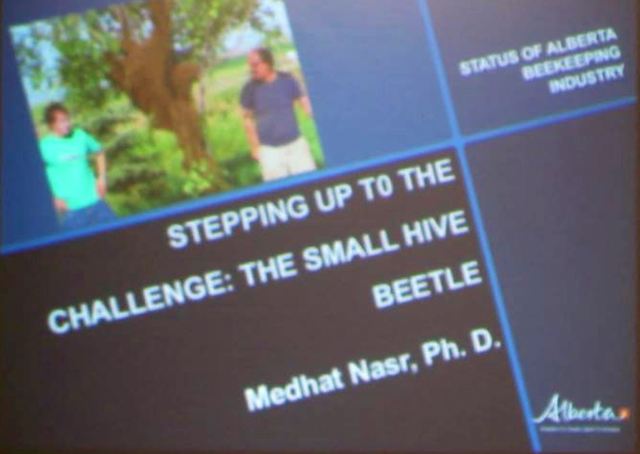
Medhat Nasr at the Calgary Bee Club

Medhat Nasr at the Calgary Bee Club

A couple of nights ago, Alberta’s chief apiculturist spoke at our local (Calgary) bee club meeting. Close to 150 people turned out to hear Dr Medhat Nasr give us a recap on the status of Alberta beekeeping and the status of the hive beetle in Canada.

There was plenty of good news in Medhat’s talk. Alberta beekeeping is thriving with more colonies (296,000) than there have ever been in our history. That’s more than twice the number of hives as there were back in 1987, according to provincial statistics. And production is high – the province-wide average was 145 pounds of honey per colony in 2015. The average would have been higher, if the 50,000 or so colonies kept for pollination weren’t counted – pollinating hives aren’t used to produce honey crops. Still, I’ll take 145 pounds per hive – it’s better than Britain’s 30 lb average, or the typical 60 pounds per hive gathered in the USA. Colony count in Alberta is growing, production is high, and wintering has been good for the past several years, with close to just 10% losses.

However, Medhat Nasr, Alberta’s provincial apiculturist, did have some potentially troubling news for beekeepers here. After running through the stats on production and after briefly talking about the free downloadable bee-health app his department created, Medhat’s Wednesday evening talk switched to the appearance of hive beetles in British Columbia, a Canadian province that shares a border (and a ridge of Rocky Mountains) with Alberta.

hive beetle slide 1

For those not familiar with the fifth horsemen of beekeeping doom* (or the Fifth Beatle, as I’ve heard the small hive beetle called), here’s what you might get when you open your hive and its got the beetles: slime and wiggly worms. Sometimes the only thing a beekeeper can do to stop a serious infestation is to burn everything. The fruit-sucking, honey-slurping creatures can multiply by the thousands with ugly, smelly results.

hivebeetles

Small hive beetle damage.

We correctly associate the small hive beetle with sloppy beekeeping in hot humid climates, so we are liable to become complacent on Alberta’s dry prairies where winters are long and cold. But apiculturist Medhat cautions us to be vigilant. He described research that claims the beetles cluster among bees through cold winters and even use their little antennae to beg for food. The kindly bees, it is said, are tricked into keeping the beetles warm and plump all winter. The best offense against the slimy intruders is defensive behaviour on the part of beekeepers. A hive does not always get overrun when hive beetles are present.

A few years ago, I saw a bee outfit in Florida where just a single hive beetle was hiding under a pollen cake. The beekeeper told me that as long as his hives were strong and things were kept clean, the beetles never appeared in any big numbers.

Medhat repeated this advice – if the small hive beetle shows up in Alberta it will likely be no more than a minor nuisance among operations that are kept tidy and run efficiently. Among other beekeepers, though, some bad habits may need to change. Extracting can’t be postponed for days or weeks, for example. Such a lazy lag allows the beetles time to establish themselves in a shop and start messing with your honey. Extracting immediately has always been good policy among good beekeepers. Now it may become a necessity.

Although bees may tolerate a few beetles inside their hive, strong colonies don’t allow the numbers of beetles to grow. But in a big box with just a little cluster of bees, there are lots of places for the small hive beetle to hive. So, the usual advice of keeping strong colonies continues to be true.

Will Alberta have small hive beetles? It’s certainly possible. Just across the continental divide and over the ranges from us is the mild Pacific coast. That’s British Columbia and the beetle has been found there.  We call the mild coastal area “the lower mainland” and it is where Canada’s palm trees grow. It’s also home to the city of Vancouver and some outlying towns, villages, acreages, and orchards. A few Alberta beekeepers winter their colonies in the lower mainland where the winter temps hover around plus 5 to 10 (that’s Celsius, which is around 40 to 50 F). At the same time, Alberta may linger at minus 20 for weeks. Spring arrives much earlier on the coast, bees build up, can be split for increases, and perhaps rented to orchards. By May or June, the visiting Alberta bees head back 800 kilometres (500 miles) and start on the summer honey flows on the prairies. This could result in the inadvertent arrival of small hive beetles, which were recently spotted down in the lower mainland.

Our apiary inspector and chief bee scientist wanted the Calgary and District Bee Club to be aware that the small hive beetles may be coming to a venue near us. He showed us what they look like and how to get in touch with inspectors who could come and confirm the beetles if we think we’ve got them. (Follow this link to contact the inspection department.) But Medhat also suggested that we not panic but instead keep good strong hives, operate our bees on an efficient schedule, and maintain a clean and tidy shop. If we do this, we’ll have better bee operations and we won’t have to worry too much about the exotic small hive beetles.

   *The other horsemen of beekeeping doom and gloom are varroa, nosema, Africanized stock, and American foulbrood.

Posted in Beekeeping, Diseases and Pests | Tagged , , , , , | 2 Comments

Alberta is Beekeeping

Medhat, Alberta's provincial apiculturalist

Medhat, Alberta’s provincial apiculturist

Last night, the Calgary and District Beekeepers Association hosted its monthly general meeting. About 150 people showed up. To accommodate the growing membership and big turnout, our club’s president found an affordable and spacious new meeting hall near the Bow River, about 5 minutes from the city’s downtown. The bigger space was a real boon as we had a special speaker last night – our provincial apiculturist, Dr Medhat Nasr. (Don’t call him Dr Nasr. He prefers that everyone simply use ‘Medhat’.) Well, Medhat always draws a large audience and last night was typical.

Before we get to what our guest-speaker spoke, I’ll recap some of the club’s business. Committees talked about the pending arrival of queens and packages and the resounding success of last weekend’s beginner’s bee course. I helped teach it and was I glad to hear the overwhelmingly positive response from attendees. Also mentioned was the upcoming honey competition (which I will help judge) held in association with Calgary’s Agriculture Exposition (Aggie Days). Winners of next month’s honey show will have their wares exhibited at this summer’s Calgary Stampede and will be awarded admission tickets to the world’s greatest cowboy show. You still have time to submit your winning honey entry – see details here. (Winners will be famous for 15 minutes – over a million people visit the fairgrounds each year and I’ll mention their honey on this site.)

I was given a couple of minutes at last night’s meeting to announce a special bee course that I’m helping host. It’s called “Making Money from Honey” and will be held here in Calgary on April 9th. My teaching partner, Neil Bertram, will tell students how to make money with bees while I specialize on losing money from beekeeping (I can hopefully give cautionary tales). It should be a good balance. Course information is here: makingmoneyfromhoney.com.

Calgary, soon to be renamed "Bee Town"

Calgary, soon to be renamed “Bee Town”

With the big active Calgary bee club in mind and the popularity of beekeeping here, guest speaker Medhat Nasr kindly suggested that our city’s nickname (“Cow Town“) be replaced with “Bee Town”. There are now several hundred bee colonies in and near the city – certainly more than the number of cows in town.

Medhat spoke on two related bee topics at the meet-up – the small hive beetle and the status of Alberta beekeeping. Well, they are loosely related because the Beatles have not been performing in Alberta yet, though they’ve been spotted in British Columbia. A few Alberta beekeepers winter their hives in BC, so they could possibly haul the beetles back here in the spring. Tomorrow, I’ll write about what Medhat told us about the small hive beetle. Today, I want to briefly touch upon his status update for Alberta beekeeping.

Alberta is beekeeping. The province’s beekeepers are keeping their bees alive – and prospering. The provincial apiculturist showed us the statistics. While alarmist claims are made that honey bees are going extinct (they are not), Medhat used real numbers to prove the contrary. Alberta had 145,000 colonies in 1987. Today, it has twice as many – 296,000 hives. The increasing trend accelerated in the past few years, even as headlines in papers like the Washington Post and Time magazine screamed the opposite. (Around the world, the number of colonies has also increased recently – up by 50% since 1961, according to the United Nations.) Alberta now has 10% more colonies than it did five years ago. And those bees are doing well – the 2015 crop average was 145 pounds per hive!

Medhat presented Alberta’s wintering statistics. These were absolutely gob-smacking. During the past three winters, the average province-wide loss has been just 10%. A few beekeepers lost more, sometimes due to inexperience or negligence. But 10% is the average. The worst winter in recent years had an autumn that caught beekeepers off-guard – bees made honey late into September with daily 10 pounds gains late in the fall. You might think that heavy hives going into winter is the best thing for the bees. It’s important, of course. But when honey clogs the brood chamber so much that the queen quits laying eggs, the result is few late-winter worker bees left in the hive. The population collapses in February or March. Our own outfit did OK, with minimal losses, because we put three empty drawn frames in the center of each brood nest  in mid-September when we realized what was happening. This gave us late-autumn brood and a good population of young bees later in the winter.

So, Alberta beekeepers are doing OK. High honey prices and big crops have helped beekeepers do things right. Minimal winter losses and expanding colony numbers also owe a nod of thanks to Dr Medhat Nasr’s government apiary office which has led the growth of beekeeping through research into bee diseases and education programs that help beekeepers beekeep smarter and better.

Part of the 150 folks attending last night's bee club meeting in Calgary.

Part of the 150 folks attending last night’s bee club meeting in Calgary.

Posted in Beekeeping, Friends, Outreach, Save the Bees | Tagged , , , , | 4 Comments

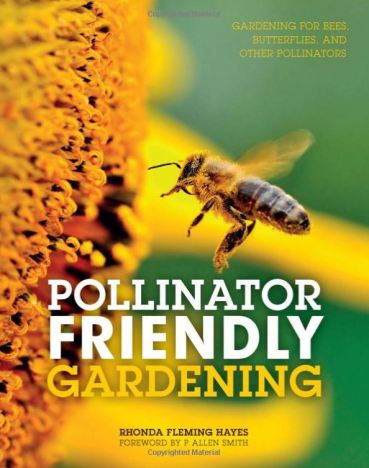
Pollinator Friendly Gardening

Helpful gardener's book. Available at Amazon.

Helpful gardener’s book.
Available at Amazon.

Pollinator Friendly Gardening: Gardening for Bees, Butterflies, and Other Pollinators, by Rhonda Fleming Hayes, is a new book for the gardener who wants to help pollinators. With all the news about loss of habitat, warming climate, and pesticides, most wild bugs and birds seem to be in trouble. Ms Hayes’ book will give you some ideas on how you may help them.

A gardener friend told me that she feels a little guilty about her flower garden because she knows it has displaced the wild natural habitat that once occupied her backyard. But her city – like most in the world – prefers tidiness over naturalness so letting it go wild is not an option. She has asked me what she might plant instead of Kentucky Bluegrass. This book will add greatly to our conversations.

Pollinator Friendly Gardening makes it easy to select plants that are known to be helpful to pollinators. You may be disappointed to learn that not all flowers give food to bees, butterflies, or hummingbirds. Actually, most do not – or they are marginally helpful at best. Bright and cheerful flowers are often like clowns at the circus – beneath their cheery posturing is a dearth of pollen and nectar.

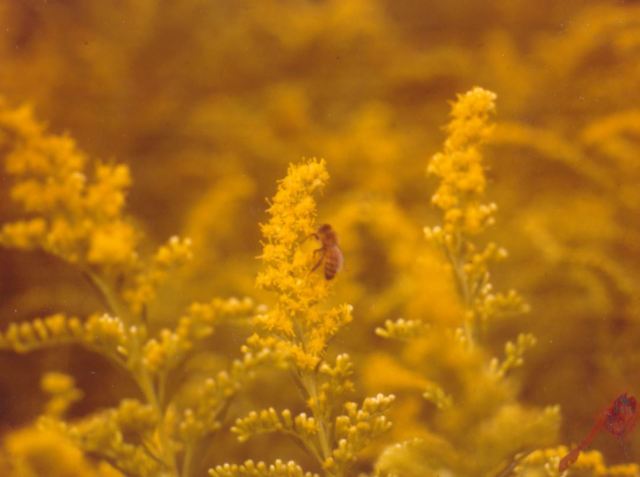
Goldenrod, not a typical choice for a flower garden. But in some regions, highly attractive to honey bees.

Goldenrod, not a typical choice for a flower garden. But in some regions, highly attractive to honey bees.  (Photo: Miksha)

This book helps you find flowers that are both lovely and fruitful for pollinators. If you really want to be natural and helpful, you may consider going native. The author obliges with lists of native (to North America) plants that are attractive to bees. Native perennials in her list include asters, California poppies, goldenrod, and sunflowers. For annuals, Ms Hayes suggest that you consider alyssum, marigolds, snapdragons, and zinnias among many others.

If you are a beekeeper, perhaps you are thinking you can cultivate a few flowers for your colony and the bees will love you more because of your thoughtfulness. Forget it. Your bees fly five kilometres in each direction every day. Unless you are planting half a hectare of yellow sweet clover or canola, they will not stay home. Some researchers tell us that honey bees prefer flowers located between 500 and 1,500 metres better than those closer – even if they are the same species. So, keep your bees happy by supplying water on hot days (Pollinator Friendly Gardening mentions essentials like water, shade, and wind breaks) but fill your backyard with flowers that non-honey bees and butterflies will enjoy. These creatures have ranges that are closer to their homes and it is this group that is most at risk from changes in our environment.

Pollinator Friendly Gardening explains the relationship between plants and pollinators of all sorts. This information makes it easier for anyone to turn a yard into a friendly habitat for pollinators. “Gardening” is a broad topic. I like the way the author handled the wide range of subject manner. She appropriately covers the ecology of the garden and the symbiotic relationship between bee and flower.

This is a useful, attractive book. It is arranged in a fun way with charts and informative pictures. Unfortunately, the dozen or so inset factoid boxes (“It takes 100 honeybees to do the same pollination job as one mason bee” and “Since butterflies don’t have eyelids, it’s doubtful they even sleep!”) are almost all incomplete and/or erroneous.  100 vs 1 mason bee – to pollinate what? For most plants, this statement is simply wrong. Further, I’m surprised that she wrote honeybees as a single word in that factoid. It is not. Honey bees are honey bees.  I’m also surprised that the author does not know that all insects have wide-open eyes, all the time, and all insects enter a sleep-like state to rest.  She makes up for such occasional silliness with sections such as  “Ask the Expert” that include Q&A’s with people as noteworthy and knowledgeable as bee researchers Marla Spivak (Have you seen her Ted Talk? It’s here.) and Chip Taylor (A renowned bee guy who is quizzed about monarch butterflies.)

This book is a good choice for advanced as well as beginner beekeepers. Turning our garden into a sanctuary for bees, butterflies, birds, and flowers is not beyond our grasp. Regardless my minor criticisms, I enjoyed reading this book. So did reviewers at newspapers such as The Monterey Herald and The Spokesman, among many others. If you like gardening, you’ll like the book, too.

One final note. The author, Rhonda Hayes, is clearly an advocate for pollinators and a crusader for the cause of healthier, more natural gardens. But she does not blare her convictions through a megaphone – instead she quietly and intelligently shares her ideas through useful, relevant information. Her book is a credit to the voluminous ecology literature and a nice respite from ardent alarmists announcing the extinction of birds and bees with every mint-flavoured breath. This new book (released in 2015) is sold in finer bookstores or can be ordered from Amazon.

Posted in Books, Ecology, Honey Plants, Pollination, Save the Bees | Tagged , | Leave a comment

De-stressing during the Oscars

Feeding Bees

In our continuing series on Oscar-winning beekeepers…

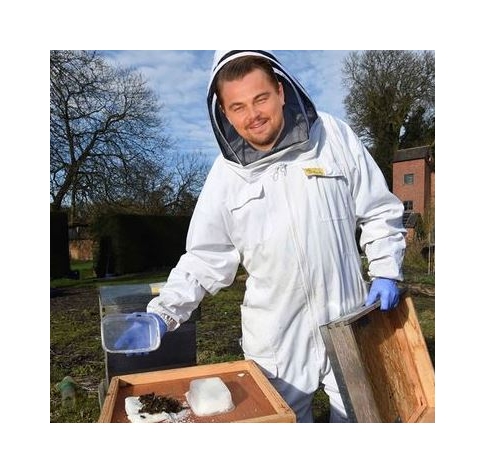
Leo says keeping bees reduces stress during the annual awards cycle. Funny, I find it helps me the exact same way.  Similarly, beekeeping seems to be a preferred pasttime for Scarlett Johansson, Morgan Freeman, Martha Stewart, Bon Jovi, and a few other big names, as it once was for Henry Fonda and Mae West.

Beekeeping is the sensible thing to do to calm down during the tense Oscar Awards season. DiCaprio says he’s hooked on bees. Bees are good and can certainly be relaxing. But it would have been a bit unfortunate had he accepted his first little gold man Sunday night while sporting a swollen lip or bee-stung eyelid.

Posted in Culture, or lack thereof, Outreach, People | Tagged | 1 Comment

Dr Seuss’ B-Day

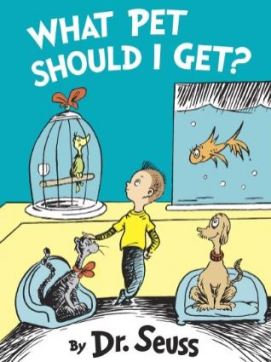
What Pet Should I Get? Available from Amazon.

What Pet Should I Get?
Available from Amazon.

Today is Dr Seuss Day, according to my 9-year old, who was once a big fan of fables like Oh The Places You’ll Go. She has (temporarily) outgrown the good doctor, but like many of us may rediscover him in later years. I think my daughter would particularly enjoy What Pet Should I Get? – the newly discovered Seuss book written 50 years ago, but lost in a trunk in La Jolla until last year. I might like What Pet? myself, if the pets include bees. I haven’t seen this new, posthumous story. Perhaps bees are indeed in there.

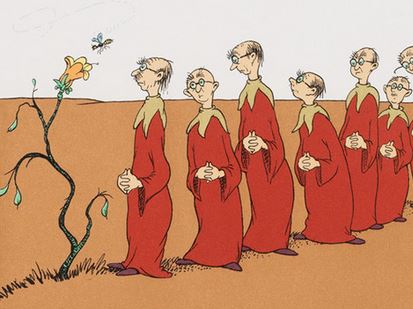
Dr Seuss, or Theodor Geisel, as he was once known, was neither a doctor nor a Seuss. Nor, I suppose, a keeper of bees.  But Seuss occasionally allowed bees to flutter within some of his stories. As we remember the 112th birthday of the great artist (and our children enjoy their celebratory day off from school), we note Seuss’s  bee-watcher watcher, watched by watcher-watchers.

bee watcher

The story, a didactic for libertarianism, goes like this:

Out west near Hawtch-Hawtch
there’s a Hawtch-Hawtcher Bee-Watcher.
His job is to watch…
is to keep both his eyes on the lazy town bee.
A bee that is watched will work harder, you see.

Well… he watched and he watched.
But, in spite of his watch,
that bee didn’t work any harder. Not mawtch.

So then somebody said,
“Our old bee-watching man
just isn’t bee-watching as hard as he can.
He ought to be watched by another Hawtch-Hawtcher!
The thing that we need
is a Bee-Watcher-Watcher!”

Well…

The Bee-Watcher-Watcher watched the Bee-Watcher.
He didn’t watch well. So another Hawtch-Hawtcher
had to come in as a Watch-Watcher-Watcher!
And today all the Hawtchers who live in Hawtch-Hawtch
are watching on Watch-Watcher-Watchering-Watch,
Watch-Watching the Watcher who’s watching that bee.
You’re not a Hawtch-Watcher. You’re lucky, you see!”

                                                                     – Dr Seuss, 1973

Of course, the bee-watcher is a fable protesting those who idly watch others create, labour, and produce. Political radicals of differing stripes have used the poem to disparage totalitarian overlords and capitalist shareholders alike.  But be aware, bees actually work harder when not watched.

Posted in Books, Culture, or lack thereof, Humour, Strange, Odd Stuff | Tagged , , | 1 Comment

Manuka Recall

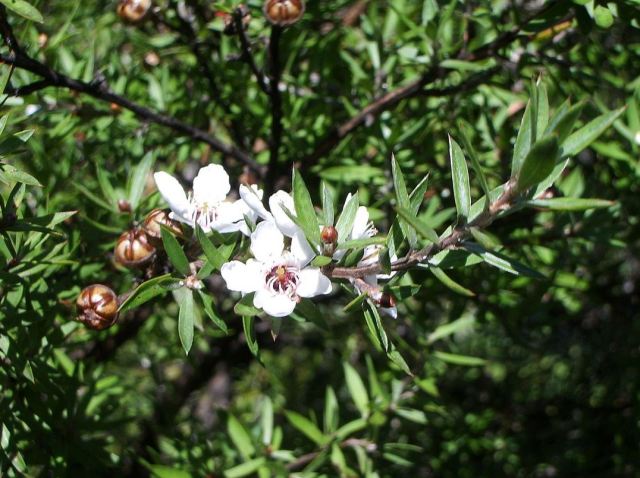
Manuka in bloom. (Source: Wikicommons)

New Zealand manuka in bloom.  (Source: Wikicommons)

For years, I’ve been thinking that manuka honey is over-rated. And maybe overpriced, though every beekeeper’s honey should sell at $80/pound retail, as manuka sometimes does.  Why is manuka honey so expensive? It could be partly due to brilliant marketing. Having the gimmick that manuka has also helps.

Manuka’s gimmick is methylglyoxal, which adds to honey’s naturally high anti-bacterial activity. To hear some reports, if you drop either a super-bug or a Volkswagen beetle into a tub of manuka, the bug goes poof and it’s dead. All honey kills bacteria, most of the time, but some honeys are more effective killers than others. Diluted, the enzyme glucose oxidase in honey becomes hydrogen peroxide which kills germs. Honey also has an osmotic effect, drawing moisture out of bacteria to kill it. These and a few other factors  came to the attention of researchers looking for antibiotics to stop methicillin-resistant Staphylococcus. They found that honey is effective, as you may read in this paper from the US National Institutes of Health (among many other reports).

Manuka honey goes one step further. It has naturally occurring methylglyoxal, yet another potential bactericide. Unfortunately, there is evidence that all of this breaks down in heating and processing, so people serious about pursuing manuka honey seek raw, unfiltered, unheated samples. However, they may be wasting their money as there is no evidence that eating a bit of manuka will specifically kill bad bacteria, for example inside a diabetic ulcer. In raw form, manuka is likely very effective applied topically on wounds. But so are buckwheat, canola, and alfalfa honeys (to name just a few). If we have a cut or a burn in our household, we often treat it with honey.

With all of this in mind, it is disappointing to read about the recall of some manuka honey. Evergreen Life Limited, which makes “100% Pure New Zealand Honey”, “Evergreen Manuka with Pine Bark & Royal Jelly MGO 150+ mg/kg (including product labelled as Methyl Glyoxal Level 150+)” and “Evergreen Manuka with Royal Jelly & Kiwifruit”, is recalling those and many other products because they contain contaminants. The honey is sold in New Zealand and abroad (including Amazon). An advisory posting on New Zealand’s Ministry of Primary Industries (MPI) website says that non-approved substances may have been used during the processing of the honey. Specifically, the Ministry has announced: “There is information to suggest non-approved substances, dihydroxyacetone and methylglyoxal, may have been used during the processing of the honey.”

In most parts of the world, including New Zealand, it is against the law to add anything to honey. We mentioned one of the allegedly added materials in question, methylglyoxa, just a moment ago as the special natural antibiotic found in manuka honey. The other ingredient, dihydroxyacetone is found in manuka nectar and breaks down to become methylglyoxa.  If these were added to the honey, as alleged on the MPI website, what could be the reason?

We don’t know why the honey was contaminated, of course. Evergreen Life Limited is a large and reputable company. If a less reliable organization had added methylglyoxa to their products, we might conclude that real natural manuka was in short supply so other honey was used (at $2/pound), fortified with methylglyoxa, and then sold as manuka (at $80/pound). You see, manuka is inspected for its level of methylglyoxa. Without enough methylglyoxa, honey can’t be certified as manuka honey. And once certified, it fetches a higher price if the methylglyoxa level is higher.

It is unlikely that Evergreen would have intentionally jeopardized its reputation and called into question the purity or naturalness of its products. The company may have been the victim of sabotage from a recalcitrant employee. Or the investigating ministry may be mistaken and methylglyoxa might not have been added after all. Managing this recall is surely a nightmare for the people managing Evergreen.

Product sample recalled, as displayed on MPI website.

Product sample recalled, as displayed on MPI website.

The NZ government food safety website stresses that there is no food safety risk associated with the recalled products, which are listed as 18 different labeled items. No health risk, but the MPI does tell the public “if you have consumed this product and have any concerns about your health, contact your doctor or seek medical advice.”

The New Zealand Ministry of Primary Industries adds, “Customers should return the product to the retailer for a full refund.”

Getting a refund should be easy as Evergreen’s website says they guarantee their products: “Every step of our manufacturing process not only meets, but exceeds domestic and international statutory requirements. At Evergreen, we only use top quality natural resources and the quality of our products are always guaranteed.”

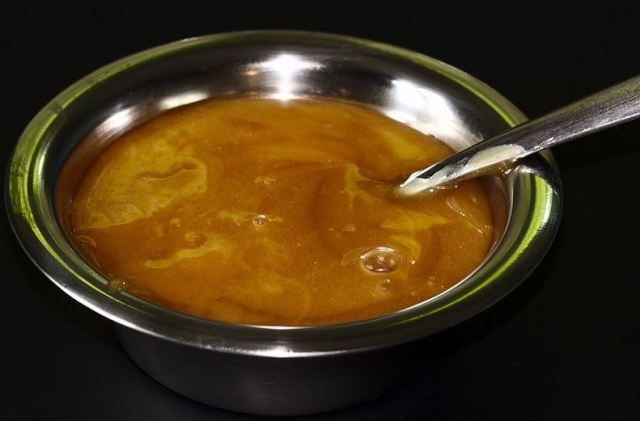
Pure, raw manuka honey. Whenever possible, but directly from the farmer's hive. S(Sourse: Wikimedia)

Pure, raw manuka honey. If possible, buy directly from the farmer’s hive.
(Source: Wikimedia)

Posted in Apitherapy, Hive Products, Honey | Tagged , , , , | 3 Comments

Almonds, Water, and Bees

February is almond pollination month in California. A couple of nights ago, the CBC aired a story about almonds, water, and bees. They try to cover everyone involved – the consumer who loves the heart-friendly food, the almond grower who is trying to juggle water and trees and bills, the beekeeper who would rather not drag hives across the country but needs the money that pollination gives him, and finally, the bees themselves – they’d rather not be in a California almond grove in February.

I’ll  write more about this later – and the environmental impact this is causing – but for today, here’s How the High Demand for Almonds is Affecting California. It’s  quite an interesting story about almonds, water, and bees.

http://www.cbc.ca/news/thenational/how-the-high-demand-for-almonds-is-affecting-california-1.3462764

Clicking on the link will take you to the story at CBC’s news site. The 12-minute clip starts with a chicken crowing like a rooster and you’ll find the Canadian reporter’s accent endearing. The bees make their appearance about half way into the report. Don’t be discouraged. It’s a good video. Here are a few images:

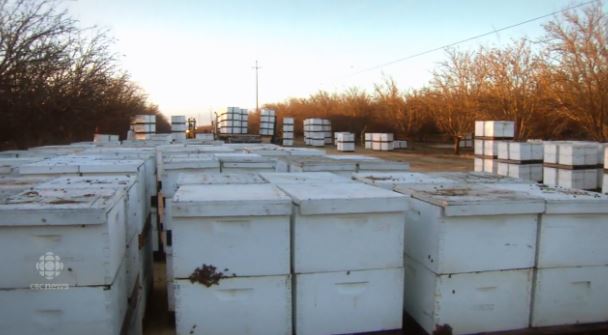
CBC bees among the almonds

A staging yard in an almond grove. 2,000,000 colonies are paid for pollination. From here, they’ll be distributed at a rate of about 2 hives per acre.

CBC migrant bees

Colonies arrive every February from as far as Maine and Florida to pollinate California’s 800,000 hectares of almoonds.

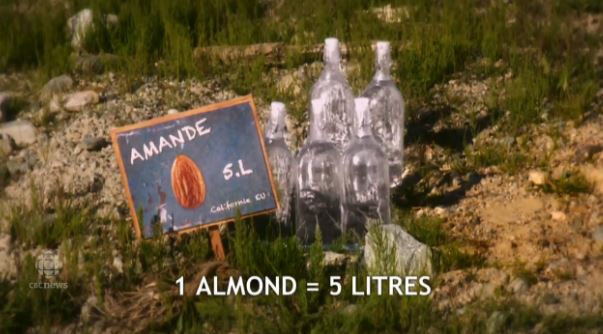
CBC one almond

The heart of the CBC story is water. It takes 5 liters (about 1 gallon) of water to grow each almond. That’s right. One gallon, one almond.

CBC almond parade

Everyone knows the value of bees. These puppeteers are part of the annual Ripon, California, parade. Ripon? That’s the “Almond Capital of the World“.

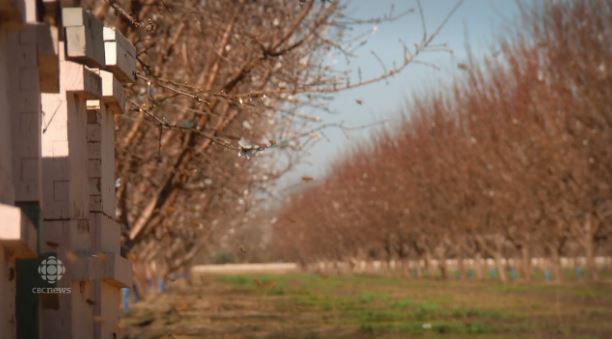
CBC almonds and bees

Bees in an almond grove. Watch the CBC video.

Posted in Bee Yards, Beekeeping, Commercial Beekeeping, Ecology, Honey Plants, Pollination | Tagged , , , | 2 Comments

Big Brain, Small Brain, Bee Brain

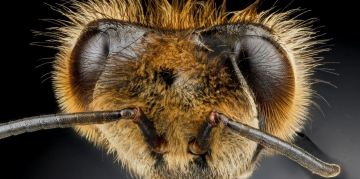
There's a big brain behind those big eyes.

There’s a big brain behind those big eyes.

A bee brain is bigger in the summer, when there are more things to learn, experience, and think about. It shrinks in the winter, which must be a blessing because bees spend weeks on end doing nothing – an active brain might lead to boredom and depression if you are one of thirty thousand bees assigned the job called ‘cluster’ for six weeks. You and I know that the same bee who experiences the bliss of spring and summer is unlikely to be alive in mid-winter, so this would be an average. As such, it is possible that there is something fundamentally different about summer versus winter bees (like nutrition), but researchers think that the variation in brain size is due to the lack of meaningful thought during the winter months.

Researchers at Monash University (a huge campus of 65,000 students in Melbourne, Australia) found something else, too. Professor Charles Claudianos at the Monash Institute of Cognitive and Clinical Neurosciences thinks he and his colleagues have discovered part of the controls which influence bees’ aggression.

Beekeepers know that smoke and certain scents (like lavender) calm bees while other odours (human sweat, expensive cologne, whiskey breath, and perfume) agitate them. Using this knowledge, Claudianos studied bee brain chemistry and neurological function. According to a news release issued by Monash University, “the team has shown that odours such as lavender block aggressive behaviour not by masking the alarm pheromones, but by switching the response off in the brain.” This is different from what I thought. I figured that my smoker provided a camouflage odour that hid my own manly scent. Maybe not, says the research.

The resulting report (“Appetitive floral odours prevent aggression in honeybees“) was published in Nature. There is more work to do, of course, however, the entire field of examining bee brains and neurological function is an exciting and potentially mind-altering way to understand both honey bees and humans.

Benny readingHumans? The human application of bee brain discoveries is potentially huge. Bee genetics is relatively simple. Despite their intricate social behaviour, bees have fewer genes than most living creatures, even including plants. Working with a highly developed social insect which displays advanced community and language activity – but which possesses a limited number of genes – is a smart choice to analyze aggression, nurturing, and cooperation. Applicable human corollaries are being investigated, including the bees’ ability to learn, remember, and read The ABC & XYZ of Bee Culture, which seem similar to our own.

It speaks volumes that Dr Claudianos, one of the authors of the bee brain research paper, is actually a brain scientist focused mainly on human neurology. His university biography tells us “his research topics include the molecular basis of learning and memory, human DNA variations associated with autism, RNA and epigenetic regulation of brain plasticity.” And now, bee brains.

Posted in Bee Biology, Genetics, Science | Tagged , , , , | 6 Comments