2017: The Year in Bee Review

As 2017 draws to a close, let’s look back at the year’s best beekeeping stories. With lower honey prices in 2017, some beekeepers left the business and colony counts fell a little.  Back in 2016, I reported that honey bees were in recovery – colony collapse hadn’t been reported in five years (now six) and (in Canada, at least) there were more bees than anytime in Canadian history.

Many of the world’s 20,000 species of bees are in trouble from chemical exposure, climate change, and habitat loss. Some have been listed as endangered, at risk of becoming extinct. However, honey bees are managed livestock – their numbers rise and fall depending on honey prices and pollination demands of fruit and almond growers. Worldwide, the number of kept honey bees is still near last year’s record high because beekeepers do all they can to care for their little friends, feeding and protecting them – and earning a livelihood from their bees.

The most popular post of 2017 was my story on Chinese honey.  One More Thing About Chinese Honey… focused on the dreadful way that wet honey is often taken right from the broodnest, then dried in industrial evaporators until its moisture is low enough to sell the syrup as “honey”.  It’s not what you and I would call honey.

The second-most read piece from 2017 was a revision of the story of Warwick Kerr, the Brazilian geneticist who “Invented Killer Bees”. I’m glad that you liked that piece because Kerr’s story, published on his 95th birthday, is important on a lot of levels. The Brazilian military dictatorship tried to destroy Professor Kerr, but his worked helped the poor people of his country tremendously.  If you missed that blog post, I hope that you’ll find time to read it now.

In 2017, people from 174 countries dropped by to learn some bad beekeeping (Hello, Zambia! And Azerbaijan, Mongolia, Bosnia, and 170 other countries!) from this blog. The majority of readers are in the USA, Canada, the UK, Australia, and New Zealand, so I will continue to write mostly in English and mostly about beekeeping in the west.

I published 101 bee blog posts in 2017 – that was about 75,000 words. A lot of bee news, ideas, and opinions.  All of those bee stories were fascinating,  but here are some of my favourites:

January 2017

One More Thing About Chinese Honey…

We hear a lot about Chinese honey. It’s worse than most people realize.

February 2017

Beekeeper Royally Stung

From a news story about a fellow (“Prince Charles’ beekeeper”) trying to keep his bees alive by doing something he apparently wasn’t supposed to be doing.

Maple Syrup is Dark

Maple syrup has a dark side.

March 2017

Eating the Vomit of Slaves?

There are people out there who say honey-eaters are consuming the vomit of slaves. Bees are slaves? The idiots couldn’t be more wrong if they tried.

Black Pollen in March

Pollen comes in many colours – mostly golden yellow, but white, green, tawn, you name it.  Bees are packing in black pollen right here in Clagary. Thing is, no flowers are blooming.

March 30: World Apitherapy Day

March 30th, my birthday, has been chosen as World Apitherapy Day. What an honour!

April 2017

Daffodils in December

Daffodils are blooming much too early. What does that mean for bees?

Judgement Day for Aggie Days

Calgary has a Stampede and at the fair grounds is an annual Aggie Days agricultural exhibit. This year we judge local honey. See what’s involved in honey judging.

World’s Sweetest Honey

Not all honey is created equal. I use some stats and 505 samples of honey from the USA (and few hundred more from abroad) to find the world’s sweetest honey.

March on Down

The March for Science and all its associated excitement. Enough here for a 2-part story, so I posted two consecutive pieces.

Have These Kids Found a Way to Kill Varroa?

Can a comb brush off varroa before it enters a hive?  That’s what these elementary school kids figured would happen with their 3-D printed gadget.

May 2017

PolliNation Podcast

There are just a few really good bee-related podcasts. PolliNation is one of them. Produced by one of Oregon State’s newest profs, my friend Andony Melathopoulos.

May 20: World Bee Day

Every day should be World Bee Day.

Good Queen; Bad Queen

With 20 comments, this was one of our most engaging post in 2017. This is basically an overview of some differences in queen bee quality.

June 2017

Mind the Gap!

We look at the infamous “June Gap” – the period after the spring nectar flow, but before the summer and autumn honey comes in.  It’s a risk time for the bees.

Miel Carlota: Once the World’s Biggest Bee Farm

Not much is remembered about Miel Carlota, founded by German immigrants to Mexico. They had over 50,000 hives back in the 50s. Then their company disappeared.

July 2017

The Beekeeper Everyone Knows

Sir Edmund Hillary was likely the only beknighted commercial beekeeper. And he and his friend Tenzing Norgay were the first to survive Mount Everest’s summit.

Are You Giving It Away?

This post is a look at honey prices. Most of us are giving it away.

August 2017

Does the Truth Matter?

My perennial gripe.  These days it seems telling the truth is no longer a matter of honour. I’m getting tired of exaggerated bee stories passing as news in the media. I vent a little.

The Lazy Bees

My friends at the Hutterite Colony try to emulate the honey bee’s work ethic. So do the Mormons who live near us.  Should I tell them that bees are a wee bit lazy?

September 2017

The World’s Weirdest Beekeeping Family

The world’s weirdest beekeeping family.  Now a motion picture.  Need I say more?

My Failure as a Beekeeper

In this six-part series (!), I expose my very bad beekeeping.  Just when you think it can’t get worse, it does.

95th Birthday for “The Man Who Made Killer Bees”

This was the most popular post for the entire year. The man who brought Africanized bee stock to America had his 95th birthday. Warwick Kerr’s story is important. I’m glad that thousands of you read this piece.

They Got Me – on Kiwimana Podcast

Kiwimana, a great bee podcast out of New Zealand, called me up and we chatted for an hour. Want to hear how I ramble unfettered by print? Here’s your chance!

October 2017

Creamed Honey

Here’s a simple and practical explanation of how creamed (spun?) honey is creamed and spun. Includes the secret formula.

November 2017

Unseen Pollinators

This blog post is a short summary of a paper by Jeff Ollerton which reviews the state of the world’s pollinators. What’s happening to them?

December 2017

Busy as a Bee

Writing this blog is one of many things that fill my day. This blog is important to me and in Busy as a Bee, I apologize for not writing enough.

The Man Who Discovered that Bees Can Think

2017 was the 150th birthday anniversary of Charles Henry Turner. He was an American bee scientist who figured out that bees can solve problems, have personalities, and think. But he’s largely unappreciated, almost forgotten.


That’s a quick summary of some my favourite blog posts from 2017. I only write when I get a free hour or two, but it added up to 101 short stories – enough to fill a small book. With the new year upon us, I hope you’ll drop by occasionally and see what’s new in bees in 2018. Meanwhile, have a healthy, happy, and sweet new year!

Posted in Apitherapy, Bee Biology, Beekeeping, Culture, or lack thereof, Diseases and Pests, Friends, History, Hive Products, Honey, Honey Plants, Killer Bees, Movies, Outreach, People, Pesticides, Pollination, Queens, Save the Bees, Science | Tagged | 6 Comments

The Man Who Discovered that Bees Can Think

You probably know that Karl von Frisch figured out how honey bees use their waggle-dance to communicate. He won the Nobel Prize for that and for other studies of bee behaviour. I think it was well-deserved and his experiments withstood criticism and independent confirmation. His discovery was intuitive and required hundreds of replicated experiments conducted over years of work in personally risky circumstances in Nazi Germany. But there is another scientist who came close to figuring out many of the things which brought von Frisch fame. The other scientist did his experiments in America, decades earlier. But he’s mostly unknown, largely forgotten.

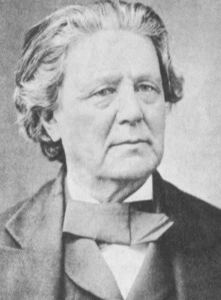
This year – 2017 – marked the 150th anniversary of Charles Turner’s birth.  He’s likely the most important biologist you’ve never heard.  Charles Henry Turner published at least 70 papers, mostly on animal behaviour. Years before Karl von Frisch realized that bees possess colour vision and can recognize and remember patterns, Turner had published his own results on exactly the same thing.  Turner published the first research showing that insects can learn and solve problems.  At the time, in 1900, it was generally believed that invertebrate activity was due to reaction to chemical and physical stimuli, without the need for neural discernment. Following Turner’s discoveries, we have seen that insects of all sorts exhibit signs of personality and certainly demonstrate problem-solving skills. Turner’s experiments created a new field of science focused on cognitive ability in insects and other invertebrates.

Turner’s father, from Alberta, Canada, was a church custodian. A church custodian who was known as a master of debate and who – in the 1870s – owned several hundred books.  Charles Turner’s mother, who was from Kentucky, was a nurse. Our budding scientist was born in Cincinnati where he attended public schools and graduated as class valedictorian. Charles Turner studied biology at the University of Cincinnati, graduating in 1891 – the same year he published his first paper (“Morphology of the Avian Brain”) in the Journal of Comparative Neurology. He followed that with another avian neurology paper, this time published in the prestigious magazine Science. He earned his MSc just a year later. His research moved from dissections and interpretations of bird nervous systems to spiders, river shrimp, and insects. Turner was also the first to demonstrate Pavlovian conditioning in an insect. In 1907, Turner became one of the first African-Americans to receive a graduate degree from the University of Chicago. His doctorate, “The Homing of Ants: An Experimental Study of Ant Behavior,” was emblematic of his work in the learning and thinking patterns of invertebrates.

One of Turner’s biggest discoveries involved honey bees, which he trained to recognize shapes and patterns and which – he discovered – could remember the colours of hidden trays of sugar syrup, returning to the correct colours even when tray positions were scrambled.

Dr Charles I. Abramson, a professor at Oklahoma State, investigated Charles Turner’s life. Abramson, in his piece “A Study of Inspiration” describes Turner’s honey bee research:

“Turner begins the paper with a scholarly review of the literature in which the various theories of why bees should see colors are enumerated, followed by a discussion of the limitations of the existing data.

“To investigate the problem, he studied honey bees in O’Fallon Park in St. Louis. He designed various colored disks, colored boxes,and “cornucopias” into which the bees were trained to fly. Thirty-two experiments were designed, and controls for the influence of odor and brightness were instituted. The results of his experiments showed that bees see colors and discriminate among them. It is interesting that in considering the results of his experiments, he believed that bees may be creating, in his words, “memory pictures” of the environment. The idea of memory pictures is certainly contemporary.

“The second paper of the series on honey bee learning was stimulated by the color vision paper. The methods used were identical to those in the color vision paper with the exception that various patterns were used, as were colors. The use of patterns and colors on the same target is the first use, in my opinion, of the compound-conditioning methods popular in contemporary studies of animal discrimination learning. The study contains 19 experiments and the results show that honey bees can readily distinguish patterns.”

Although he earned his PhD as a magna cum laude graduate at the University of Chicago, Turner didn’t find the sort of work that such a brilliant scientist would be expected to receive. He ended up with no laboratory to direct, no grad students to mentor, and no position at any research university. He applied to various universities, but was routinely rejected due to his race. Consequently, Turner spent most of his career as a high school science teacher at the Negro Sumner High School, conducting his experiments at a city park, paying for his spare-time research out of his own pocket.


Historian W.E.B. Du Bois wrote:

Charles Turner “became a teacher in a small colored Methodist school in South Atlanta which had at the time about a dozen college students, no laboratories and few books. He received inadequate pay and a heavy teaching load . . . but the only appointment carrying a living wage that he was able to get was in the Negro Sumner High School in St. Louis. There he stayed until he died of overwork. He was a promising scientist; with even fair opportunity he ought to have accomplished much; but his color hindered him.”

Charles Henry Turner died young from a heart attack, passing away in 1923 at the age of 55. For a comprehensive biography and an analysis of the science behind Turner’s work, I invite you to read “A Study of Inspiration” by Charles I. Abramson.

Most of the material in my blog piece today comes from various papers by Abramson, who has researched Turner’s life for years. You can download Dr Abramson’s biography about Dr Turner, see a brief review in Nature, or read more about Turner (and see some family photos) at Abramson’s Charles Henry Turner website. It would be a nice tribute to Charles Henry Turner if you could read more of his story as the sesquicentennial of Dr Turner’s birth draws to a close.

🐝 🐝 🐝 🐝 🐝🐝 🐝 🐝 🐝 🐝

Posted in Bee Biology, Culture, or lack thereof, History, People, Science | Tagged , , , | 16 Comments

Langstroth: The Great Christmas Gift

I’m repeating a blog which I post each Christmas Day, Langstroth’s birthday. He is often considered the inventor of modern beekeeping.

Langstroth

Langstroth, 1810-1895

He invented the modern beehive, making it easier, more productive, and less stressful for bees. However, Lorenzo Lorraine Langstroth earned nothing from his invention and suffered severely from self-doubt, melancholy, and clinical depression. Yet, he changed beekeeping to its core and on his birthday anniversary (Christmas Day!) we give homage to the most important beekeeper America ever produced.

Langstroth was born December 25, 1810. That was some Christmas gift to the world, wasn’t it? His childhood seems to have been typical for a kid who spent a lot of time on his hands and knees on the streets of Philadelphia, trapping bugs and ants with table scraps. “I was once whipped because I had worn holes in my pants by too much kneeling on the gravel walkways in my eagerness to learn all that I could about ant life,” Langstroth wrote.

He built paper traps for beetles and flies, leading to a traumatic experience when his grammar school teacher – fed up with six-year-old Lorenzo’s wasted bug time – smashed his paper cages and freed his flies. Lorenzo was sent to cry himself to sleep inside a dark cupboard at the school. The teacher’s reform strategy worked. Langstroth gave up his interest in insects and became a preacher instead.

Langstroth's Andover church

Langstroth’s Andover church

Langstroth studied theology at Yale. At 25, he was offered a job as pastor at the South Church in Andover, Massachusetts. Even in Langstroth’s day it was an old prestigious church. In 2011 it celebrated its 300th anniversary. The plum assignment as pastor at South Church was a recognition of the young man’s abilities.

While visiting a parish member, Langstroth noticed a bowl of comb honey. He said that it was the most beautiful food he had ever seen. He asked to visit his new friend’s bees. Langstroth was led to the fellow’s attic where the hives were arranged near an open window. “In a moment,” Langstroth remembered, “the enthusiasm of my boyish days seemed, like a pent-up fire, to burst out in full flame. Before I went home I bought two stocks of bees in common box hives, and thus my apiarian career began.” Langstroth had been bitten by the bee bug.

Head troubles

Throughout his lifetime, Langstroth suffered badly from manic-depression. In the mid-nineteenth century there was little anyone could do to help a person afflicted with mental illness. The only solace was temporary and usually came to Langstroth when he was with his bees.

The young minister felt that he wasn’t an effective parson because of his recurring dark days, so he quit preaching and became principal of a women’s school instead. By all accounts, he was a empathetic minister and a dedicated teacher, but bouts of depression forced him to cancel sermons and classes. He needed a change. Bees were the only thing he knew that could give him peace, comfort, and meaningful work while fitting into a life disrupted by debilitating illness. But sometimes not even bees could stop what he called his “head trouble” when darkness crept upon him.

He built an apiary and hoped to make his living from bees. But that summer, severe depression returned and lasted for weeks. He sold all his colonies in the fall. Then he started with the bees again. His life would turn over again and again with periods of manic enthusiasm and productivity followed by gloomy months of despondency. During his depressed phases, Langstroth took shelter in a bed in a dark room. He would remain there, immobile, for days. “I asked that my books be hidden from my sight. Even the letter “B” would remind me of my bees and instill a deep sadness that wouldn’t leave.”

When he was able to return to his bees, Langstroth made great strives at increasing efficiency in his apiary. He made his tasks more effective. He would never know when depression would return, so he worked day and night during highly productive manic periods.

Eureka!

The major inefficiency in the apiary was the design of the boxes which held his bees. The boxes were usually simple wooden crates with solid walls and small holes which the bees used as entrances. During harvest of a hive, the lid was lifted from the crate. Attached to the lid would be wax combs which the bees built in haphazard jumbles. The combs cracked and broke during the beekeeper’s excavation, causing a sticky mess and disturbing the excited bees. It was a messy, nasty way to inspect bees and harvest honey.

Langstroth noticed that bees often left a small space around the edge of their combs. Sometimes, upon lifting the lids, he would find wax attached to both the lid and the walls inside the hive, while at other times the hanging combs were not stuck to the hive walls at all. Langstroth’s brilliant insight (his Eureka! moment) was to notice that the space was about 3/8 of an inch when the combs hung freely. If a comb were closer than that to a wall, the bees would attach it to the walls. But at 3/8 inch (actually, between 6.35 and 9.53 mm), the bees always left a space. He had discovered “bee space”.

Langstroth’s next step was brilliant. He made wooden frames that held the wax combs, designing them so they dangled within the hive’s box with their wooden edges always 3/8 of an inch from anything that might touch them: the lid, the interior box walls, the box bottom, other frames. Positioned like this, the bees neither waxed the frames together nor stuck them to the sides or bottom of the hive. The result was a beehive with movable frames. Combs could be lifted, examined, and manipulated. It was 1851 and modern beekeeping had begun.

Langstroth frames, the heart of his invention

Langstroth frames, the heart of his invention (Source: R. Engelhard)

Colonies could be handled more gently. Frames could be inspected for disease, queen quality, and honey and pollen reserves. Movable frames meant queen bees could be produced and strong hives split (by sharing frames between two or more new hives) – increasing colony numbers while preventing swarming. It was a new era in beekeeping. The next few decades were “The Golden Age of Beekeeping“.

Easy to use, easy to make, easy to copy

L.L. Langstroth was not alone in figuring out bee space and inventing applications for it. About the same time, some European beekeepers (Huber, in Switzerland and Dzierzon in Poland/Germany, Prokopovich in the Ukraine) had made similar discoveries. But Langstroth created a simpler hive. His Langstroth beehive was a fine example of North American utilitarian craftsmanship. Efficient, practical, and cheap.

Langstroth’s invention was so simple and inexpensive that his patent was readily violated. Minor modifications were touted as significant improvements to Langstroth’s original design, circumventing the patent. Langstroth began a number of lawsuits against the more flagrant violators, but when the court cases began, his “head troubles” returned.

He dropped the litigation when he realized he could not win and when his illness prevented a spirited defense. Realistically, it was impossible to stop imitations and adaptations. Beekeepers – who were often handy farmers and carpenters – quickly built one or two hives with frames for themselves. Langstroth sought one dollar to license each box, which was a huge price in those days. But his real discovery was “bee space” which could not be patented. His position was like trying to patent sails for ships after discovering wind. Even Langstroth’s supporters wrote that Langstroth should have simply allowed the idea to flourish in the public domain. Trying to enforce the patent was expensive. It left Langstroth nearly bankrupt.

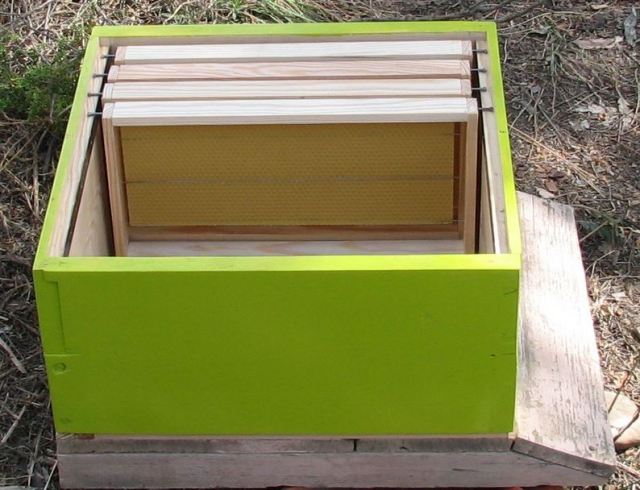
Frames, dangling in a hive. (Source:

Frames, dangling in a hive. (Source: D. Feliciano)

With a plethora of modifications and with similar boxes being designed in Europe, Langstroth’s great contribution may have entered the world anyway and without much credit to him. But the retired minister had one other major contribution to society. It earned him much-deserved praise and even a bit of money. In one feverish six-month manic spell, Langstroth wrote one of the greatest beekeeping books ever produced.

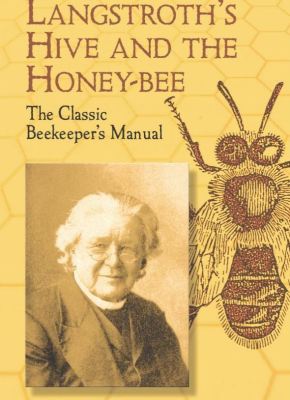
Hive and Honey Bee

Langstroth's Hive and Honey-Bee, first published in 1853

Modern copy of Langstroth’s 1853
Hive and Honey-Bee

In 1852, working for six months without stop and almost no sleep, Langstroth wrote The Hive and the Honey-Bee. This book, revised and expanded in more than 40 subsequent editions, is still a reliable source for beekeepers. When Langstroth wrote it, there were other good bee primers on the market, but his book moved to the top spot. You may read the original 1853 book on-line. I’ve read and re-read my 1859 copy with its 409 pages of fading text protected by orange hardboard covers. It earned its spot in my library. Within the book are chapters on Loss of the Queen (and what to do about it), Swarming, Feeding, Wintering, and Enemies of the Bees. It’s a very practical guide to keeping bees and much of it is still relevant today.

Langstroth never found lasting peace from his cycles of manic depression, though in his 60s he traveled to Mexico and discovered that the stimulation and change of scenery gave him an unexpected respite from depression. The illness returned when he returned to his home, but he remembered the break from head troubles with great appreciation. He lived long enough (85 years!) to see his work appreciated, his name honored, and his book sell hundreds of thousands of copies. Despite his life-long disability, he had a long, full life, three children, and interesting work. And he made a phenomenal contribution to beekeeping.

Merry Christmas and Happy Birthday,
Lorenzo Loraine Langstroth!

Posted in Beekeeping, Books, Culture, or lack thereof, History, Hives and Combs, People | Tagged | 7 Comments

Solstice

My friend Nichol sent this picture of her backyard hive. It’s beautiful, isn’t it? A quintessential image of winter in Canada. Besides being a great photographer, Nichol is a woodworking artisan. She handcrafted the hive equipment in her workshop.

It’s winter here in the north. Today is the day we get the least sunlight – less than eight hours. Even while the sun shines on the bright side of the horizon, it hugs the edge, casting long shadows, even at noon.

Tomorrow will be different. Helios will hand us four seconds more sunlight. But I won’t notice the gift. I wonder if the bees will. They are much more attuned to nature’s whims.  In a week, each day will be almost four minutes longer; in a month, nearly an hour. Surely, you, I, and the bees will appreciate that.

Many forces affect our bees – wind keeps them home; flowers draw them out. In cold, they cluster; in heat, they stretch. What about the increasing daylight as winter’s solstice passes? That affects them, too. I kept bees in Florida for a dozen winters and saw egg-laying escalate in early January – even in chilly dearth years when pollen from red maple, willow, and live oak was scarce. Even without a good pollen flow and without warm weather, the days lengthened and the bees responded. We witnessed this in January, in Florida. However, only a sadist breaches a Calgary hive in January to investigate a colony’s welfare. (Which was fine until the irresponsible lout intruded.)

My thanks, again, to Nichol for sharing her wintery photo. I hope that the next few months of cold and snow (for you northern readers) passes pleasantly. Spring is just 91 days away.

Posted in Beekeeping, Friends | Tagged , | 6 Comments

Wax Worms Biggly in the News

The folks who write my favourite business magazine, Economist, have a freebie on their website. They are giving away a 50-page book,  Ten Things We Learned in 2017. You’ll like the second story in their feature: “How plastic-eating caterpillars could save the planet” – a story about wax worms, of course. In April, I blogged about the accidental discovery that wax worms are willing to eat some types of plastics. Now you can see more of the background to the story in the little PDF-booklet.

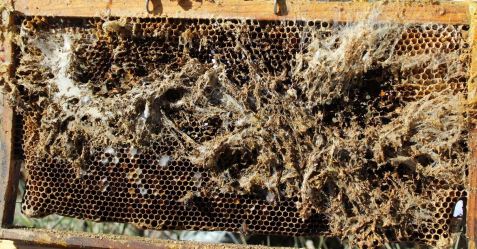
If you keep bees in a warm climate, you probably already know too much about wax worms. They will wreck improperly stored equipment and they will eat your weak hives’ combs if they get established. Maybe that would be OK if everything simply vanished, but the worms leave behind a despicable mess. It looks like this:

A study was just published about plastic-eating wax worms. This is among the first positive press the hungry worm has ever had. To be fair, the wax worm has always played an important role: If a hive dies from foulbrood, the equipment is sometimes eaten by the caterpillars, reducing the chances that the diseased equipment spreads foulbrood spores.  The worms have been cleaning up such garbage for a long time.  But just recently, a biologist/beekeeper accidentally found that wax worms can eat plastic. She published her paper in Current Biology. Here’s some of what Economist wrote:

The experiment behind the paper was inspired when Federica Bertocchini, an amateur beekeeper who is also a biologist at Cantabria University, in Spain, noticed caterpillars chewing holes through the wax in some of her hives and lapping up the honey. To identify them, she took some home in a plastic shopping bag. But when, a few hours later, she got around to looking at her captives she found the bag was full of holes and the caterpillars were roaming around her house.

This might turn out to be a big deal. Certain types of plastics have complicated molecules which could last millions of years before biodegrading. But enzymes produced by wax worms speed up the process. In fact, 100 worms can eat an empty sandwich bag in less than an hour. That’s impressive.  You can get your copy of the free Economist booklet here, and read the whole story.

Posted in Bee Biology, Diseases and Pests, Ecology, Science, Strange, Odd Stuff | Tagged , , | 3 Comments

National “I Love Honey Day”

I’m not sure how serious this is, but someone somewhere has declared December 18 to be national I Love Honey Day.  I’m not sure what we’re supposed to do. But here’s an idea: Go out and buy some honey.

Even if you make your own honey (and who doesn’t these days?), you should consider buying some honey. You’d want to look for something unusual, of course. Maybe you live in a dark honey area but one of your friends has produced some nice water-white stuff. Perhaps from fireweed or sweet clover. Or perhaps you don’t make comb honey but you can get some from a nearby market. The point is, you can try something different while encouraging a local beekeeper. From the sample, you can critique the jar and its label while you inhale the honey’s aroma.

If – due to principle or poverty – you can’t or won’t buy another’s honey, then celebrate the day with a bit of your own stuff. Or you could just think about honey. Have you ever held a spoonful of honey and just dripped it all on the floor, then sponged it up and threw it into your compost bin? Probably not. Well, here’s your chance. It will surely get you thinking about the lovely sticky stuff.

If you are totally at a loss for celebration ideas, then just kick back and enjoy Herb Albert’s brassy Taste of Honey – it was number one on the charts on this day back in 1965. And it’s such a sweet song.

Posted in Culture, or lack thereof, Honey, Humour | Tagged , | 11 Comments

Busy as a Bee

I try to write at least one blog post every week. It’s not hard to find material. Honey production, honey chemistry, queen breeding, nectar sources, apitherapy, famous beekeepers, colony management, bee diseases, and on and on – it’s easy to find something interesting to describe. And, of course, beekeepers are always doing something horribly stupid. There’s no end to the delightful stories that can be told.

But during the past three months, my internet offerings have been slim. Several people (actually, just four of you) have sent me notes asking if I am OK. I really appreciated that. It’s no secret that I’ve had a serious progressive illness for years. It makes it hard for me to do a lot of things that others do easily – but it could be much worse. And, I hasten to add, my illness doesn’t seem to be life-threatening. So, to those who sent notes of concern, thank you! I am doing relatively well. Illness was not the cause of my writing hiatus. Instead, I have been busy as a bee in a honey pot this fall.

My day job – as a geophysicist – suddenly became really hectic. I enjoy the earth science stuff that I do.  Having lots of work is always great. But I was unexpectedly working more than I had in a couple of years and the work (from multiple clients) was urgent. That’s where most of my time went.

Meanwhile, I was invited to write a couple pieces (on bees) for an independence-movement magazine. If you saw my post a couple of days ago, you know about that. I also helped teach two different beekeeping programs this fall – one for our huge Calgary beekeepers’ association where I helped instruct a two-day beginning beekeeping workshop – and helped prepare and edit the talks and manuals. It takes a lot to make a workshop happen. My co-presenters do the hard work, but I’m involved in the whole thing.

My other workshop this autumn is something which my teaching partner and I call “Making Money from Honey”. It’s a full-day program where we guide people through the behind-the-scenes activity of making beekeeping into something more than a hobby. Preparing those workshops (and researching and editing a couple hundred powerpoint slides) along with my geophysics work has kept me busy.  But wait! – there’s more!

Although I find geophysics fascinating (who doesn’t like a little seismic activity from time to time?), I felt that I needed some formal instruction in ecology. So, I enrolled in fourth-year ecology at the local research university. My first class was Ecology 425: Quantitative Biology II. Geez, was it ever hard! Not just understanding the statistics and modeling (ecological analysis) but also sitting for exams, maneuvering my wheelchair through the icy, snow-draped parking lot, and trying to fit in as a ‘normal’ student with youngsters less than half my age.

I enjoyed the work and mental exercise. But it was challenging. Along with my family and consulting duties, I worked extremely long days pulling everything together. The last time that I took a university exam was over twenty years ago. I had to remember how to study and how to prepare. But now I feel much more informed and more competent analyzing serious research papers.

I am hoping that this will make me better at leading workshops and writing and commenting about new bee science. But I have a lot more to learn. So, I’ll be back at university next semester, in January.  Now that I’ve grown comfortable with my first efforts into the science of ecology, I think that I’ll manage to post more regularly again. (I’ve missed it!)  I’ll stay busy as a bee, but I expect to have a bit more time for blogging.

Posted in Ecology, Outreach | Tagged , | 10 Comments

Walden Publishing: Helping New Beekeepers

A few months ago, Walden Publishing printed a beginning beekeeping article which they asked me to write: When to Harvest Honey.  It can be found here.  Then I was asked to produce a more general piece on beekeeping, which is now in their monthly, subscription-based e-journal, Independence Monthly. I’ll probably prepare a few more articles in this series.  If you are a new beekeeper, you will find these pieces useful. If you are interested in self-sufficiency, living off-grid, or exploring new independent lifestyles, you will find the journal and their free website helpful.

If you are an old hand at beekeeping, you might question some of my advice.  That’s OK. There are as many ways to keep bees as there are climates, environments, nectar sources, beehives, and beekeepers in the world.  The basics are similar, but in the end, all beekeeping is local. You first learn the basic stuff, then adapt it to the conditions in your own back yard.

But when it comes to dispensing written bee advice, here’s another thing to ponder: how does one distill essential facts into a few hundred well-chosen words? The Walden editors were kind enough to offer suggestions. But it was still a tough task. If a stranger phoned you and asked, “What should I do to become a beekeeper?” could you answer in under three minutes? If I were actually asked in that way, my advice would be “Meet up with a good, established beekeeper in your area.”  Then I’d have to explain the difference between a good beekeeper and a messed-up one. I’d also have to give some ideas on how to find and then approach that potential good beekeeper/mentor. But really, I’m just deflecting the answer, aren’t I? Basically, I’m saying, “Let someone else show you.” 

In my Walden piece, I give lots of basic advice.  I also mention the importance of a mentor. Here’s the story lead, as it appears in Walden’s Independence newsletter:

Most readers of this blog are experienced beekeepers. You probably have your own answers for newbee/wannabees, but if you take a look at one of my pieces over at Walden, you can see how I handled the question.  It’s not easy. But trying to explain some aspect of beekeeping to a beginner is a good, disciplined way to consider your own beekeeping habits. By thinking about what you need to tell a new beekeeper, you engage in a bit of self-examination.

If you are an independent spirit (and most beekeepers do), there is a lot of advice about non-bee subjects which you will enjoy from Walden Publishing. Recent pieces include home brewing, increasing health and well-being, protecting your internet privacy, selecting a proper dairy cow, and producing enough eggs from back yard chickens. That’s a pretty good variety.  Check it out, read my piece, and tell me what you think about it.

Posted in Beekeeping, Culture, or lack thereof, Outreach | Tagged , | 9 Comments

Unseen Pollinators

If you are interested in ecology (and especially pollination), there’s a great piece you’ll want to read on Jeff Ollerton’s website. Dr Ollerton (University of Northampton) has just released a comprehensive paper on pollinator diversity in Annual Review of Ecology, Evolution and Systematics. If you go to Jeff’s blog, you can follow his link and get a copy of his paper. I enjoyed a couple of hours of deep introspection reading his article this morning. There’s a lot to think about.

I’m not going to paraphrase Ollerton’s piece – it’s written in a clean, accessible style. You’ll have no trouble reading Pollinator Diversity and Why It’s Important. I won’t repeat his work here, but I will give you a little summary and a few extractions that are particularly interesting. (To me, anyway.)

Here’s the bottom line.  For the health of our ecology – including agricultural endeavours – diversity of pollinator species is essential. Diversity of species means a wide variety of kinds of creatures. We tend to go for quantity as a solution for our problems, but throwing more honey bees into a pollination problem is not necessarily the best fix. The loss of pollinator varieties frazzles the strands of the threads holding flowers, fruits, and foragers together in the web of life. Many – perhaps most – of these pollinators are largely unseen, unstudied, and virtually unknown. For example, there are ten times as many species of moths that work as pollinators. But they work at night. Most of us have never watched a moth pollinate a flower.

We (beekeepers) usually figure that if an anonymous pollinator or two disappears, honey bees can step in and fill the void. But here are two things to think about:

1) many pollinators are specialists which effectively pollinate flowers which honey bees usually ignore (or physically can’t work); and,

2) if the world is becoming too harsh for some pollinators, then it’s probably becoming too harsh for our own favourite pollinator. What’s good for the bumblebee is likely good for the honey bee, as Marcus Aurelius never quite said.

Vase of ill-fated WannaBeeFlowers.
(Original art: Daniel Miksha)

What happens when non-mellifera pollinators disappear? Here’s a wee example to consider. Let’s say that a certain type of flower (the glorious WannaBeeFlower, for example) is well-adapted to pollination by one of those 20,000-or-so odd bee species that populate our world. That WannaBeeFlower is sometimes also visited by honey bees who just grab a little nectar and run along to more enticing clovers. But because of those other bees, the WannaBeeFlower gets pollinated and blooms nicely season after season. Then one year, a clover parasite wipes out the clover. Your honey bees might starve, but they turn to the WannaBeeFlower. If that flower’s main pollinator goes extinct, the flower might also disappear, leaving your bees hungry on the bad year. Multiple this by a thousand similar flowers and their main pollinators and you can see the problem.  This is a selfish and narrow-minded reason to preserve diverse pollinators, but it gets our attention.

Of course there is more. Although honey bee keepers perform herculean tasks to keep honey bees flourishing, it’s becoming more and more expensive and frustrating. The same pollution and pesticides that are killing the “lesser” bees also affect honey bees. Conservation measures that help all of the pollinators will help your honey bees, too.

Those are only a couple of reasons that biodiversity is important. If we remind ourselves of the vast interconnected ecology of living things, we might disabuse ourselves of our narcissistic concern for our own hives.

I’m going to step off my palmolive box for a moment. If you want the facts presented without editorial comment, read Ollerton’s piece. It’s important. But before you go away, here are a few gleanings from his biodiversity paper that you can carry with you:

  • We usually think of honey bees when we think of pollinators. But one in ten terrestrial animals (including humans) pollinate flowers.
  • Wind plays an important role in pollination – but a whopping 87.5% of all flowering plants are visited by bees, bats, birds, butterflies, and other beasties.
  • New species are being identified daily. Today’s 350,000 species of pollinators (!) which visit 352,000 species of flowering plants (!) is an underestimate.
  • Heterocera (moths) are the most common pollinator species group (123,000), followed by Coleoptera (beetles, with 77,000), and Hymenoptera (bees and freinds, 70,000). Rhopelacera (butterflies) are relatively less diverse, represented by 18,500 known species that engage in pollination.
  • A thousand species of birds do some pollination work as well as a couple hundred bats. But to date, only three different species of marine worms have been spotted carrying pollen. Why’s that?
  • The effectiveness of pollinators varies a lot. Some rarely help flowers, but as a group, bees are the most prolific – probably because of their large hairy bodies – and because bees are almost completely dependent upon flowers for all their food.
  • The diversity of pollinators varies a lot across geographic areas – flies dominate in the arctic, bumblebees are dominant almost everywhere in the world except Africa, and there are almost no birds which work as pollinators in Europe, though elsewhere in the world they are important.

Dr Ollerton also tells us that there “is also much that we do not understand about the potential effects of pollinators that have been introduced to parts of the world in which they are not native.” Honey bees (which are not native to the Americas, Oceania, and much of Asia) may impact native species of bees. Their deleterious effects seem limited,  ranging from insignificant to potentially disruptive, depending on the biodiversity of the environment and the density of the managed honey bee colonies. If just a few non-native honey bee colonies are kept in areas with a variety of flowering plants, they probably are not displacing other pollinators. But we don’t really know for sure – this aspect of ecology hasn’t been thoroughly studied.

It’s possible that people who keep bees are doing more ecological good than harm. Here’s one reason. If you care about your bees, you will be more eager to support green spaces in your community and will be more likely to complain to city hall when the spray planes leave their hangars. Having more beekeepers means having more voices for initiatives that will help all the pollinators. In balance, keepers of honey bees are likely doing more to preserve wild pollinator habitat than they are to reduce foraging opportunities for other pollinators.

More good than bad?

Posted in Bee Biology, Ecology, Pollination, Save the Bees | Tagged , | 22 Comments

Creamed Honey

I’ve written about ‘creamed’ honey before, but I think it’s time to mention it again. I don’t know what you call smooth honey – some folks call it creamed (though no dairy products are involved), spun (though no spinning is involved) or smooth (which it certainly is!).  If you had a nice crop of honey this year, you might like this way to present honey. Fall is the natural time to make creamed, or spun, honey. Your main season is over, the weather is turning chilly, and cool weather helps the fine-granulation process that results in great creamed honey. And creamed honey will certainly boost your sales.

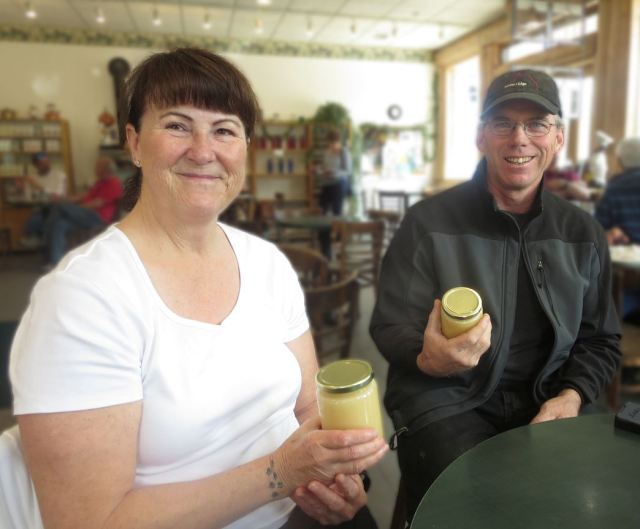
Brenda and Mike with some of their creamed honey.

Brenda and Mike with some of their creamed honey

These friends of mine, Brenda and Mike, make great creamed honey. The bees are kept in the Rocky Mountain foothills where the honey is usually mild and light. Brenda handles the honey smoothing at her home.

 I’ll give you Brenda’s recipe:

smooth honey recipe

It’s actually pretty simple. Heat the honey until it’s completely liquid with no granulation crystals left in it. Cool it to room temperature and stir in some creamy ‘seed’ honey. Stir and stir and stir. Pour it into the final containers and store it in a cool place. The seed can be creamed honey from your previous batch of creamed honey. If this is your first year making the stuff, you’ll have to get some creamy (“spun”) honey at the grocery or from a friend. After that, keep some in reserve for the next crop. People use from 5 to 20 percent seed, but most add about 10 percent.

creamed honey

Once ‘creamed’, the honey will stay this smooth for months – or even years.

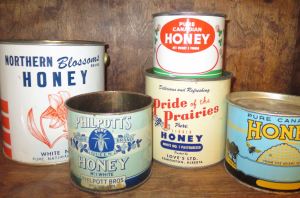
Selling granulated honey is tricky. If it crystallizes slowly, big grainy chunks form. If moisture is a bit high, the water and honey may separate after packing, with a layer of sour fermenting honey-water floating above large, unattractive grains. Because most of the honey here in Canada granulates quickly, beekeepers learned to pack it in pails with wide lids, making the honey accessible after the inevitable hardening. This became known as “real” honey while honey that stayed liquid (which was rare) was suspected of being overheated or adulterated. That’s why, even today, crystallized honey is more common that liquid honey on grocery shelves in Canada.

But granulated honey sometimes spoils because it’s usually not heated enough during packing to kill yeast. Another common problem is the growth of over-sized granulation crystals (if honey crystallizes slowly over several months, the crystals are bigger). Poor quality granulated honey was common in the early 1900s. At the time, most Canadian honey was packed in gallon-sized tins and sent off to England. After producing, packing, and shipping across the ocean, beekeepers sometimes weren’t paid – the buyers in London had to dump the stuff as it had soured or had a watery layer on top. A young Canadian ag-scientist, Elton Dyce, recognized the problem and spent years looking for a fix.
Dyce was working at the Ontario Agriculture College (now known as the University of Guelph). In the 1920s, he taught apiculture to farm kids who came to the school from across central Canada. They told him about the honey that went bad back on the farm. From their samples, he noticed that finer-granulated honey had less moisture-separation problems. And it generally tasted better.

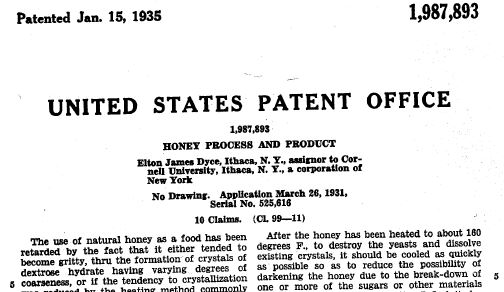
At age 28, Elton Dyce moved to Cornell University in New York to work on a Masters’ in entomology. Until he developed his system, most efforts to improve honey focused on heating it. This resulted in longer-lasting liquid honey, but Dyce felt that such honey wasn’t what consumers wanted on their tables. At Cornell, he continued to work on the Canadian honey problem. Three years later, he filed US Patent 1987893, simply called “Honey Process and Product“. He began his patent claim by stating that the use of honey is inhibited because it can be gritty and inconsistent unless heated. Then, he said, such liquid honey becomes drippy and harder to use. Dyce had a better idea. In paragraph 4 of his claims, Elton Dyce spelled out his system:

4.) A honey product made by heating honey to a temperature sufficient to destroy yeasts, quickly cooling it to a temperature below the melting point of honey crystals preferably about 75 degrees F., adding about 5% of fine grained crystalline honey, agitating the honey to distribute said nuclei uniformly thruout the honey, and controlling the temperature within a few degrees of 57 degrees F., whereby a fine-grained, fondant-like product is formed.

That’s the entire method, now known as the Dyce Process: Heat honey to destroy yeast, quickly cool it to 75 ºF, uniformly mix in fine-grained crystallized honey (‘seed’), and store it at 57 ºF. Quite soon, your honey is a smooth, fine-grained fondant. At this stage, the honey is attractive, ships well, and won’t spoil.

Dyce’s patent was issued 80 years ago and has long-since expired. Anyone may now use his technique to make perfect, tasty, smooth honey. My friends Brenda and Mike proved that to me.

*Part of the preceding is from my 2016 American Bee Journal article.

Posted in Friends, History, Honey, Tools and Gadgets | Tagged , , , , | 16 Comments